
The JM press is a hybrid lift that combines a close-grip bench press with a skull-crusher-style elbow bend to target the triceps hard while still allowing fairly heavy loading. Learning it matters because it can be a smart accessory for building stronger triceps and improving bench press lockout strength when performed with controlled range of motion and joint-friendly technique.
What Is the JM Press?
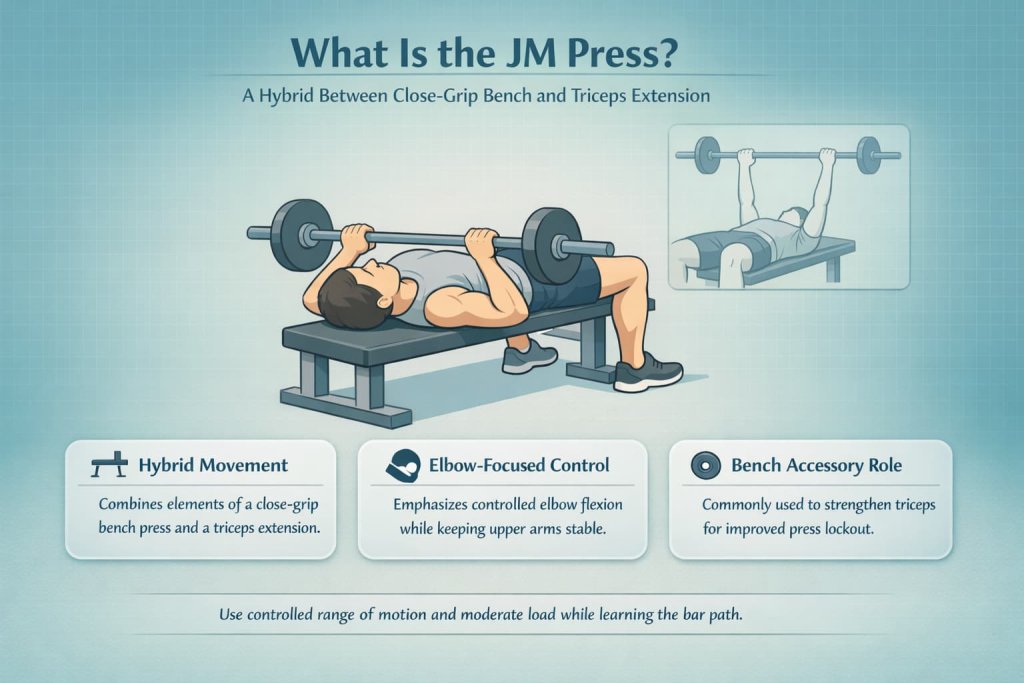
The JM press is typically done lying on a flat bench with a barbell (or dumbbells), lowering the weight in a controlled arc toward the upper chest/neck line while keeping the elbows tucked, then pressing back up. Many coaches describe it as a “middle ground” between pressing and elbow extension work, which is why it’s popular in bench-focused strength programs.
How to Do the JM Press Correctly
Setup cues
- Lie on a flat bench like you would for bench press: feet planted, upper back tight, shoulder blades set.
- Use a grip that’s usually around shoulder-width (often similar to close-grip bench).
- Start with lighter weight than you think you need until the groove feels consistent.
JM Press execution cues
- Lower the bar in a controlled path toward the upper chest/neck line, not down to the lower chest.
- Keep elbows tucked and slightly forward rather than flaring wide.
- Think “bend the elbows” while keeping the upper arm position stable.
- Press back up smoothly, keeping wrists stacked and elbows under control.
JM Press Variations and Regressions
These JM press variations and regressions help you adjust load, range of motion, and joint stress based on your experience level. Use them to build triceps strength safely while improving bench press carryover.
1. Dumbbell JM Press
Why it works:
Using dumbbells allows each arm to move independently, which can improve control and reduce joint stress. Many lifters find this version more comfortable on the wrists and elbows because hand position can naturally adjust throughout the movement.
Muscles worked:
Primarily the triceps brachii (all heads), with secondary involvement from the anterior deltoids and chest for stability.
How to do it:
- Lie on a flat bench holding two dumbbells with a neutral or semi-pronated grip.
- Start with arms extended over your shoulders.
- Bend your elbows while keeping upper arms relatively stable and slightly angled forward.
- Lower the dumbbells toward the upper chest/neck line in a controlled path.
- Press back up by extending your elbows without flaring them wide.
Trainer Tip:
Start lighter than you would for barbell JM presses. Focus on smooth elbow tracking and avoid turning it into a full chest press.
2. Close-Grip “JM Press Hybrid”
Why it works:
This variation blends a close-grip bench press with a shorter-range JM press pattern. It’s useful for beginners who need to learn elbow control before performing the more elbow-dominant full JM press.
Muscles worked:
Triceps remain the primary driver, with slightly more chest involvement compared to the traditional JM press.
How to do it:
- Set up like a close-grip bench press with hands just inside shoulder width.
- Lower the bar toward the mid-to-upper chest with elbows tucked.
- Instead of a deep elbow bend, use a moderate, controlled range.
- Press the bar upward while keeping elbows under the wrists.
Trainer Tip:
Think “controlled press with extra elbow bend.” If it feels like a standard close-grip bench, reduce chest involvement by slightly increasing elbow flexion.
JM Press Muscles Worked
The JM press primarily trains the triceps brachii (all heads), because the main action is elbow extension under load.
Secondarily, you may feel some assistance from:
- Chest (especially if you turn it into more of a close-grip press)
- Front deltoids (especially if elbows flare or the bar drifts too far)
Benefits of the JM Press for Strength and Size
It can build triceps strength that carries over to bench press lockout
Powerlifters often use JM presses to strengthen the “finish” of presses, where triceps contribution is high. JM Blakley’s demonstrations and coaching insights shared through EliteFTS helped popularize the movement in bench-specialist circles.
It lets you load the triceps heavier than many isolation moves
Compared with many triceps isolation exercises, the JM press can often be loaded more like a press while still emphasizing elbow extension mechanics.
It’s a useful alternative if skull crushers feel rough
A common reason lifters rotate JM presses into their program is that skull-crusher variations can irritate elbows for some people, while the JM press can be easier to tolerate when the range is controlled and elbows stay tucked.
Common JM Press Mistakes That Make It Feel Bad
Going too heavy too soon
This is one of the fastest ways to lose the bar path and turn it into a messy close-grip bench (or a painful elbow-extension grind). Start lighter and earn load.
Flaring the elbows
Elbow flare usually shifts stress away from the triceps and can make the movement feel uncomfortable in the elbows or shoulders.
Forcing a deep range of motion
Many lifters do better with a controlled, non-forced range of motion that keeps tension on the triceps without jamming the elbow joint at the bottom.
Letting the wrists collapse back
If your wrists bend back hard, the bar path tends to drift and your elbows take extra stress. Keep the wrists stacked and firm.
How to Program the JM Press
For triceps size (hypertrophy emphasis)
Research reviews show that moderate loads and moderate rep ranges are effective for muscle growth across many training contexts, as summarized in evidence-based discussions on PubMed Central.
Practical starting point:
- 3–4 sets of 8–12 reps
- 1–2 minutes rest
- Stop 1–3 reps short of failure until form is locked in
For strength carryover to bench
The JM press is often used as an accessory after heavier pressing.
- 3–5 sets of 4–6 reps (moderate-heavy)
- Longer rest (2–3 minutes)
- Keep range controlled and repeatable
General resistance training progression principles, including load and frequency guidance, are outlined in the position stand published on PubMed.
Where it fits in a workout
Most lifters place it:
- After bench press or close-grip bench
- Before lighter isolation work (pushdowns, overhead extensions)
If you want broader comparisons of triceps exercise effectiveness, the research summary provided by American Council on Exercise (ACE) discusses activation patterns across several common triceps movements.
Who Should Be Cautious With JM Presses?
Be careful (or choose a different option) if you have:
- Persistent elbow pain that worsens with elbow extension under load
- Shoulder discomfort in pressing positions
- A history of tendon irritation that flares up with heavier triceps work
A safer move is the one you can do consistently with clean form and no symptom escalation. When in doubt, use lighter loads, shorten range, or swap to cable pushdowns or dumbbell variations.
JM Press FAQs
Is the JM press good for triceps?
Yes—when you keep elbows tucked and control the bottom position, the JM press is highly triceps-focused and is commonly used as a triceps strength builder in bench-focused training.
Why does the JM press hurt my elbows?
Common causes include going too heavy, flaring elbows, forcing a deep range of motion, or letting wrists collapse. Try reducing load, tightening elbow position, and shortening range first.
Should I do JM presses with a barbell or dumbbells?
Either works. Many beginners prefer dumbbells because they can self-adjust wrist and elbow angles.
How heavy should I go on JM presses?
Start lighter than your close-grip bench. Use a weight that lets you repeat the same bar path and elbow position for every rep. Add load gradually as control improves.
How often should I train JM presses?
Most people do best with 1–2 times per week as an accessory, depending on total pressing volume. Programming frequency and progression principles are discussed in resistance training guidelines published on PubMed.
Is the JM press better than skull crushers?
Not universally. Some lifters tolerate JM presses better, while others prefer skull crushers for long-head emphasis. The best option is the one you can train hard with stable joints and consistent technique.
Conclusion
If you want bigger triceps and stronger lockout strength, the JM press is one of the most practical bench accessories you can add—especially when you keep the range controlled, elbows tucked, and progression patient. Start light, master the groove, and use it consistently for several training cycles to build measurable triceps strength and pressing stability.
References
- Evidence-based loading guidance for strength and hypertrophy: PubMed Central
- Strength and hypertrophy outcomes across different loading ranges: PubMed
- Load effects on strength/hypertrophy (systematic review/meta-analysis): PubMed