
Box jumps are a plyometric exercise that builds lower-body explosiveness by training you to produce force quickly and land with control. If you want a higher vertical jump, faster sprint takeoff, and more athletic power, box jumps can be a smart add-on—when you use the right box height, progress gradually, and prioritize clean landings.
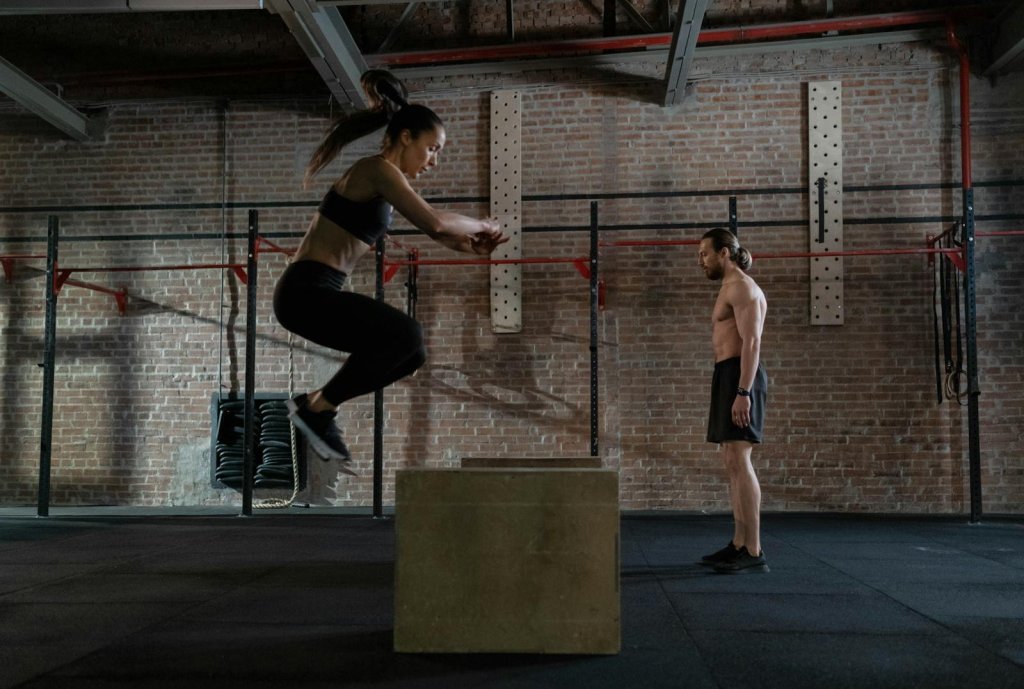
Box jumps are a form of plyometric training that uses the stretch-shortening cycle (a quick “load then explode” action) to develop power, as explained in research indexed by the National Institutes of Health (NIH).
What Are Box Jumps
A box jump is a jump from the floor onto a stable box or platform. The goal is not just to “get up there,” but to:
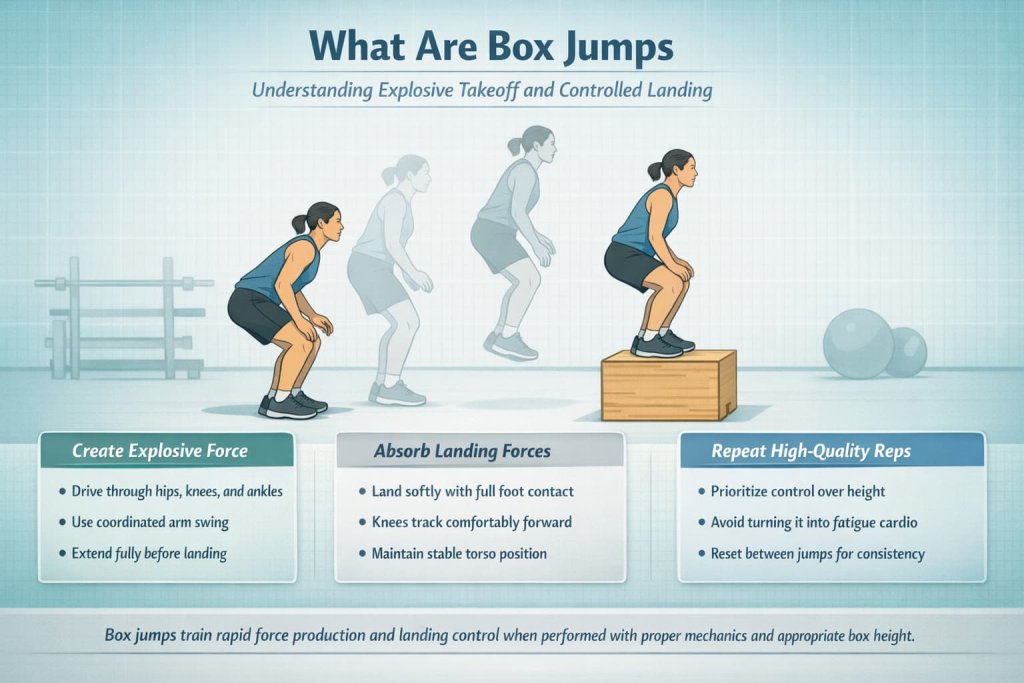
- Create explosive force through the hips, knees, and ankles
- Absorb landing forces quietly and safely
- Repeat high-quality reps without turning it into sloppy cardio
The box itself can make jump training more manageable because you land in a higher position (often with less repeated ground impact than continuous broad jumps), as long as your landing mechanics stay strong.
How to Do Box Jumps Safely and Correctly
Why it works: Box jumps train explosive triple extension (hips, knees, ankles) and teach you to absorb force on landing. When performed with strong mechanics, they can be a clean, powerful way to add plyometrics to a strength plan, as described in research summarized by the National Institutes of Health (NIH).
How to do it:
- Place a stable box on a non-slip surface and stand a few inches in front of it.
- Start tall with feet about hip-width, brace your core, and keep your ribs stacked over your pelvis.
- Perform a quick, athletic dip (small bend at hips and knees), then drive the floor away and jump.
- Swing your arms naturally to help power the jump.
- Land softly with your whole foot on the box and knees tracking comfortably (not caving inward).
- “Stick” the landing briefly, then stand tall to finish the rep.
- Step down carefully instead of jumping down.
Trainer Tip: Think “quiet landing.” If your landing is loud or your knees collapse inward, lower the box and rebuild control. The National Strength and Conditioning Association (NSCA) consistently emphasizes mastering movement quality and appropriate volume over chasing endless variations.
Box Jump Variations
Box jump variations help you target different power qualities, landing control, and starting strength depending on your training goal. By adjusting tempo, starting position, or landing focus, you can safely progress while continuing to build explosive performance.
1. Countermovement Box Jump
Why it works:
The countermovement box jump uses a rapid dip at the hips and knees before takeoff. This quick preload helps you use the stretch-shortening cycle, allowing the muscles and tendons to store and release elastic energy. It’s one of the most practical ways to train explosive triple extension (hips, knees, and ankles) with natural arm drive and athletic coordination.
Muscles worked:
Glutes, quadriceps, hamstrings, calves, and core stabilizers. The shoulders and upper back assist with arm swing and balance.
How to do it:
- Stand a few inches in front of a stable box with feet about hip-width apart
- Brace your core and keep your chest tall
- Perform a quick, shallow dip by bending hips and knees
- Swing your arms back, then drive them forward as you jump
- Extend through hips, knees, and ankles explosively
- Land softly with the whole foot on the box
- Stick the landing briefly before standing tall
- Step down under control
Trainer Tip:
Keep the dip quick and consistent. If you start squatting too deep before jumping, you reduce reactivity and change the stimulus.
2. Pause-Landing Box Jump
Why it works:
This variation emphasizes landing mechanics and force absorption. By pausing after contact, you reinforce joint alignment, balance, and trunk stability. It’s excellent for athletes who need better deceleration control or anyone rebuilding clean landing habits.
Muscles worked:
Glutes, quadriceps, hamstrings, calves, and core — with increased demand on stabilizers at the hips and trunk.
How to do it:
- Perform a standard box jump with controlled takeoff
- Land softly on the box with knees tracking over toes
- Hold the landing position for 1–2 seconds
- Maintain a neutral spine and balanced foot pressure
- Stand tall only after full control is established
- Step down carefully
Trainer Tip:
If you wobble, collapse inward at the knees, or can’t hold the position, lower the box height. Master stability before increasing intensity.
3. Seated Box Jump (Advanced)
Why it works:
Starting from a seated position removes the typical countermovement dip. This reduces elastic momentum and places more emphasis on concentric power output. It challenges your ability to produce force from a static position, which can help develop starting strength.
Muscles worked:
Glutes, quadriceps, hamstrings, calves, and core stabilizers.
How to do it:
- Sit upright on a bench or box with feet flat and shoulder-width apart
- Brace your core and lean slightly forward at the hips
- Swing your arms back, then drive them forward explosively
- Push forcefully through the floor without a rocking motion
- Land softly on a low box with full foot contact
- Stabilize before standing tall
- Step down under control
Trainer Tip:
Keep the box height conservative. Because there’s less momentum, quality and safety matter even more in this variation.
Box Jumps Benefits for Power and Athleticism
Box jumps can help support athletic performance because they train rapid force production and efficient coordination.
Common performance-focused benefits include:
- Improved rate of force development (how fast you can generate force)
- Better jumping mechanics when you focus on consistent takeoff and landing
- A practical way to train explosive intent without needing heavy loads
Plyometric training is widely used in performance settings because it leverages the stretch-shortening cycle and power-focused mechanics, a concept detailed in clinical commentary research available through the National Institutes of Health (NIH).
Box Jump Form Basics You Should Get Right First
Before you worry about height, lock in the fundamentals:
- Stable footwear and a non-slip surface
- A box that does not slide, wobble, or tip
- A landing you can “stick” without collapsing
How High Should Your Box Jump Be
Higher is not automatically better. A 2024 study indexed by the National Institutes of Health (NIH) found that changing box height did not meaningfully alter many performance outcomes in recreationally trained individuals when maximal intent was used, suggesting that technique and effort may matter more than extreme height.
Practical height rules that work well:
- Start low enough that you can land without aggressively tucking your knees to your chest.
- Choose a height you can repeat for clean reps.
- Increase height only when every rep looks consistent and controlled.
Common Box Jump Mistakes That Limit Results
Using a box that’s too high
When the box is too high, people often pull their knees excessively and land in a collapsed position. That’s not better performance—it’s reduced control.
Landing with poor knee and hip control
A soft landing with knees tracking well and a stable torso is a key quality marker.
Turning box jumps into fatigue training
Box jumps are best used for power. Once reps get slow or sloppy, the training effect shifts away from explosiveness.
Jumping down from the box repeatedly
Many trainees benefit from stepping down to reduce unnecessary impact. Reactive depth jumps are a separate, more advanced progression that should be programmed carefully, as explained in plyometric research summaries available via the National Institutes of Health (NIH).
Box Jumps Programming Guide (Sets, Reps, Frequency)
You’ll get more from box jumps by keeping volume controlled and reps crisp.
The National Strength and Conditioning Association (NSCA) commonly recommends low frequency and low-to-moderate volume for plyometric training, often in the range of 2–3 sessions per week with small rep counts per set.
A simple approach:
- Frequency: 1–3 times per week
- Sets/Reps: 3–6 sets of 2–5 reps
- Rest: 60–120 seconds between sets
- Placement: Early in your workout, after a proper warm-up
Warm-Up for Box Jumps
A good warm-up raises body temperature and rehearses landing mechanics.
Example:
- 3–5 minutes of light movement
- 1–2 rounds of bodyweight squats, hip hinges, calf raises
- 2–3 low practice jumps focusing on quiet landings
Preparing tissues before explosive work is consistent with general plyometric preparation principles described in sports performance literature indexed by the National Institutes of Health (NIH).
Box Jump Progressions for Beginners
Progress gradually to build confidence and consistency.
Progression 1: Step-up to box
Focus on balance and controlled foot placement.
Progression 2: Small jump to low box
Start with a height you can land on cleanly every time.
Progression 3: Repeatable power sets
Add sets before increasing height.
Progression 4: Slightly higher box
Increase height only when technique stays identical from rep to rep.
This progression-first mindset aligns with performance research available through the National Institutes of Health (NIH).
Who Should Be Careful With Box Jumps
Be cautious or seek guidance if you have:
- Current ankle, knee, hip, or low-back pain aggravated by jumping
- Recent lower-body injury or surgery
- Poor balance or frequent instability
- Limited training experience
Plyometric exercises place higher demands on tissues and neuromuscular coordination, as discussed in clinical sports science literature accessible via the National Institutes of Health (NIH).
People Also Ask About Box Jumps
Do box jumps increase vertical jump?
They can support vertical jump improvements when combined with structured strength training and progressive plyometrics, as outlined in sports performance research indexed by the National Institutes of Health (NIH).
Are box jumps cardio or strength?
They are primarily power training (speed-strength). High reps with short rest may feel like cardio, but that reduces explosiveness.
Should you jump down from a box?
Stepping down is often safer for general trainees. Reactive depth jumps are an advanced progression and should be planned carefully.
Are box jumps bad for knees?
They are not inherently harmful, but excessive height, poor mechanics, and uncontrolled volume can increase stress. Focus on quiet, stable landings.
FAQs
1) How many box jumps should I do?
A common range is 3–6 sets of 2–5 reps, focusing on maximal quality rather than fatigue, consistent with general guidance from the National Strength and Conditioning Association (NSCA).
2) How often should I train box jumps?
1–3 times per week works for most recreational trainees.
3) What is a good beginner box height?
Start low enough to maintain perfect landing mechanics. The American Council on Exercise (ACE) suggests beginning conservatively and progressing gradually.
4) Should I add weight to box jumps?
Usually not necessary. Improve technique and consistency first.
5) What should a proper landing feel like?
Controlled, balanced, and quiet.
6) Can box jumps replace squats?
No. Squats build foundational strength, while box jumps build speed-strength. They complement each other.
Conclusion
Box jumps are one of the most effective ways to train explosive lower-body power—when you prioritize control, intent, and progression over ego-driven height. Choose a box you can land on quietly, keep reps crisp, and integrate them early in your workout for the best results.
If you want, tell me your current training level and vertical jump goal, and I’ll design a simple 2-week box jump progression you can plug directly into your routine.