
Lat exercises for women build a stronger, more defined back by training the lats through vertical pulls (pulldown/pull-up patterns) and rows (horizontal pulls). Understanding the right angles, cues, and progressions matters because good lat training supports posture, shoulder comfort, and everyday strength.

What the lats do and why women should train them
Your latissimus dorsi (“lats”) are large back muscles that help with:
- Pulling your arms down and back (think pulldowns, pull-ups, rows)
- Stabilizing your shoulders during pressing, carrying, and lifting
- Supporting upright posture by balancing chest/shoulder tightness from daily sitting
A well-built back is not about “bulking.” It’s about strength, shape, and shoulder-friendly movement patterns.
Quick form cues for better lat activation
Use these cues on most lat exercises:
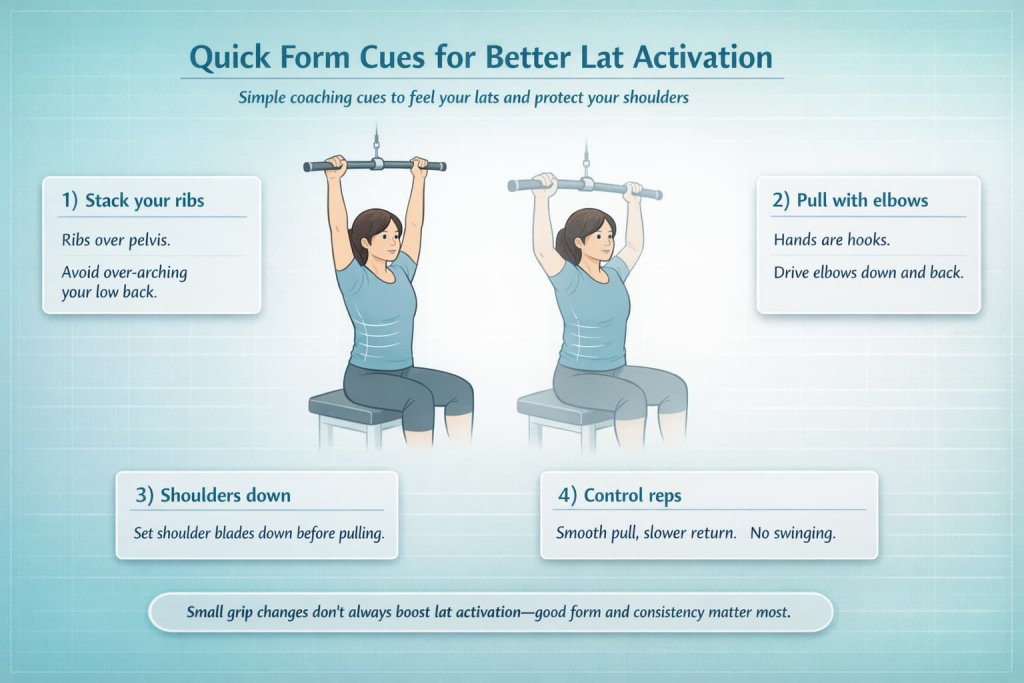
- Keep ribs stacked over pelvis (avoid over-arching your low back)
- Pull with elbows, not hands (hands are hooks)
- Start each rep by setting shoulder blades “down” (scapular depression)
- Use controlled reps, not momentum
Research comparing pulldown variations suggests grip changes don’t automatically “switch on” the lats for everyone—execution and consistency matter more than chasing a perfect grip, which is supported by a recent EMG-focused analysis from PubMed Central.
The 10 best lat exercises for women
Build a stronger, more defined back by combining pulldowns, rows, and straight-arm variations that target the lats from multiple angles. Use controlled reps, keep shoulders down, and progress weekly with small increases in reps or resistance.
1) Seated lat pulldown (front)
How to do it:
- Set thigh pads snug and sit tall with a slight lean back (small, not dramatic).
- Grip the bar just outside shoulder width (adjust for comfort).
- Start by pulling shoulders down, then drive elbows down toward your ribs.
- Pull the bar to upper chest height, pause briefly, then return with control.
Why it works: It trains the lats through a clear vertical pulling path with easy load control, so you can build strength while keeping the movement smooth and repeatable.
Muscles worked: Lats, teres major, mid-back, biceps.
Trainer Tip: Think “elbows to pockets,” not “bar to chest,” so your lats do the work instead of your arms taking over.
2) Assisted pull-up (machine or band)
How to do it:
- Use an assisted pull-up machine or loop a band over a sturdy bar.
- Start from a dead hang with shoulders “down” (not shrugged).
- Pull chest toward the bar by driving elbows down and back.
- Lower slowly to a full stretch without losing control.
Why it works: It builds real pull-up strength while keeping reps achievable, which helps you progress without sacrificing form or shoulder comfort.
Muscles worked: Lats, mid-back, biceps, forearms, core.
Trainer Tip: If your shoulders feel cranky, use a neutral-grip option when possible and keep your ribs “down” so you don’t over-arch.
3) Single-arm cable lat pulldown (half-kneeling or standing)
How to do it:
- Set a cable to a high pulley and use a single handle.
- Take a split stance or half-kneel for stability.
- Keep ribs down and pull your elbow toward your hip.
- Control the return until you feel a stretch in the lat.
Why it works: Unilateral pulling makes it easier to feel the lat working and helps correct side-to-side strength or control differences.
Muscles worked: Lats, teres major, core stabilizers.
Trainer Tip: Keep your torso quiet—no twisting to “finish” the rep—so the lat stays the prime mover.
4) Straight-arm cable pulldown
How to do it:
- Set the cable high and hold a bar or rope.
- Use a slight hip hinge, soft knees, and brace your core.
- Keep arms mostly straight and pull the handle down to your thighs.
- Return slowly until arms are overhead and lats stretch.
Why it works: It isolates shoulder extension, one of the lats’ main actions, without relying heavily on the biceps, making it a great technique builder and finisher.
Muscles worked: Lats, long head triceps (assist), core.
Trainer Tip: If you feel it mostly in shoulders, lighten the load and keep your shoulder blades “down” the entire set.
5) Chest-supported dumbbell row (incline bench)
How to do it:
- Set an incline bench and lie face down with dumbbells.
- Brace your core and keep your neck neutral.
- Row by pulling elbows toward your hips (not flaring wide).
- Pause, then lower under control.
Why it works: Chest support reduces lower-back fatigue and momentum, so you can focus on pulling with the back and getting cleaner reps.
Muscles worked: Lats, rhomboids, traps, rear delts, biceps.
Trainer Tip: Aim elbows “down and back” and keep shoulders away from ears so the upper traps don’t take over.
6) One-arm dumbbell row (bench-supported)
How to do it:
- Place one knee and hand on a bench, other foot on the floor.
- Keep your spine long and shoulders squared to the floor.
- Pull the dumbbell toward your hip, not your chest.
- Lower until your arm is long and you feel a lat stretch.
Why it works: It’s a classic lat builder because you can load it progressively and usually feel the working side clearly when your elbow path is right.
Muscles worked: Lats, mid-back, biceps, core.
Trainer Tip: Keep your ribs stacked and avoid rotating your torso—imagine your elbow sliding into your back pocket.
7) Seated cable row (lat-biased grip and elbow path)
How to do it:
- Sit tall with a neutral or slightly angled handle if available.
- Start with shoulders down and chest proud (no exaggerated lean).
- Row by driving elbows toward your hips.
- Pause, then return slowly without rounding your low back.
Why it works: Rows build back thickness and strength that support posture and shoulder control, and the cable keeps tension steady through the range.
Muscles worked: Lats, rhomboids, traps, rear delts, biceps.
Trainer Tip: If you feel mostly arms, slow the return and keep elbows close so the lats stay involved.
8) Dumbbell pullover (bench or floor)
How to do it:
- Lie on a bench (or floor) holding one dumbbell with both hands.
- Keep ribs down and core braced.
- Lower the dumbbell overhead until you feel a stretch (don’t force range).
- Pull back up using lats, not momentum.
Why it works: It trains shoulder extension while giving many people a strong lat stretch under control, which can complement pulldowns and rows.
Muscles worked: Lats, serratus (assist), chest (assist), triceps (stabilize).
Trainer Tip: Keep elbows slightly bent and stop the range before any shoulder pinch—better control beats deeper range.
9) Banded lat pulldown (home-friendly)
How to do it:
- Anchor a band high in a doorway anchor or sturdy point.
- Sit or half-kneel with arms overhead and ribs down.
- Pull elbows down toward your ribs.
- Return slowly to a full stretch.
Why it works: It mimics the vertical pull pattern at home with minimal equipment, and the band’s tension makes the end range feel strong.
Muscles worked: Lats, biceps, mid-back.
Trainer Tip: Pause for one second at the bottom and keep shoulders down so you don’t shrug through the pull.
10) Banded straight-arm pulldown (home lat finisher)
How to do it:
- Anchor a band high and hold it with straight arms.
- Use a slight hinge, brace your core, and keep shoulders down.
- Pull to thighs with straight arms.
- Return slowly to a stretch.
Why it works: It’s a simple, joint-friendly way to isolate the lats and add extra volume without heavy loading, making it ideal for higher-rep finishers.
Muscles worked: Lats, triceps (assist), core.
Trainer Tip: Think “pull from the armpits” and keep wrists neutral to maintain tension where you want it.
What to avoid for shoulder comfort
Most lifters do better keeping pulldowns in front rather than behind the neck, since behind-the-neck variations can place the shoulder in less friendly positions for many bodies, which is discussed in a technique-focused review from the NSCA Strength and Conditioning Journal.
Best weekly plan using these lat exercises for women
General strength-training guidance recommends training major muscle groups at least two days per week, which you can confirm in the American College of Sports Medicine physical activity guidance.
Option A (2 days/week)
- Day 1: Lat pulldown, chest-supported row, straight-arm pulldown
- Day 2: Assisted pull-up, one-arm dumbbell row, seated cable row
Do 2–4 sets per exercise, 8–12 reps for most sets (use lighter resistance for band finishers: 12–20 reps).
Option B (3 days/week, shorter sessions)
- Day 1: Vertical pull + finisher (pulldown + band straight-arm pulldown)
- Day 2: Row focus (chest-supported row + seated cable row)
- Day 3: Unilateral pull (single-arm cable pulldown + one-arm dumbbell row)
Progress by adding 1–2 reps first, then small weight increases once you can hit the top of your rep range with solid form.
Common mistakes that stop lat growth
- Pulling with the hands and forearms instead of driving elbows down
- Shrugging shoulders up (upper traps take over)
- Leaning back hard on pulldowns (turns into a weird row)
- Cutting the stretch short on every rep
- Using loads that force swinging or bouncing
Who should avoid or get guidance first
Get professional guidance first if you have:
- Ongoing shoulder pain, numbness/tingling, or frequent pinching
- A recent shoulder, neck, or back injury
- Limited overhead range that forces compensations (arching, shrugging, twisting)
If pain is persistent, worsening, or changing your daily function, it’s smart to check in with a qualified clinician before pushing volume or load.
FAQ
Are lat exercises different for women than men?
No. The best lat exercises are based on movement patterns and progressive overload, not gender. Women can use the same proven pulls and rows and adjust volume and loads to their goals.
Will lat training make me bulky?
Building noticeable size takes consistent training, enough calories, and time. Most women see improved shape, posture, and strength long before any “bulk.”
How many lat exercises should I do per workout?
Usually 2–3 is plenty: one vertical pull, one row, and optionally an isolation move like straight-arm pulldowns.
What’s better for lats: pulldowns or rows?
Both. Pulldowns train vertical pulling strength, while rows add thickness and shoulder control. Combining them works best.
How often should women train lats?
Most people do well with 2–3 sessions per week, depending on recovery and total weekly training volume.
What if I don’t have a pull-up bar?
Use lat pulldowns (gym), single-arm cable pulldowns, or banded lat pulldowns at home. You can still train the same movement pattern.
Can beginners do these lat exercises?
Yes. Start with machines and bands, focus on control, and build capacity before heavy free-weight rows or high-volume pull-ups.
Conclusion
Lat exercises for women work best when you train both pulldown and row patterns, keep your shoulders comfortable, and progress gradually. Pick 3–5 moves from this list, train them consistently for 6–8 weeks, and you’ll feel stronger, stand taller, and see clearer back definition.