
The dead hang exercise is a simple hang from a pull-up bar that can build grip endurance and support safer overhead shoulder positioning. Because it’s easy to scale, the dead hang works well for beginners, pull-up training, and desk-bound individuals looking to improve upper-body tolerance.
What Is a Dead Hang Exercise?
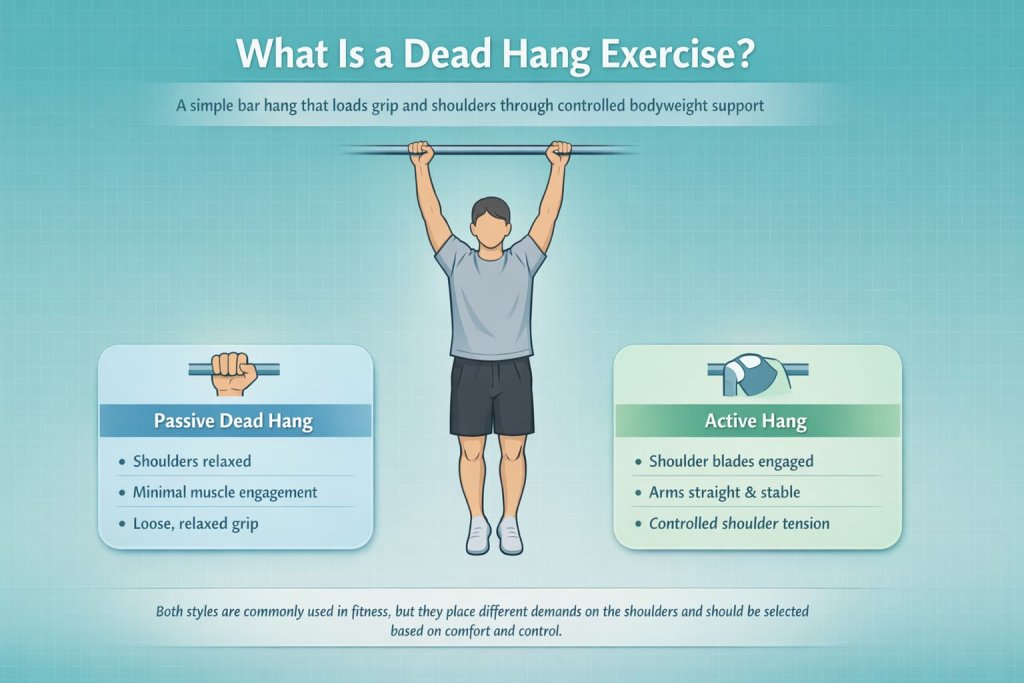
A dead hang is an isometric exercise where you hang from a bar with straight arms while your bodyweight loads the hands, forearms, shoulders, and upper back.
There are two commonly used styles:
- Passive dead hang: shoulders relaxed upward with minimal muscular engagement
- Active hang: light engagement of the shoulder blades without bending the elbows
Both styles are used in fitness settings, but they place different demands on the shoulders.
Dead Hang Exercise Form
How to do it
- Use a stable pull-up bar
- Grip the bar at a comfortable width
- Step off so your bodyweight is supported
- Keep arms straight and ribs stacked over hips
- Choose passive or active hang based on comfort
- Hold for the target time, then step down with control
Trainer Tip
Short, high-quality holds performed consistently are more effective than forcing long hangs that compromise shoulder position.
Dead Hang Exercise vs Active Hang
Passive hang
- Emphasizes grip endurance and relaxation
- Produces a stretching sensation through the shoulders and upper back
- May increase joint stress in individuals with shoulder instability
Active hang
- Emphasizes shoulder control and scapular stability
- Often preferred for pull-up preparation
- Typically feels more controlled and stable
For shoulder safety and strength carryover, active hangs are often the better starting option.
Dead Hang Exercise Progressions and Variations
These variations allow you to gradually increase grip demand, improve shoulder control, or reduce load based on your ability level. Choose the option that feels stable, pain-free, and matches your current strength and shoulder tolerance.
1. Towel Dead Hangs
Why it works:
Wrapping towels over the bar increases grip thickness and instability, forcing the forearm and hand muscles to work harder than a standard bar hang. This variation is commonly used to improve grip endurance carryover to pulling and carrying tasks.
Muscles worked:
Forearm flexors, intrinsic hand muscles, wrist stabilizers, shoulder stabilizers.
How to do it:
- Loop one or two sturdy towels evenly over a pull-up bar
- Grip the towels firmly instead of the bar
- Step into a controlled hang with arms straight
- Keep ribs stacked and body still
- Hold for a shorter time than a regular dead hang
Trainer Tip:
Reduce hold time by 30–50% compared to standard hangs. Grip fatigue rises quickly with towels.
2. Neutral-Grip Hangs
Why it works:
Neutral grips place the shoulders in a more joint-friendly position for many people, reducing rotational stress compared to straight-bar overhand grips while still training grip and shoulder tolerance.
Muscles worked:
Forearm flexors, lats, lower trapezius, rotator cuff stabilizers.
How to do it:
- Use parallel handles or a neutral-grip pull-up bar
- Grasp handles with palms facing each other
- Step into a controlled hang with arms straight
- Keep shoulders lightly active if comfortable
- Hold for the target time
Trainer Tip:
If straight-bar hangs bother your shoulders, neutral grips are often the safest long-term option.
3. One-Arm Assisted Dead Hangs
Why it works:
This variation reduces total load while introducing unilateral grip and shoulder demands, making it a smart bridge toward higher-level hanging strength.
Muscles worked:
Forearm flexors, shoulder stabilizers, upper back support muscles.
How to do it:
- Hang primarily from one hand
- Use the opposite hand lightly on the bar, strap, or band for assistance
- Keep elbows straight and shoulders controlled
- Adjust assistance to manage difficulty
- Hold briefly and switch sides
Trainer Tip:
Think “support, not pull” with the assisting hand—its job is balance, not strength.
4. Scapular (Active) Hangs
Why it works:
Scapular hangs teach controlled shoulder blade positioning, improving overhead stability and preparing the shoulders for pull-ups and other vertical pulling movements.
Muscles worked:
Lower trapezius, rhomboids, latissimus dorsi, rotator cuff stabilizers.
How to do it:
- Start in a dead hang with arms straight
- Gently pull the shoulders down and back without bending elbows
- Hold the active position steadily
- Relax back to a passive hang if needed
- Repeat for short, controlled holds
Trainer Tip:
If elbows bend, you’re pulling too hard. The movement should stay subtle and controlled.
How Long Should You Dead Hang?
Most beginners progress best with multiple short holds rather than one long effort.
| Level | Sets | Hold time |
|---|---|---|
| Beginner | 3–5 | 10–20 seconds |
| Intermediate | 3–5 | 20–40 seconds |
| Advanced | 3–5 | 40–60+ seconds |
Stop the set before grip failure causes shoulder collapse.
How Often Should You Do Dead Hangs?
Two to four sessions per week works well for most people. This aligns with strength-training recommendations outlined by the American College of Sports Medicine, which emphasize regular muscle-strengthening activity for long-term musculoskeletal health.
Dead Hang Exercise Benefits That Matter Most
Improves grip strength and endurance
Dead hangs train “support grip” by requiring sustained hand contact under bodyweight. This quality is especially important for pull-ups, carries, and climbing-based sports. Research published on PubMed Central examining dead-hang finger training protocols in climbers showed improvements in grip-related performance measures over structured training periods.
Builds shoulder tolerance in overhead positions
Hanging places the shoulder in full overhead flexion. With proper control, this position helps condition the shoulder complex for pulling movements such as pull-ups and lat pulldowns.
May help you feel less stiff after prolonged sitting
Many people report a temporary sensation of lengthening through the upper body after hanging. This sensation can feel relieving, especially after long periods of sitting, but it should not be viewed as a guaranteed spinal treatment.
Dead Hang Exercise for Beginners
If full bodyweight hangs feel difficult, use regressions:
- Toe-assisted hangs
- Lower bar height
- Resistance-band assistance
- Very short holds with more sets
Progress gradually as grip and shoulder tolerance improve.
Who Should Avoid Dead Hangs or Get Clearance First?
Caution is advised for individuals with shoulder instability, hypermobility, or a history of dislocations. Experts at Swinburne University have noted that dead hangs may stress passive shoulder tissues in people prone to instability, increasing injury risk if not properly scaled.
Anyone experiencing sharp pain, numbness, or a slipping sensation should stop and seek professional guidance.
Common Dead Hang Mistakes
Hanging on the joints
Allowing the shoulders to fully relax without control may increase joint stress. Switching to an active hang or reducing load can help.
Excessive rib flare and swinging
Maintaining light core engagement improves control and reduces unnecessary strain.
Training to failure every set
Repeated max hangs can irritate the elbows and shoulders. Ending sets early improves long-term consistency.
How the Dead Hang Exercise Supports Shoulder Health
The dead hang places the shoulder in a fully overhead position, which can help build tolerance and control when performed correctly and progressively.
- Encourages controlled exposure to overhead loading, a position required for pull-ups and lat-based movements
- Trains shoulder stabilizers to support the arm while bearing bodyweight
- Helps reinforce scapular awareness, especially when using an active hang rather than fully relaxed shoulders
- Can improve confidence in overhead positions when introduced gradually and without pain
This benefit depends on clean technique and appropriate scaling. For many people, lightly engaging the shoulder blades (active hang) provides better joint control than completely relaxed hanging.
Dead Hang Exercise and Spinal Health: What It Can and Cannot Do
Dead hangs are often discussed in relation to spinal health, but it’s important to set accurate expectations.
What it can do:
- Create a temporary unloading sensation through the upper body
- Help some people feel less stiff after prolonged sitting
- Encourage upright posture awareness when paired with core control
What it cannot do:
- It does not medically “decompress” the spine in a permanent or therapeutic way
- It does not treat spinal conditions or replace clinical care
- It is not appropriate for everyone, especially those with certain spine or shoulder issues
The spinal effects of dead hangs are highly individual. Any sharp pain, nerve symptoms, or discomfort during hanging is a clear sign to stop and reassess.
People Also Ask About Dead Hang Exercise
- Does the dead hang decompress the spine?
It may feel relieving for some people, but it is not a guaranteed or universal spinal intervention. - Is passive or active hanging better?
Active hangs generally provide better shoulder control and carryover. - Can dead hangs help with pull-ups?
Yes, they support grip endurance and overhead shoulder tolerance. - Are dead hangs safe daily?
Some people tolerate daily short hangs, but excessive volume may irritate joints.
FAQ
1. Should dead hangs be done before or after workouts?
Either works, depending on whether grip endurance or warm-up preparation is the goal.
2. What grip is best?
Choose the grip that feels stable and pain-free.
3. Why do my shoulders feel uncomfortable?
This often indicates limited overhead tolerance or instability—reduce load and reassess.
4. Can dead hangs build forearms?
They contribute by increasing grip time-under-tension.
5. How do I reduce swinging?
Use light core engagement and controlled entry into the hang.
6. Are dead hangs safe for teens?
Yes, when performed with proper supervision and scaled loading.
7. What sensations are normal?
Grip fatigue and controlled shoulder engagement—stop if pain or numbness appears.
Conclusion
The dead hang exercise is a simple, equipment-minimal way to build grip endurance and improve overhead shoulder control. When progressed gradually and performed with good technique, it can fit safely into a wide range of strength and fitness programs.