
Lower body plyometric exercises help train your legs to produce force quickly, which can improve jump performance, sprinting, and change-of-direction ability when they are done with good technique and smart progression. This matters because explosive lower-body power supports sports performance, athletic movement, and even better force absorption during landing.
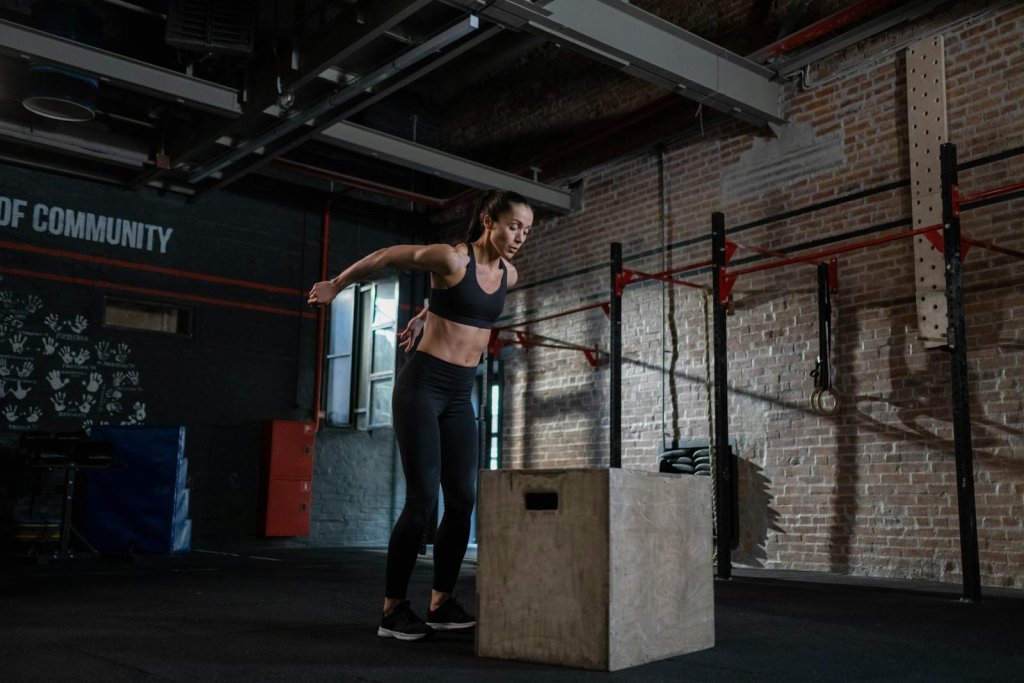
Current guidance from Hospital for Special Surgery, and recent research in PubMed supports starting with landing control, then progressing to more explosive jumps as your strength and mechanics improve.
What Are Lower Body Plyometric Exercises?
Lower body plyometric exercises are fast, explosive movements such as jumps, hops, bounds, and skips that use the stretch-shortening cycle. In simple terms, your muscles and tendons load quickly and then release force quickly.
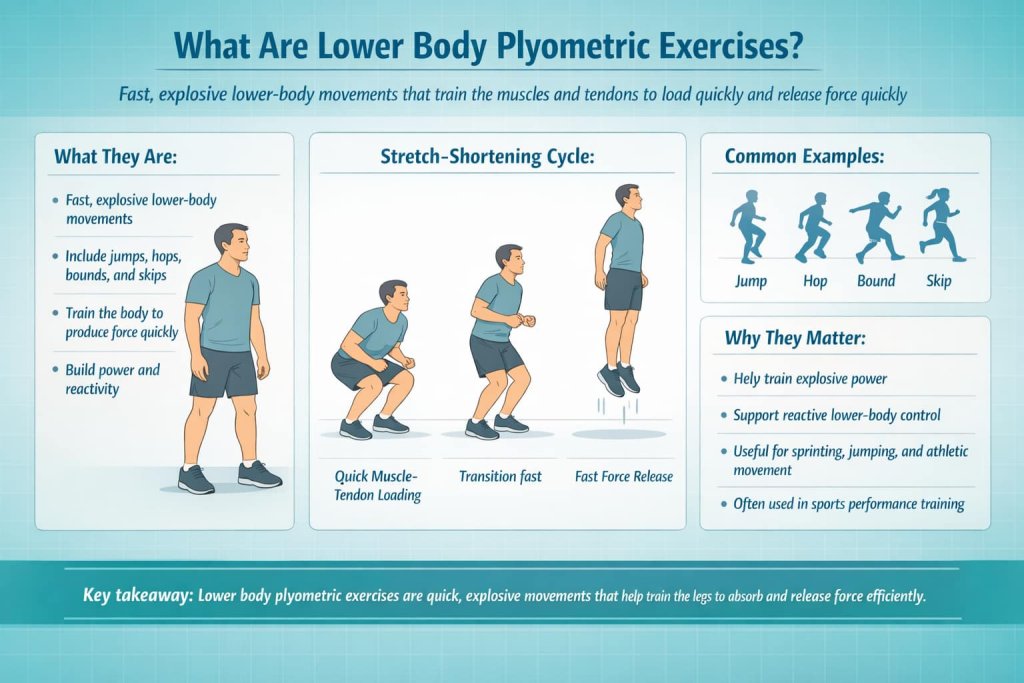
That is why plyometrics are often used to build power, reactivity, and athletic explosiveness. Open-access research in PMC continues to support this performance-focused role.
Do Lower Body Plyometric Exercises Actually Work?
Yes, they can work well when the program is structured and appropriate for the person doing it. A 2025 systematic review indexed in PubMed found that plyometric training significantly improved jumping ability, sprinting ability, and change-of-direction performance in adolescent soccer players, with moderate effects for jumping and change of direction and a small effect for sprinting. A 2025 open-access study in PMC also reported meaningful gains in squat jump power and short sprint performance after a 6-week plyometric program in sprinters.
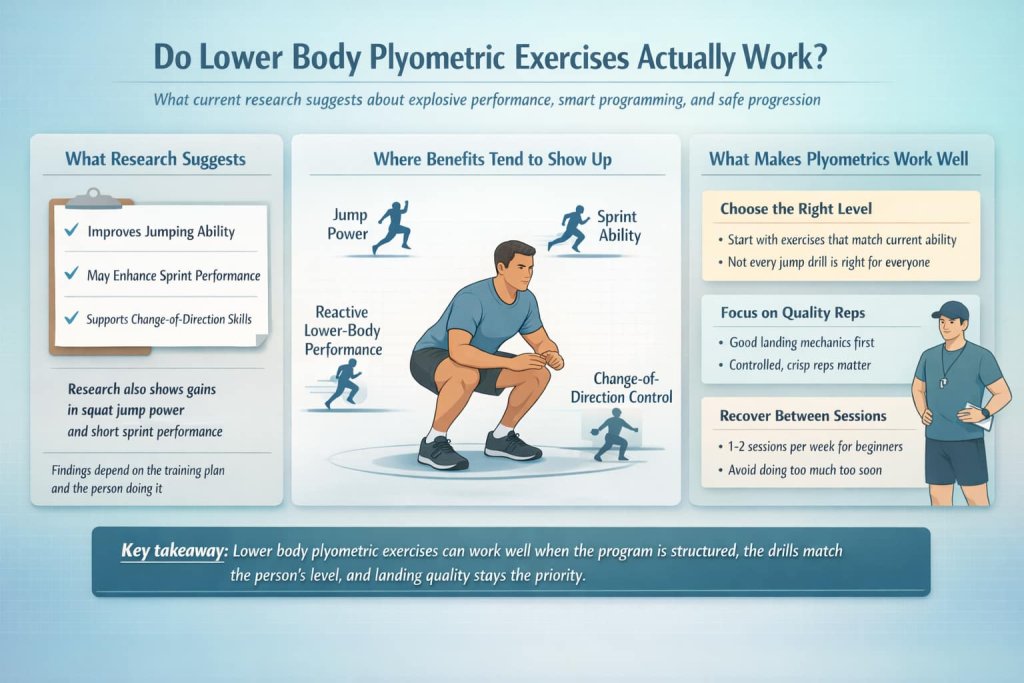
That does not mean every jump drill is right for every person. The best results usually come from choosing the right level, using quality reps, and recovering enough between sessions. Hospital for Special Surgery advises beginners to focus on landing first and generally limit plyometrics to one to two times per week so soreness and fatigue do not build up too quickly.
11 Best Lower Body Plyometric Exercises
Build explosive power, speed, and athletic control with these 11 lower body plyometric exercises. From jump squats to depth drops, each move helps train stronger, faster, and more efficient lower-body performance.
1. Jump Squats
How to do it:
- Stand with your feet about shoulder-width apart.
- Sit into a controlled squat.
- Swing your arms back.
- Drive through the floor and jump straight up.
- Land softly and return to a squat position.
- Reset and repeat.
Why it works: Jump squats are one of the most direct ways to train rapid force production through the hips, knees, and ankles. They are also one of the most recognized lower-body plyometric patterns in training literature and coaching practice. ACE includes jump squats in its lower-body plyometric programming.
Muscles worked: Quads, glutes, calves, hamstrings, and core.
Trainer Tip: Do not rush the landing. A quiet, controlled landing is more valuable than a higher jump with poor mechanics.
2. Box Jumps
How to do it:
- Stand facing a sturdy box or platform.
- Drop into a small quarter squat.
- Swing your arms and jump onto the box.
- Land softly with both feet fully on the box.
- Stand tall.
- Step down carefully between reps.
Why it works: Box jumps train explosive extension while reducing some landing stress compared with repeated ground landings, because you land on an elevated surface and step down under control. Hospital for Special Surgery lists box jumps as a later progression once force absorption mechanics are solid.
Muscles worked: Glutes, quads, calves, hamstrings, and core.
Trainer Tip: Choose a box height that lets you land in an athletic stance. Do not chase a higher box by tucking your knees excessively.
3. Broad Jumps
How to do it:
- Stand with your feet hip-width apart.
- Bend your hips and knees slightly.
- Swing your arms back.
- Jump forward as far as you can with control.
- Land softly on both feet.
- Reset before the next rep.
Why it works: Broad jumps build horizontal power, which is useful for acceleration and field or court sports. They also teach you to project force forward instead of only upward.
Muscles worked: Glutes, hamstrings, quads, calves, and core.
Trainer Tip: Stick the landing for one to two seconds before resetting. That helps reinforce control, not just distance.
4. Lateral Bounds
How to do it:
- Start on one leg or with a light push off both feet.
- Jump sideways to the other side.
- Land softly with your knee and foot lined up.
- Stabilize your body before the next bound.
- Repeat side to side.
Why it works: Lateral bounds develop side-to-side power and deceleration control, which are important for cutting, skating, and multidirectional sport movement. They also challenge frontal-plane stability that straight-up jumps may miss.
Muscles worked: Glute medius, glute max, quads, calves, hamstrings, and core.
Trainer Tip: Focus on balance after each landing. That is where much of the value comes from.
5. Split Squat Jumps
How to do it:
- Start in a split squat stance.
- Lower slightly with your torso tall.
- Explode upward.
- Switch legs in the air.
- Land softly in the opposite split stance.
- Reset your balance before the next rep if needed.
Why it works: Split squat jumps train unilateral power, hip stability, and coordination between legs. They are especially useful for people who want a plyometric drill that feels closer to sprinting and lunging patterns.
Muscles worked: Quads, glutes, calves, hamstrings, and core.
Trainer Tip: Keep the reps low and crisp. This drill gets sloppy fast when fatigue builds.
6. Tuck Jumps
How to do it:
- Stand tall with your feet about hip-width apart.
- Dip slightly into a squat.
- Jump up explosively.
- Bring your knees upward as you rise.
- Land softly and reset before repeating.
Why it works: Tuck jumps increase jump demand and reactive coordination. Hospital for Special Surgery includes tuck jumps among examples of full plyometric progressions once a person is comfortable absorbing force safely.
Muscles worked: Quads, hip flexors, glutes, calves, and core.
Trainer Tip: This is an advanced progression for many people. Do not add it too early if your landings are still noisy or unstable.
7. Pogo Jumps
How to do it:
- Stand tall with your feet hip-width apart.
- Stay mostly stiff through the knees.
- Bounce quickly on the balls of your feet.
- Keep ground contact short.
- Maintain an upright posture.
- Continue for a short set.
Why it works: Pogo jumps are a great entry point for lower body plyometric exercises because they teach quick force absorption and rebound through the ankles and lower legs. Hospital for Special Surgery specifically recommends pogo jumps as an easy early plyometric option.
Muscles worked: Calves, feet and ankle stabilizers, and core.
Trainer Tip: Think “springy and quiet,” not “high and hard.”
8. Skater Jumps
How to do it:
- Start standing on one side of your space.
- Push laterally off one foot.
- Jump to the other side.
- Land softly on the opposite foot.
- Let the non-landing leg trail behind for balance.
- Repeat smoothly from side to side.
Why it works: Skater jumps blend power, balance, and lateral control. They are useful for sports and for general athletic movement because they train force production and braking in the frontal plane.
Muscles worked: Glutes, quads, calves, hamstrings, adductors, and core.
Trainer Tip: Keep your chest proud and hips back as you land so you do not collapse inward at the knee.
9. Single-Leg Hops
How to do it:
- Stand on one foot.
- Bend slightly at the hip, knee, and ankle.
- Hop forward, in place, or side to side.
- Land softly on the same foot.
- Stabilize fully before the next rep.
- Switch sides.
Why it works: Single-leg hops increase the balance and control demands of plyometrics. Hospital for Special Surgery includes single-leg jumps as a progression once a person can absorb force safely.
Muscles worked: Glutes, calves, quads, hamstrings, and foot-ankle stabilizers.
Trainer Tip: Start with very small hops. Control matters more than distance or height.
10. Lateral Line Jumps
How to do it:
- Imagine or mark a line on the floor.
- Stand with feet together or on one foot for a harder version.
- Jump quickly side to side over the line.
- Keep the jumps low and controlled.
- Stay light on the ground.
- Continue for a short burst.
Why it works: Lateral line jumps are a simple way to build rhythm, reactivity, and lower-leg stiffness without needing much space or equipment. They can work well as a low-level progression before bigger lateral bounds.
Muscles worked: Calves, quads, glutes, and core.
Trainer Tip: Keep the movement compact. Small, quick, clean reps usually work better than huge swings.
11. Depth Drops
How to do it:
- Stand on a small box, usually a low height.
- Step off rather than jump off.
- Land in an athletic squat position.
- Absorb the force quietly.
- Hold the landing briefly.
- Step back up and repeat.
Why it works: Depth drops are excellent for teaching force absorption and landing mechanics. Hospital for Special Surgery recommends the depth drop as a low-intensity progression from basic landing drills before moving to more forceful plyometric actions.
Muscles worked: Quads, glutes, calves, hamstrings, and core.
Trainer Tip: The goal is not rebound speed here. The goal is learning to land well.
Before You Start Lower Body Plyometric Exercises
Plyometrics are high impact and not ideal for everyone at every stage. ACE notes that this style of training is ballistic and high intensity, so it should be added only after you check that the person is ready, has sound movement mechanics, and knows how to land. ACE also suggests emphasizing quality over quantity and allowing recovery based on intensity and fitness level.
A practical beginner sequence is:
- learn landing position and force absorption
- start with low-level hops or small jumps
- progress to bigger vertical, lateral, and single-leg drills
- keep sessions short and crisp
- stop if form falls apart
That progression matches current Hospital for Special Surgery guidance, which starts with landing mechanics and low-level pogo-style drills before moving into higher-intensity jumps and box work.
Why Lower Body Plyometric Exercises Are Effective
Lower body plyometric exercises can be effective because they train the neuromuscular system to create force quickly. Recent research continues to show benefits for lower-limb explosive power, sprint performance, and jump outcomes, while coaching guidance highlights that better landing skill also helps people absorb force more efficiently.
For many people, the biggest benefits include:
- better jump performance
- more explosive push-off
- improved short sprint ability
- stronger change-of-direction ability
- better lower-body coordination and reactivity
How to Add Lower Body Plyometric Exercises to Your Routine
For most people, one to two plyometric sessions per week is a sensible starting point, especially if the drills are new or high impact. Hospital for Special Surgery specifically recommends limiting beginner plyometrics to one to two times per week and doing them early in the workout while fresh.
A simple structure looks like this:
- choose 3 to 5 exercises
- do 2 to 4 sets of 3 to 6 reps for bigger jumps
- use short sets for low-level pogo or line jumps
- rest enough that each rep stays explosive
- stop before technique drops off
ACE notes that recovery needs can range widely depending on workout intensity and the person’s fitness level, but form should stay the priority throughout.
Lower Body Plyometric Exercises Safety Checklist
Landing quality is one of the most important parts of plyometrics. Hospital for Special Surgery recommends checking that your knees stay over your toes, your upper body does not collapse, your feet land flat, and your landing sounds quiet rather than heavy. Mayo Clinic also warns that poor landing mechanics, especially a valgus or knock-kneed position, can raise injury risk.
Use these rules before and during your workout:
- warm up first with light movement and dynamic drills
- do plyometrics early in the workout while you are fresh
- land softly and under control
- keep reps low enough that technique stays sharp
- stop if you feel sharp pain, joint instability, or repeated sloppy landings
Who Should Be Careful With Lower Body Plyometric Exercises?
These exercises may not be the best starting point for everyone. Be more cautious if you:
- are new to exercise
- have current ankle, knee, hip, or back pain
- cannot squat or land with control
- are returning from a recent lower-body injury
- lose alignment quickly when tired
Mayo Clinic’s landing guidance is especially relevant here because hip or knee weakness and fatigued, valgus-style landings can increase injury risk in jumping activities.
Common Mistakes to Avoid
The most common problems with lower body plyometric exercises are doing too much too soon, landing heavily, and continuing after technique fades. Hospital for Special Surgery recommends checking alignment in a mirror when possible and listening for a quiet landing. ACE also stresses that plyometrics should be progressed only when the person is ready and can maintain movement quality.
Avoid these mistakes:
- skipping the warm-up
- chasing height instead of clean mechanics
- using advanced drills before mastering basic landings
- turning every set into conditioning work
- training through joint pain
FAQs About Lower Body Plyometric Exercises
Are Lower Body Plyometric Exercises Good for Beginners?
They can be, but beginners should start with landing drills, low-level pogo jumps, and very small jumps before moving to higher-intensity drills. Hospital for Special Surgery recommends learning proper form and landing first.
How Often Should I Do Lower Body Plyometric Exercises?
A good starting point is one to two times per week. That matches Hospital for Special Surgery beginner guidance and gives you time to recover between sessions.
Can Lower Body Plyometric Exercises Build Muscle?
They can support muscle development, especially when paired with strength training, but their main role is usually power, speed, and force production rather than maximum hypertrophy. ACE specifically frames plyometrics as a complement to lower-body strength training.
What Is the Best Surface for Plyometric Training?
A stable, non-slippery surface with some shock absorption is usually best. The exact choice depends on the drill, but the bigger priority is safe footing and good landing mechanics. Recent research also suggests surface type can affect jump, sprint, and agility outcomes.
Are Box Jumps Better Than Jump Squats?
Not always. Jump squats are simple and direct for vertical power, while box jumps can be useful as a progression and may reduce repeated landing stress when you step down between reps. The better choice depends on your goal and skill level.
Should Runners Use Lower Body Plyometric Exercises?
Many runners can benefit from them when they are introduced carefully. Hospital for Special Surgery notes that learning to absorb force properly is particularly helpful for runners because each foot strike creates substantial load.
Conclusion
Lower body plyometric exercises can be a smart way to build explosive power, improve athletic movement, and sharpen your ability to produce force quickly. The key is to earn the harder drills by first mastering landing mechanics, starting with lower-level options, and keeping quality high from the first rep to the last. Use the 11 exercises above to build a progression that matches your current level, not your ideal level.
If you are adding these drills to your training plan, start with two or three movements, keep the reps crisp, and progress only when your landings stay quiet and controlled.
References
- PMC – Meta-Analysis of the Effects of Plyometric Training on Lower Limb Explosive Strength in Adolescent Athletes
- PubMed – Plyometric Training Enhances Jump, Sprint, and Agility Performance Across Different Surface Types: A Systematic Review and Meta-Analysis
- HSS – Deceleration Training and Exercises for Athletes