
The best leg exercises for runners are the ones that build single-leg strength, glute power, calf capacity, balance, and control without creating so much fatigue that they hurt your running. Done consistently, the right strength work may help improve running economy, support performance, and make your body more prepared for training loads.

If you want a simple place to start, focus on squats, lunges, step-ups, hip bridges, single-leg hinges, calf raises, and a small amount of power work. Current guidance from the American College of Sports Medicine, CDC, and World Athletics supports regular muscle-strengthening work, with adults doing strength training at least 2 days per week.
Why Leg Exercises for Runners Matter
Running is repetitive. Every stride asks your hips, thighs, calves, and feet to absorb force, stay stable, and create propulsion. That is why runners often benefit from strength work that improves not just raw force, but also balance, coordination, and single-leg control. World Athletics specifically highlights exercises such as lunges, squats, glute bridges, calf raises, and single-leg Romanian deadlifts as practical strength-and-conditioning options for runners.
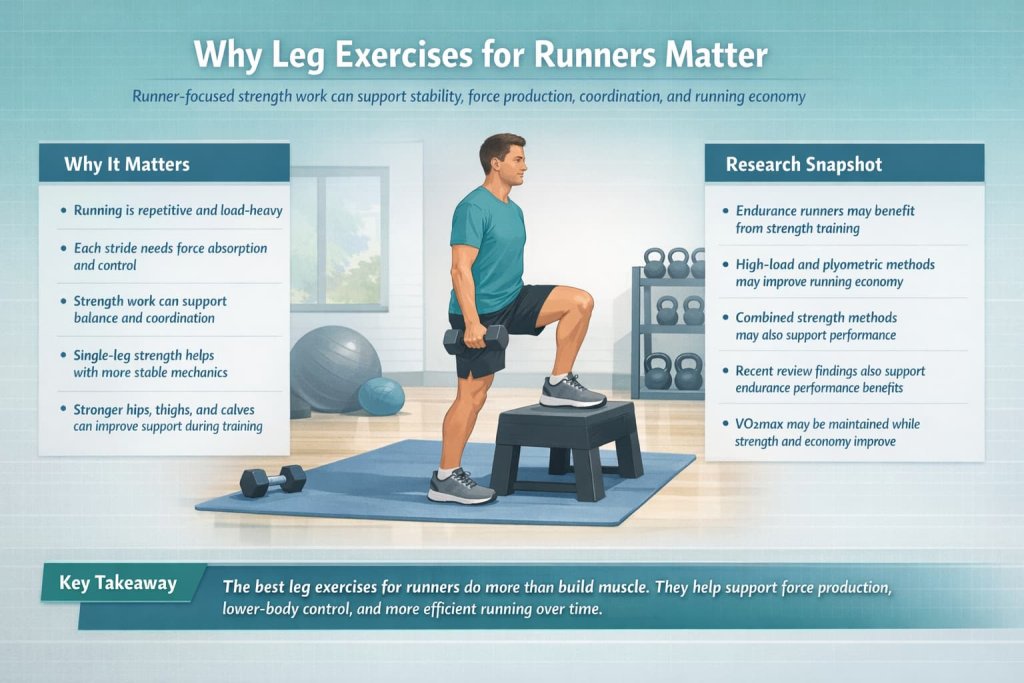
Research also continues to support strength training for endurance runners. A 2024 systematic review and meta-analysis on PubMed found that high-load strength training, plyometric training, and combined methods may improve running economy in middle- and long-distance runners. A 2025 umbrella review also reported that strength training improves endurance performance and running economy overall, while helping maintain VO2max.
How Often Should Runners Do Leg Strength Work?
For most runners, a practical target is 2 strength sessions per week. That matches current CDC guidance that adults should do muscle-strengthening activity on at least 2 days each week, alongside aerobic activity. The updated ACSM guidance also emphasizes that consistency matters more than complicated programming.
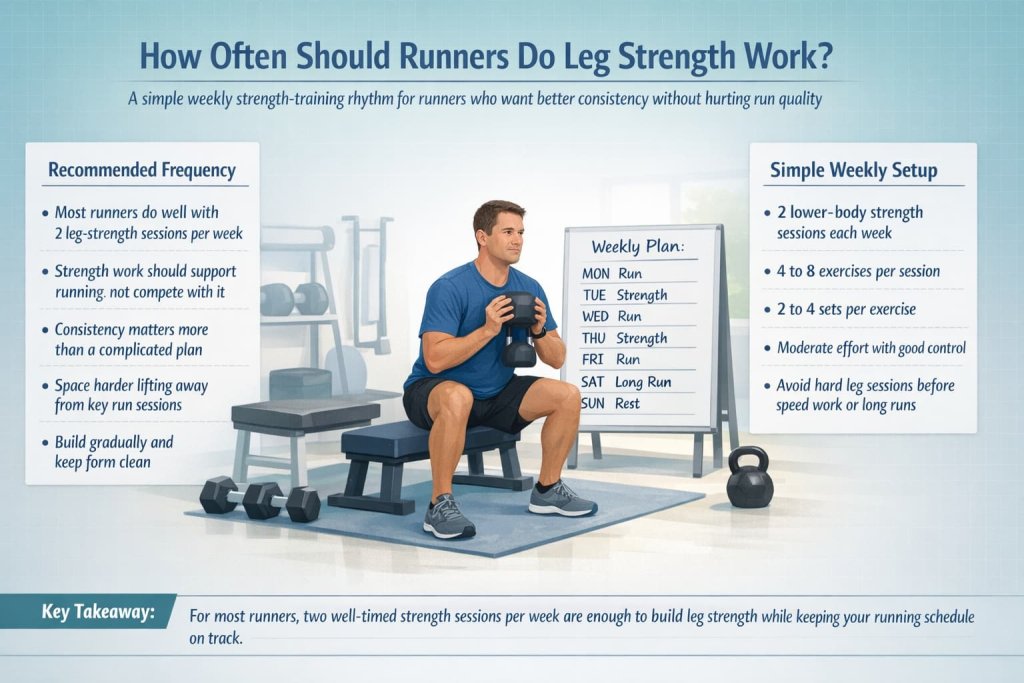
A simple weekly setup might look like this:
- 2 lower-body strength sessions per week
- 4 to 8 total exercises per session
- 2 to 4 sets per exercise
- moderate effort with clean form
- harder lower-body lifting away from your key speed workout or long run
12 Best Leg Exercises for Runners
Build stronger legs, better balance, and more running-specific power with these effective exercises for runners. This list targets the glutes, quads, hamstrings, and calves to support performance, control, and a more efficient stride.
1. Goblet Squat
How to do it
- Hold a dumbbell or kettlebell at your chest
- Stand with feet about shoulder-width apart
- Brace your core and sit down between your hips
- Keep your heels down and chest tall
- Stand back up with control
- Repeat for 6 to 10 reps
Why it works: Goblet squats build lower-body strength in a simple, easy-to-learn pattern. For runners, they help train the quads and glutes together while reinforcing good trunk position.
Muscles worked: Quads, glutes, adductors, hamstrings, core.
Trainer Tip: If you struggle to stay upright, the goblet hold often feels more natural than a back-loaded squat.
2. Forward or Reverse Lunge
How to do it
- Stand tall with feet hip-width apart
- Step forward or backward into a lunge
- Lower until both knees bend comfortably
- Keep your front foot planted and knee tracking with your toes
- Push through the front leg to return to standing
- Alternate sides
Why it works: Lunges build single-leg strength, balance, and hip control. They also resemble the split-leg demands of running better than many bilateral exercises.
Muscles worked: Quads, glutes, hamstrings, calves, core stabilizers.
Trainer Tip: Reverse lunges are often easier to control for beginners and may feel more comfortable on the knees.
3. Bulgarian Split Squat
How to do it
- Stand a few feet in front of a bench or step
- Place your back foot on the bench
- Lower straight down with control
- Keep most of your weight on the front leg
- Drive through the front foot to stand
- Complete all reps, then switch sides
Why it works: This is one of the best leg exercises for runners because it challenges single-leg strength heavily without needing very heavy external load.
Muscles worked: Quads, glutes, hamstrings, adductors, core.
Trainer Tip: Start with bodyweight or a shallow range if balance is your limiting factor.
4. Step-Up
How to do it
- Stand facing a sturdy box, step, or bench
- Place one foot fully on the platform
- Drive through that foot to stand up
- Avoid pushing too hard off the trailing leg
- Step down slowly
- Repeat on one side, then switch
Why it works: Step-ups train upward force production, pelvic control, and single-leg stability. They are especially useful for runners because they build strength in a very functional way.
Muscles worked: Glutes, quads, hamstrings, calves.
Trainer Tip: Choose a step height that lets you stay controlled without twisting or collapsing.
5. Barbell or Dumbbell Romanian Deadlift
How to do it
- Stand tall holding the weight in front of your thighs
- Unlock your knees slightly
- Push your hips back as your torso leans forward
- Keep your spine neutral and weights close to your body
- Lower until you feel tension in the hamstrings
- Drive your hips forward to stand
Why it works: Romanian deadlifts build posterior-chain strength, which matters for stride support, hip extension, and lower-body durability.
Muscles worked: Hamstrings, glutes, lower back, adductors.
Trainer Tip: Think “hips back” rather than “bend down.”
6. Single-Leg Romanian Deadlift
How to do it
- Stand on one leg with a soft knee
- Hinge at the hips as the other leg extends behind you
- Keep your hips square and back flat
- Lower until you feel hamstring tension
- Return to standing with control
- Repeat, then switch sides
Why it works: This exercise combines balance, hamstring loading, and hip stability. It is one of the most runner-specific strength patterns you can add.
Muscles worked: Hamstrings, glutes, foot and ankle stabilizers, core.
Trainer Tip: Reach the free leg long behind you instead of just tipping your chest down.
7. Hip Thrust or Glute Bridge
How to do it
- Lie on your back with knees bent and feet flat
- Press through your heels
- Lift your hips until your body forms a straight line from shoulders to knees
- Pause briefly at the top
- Lower with control
- For hip thrusts, place your upper back on a bench
Why it works: Glute strength matters for force production and pelvic control during running. World Athletics also lists glute bridge variations as a practical strength option for runners.
Muscles worked: Glutes, hamstrings, core.
Trainer Tip: Do not overarch your lower back at the top.
8. Hamstring Curl or Nordic Hamstring Lean
How to do it
- For a machine or band curl, bend your knees against resistance
- For a Nordic lean, kneel with your ankles secured
- Keep your body straight from knees to head
- Lower slowly as far as you can control
- Use your hands lightly if needed to catch yourself
- Reset and repeat
Why it works: Strong hamstrings help with braking, swing-phase control, and force transfer. This variation adds a knee-flexion emphasis that complements hip-dominant exercises like deadlifts.
Muscles worked: Hamstrings primarily, with glutes and core assisting.
Trainer Tip: Nordic work is advanced. Start with very small range and low reps.
9. Standing Calf Raise
How to do it
- Stand tall on both feet or one foot
- Rise onto the balls of your feet
- Pause briefly at the top
- Lower slowly until your heels come down fully
- Repeat for controlled reps
Why it works: Calf strength is easy to underestimate in runners. A 2024 study available through PubMed found that improvements in calf-raise strength were significantly associated with better running economy in recreational runners.
Muscles worked: Gastrocnemius, soleus, intrinsic foot support.
Trainer Tip: Use a full range and slow lowering instead of bouncing through reps.
10. Bent-Knee Soleus Raise
How to do it
- Sit or stand with knees bent
- Lift your heels while keeping the knees flexed
- Pause at the top
- Lower slowly
- Repeat for higher reps
Why it works: The soleus contributes heavily during running, especially at endurance paces. Bent-knee calf work helps train this deeper calf muscle in a more specific way than straight-leg raises alone.
Muscles worked: Soleus mainly, with other calf muscles assisting.
Trainer Tip: This usually responds well to slower tempo and higher reps.
11. Lateral Band Walk
How to do it
- Place a mini band around your ankles or above your knees
- Stand in a slight athletic stance
- Step sideways with control
- Keep tension on the band the whole time
- Take several steps one way, then back
Why it works: Running happens forward, but runners still need frontal-plane stability. Lateral band walks help train the hip muscles that support alignment and control.
Muscles worked: Glute medius, glute minimus, lateral hip stabilizers.
Trainer Tip: Keep your toes mostly forward and avoid rocking side to side.
12. Low-Level Pogo Hops or Jump Squats
How to do it
- Start with small, controlled jumps
- Land softly and stay tall
- Keep ground contact quick but controlled
- Perform low reps with full recovery
- Stop if landing quality drops
Why it works: Plyometric training may improve running economy when used appropriately. This type of exercise helps train stiffness, reactivity, and force production, but it belongs after you can tolerate basic strength work well.
Muscles worked: Calves, quads, glutes, foot-ankle complex.
Trainer Tip: This is not the first exercise to add. Earn it by building strength and landing control first.
Before You Start Leg Exercises for Runners
Warm up first with 5 to 10 minutes of easy movement such as brisk walking, marching, cycling, or light jogging. Then do a few dynamic drills like leg swings, ankle rocks, or bodyweight squats.
Use these quick rules:
- Stop if you feel sharp or worsening pain
- Start with bodyweight if you are new to strength work
- Keep 1 to 3 reps in reserve on most sets
- Build volume gradually
- Avoid doing a very hard leg session right before an important run
A Simple Runner Leg Workout You Can Start With
Option 1: Beginner Runner Strength Day
- Goblet squat: 3 sets of 8
- Reverse lunge: 3 sets of 6 to 8 per side
- Glute bridge: 3 sets of 10 to 12
- Standing calf raise: 3 sets of 12 to 15
- Lateral band walk: 2 to 3 sets of 10 steps each way
Option 2: Intermediate Runner Strength Day
- Bulgarian split squat: 3 sets of 6 to 8 per side
- Romanian deadlift: 3 sets of 6 to 8
- Step-up: 3 sets of 8 per side
- Soleus raise: 3 sets of 15 to 20
- Single-leg Romanian deadlift: 2 to 3 sets of 6 per side
- Pogo hops: 2 to 3 sets of 10 to 20 contacts
How to Fit Leg Exercises Around Running
Place heavier strength work after an easy run or on a non-key running day. Try not to schedule a demanding lower-body lift right before a race, a long run, or your hardest interval session.
A practical example:
- Monday: easy run plus strength
- Tuesday: workout run
- Wednesday: easy or recovery
- Thursday: strength plus short easy run
- Friday: easy
- Saturday: long run
- Sunday: recovery
This kind of spacing helps reduce the chance that sore legs will interfere with your most important runs.
Common Mistakes Runners Make With Strength Training
Doing too much too soon
A sudden jump in lifting volume can leave your legs overly sore and affect running quality. Start with fewer total sets than you think you need.
Skipping calf work
Many runners focus on squats and lunges but ignore lower-leg strength. That is a mistake, especially because recent research links calf strength gains with running economy improvements.
Only training bilaterally
Exercises like squats are useful, but runners also need single-leg control. Include step-ups, lunges, or split squats regularly.
Turning every lift into a max-effort session
Most runners do not need bodybuilding-level fatigue or powerlifting-level intensity every session. Good technique and consistency matter more.
Who Should Be Careful Before Starting?
Use extra caution or get qualified guidance first if you have:
- a recent lower-body injury
- tendon pain that is already aggravated by running
- sharp pain with hopping, squatting, or lunging
- recent surgery
- major balance problems
For general activity planning, the CDC physical activity guidance is a good public-health starting point, but individual rehab or return-to-sport decisions should be personalized.
Are Leg Exercises for Runners Actually Effective?
Yes, but the benefit depends on good programming and consistency. The current evidence does not suggest that random exercise alone magically makes someone faster. What it does show is that well-placed strength work may improve running economy, support endurance performance, and help runners better tolerate training.
That is also why the best leg exercises for runners are usually simple. You do not need a flashy plan. You need a repeatable one.
Frequently Asked Questions
Should runners lift heavy legs?
They can, if technique is good and the program fits their running schedule. Research reviews suggest high-load strength training may improve running economy, but it should be progressed sensibly.
How many days a week should runners train legs?
For most runners, 2 days per week is a solid target. That aligns with CDC muscle-strengthening guidance for adults.
What leg exercise helps runners the most?
There is no single best choice for everyone, but step-ups, split squats, lunges, Romanian deadlifts, bridges, and calf raises are among the most useful because they cover strength, balance, and stride-relevant muscle groups.
Should runners do calf raises?
Yes. Calf work is one of the most practical additions for many runners because the lower leg plays a major role in propulsion and running economy.
Are squats enough for runners?
No. Squats are helpful, but runners also benefit from single-leg work, posterior-chain training, and calf exercises.
When should runners avoid plyometrics?
Avoid them when you are new to strength work, currently hurt, or unable to land softly and control your body well. Build a base first.
Can runners do leg exercises on the same day as a run?
Yes. Many runners do best pairing strength with an easy run so hard days stay hard and easy days stay easy.
Conclusion
The best leg exercises for runners are not just about bigger muscles. They are about building a stronger stride, better control, and a body that can handle more running with less wasted motion. Start with the basics, train legs twice per week, and focus on clean, repeatable exercises that match your current level.
References
- PubMed: The Effect of Strength Training Methods on Middle- and Long-Distance Running Performance
- PubMed: The Effect of Strength Training on Endurance Performance and Running Economy in Middle- and Long-Distance Athletes
- Centers for Disease Control and Prevention (CDC): Adding Physical Activity as an Adult
- ACSM: 5 Things to Know About Creating an Effective Resistance Training Program