
Honey has about 64 calories per tablespoon, about 21 calories per teaspoon, and roughly 304 calories per 100 grams. That makes it a concentrated sweetener, so even small amounts can add up quickly. Knowing the calorie count in honey matters if you are tracking portions, managing sugar intake, or trying to keep calories in check while still enjoying something sweet.
How Many Calories in Honey by Serving Size
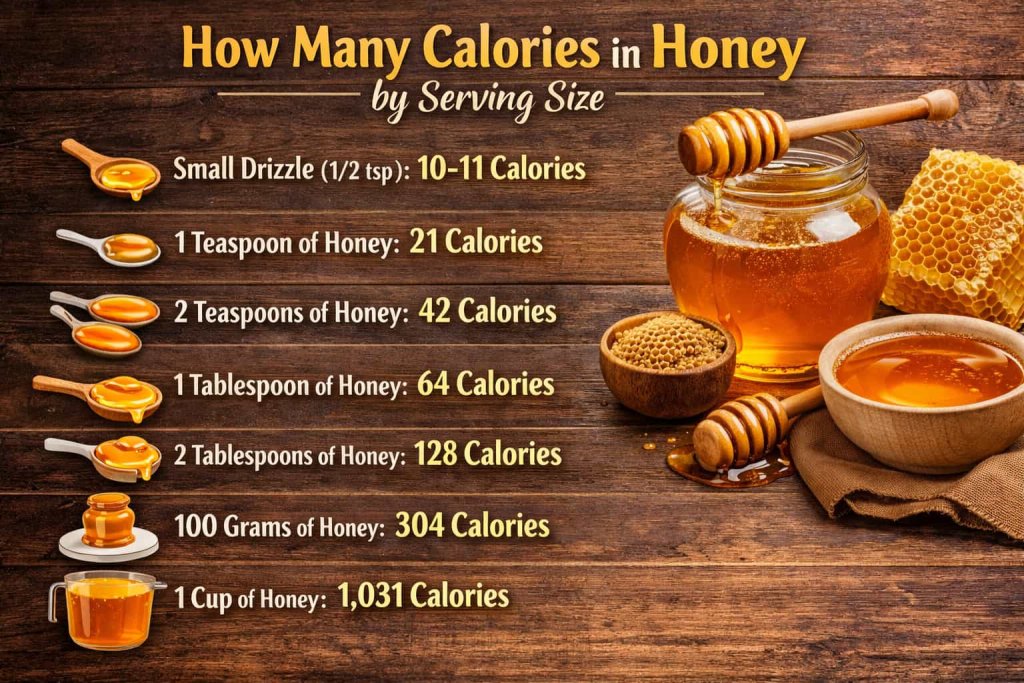
Here is the most practical calorie guide for plain honey:
- 1 small drizzle (about 1/2 teaspoon): about 10 to 11 calories
- 1 teaspoon of honey: about 21 calories
- 2 teaspoons of honey: about 42 calories
- 1 tablespoon of honey: about 64 calories
- 2 tablespoons of honey: about 128 calories
- 100 grams of honey: about 304 calories
- 1 cup of honey: about 1,031 calories
This makes it easier to estimate calories in tea, oatmeal, toast, yogurt, and other everyday uses where honey is often added a little at a time.
The big takeaway is simple: honey is not especially bulky, but it delivers calories fast. A quick drizzle in tea or over toast may seem small, yet 2 tablespoons already adds about 128 calories. According to the USDA, honey is an energy-dense sweetener, so portion size matters.
Nutrition Profile of Honey
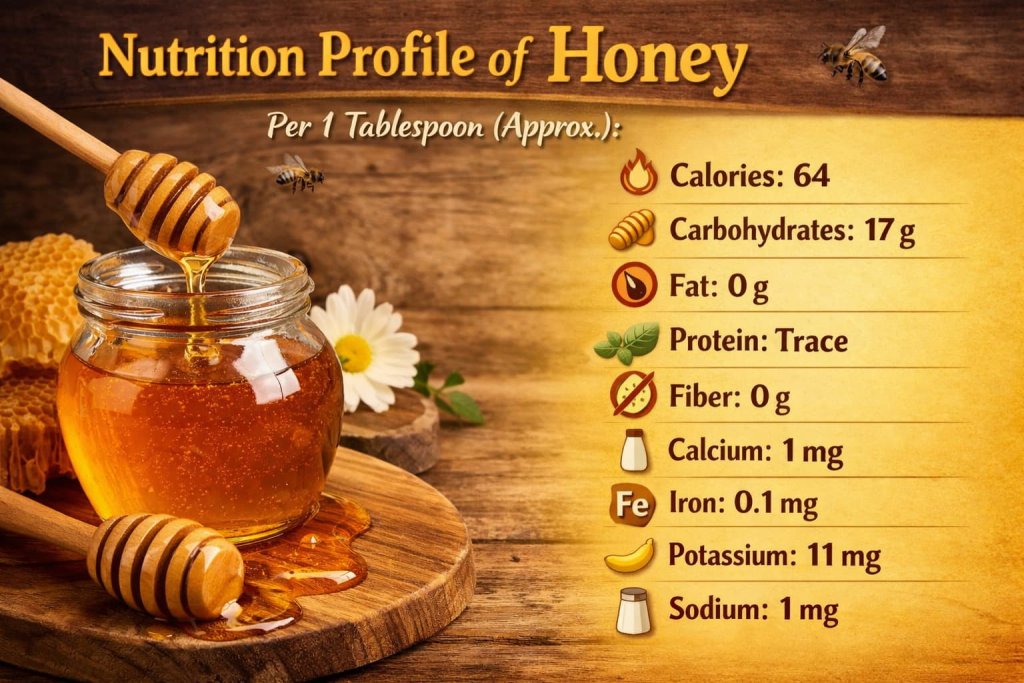
Honey is mostly carbohydrate, with very little protein or fat. Based on USDA data, 1 tablespoon of honey provides approximately:
- Calories: 64
- Carbohydrates: 17 g
- Fat: 0 g
- Protein: trace
- Fiber: 0 g
- Calcium: 1 mg
- Iron: 0.1 mg
- Potassium: 11 mg
- Sodium: 1 mg
That means honey gives you energy mainly from sugars, not from protein, fiber, or meaningful amounts of vitamins and minerals. It may contain tiny amounts of minerals and naturally occurring compounds, but in everyday serving sizes it is best thought of as a sweetener, not a major nutrient source.
Is Honey Good for Weight Management?
Honey can fit into a weight-management plan, but it is not a low-calorie food. Because it is concentrated and easy to overpour, portion size matters more than the fact that it is natural.
The FDA says the Dietary Guidelines for Americans recommend limiting calories from added sugars to less than 10% of total daily calories. On a 2,000-calorie diet, that works out to under 50 grams of added sugars per day. One tablespoon of honey already gives you about 17 grams of carbohydrate, so repeated spoonfuls can take up a large share of that limit.
The American Heart Association sets an even tighter practical limit for added sugar: no more than 25 grams per day for women and 36 grams per day for men. By that standard, 1 tablespoon of honey is already a sizable amount.
When honey may work well
Honey may fit better when you:
- use a measured teaspoon instead of pouring freely
- swap it for larger amounts of sugar-heavy syrups or spreads
- add it to foods that also contain protein or fiber, such as plain yogurt or oatmeal
When honey can work against your goal
Honey can make weight management harder when you:
- add it to drinks several times a day without measuring
- pair it with already high-calorie foods
- assume natural means low-calorie or unlimited
Key Nutrients in Honey
The main nutritional role of honey is to provide quick energy from carbohydrate. Its standout feature is not a high vitamin or mineral content, but its sweetness in a small volume.
In practical terms, foods like fruit, beans, nuts, yogurt, and whole grains give you much more nutritional value per calorie than honey does. Honey can still have a place in a balanced diet, but it should not be your main source of nutrients.
Who Should Be a Little More Careful With Honey?
Infants under 12 months
This is the most important safety point. The CDC says honey should not be given to children younger than 12 months because it may cause infant botulism, a serious type of food poisoning.
People watching sugar intake
If you have diabetes, insulin resistance, or are trying to cut back on added sugars, honey still needs to be counted carefully. Even though it is less processed than table sugar, it is still a concentrated source of sugar and calories.
Honey should still be counted as a sugar source in meal planning. Even though it is often seen as more natural than table sugar, it can still raise blood sugar and add calories quickly, especially in larger portions. For people with diabetes or prediabetes, the most helpful approach is usually to treat honey like any other sweetener and keep portions small.
People with pollen or bee-related allergies
The National Center for Complementary and Integrative Health notes that people with pollen allergies may also react to bee products such as honey. People allergic to pollen or bee stings may want to be extra careful.
Honey vs Sugar Calories
From a calorie standpoint, honey is not dramatically different from other sweeteners. What often changes is serving size. Because honey is liquid and easy to drizzle, many people use more than they realize. Measuring it with a teaspoon can make a real difference if you use it daily.
Best Ways to Use Honey Without Overdoing Calories
If you enjoy honey, these habits help keep it realistic:
- measure it instead of pouring straight from the bottle
- use 1 teaspoon when you only need a little sweetness
- combine it with filling foods, such as plain Greek yogurt or oats
- watch repeated use in tea, coffee, smoothies, and toast toppings
A small serving can be perfectly reasonable. The trouble usually comes from unmeasured extras throughout the day.
Honey Calories in Tea, Coffee, and Other Drinks
Honey calories can add up especially fast in drinks because liquid sweeteners are easy to pour without measuring. A teaspoon adds about 21 calories, while a tablespoon adds about 64 calories. That may not sound like much once, but using honey in several cups of tea or coffee a day can quietly add a few hundred extra calories over time.
This is why measuring matters. If you like honey in drinks, using a teaspoon instead of a free pour is one of the easiest ways to keep the calories realistic.
FAQ
Does honey have fewer calories than sugar?
Honey is still a high-calorie sweetener. The more useful point is that both should be used in moderation, especially if you are trying to reduce added sugar intake.
Is honey healthier than sugar?
Honey may contain tiny amounts of naturally occurring compounds, but it is still mostly sugar. In practical day-to-day nutrition, portion size matters more than the health halo.
Can I eat honey every day?
Many adults can include small amounts of honey in a balanced diet. The key is keeping portions modest and staying aware of your total added sugar intake across the day.
Is honey okay for babies?
No. Children under 12 months should not have honey because of the risk of infant botulism.
Conclusion
Honey can absolutely fit into a healthy eating pattern, but it is still a concentrated source of sugar and calories. A teaspoon has about 21 calories, and a tablespoon has about 64 calories, so portion size is the key detail to remember. That also means 3 tablespoons of honey add up to about 192 calories, which is enough to matter if you use it generously every day without measuring.
If you enjoy honey, use it deliberately, measure it when possible, and think of it as a sweetener rather than a major nutrition food. That approach makes it much easier to enjoy the flavor without letting calories quietly pile up.
Sources and References
- USDA — FoodData Central: Honey
- FDA — Added Sugars on the Nutrition Facts Label
- CDC — Foods and Drinks to Avoid or Limit
- American Heart Association — How Much Sugar Is Too Much?
- National Center for Complementary and Integrative Health — Seasonal Allergies at a Glance