
Yes, you can build a stronger back at home with dumbbells if you use the right movement patterns, train consistently, and focus on controlled form. For most people, the best at-home dumbbell back exercises are row variations, reverse-fly patterns, pullovers, and hip-hinge movements that train the lats, upper back, rear shoulders, and back-supporting posterior chain. Guidelines from the CDC, Mayo Clinic, and NHS all support regular muscle-strengthening work, including home-based exercise, as part of a healthy routine.
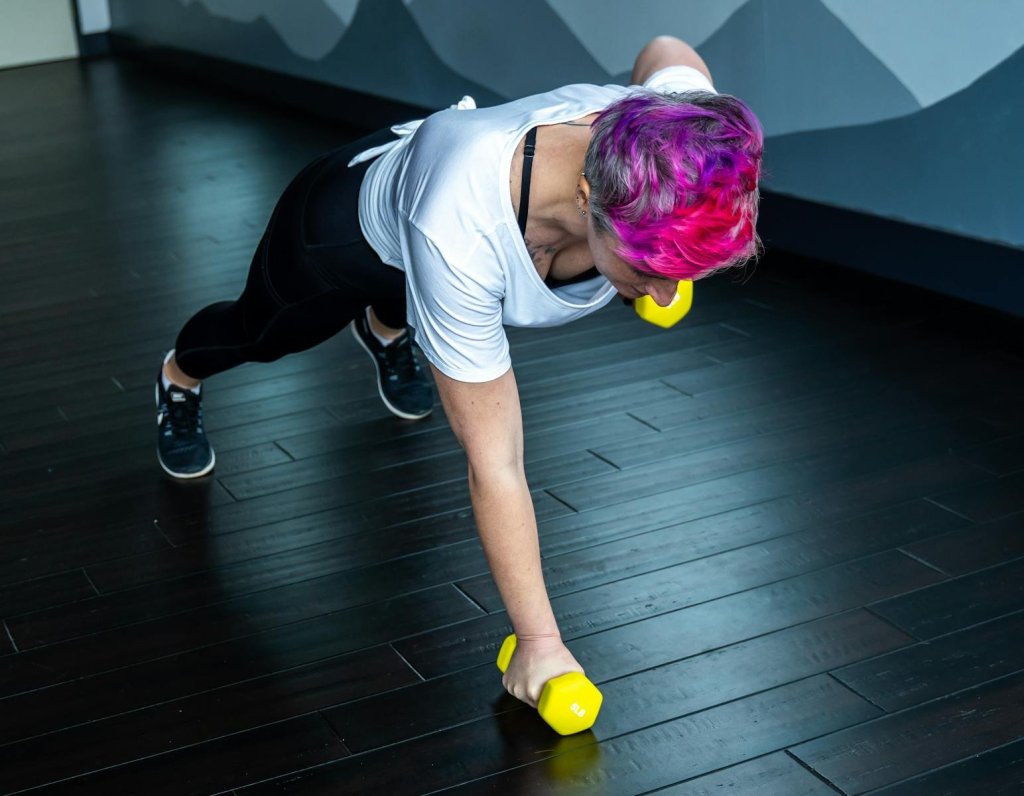
Understanding which dumbbell back exercises to do at home matters because many people want effective training without a bench, cable machine, or pull-up bar. The good news is that a simple home setup can still cover major back-training needs: horizontal pulling for the upper back, lat-focused work, rear-delt support, and hip-hinge strength for the posterior chain.
Why dumbbell back exercises at home can work
Home dumbbell training can be effective because strength gains come from challenging muscles with enough resistance, practicing good technique, and progressing over time. The CDC says adults need muscle-strengthening activity at least 2 days per week, and Mayo Clinic recommends training all major muscle groups at least twice weekly while avoiding the same muscle group on back-to-back days.
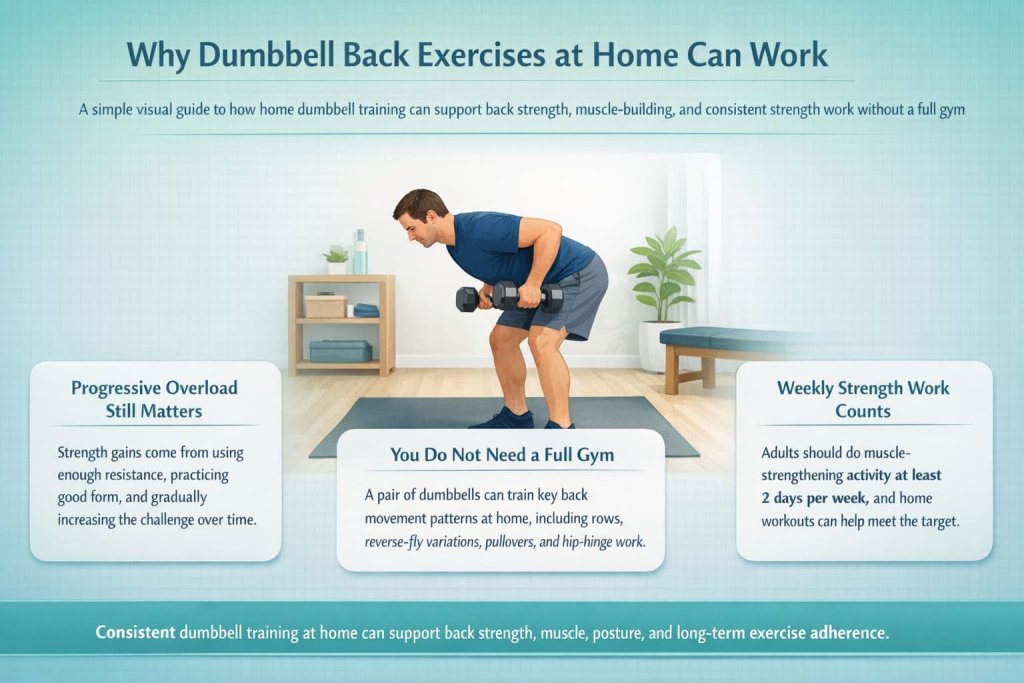
That is why dumbbell back exercises at home can be a practical choice. You do not need a full gym to train your back well. The NHS specifically notes that strength exercises can be done at home to improve health and mobility, which fits this topic perfectly.
Before you start dumbbell back exercises at home
Start with a weight you can control. Mayo Clinic advises choosing a resistance level that tires your muscles with good form, often around 12 to 15 reps for general fitness, rather than jumping straight to the heaviest dumbbells you own. The National Institute on Aging also recommends warming up, breathing normally during strength work, and paying attention to form and joint position.
Use these quick rules before your first set:
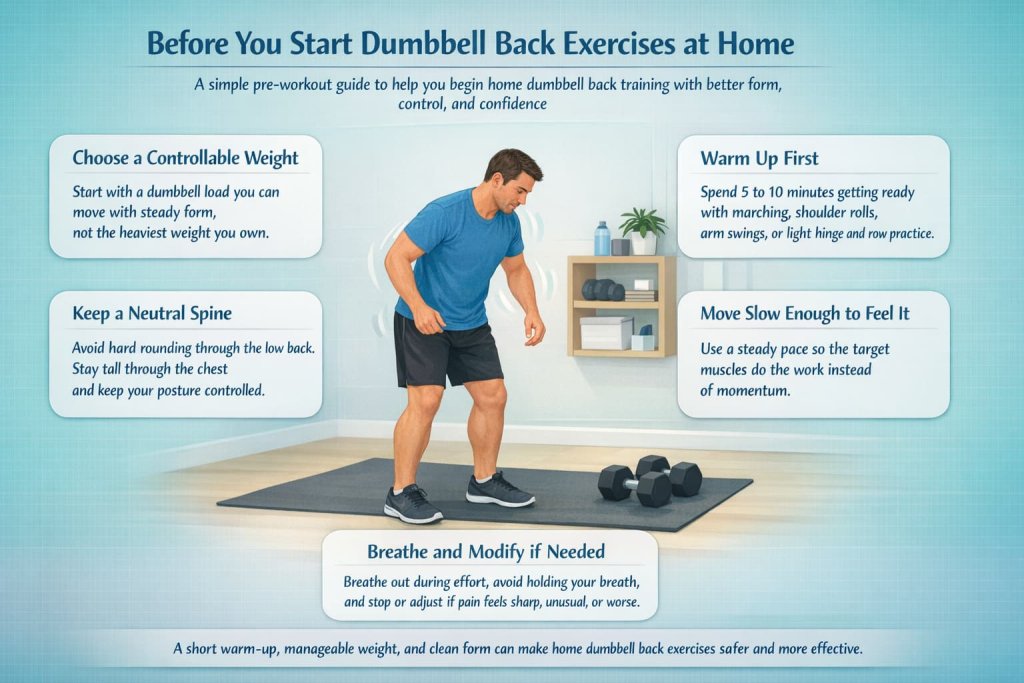
- Warm up for 5 to 10 minutes with marching, arm swings, shoulder rolls, or light hinge and row practice
- Keep your spine neutral instead of rounding hard through the low back
- Move slowly enough that you can feel the target muscles working
- Breathe out during the effort and avoid holding your breath
- Stop and modify if you feel sharp, unusual, or worsening pain
10 best dumbbell back exercises at home
Build a stronger back at home with these 10 effective dumbbell exercises for muscle, posture, and pulling strength.
This list includes beginner-friendly moves that target the lats, upper back, rear delts, and back-supporting muscles with minimal equipment.
1. Dumbbell Bent-Over Row
Why it works: This is one of the most practical dumbbell back exercises at home because it trains the upper back with minimal equipment. Mayo Clinic includes the bent-over dumbbell row as a basic strength-training movement and emphasizes a stable hinge position and controlled pulling path.
Muscles worked: Upper back, rear delts, lats, biceps, and core stabilizers.
How to do it:
- Stand with feet about hip-width apart holding a dumbbell in each hand
- Hinge at the hips and bend your knees slightly
- Keep your back flat and chest angled toward the floor
- Let the dumbbells hang below your shoulders
- Pull your elbows back toward your torso
- Pause briefly at the top
- Lower the dumbbells slowly with control
- Repeat for reps
Trainer Tip: Keep the movement smooth and avoid jerking the weights up. If you feel more low-back strain than back-muscle work, lighten the load and shorten the range slightly.
2. Single-Arm Dumbbell Row
Why it works: The single-arm row helps you train one side at a time, which can make it easier to focus on position, range of motion, and side-to-side balance. ACE lists the single-arm row as a back exercise and uses a supported setup, but at home you can brace one hand on a sturdy chair, couch, or your front thigh.
Muscles worked: Lats, rhomboids, middle traps, rear delts, and biceps.
How to do it:
- Place one hand on a sturdy support or on your front thigh
- Hold one dumbbell in the other hand
- Hinge forward with a flat back
- Let the working arm hang straight down
- Pull the elbow toward your hip
- Pause at the top without twisting your torso
- Lower slowly
- Finish all reps, then switch sides
Trainer Tip: Think about pulling with your elbow, not shrugging your shoulder up.
3. Supported Two-Point Dumbbell Row
Why it works: This is a smart at-home substitute when you want more support than a full bent-over row but do not have a bench. Bracing one hand against a wall, chair, or couch can reduce how much your lower back has to stabilize, which helps many beginners feel the target muscles better. This adaptation follows the same basic row principles used in supported row setups from ACE.
Muscles worked: Lats, rhomboids, mid-back, rear delts, and biceps.
How to do it:
- Stand in a split stance next to a sturdy support
- Place your non-working hand on the support
- Hinge forward with a neutral spine
- Hold the dumbbell in your free hand
- Row the weight toward your lower ribs or hip
- Keep your shoulders square
- Lower with control
- Repeat, then switch sides
Trainer Tip: This is often easier to control than an unsupported row, so it is a great beginner option.
4. Dumbbell Reverse Fly
Why it works: Reverse flies train the upper back and rear shoulders, which many home programs miss. Mayo Clinic specifically cues a controlled raise without swinging the weights.
Muscles worked: Rear delts, rhomboids, and upper back.
How to do it:
- Hold a dumbbell in each hand
- Hinge forward or sit and lean forward with a flat back
- Let your arms hang down with a soft bend in the elbows
- Raise the weights out to the sides
- Stop around shoulder level
- Lower slowly to the start
- Repeat for reps
Trainer Tip: Use lighter weights than you think you need. Reverse flies usually work best with strict form, not momentum.
5. Dumbbell Pullover
Why it works: The dumbbell pullover adds a different angle than rows and can help train the lats through shoulder movement. ACE includes lying pullovers in its exercise library and shows the overhead arc pattern that makes this move distinct from a row. At home, many people do it lying on the floor instead of a bench.
Muscles worked: Lats, chest, shoulders, and core support.
How to do it:
- Lie on your back with knees bent and feet on the floor
- Hold one dumbbell with both hands above your chest
- Keep a slight bend in your elbows
- Lower the weight slowly back overhead as far as you can control
- Pull it back over your chest
- Repeat for reps
Trainer Tip: Keep your ribs from flaring too much. Only lower the weight through a range you can control comfortably.
6. Renegade Row
Why it works: The renegade row combines back training with anti-rotation core work. ACE emphasizes holding a strong plank while rowing one dumbbell at a time and resisting trunk rotation.
Muscles worked: Upper back, lats, rear shoulders, arms, and core.
How to do it:
- Place two dumbbells on the floor and grip them in a high-plank position
- Set your feet wider than hip-width for balance
- Brace your core and squeeze your glutes
- Row one dumbbell toward your ribcage
- Lower it with control
- Repeat on the other side
- Continue alternating reps
Trainer Tip: Keep your hips as still as possible. If your body twists a lot, widen your feet more or switch to a simpler row variation.
7. Dumbbell Romanian Deadlift
Why it works: While not a classic upper-back row, the dumbbell Romanian deadlift strengthens the posterior chain, including the muscles that support your back position. It is useful in a complete at-home back routine because stronger hip-hinge mechanics improve many other back exercises too. General strength-training guidance from Mayo Clinic supports including major muscle-group patterns in a routine, not just isolated upper-back work.
Muscles worked: Hamstrings, glutes, spinal erectors, upper-back stabilizers, and grip.
How to do it:
- Stand tall holding dumbbells in front of your thighs
- Soften your knees slightly
- Push your hips back as the weights slide down your legs
- Keep your spine neutral and shoulders set
- Lower until you feel a hamstring stretch while staying controlled
- Drive through your feet and return to standing
- Repeat for reps
Trainer Tip: This is a hinge, not a squat. Think hips back rather than knees far forward.
8. Dumbbell Dead-Stop Row
Why it works: Starting each rep from the floor or from a low support removes some momentum and can make every pull more honest. This makes it a useful home variation when you want to focus on clean effort and stronger upper-back contraction.
Muscles worked: Lats, rhomboids, mid-back, rear delts, and biceps.
How to do it:
- Set two dumbbells on the floor between your feet
- Hinge down into a strong bent-over position
- Grip the dumbbells and brace your core
- Pull the weights up toward your lower ribs
- Lower them fully back to the floor
- Reset your position briefly
- Start the next rep from a dead stop
- Repeat for reps
Trainer Tip: Reset your posture between reps if needed. This version works best when every rep starts from a stable position.
9. Bird-Dog Dumbbell Row
Why it works: This is a smart at-home back exercise because it combines rowing with anti-rotation core control. It can help train the lats, upper back, and postural muscles while reducing the chance of using too much momentum.
Muscles worked: Lats, rhomboids, mid-back, rear delts, core, and postural stabilizers.
How to do it:
- Start on all fours with one dumbbell placed beside one hand
- Brace your core and keep your spine neutral
- Grip the dumbbell with one hand
- Extend the opposite leg straight back
- Row the dumbbell toward your lower ribs without twisting your torso
- Pause briefly at the top
- Lower the dumbbell slowly with control
- Complete all reps, then switch sides
Trainer Tip: Move slowly and keep your hips level. If balancing on three points feels too difficult, keep both knees on the floor and do the row first.
10. Suitcase Row Hold or Isometric Bent-Over Hold
Why it works: Isometric holds can make lighter home dumbbells more challenging. They also teach back tension, grip strength, and posture control. This is helpful when your available weights are limited and you need a simple overload tool. The CDC notes that gradually increasing resistance or reps helps build or maintain muscle strength.
Muscles worked: Upper back, lats, grip, core, and postural stabilizers.
How to do it:
- Hinge into a bent-over row position
- Row the dumbbells halfway or fully up
- Hold the position with your back tight
- Keep your core braced and shoulders set
- Maintain the hold for the planned time
- Lower under control
- Rest and repeat
Trainer Tip: This is a great option when your dumbbells feel too light for normal rows.
How to structure dumbbell back exercises at home
A simple at-home back workout does not need to be complicated. For general strength and muscle, 2 to 4 exercises per session is enough for many people. Mayo Clinic says one set can support health, while multiple sets are commonly used for strength and muscle goals. A practical starting point is 2 to 4 sets of about 8 to 15 reps for most movements, using a load you can control with good form.
Here is a simple example:
Beginner at-home dumbbell back workout
- Dumbbell Bent-Over Row: 2 to 3 sets of 8 to 12 reps
- Single-Arm Dumbbell Row: 2 to 3 sets of 8 to 12 reps each side
- Dumbbell Reverse Fly: 2 sets of 10 to 15 reps
- Dumbbell Romanian Deadlift: 2 to 3 sets of 8 to 12 reps
Intermediate at-home dumbbell back workout
- Dumbbell Bent-Over Row: 3 to 4 sets of 8 to 12 reps
- Renegade Row: 2 to 3 sets of 6 to 10 reps each side
- Dumbbell Pullover: 2 to 3 sets of 10 to 15 reps
- Dead-Stop Row: 2 to 3 sets of 8 to 10 reps
How to progress when your home dumbbells are limited
Limited equipment does not mean limited results. You can make dumbbell back exercises at home harder by increasing reps, slowing the lowering phase, pausing at the top, reducing rest a little, or adding an isometric hold. The CDC specifically notes that gradually increasing weight or repetitions supports muscle strength.
Good progression options include:
- Add 1 to 2 reps per set before increasing load
- Slow the lowering phase to 3 to 4 seconds
- Pause for 1 to 2 seconds at peak contraction
- Add one extra set
- Use one-arm versions to increase the challenge per side
Common mistakes during dumbbell back exercises at home
The biggest mistakes are usually technical, not motivational. People often use too much weight, shrug instead of row, round their back hard, or rush through reps. Mayo Clinic consistently emphasizes controlled movement and position in its exercise demos, which is especially important when training at home without a coach nearby.
Watch for these problems:
- Swinging the dumbbells instead of pulling under control
- Letting the shoulders roll forward too much
- Twisting hard during one-arm rows
- Using weights that force sloppy reps
- Holding your breath during effort
Who should be careful with dumbbell back exercises at home
Most healthy adults can include dumbbell back work in a regular strength routine, but some people should modify or get guidance first. Mayo Clinic notes that people with health problems should talk with a healthcare professional before starting strength training, and the National Institute on Aging recommends getting guidance if you are unsure about a movement.
Use extra caution if you have:
- Recent shoulder, neck, or back injury
- Pain that gets sharper during pulling or hinging
- Major balance problems
- Trouble maintaining a neutral spine even with light weights
Frequently asked questions
Are dumbbell back exercises at home enough to build muscle?
Yes, they can be enough for many people, especially beginners and intermediates, as long as the exercises are challenging enough and you progress over time. Muscle-strengthening guidance from the CDC and Mayo Clinic supports consistent resistance training as part of an effective routine.
How often should I train my back at home with dumbbells?
A practical target is 2 times per week for most people. That lines up with broader guidance to train major muscle groups at least twice weekly and avoid training the exact same muscle group on back-to-back days, as explained by Mayo Clinic.
What is the best dumbbell back exercise at home for beginners?
The bent-over row and the supported single-arm row are usually the best starting points because they are simple, effective, and easy to scale. Mayo Clinic and ACE both include these row patterns in beginner-friendly exercise guidance.
Can I train my lats at home with dumbbells only?
Yes. Single-arm rows, supported rows, pullovers, and some bent-over row styles can all help train the lats at home. Pullovers are especially useful because they give you a different shoulder movement pattern than standard rows, as shown by ACE.
Are reverse flies a back exercise or a shoulder exercise?
They are partly both, but in practical programming they are usually used for the rear delts and upper back. Mayo Clinic specifically mentions the muscles across the upper back along with the shoulders.
What if my dumbbells are too light?
Use slower reps, longer pauses, higher reps, more sets, and one-arm versions. Those are simple ways to apply progressive overload when your equipment is limited. The CDC supports gradual increases in resistance or repetitions for strength gains.
Conclusion
Dumbbell back exercises at home can absolutely help you build strength and muscle when your routine includes smart row variations, upper-back support work, and steady progression. Start with the basics, keep your form clean, and build from there. For most people, a few well-chosen dumbbell movements done consistently will do more than a complicated plan that is hard to follow.