
A muscle up is an advanced bodyweight exercise that combines a powerful pull-up, a fast transition over the bar or rings, and a dip-style press to finish above the hands. The muscle up builds upper-body strength, pulling power, core control, and total-body coordination, but it should be trained gradually.

The key is not just “pull harder.” You need strict pull-up strength, dip strength, shoulder control, grip strength, and transition practice. CrossFit notes that there is no one-size-fits-all timeline, and progress can take months or even years depending on your starting point, strength, mobility, and technique.
What Is a Muscle Up?
A muscle up is a bodyweight skill where you move from hanging below a bar or rings to supporting yourself above them.
It has three main parts:
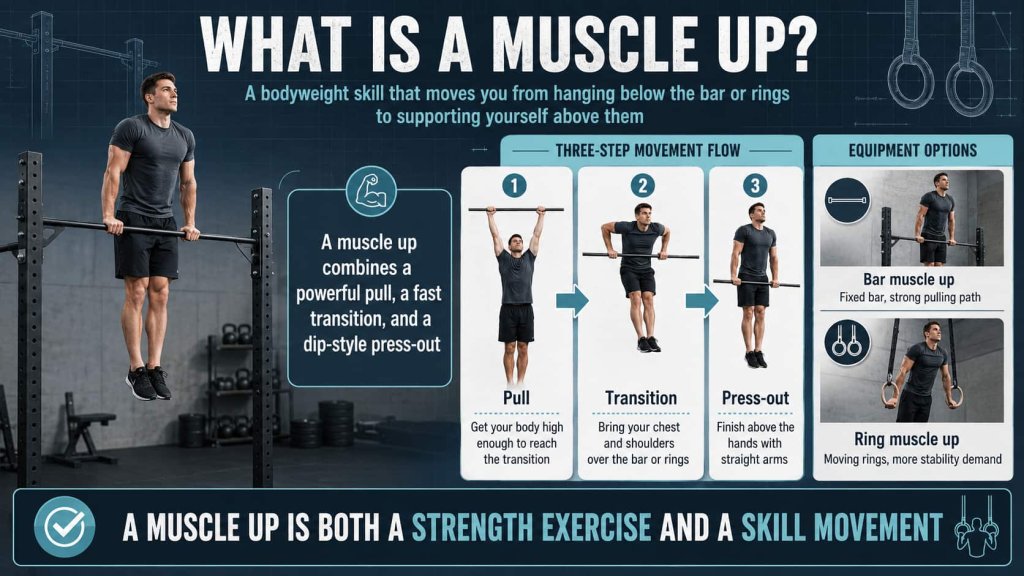
- Pull: You pull your body high enough to reach the transition.
- Transition: You bring your chest and shoulders over the bar or rings.
- Press-out: You finish by pressing into a dip position until your arms are straight.
Muscle ups are common in calisthenics, gymnastics-style training, obstacle-course training, and CrossFit. They can be done on a pull-up bar or gymnastics rings. Both versions require strength and skill, but they feel different because the bar is fixed while rings move independently.
How to Do a Muscle Up With Proper Form
The muscle up should look smooth, controlled, and powerful. The exact technique changes slightly depending on whether you use a bar or rings, but the basic pattern stays the same.
How to do it:
- Hang from a pull-up bar with your hands slightly wider than shoulder-width.
- Start in a strong active hang with shoulders engaged.
- Brace your core and keep your body tight.
- Pull your chest toward the bar, not just your chin.
- Aim to pull the bar low toward your lower chest or upper stomach.
- As you reach the top of the pull, lean your chest over the bar.
- Quickly turn your elbows from below the bar to behind you.
- Catch yourself in the bottom of a straight-bar dip.
- Press down into the bar until your arms are straight.
- Lower with control or step down safely.
Trainer Tip: Think “pull high, stay close, turn over fast.” If your chest stays far away from the bar, the transition becomes much harder.
How to Do a Ring Muscle Up
The ring muscle up uses the same pull-transition-press pattern, but the rings move freely. This makes shoulder control and ring stability more important.
How to do it:
- Set the rings high enough to hang freely or low enough for assisted practice.
- Use a false grip if you are training a strict ring muscle up.
- Start in an active hang with your core tight.
- Pull the rings toward your chest.
- Keep the rings close to your body.
- As you reach the top of the pull, bring your chest forward between the rings.
- Turn the rings close to your armpits and lean into the transition.
- Catch in a deep ring dip position with control.
- Press down until your arms are straight.
- Lower carefully and reset before the next rep.
Trainer Tip: Keep the rings close. Letting the rings drift wide usually makes the transition unstable and harder on the shoulders.
Muscle Up Muscles Worked
The muscle up trains almost the entire upper body. It is especially demanding because it combines a vertical pull and an upper-body press in one movement.
Primary muscles worked:
- Latissimus dorsi: Helps pull your body upward.
- Biceps and brachialis: Assist elbow bending during the pull.
- Upper back: Helps control the shoulder blades.
- Chest: Helps during the transition and dip.
- Triceps: Press the body up at the top.
- Shoulders: Help stabilize and press through the movement.
- Core: Keeps the body tight and controlled.
- Forearms and grip muscles: Help you hold the bar or rings securely.
The muscle up is not just an arm exercise. Your core, shoulder blades, grip, and timing all matter. This is why many people can do pull-ups and dips but still struggle with their first muscle up.
Benefits of Muscle Ups
Muscle ups are popular because they build strength, skill, and athletic control at the same time.
Key benefits include:
- Builds upper-body pulling strength
- Improves dip and pressing strength
- Trains explosive upper-body power
- Strengthens grip and forearms
- Builds core tension and body control
- Improves coordination between pulling and pressing
- Adds a challenging bodyweight skill goal
- Carries over to calisthenics, CrossFit, obstacle training, and gymnastics-style fitness
The American College of Sports Medicine emphasizes that bodyweight exercises can support strength, hypertrophy, and physical function when done consistently and safely.
Muscle Up Prerequisites
Before training full muscle ups, build a strong base. Rushing the movement can lead to sloppy reps, elbow irritation, shoulder discomfort, or stalled progress.
A good starting base includes:
| Skill or Strength Base | Practical Goal |
|---|---|
| Strict pull-ups | Several clean reps without kicking |
| Chest-to-bar pull strength | Ability to pull higher than a normal pull-up |
| Dips | Controlled bar dips or ring dips |
| Scapular control | Active hangs, scap pull-ups, and stable shoulders |
| Core control | Hollow holds, hanging knee raises, or controlled leg raises |
| Grip strength | Comfortable hanging from the bar or rings |
| Shoulder and wrist comfort | No sharp pain during pulling, dipping, or support holds |
CrossFit notes that 15 good pull-ups and 15 good dips have been used as a guideline for muscle-up readiness, but they are not absolute requirements because technique, flexibility, and individual differences matter.
Bar Muscle Up vs Ring Muscle Up
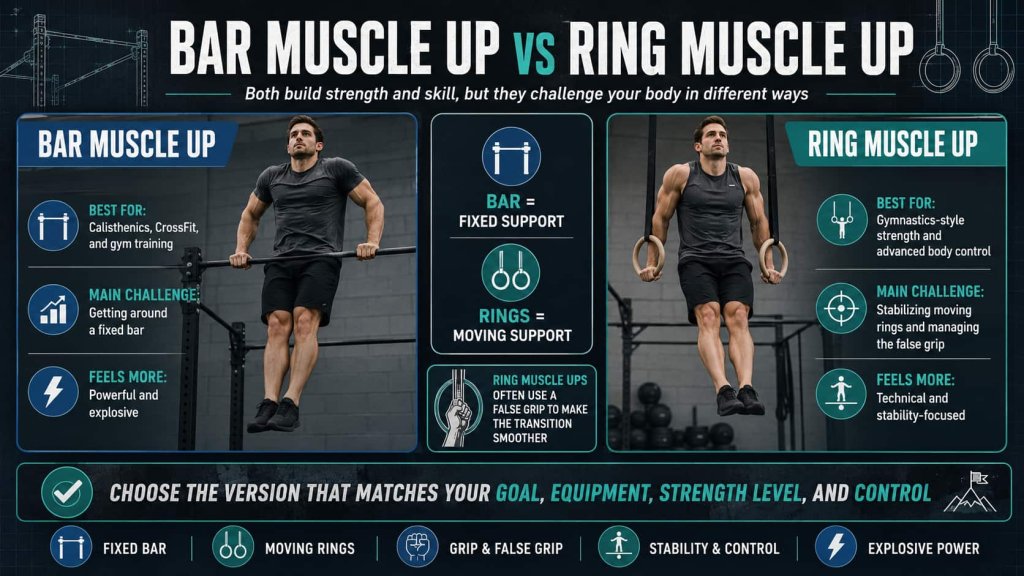
Both versions are effective, but they challenge the body in different ways.
| Type | Best For | Main Challenge |
|---|---|---|
| Bar muscle up | Calisthenics, CrossFit, gym training | Getting around a fixed bar |
| Ring muscle up | Gymnastics-style strength, advanced body control | Stabilizing moving rings and managing the false grip |
A bar muscle up often feels more powerful and explosive. A ring muscle up usually demands more stability and more precise technique. Ring muscle ups also often use a false grip, which shortens the transition but can feel uncomfortable at first.
How to Warm Up for Muscle Ups
A muscle up is a high-demand movement, so do not jump into attempts cold. Warm up your shoulders, elbows, wrists, back, chest, and core first.
A simple warm-up can include:
- 3–5 minutes of light cardio
- Arm circles and shoulder circles
- Scapular pull-ups
- Dead hangs or active hangs
- Band face pulls
- Band straight-arm pulldowns
- Push-ups or light dips
- Hollow body holds
- Low-ring transition drills
The American Council on Exercise recommends a complete dynamic warm-up before high-intensity power exercises and notes that power work should use limited reps with enough rest to reduce fatigue-related risk.
Best Muscle Up Progressions
Most people should not start with full muscle-up attempts. Use progressions to build the exact strength and technique the movement requires.
1. Strict Pull-Up
Why it works: Strict pull-ups build the base pulling strength needed for the first half of the muscle up.
Muscles worked: Lats, biceps, upper back, forearms, and core.
How to do it:
- Hang from a bar with hands slightly wider than shoulder-width.
- Start with shoulders active, not relaxed.
- Brace your core and keep your legs still.
- Pull your chest toward the bar.
- Pause briefly near the top.
- Lower with control until your arms are straight.
- Repeat without swinging.
Trainer Tip: Do not rush to kipping or swinging if your strict pull-up is weak. A stronger strict pull-up makes the muscle-up transition much easier.
2. Chest-to-Bar Pull-Up
Why it works: A muscle up needs a higher pull than a regular pull-up. Chest-to-bar pull-ups train that extra height.
Muscles worked: Lats, upper back, biceps, rear delts, forearms, and core.
How to do it:
- Start in a controlled hang.
- Brace your core and pull hard.
- Aim to bring your chest toward the bar.
- Keep your elbows driving down and back.
- Lower under control.
- Reset before the next rep.
Trainer Tip: If you can only get your chin over the bar, keep building pulling height before attempting full muscle ups.
3. Straight-Bar Dip
Why it works: The straight-bar dip strengthens the top half of the bar muscle up.
Muscles worked: Chest, triceps, shoulders, and core.
How to do it:
- Start above a straight bar with arms locked out.
- Keep your hands close to your hips.
- Lower your chest toward the bar with control.
- Keep your elbows tracking back.
- Press down into the bar to return to the top.
- Keep your core tight throughout the rep.
Trainer Tip: A strong straight-bar dip helps you finish the muscle up after the transition.
4. Ring Dip
Why it works: Ring dips build the pressing strength and shoulder stability needed for ring muscle ups.
Muscles worked: Chest, triceps, shoulders, upper back stabilizers, and core.
How to do it:
- Support yourself above the rings with arms straight.
- Keep the rings close to your sides.
- Brace your core and avoid shrugging.
- Lower slowly into a dip.
- Press back up until your arms are straight.
- Keep the rings stable throughout the movement.
Trainer Tip: If the rings shake a lot, use band assistance or practice ring support holds first.
5. Low-Ring Muscle Up Transition
Why it works: This drill teaches the hardest part of the ring muscle up without requiring full bodyweight strength.
Muscles worked: Lats, biceps, chest, shoulders, triceps, forearms, and core.
How to do it:
- Set rings low enough that your feet can stay on the floor.
- Hold the rings with a false grip if possible.
- Lean back into a ring-row position.
- Pull the rings toward your chest.
- Use your legs lightly to assist.
- Roll your chest forward between the rings.
- Finish in the bottom of a ring dip.
- Press to the top with control.
Trainer Tip: Use your legs just enough to learn the pattern. Do not turn it into a squat jump.
6. Band-Assisted Muscle Up
Why it works: A band helps reduce bodyweight demand while you practice the full movement pattern.
Muscles worked: Lats, biceps, chest, shoulders, triceps, grip, and core.
How to do it:
- Attach a resistance band securely to the bar or rings.
- Place one foot or knee in the band.
- Start in a strong hang.
- Pull high and keep your body close.
- Use the band to help you through the transition.
- Press out at the top.
- Lower carefully and reset.
Trainer Tip: Use the lightest band that still lets you move with clean form.
7. Jumping Muscle Up
Why it works: Jumping muscle ups help you practice the transition while reducing the strength demand.
Muscles worked: Lats, biceps, chest, shoulders, triceps, legs, and core.
How to do it:
- Stand under a low bar or low rings.
- Keep your feet on the floor.
- Use a small jump to help your pull.
- Pull yourself close to the bar or rings.
- Turn over into the dip position.
- Press to the top.
- Step down and repeat with control.
Trainer Tip: Use this as a skill drill, not a max-effort jumping exercise.
Muscle Up Progression Plan
Here is a simple progression path for building toward your first muscle up.
| Level | Main Focus | Best Exercises |
|---|---|---|
| Beginner | Build basic pulling and pressing | Assisted pull-ups, push-ups, ring rows, bench dips |
| Early intermediate | Build strict strength | Strict pull-ups, bar dips, ring support holds |
| Intermediate | Build higher pulling power | Chest-to-bar pull-ups, explosive pull-ups, straight-bar dips |
| Skill phase | Learn the transition | Low-ring transitions, band-assisted muscle ups, jumping muscle ups |
| Advanced | Perform clean reps | Strict muscle ups, slow negatives, controlled singles |
CrossFit recommends short, focused skill sessions and notes that transition drills can be practiced even while strength is still developing.
Common Muscle Up Mistakes
Muscle ups are technical. Small mistakes can make the movement feel impossible.
| Mistake | Why It Happens | How to Fix It |
|---|---|---|
| Pulling only to chin height | Not enough pulling height | Train chest-to-bar pull-ups |
| Staying too far from the bar | Poor body path | Pull the bar toward the lower chest |
| Slow transition | Lack of technique | Practice low-ring or low-bar transitions |
| Elbows flare wide | Poor control or weak transition | Keep elbows closer as you turn over |
| Overusing momentum | Not enough strict strength | Build pull-ups, dips, and hollow control |
| Skipping dip strength | Weak lockout | Train straight-bar dips or ring dips |
| Training too many failed attempts | Fatigue and poor reps | Use low-rep skill practice with rest |
| Ignoring shoulder discomfort | Poor recovery or poor mechanics | Modify, reduce volume, or get guidance |
How Many Sets and Reps Should You Do?
Muscle-up training should focus on quality, not exhaustion. Because the movement requires power and coordination, tired reps often get sloppy fast.
For strength work:
| Exercise | Sets | Reps |
|---|---|---|
| Strict pull-ups | 3–5 | 3–6 |
| Chest-to-bar pull-ups | 3–5 | 2–5 |
| Straight-bar dips | 3–4 | 5–8 |
| Ring dips | 3–4 | 3–8 |
| Low-ring transitions | 2–4 | 3–6 |
| Band-assisted muscle ups | 3–5 | 1–3 |
For full muscle-up attempts, start with low volume:
- 3–6 total quality attempts
- 1–3 reps per set
- 2–3 minutes of rest between hard sets
- Stop before your form breaks down
ACE notes that power-focused exercises are best performed with limited reps, often six or fewer, because too much fatigue can increase injury risk.
How Often Should You Train Muscle Ups?
Most people do well with 2–3 muscle-up-focused sessions per week.
A practical weekly setup could look like this:
| Day | Focus |
|---|---|
| Day 1 | Pulling strength and transition drills |
| Day 2 | Dip strength and ring or bar support work |
| Day 3 | Light skill practice and low-volume attempts |
You do not need to max out every session. A better plan is to practice often enough to improve skill while leaving enough recovery for your shoulders, elbows, wrists, and grip.
The CDC recommends adults perform muscle-strengthening activities at least 2 days per week that work all major muscle groups, so muscle-up training should fit into a complete strength plan rather than replace all other training.
Where Muscle Ups Fit in a Workout
Do muscle ups early in your workout when you are fresh. They require coordination, grip strength, and fast pulling power, so they are not ideal after heavy fatigue.
Best placement:
- After your warm-up
- Before heavy upper-body strength work
- Before conditioning circuits
- Before high-rep pull-ups or dips
Simple workout example:
- Dynamic warm-up
- Scapular pull-ups
- Muscle-up transition drills
- Chest-to-bar pull-ups
- Straight-bar dips
- Rows or lat pulldowns
- Core work
Muscle Up Safety Tips
A muscle up is advanced, so treat it like a skill and strength exercise, not just a challenge.
Use these safety tips:
- Warm up your shoulders, elbows, wrists, and back.
- Build strict pull-ups and dips first.
- Do not force painful reps.
- Keep full attempts low in volume.
- Rest enough between hard attempts.
- Avoid training muscle ups to failure.
- Use bands, low rings, or jumping progressions when needed.
- Stop if you feel sharp shoulder, elbow, wrist, or back pain.
- Work with a qualified coach if you are unsure about your technique.
If you have a current injury, recent surgery, significant shoulder instability, or pain during hanging and dipping, use easier alternatives and consider guidance from a qualified fitness or healthcare professional.
Who Should Avoid Muscle Ups or Modify Them?
You may need to avoid or modify muscle ups if you have:
- Shoulder pain during overhead movement
- Elbow pain during pull-ups or dips
- Wrist pain with false grip or bar support
- Poor grip strength or inability to hang safely
- Recent upper-body injury
- Recent surgery
- Poor control during pull-ups or dips
Better alternatives include:
- Ring rows
- Assisted pull-ups
- Lat pulldowns
- Push-ups
- Bench dips
- Straight-bar support holds
- Low-ring transition drills
- Controlled pull-up negatives
Muscle Up Alternatives
If you are not ready for muscle ups, you can still build similar strength patterns.
| Goal | Alternative |
|---|---|
| Pulling strength | Pull-ups, assisted pull-ups, lat pulldowns |
| Pulling height | Chest-to-bar pull-ups, explosive pull-ups |
| Transition practice | Low-ring transitions, jumping muscle ups |
| Dip strength | Straight-bar dips, ring dips, assisted dips |
| Core control | Hollow holds, hanging knee raises |
| Grip strength | Dead hangs, towel hangs, farmer’s carries |
These exercises help you build the pieces of the muscle up without forcing full reps too soon.
FAQs About Muscle Ups
Are muscle ups hard?
Yes, muscle ups are hard because they require pulling strength, pressing strength, grip, core control, and transition skill. Many people need weeks or months of focused training before getting their first clean rep.
How many pull-ups should I do before trying a muscle up?
There is no perfect number, but you should be able to do several strict pull-ups with control. CrossFit notes that 15 good pull-ups and 15 good dips can be a useful guideline, but not an absolute rule.
Is a bar muscle up or ring muscle up easier?
It depends on the person. Bar muscle ups use a fixed bar but require you to move around it. Ring muscle ups allow the hands to move but require more stability and often use a false grip.
Can beginners train for muscle ups?
Yes, beginners can train toward muscle ups, but they should start with basics like ring rows, assisted pull-ups, push-ups, dips, hollow holds, and transition drills. Full muscle-up attempts should come later.
Do muscle ups build muscle?
Muscle ups can help build upper-body strength and muscle when programmed well, but they are not the best beginner hypertrophy exercise. Pull-ups, rows, dips, push-ups, and presses are usually better for building the strength base first.
Why can I do pull-ups but not muscle ups?
A muscle up requires more than a pull-up. You need to pull higher, stay close to the bar or rings, transition quickly, and press out of the dip. The transition is often the missing piece.
Should I kip my muscle up?
Kipping can help with momentum, but it should not replace strength. Learn strict pulling strength, shoulder control, and safe mechanics first. If you train kipping muscle ups, use proper coaching and keep reps controlled.
Conclusion
The muscle up is one of the most impressive bodyweight skills because it combines strength, power, timing, and control. To master it, build strict pull-ups, dips, grip strength, core tension, and transition technique before chasing full reps.
Start with clean progressions, keep your practice low-volume and high-quality, and give your body time to adapt. A strong muscle up is not rushed. It is built one controlled rep, drill, and workout at a time.
References
- American Council on Exercise: Explosive Upper-Body Exercises
- American College of Sports Medicine: Resistance Training Guidelines Update
- CDC: Adult Physical Activity Guidelines
- National Academy of Sports Medicine: Pull-Up Exercise Guide
- American Council on Exercise: Pull-Up Exercise Library
- American Council on Exercise: Triceps Dip Exercise Library