
Three large eggs have about 225 calories. That is the most practical everyday answer for plain eggs before you add butter, oil, cheese, toast, or other sides. According to the USDA, one large egg has about 75 calories, so 3 large eggs come to about 225 calories.

That matters because eggs are more than a calorie source. They also provide high-quality protein and several important nutrients, which is why many people use them in breakfast, weight-management meals, and higher-protein eating plans. The main thing to watch is how you cook them and what you serve with them, because that can change the total fast.
Calories in eggs can vary a little depending on the exact size and the nutrition database used. In everyday use, the most reliable takeaway is that 3 large eggs are usually around 210 to 225 calories, with the standard quick estimate landing near 216 to 225 calories total.
How Many Calories Are in 3 Eggs by Size?
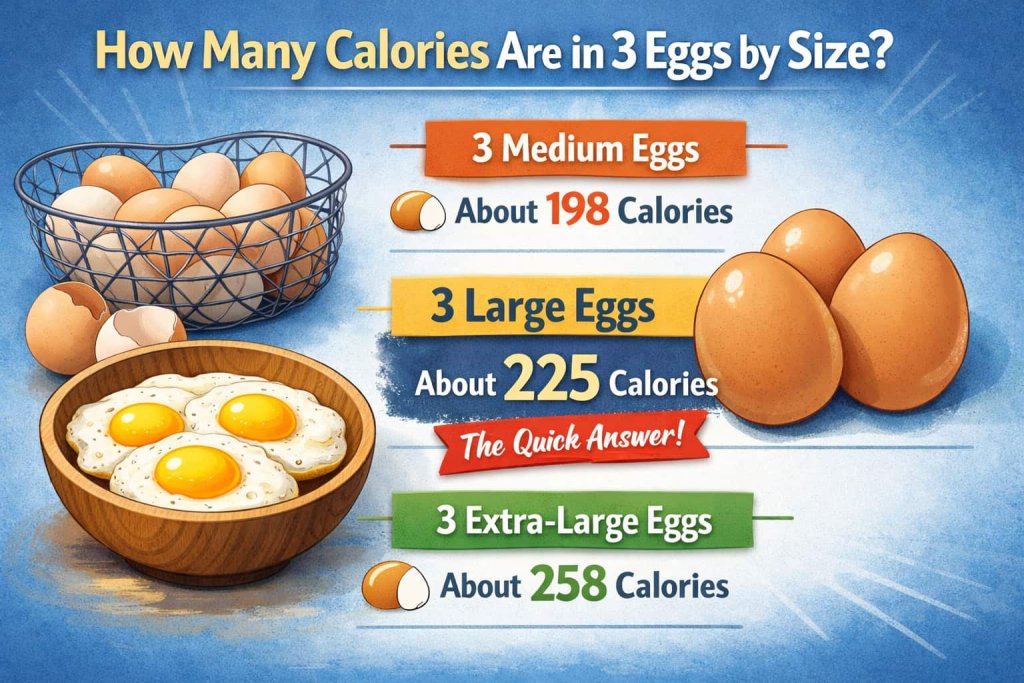
Egg calories depend on egg size. Using USDA reference values:
- 3 medium eggs: about 198 calories
- 3 large eggs: about 225 calories
- 3 extra-large eggs: about 258 calories
For most readers, 3 large eggs = about 225 calories is the best quick answer.
Nutrition Profile of 3 Eggs
Based on the same USDA reference for one large egg, 3 large eggs provide about:
| Nutrient | Amount in 3 large eggs |
|---|---|
| Calories | 225 |
| Protein | 18 g |
| Total fat | 15 g |
| Saturated fat | 4.8 g |
| Monounsaturated fat | 5.7 g |
| Polyunsaturated fat | 2.1 g |
This is one reason eggs are often seen as a filling food. You get a meaningful amount of protein for a moderate calorie cost.
It is also worth noting that 3 large eggs provide a substantial amount of dietary cholesterol. Since one large egg commonly contains about 186 to 200 mg of cholesterol, 3 eggs can provide roughly 558 to 600 mg total. That does not automatically make them unhealthy, but it does make overall diet quality especially important for people managing LDL cholesterol or cardiovascular risk.
Are 3 Eggs Good for Weight Management?
They can be. Three eggs give you about 18 grams of protein, which can help make a meal more satisfying. That can be useful when you are trying to control hunger and build a more filling breakfast or lunch. From a calorie standpoint, 225 calories for 3 plain large eggs is not especially high, but the total meal still matters. A plate of eggs with vegetables is very different from eggs cooked in a lot of butter and served with sausage, cheese, and white toast.
A practical way to make 3 eggs work for weight management is to pair them with foods that add volume and fiber without adding too many calories, such as vegetables, fruit, or beans. Keep added fats moderate, since butter, cream, and cheese can raise the calorie total quickly. The American Heart Association recommends keeping saturated fat low in a heart-healthy eating pattern.
Best Way to Eat 3 Eggs for Weight Management
If your goal is a filling, calorie-aware meal, the best approach is to keep the eggs simple and build the plate carefully. A good example is 3 eggs with vegetables or fruit, rather than 3 eggs cooked in a lot of butter and served with processed meats.
A practical weight-management plate could look like this:
- 3 eggs cooked with minimal oil
- a side of spinach, tomatoes, mushrooms, or other vegetables
- fruit or a high-fiber carb if you want the meal to be more balanced
- water, coffee, or tea instead of a sugary drink
This keeps the protein benefit of eggs while helping control the calories around them.
Key Nutrients in 3 Eggs
Eggs are valuable because they provide more than just protein.
Protein
Three large eggs provide about 18 grams of protein, which supports muscle maintenance and can make meals more filling.
Choline
According to the NIH Office of Dietary Supplements, eggs are rich sources of choline. Choline is important for normal cell function, liver function, and brain and nervous system health. This is one of the standout nutrients in eggs.
Vitamin B12
The NIH Office of Dietary Supplements notes that vitamin B12 is found in foods of animal origin, including eggs. Its food table lists one large cooked egg at 0.5 mcg, so 3 eggs provide about 1.5 mcg, or roughly 63% of the adult daily value of 2.4 mcg. Vitamin B12 helps support red blood cells and nerve function.
Vitamin D and Selenium
The USDA nutrition guide lists egg yolk among food sources of vitamin D. Eggs also contribute selenium, a mineral involved in antioxidant defense and thyroid-related functions.
Does Cooking Method Change the Calories?
The eggs themselves stay in the same general calorie range, but cooking method can still change the final number because of added ingredients. Hard-boiled and poached eggs usually stay close to the plain baseline. Fried or scrambled eggs often end up higher if you add oil, butter, cream, or cheese.
For a practical everyday estimate, here is how 3 eggs usually compare before major add-ins:
- 3 hard-boiled eggs: usually close to the plain baseline
- 3 poached eggs: usually close to the plain baseline if no fat is added
- 3 scrambled eggs: often higher if cooked with butter, oil, or milk
- 3 fried eggs: often higher because the pan fat adds calories
In other words, the eggs themselves stay fairly similar, but the cooking fat is what usually changes the final total most.
For example, 3 large eggs start at about 225 calories, but adding 1 tablespoon of butter or oil can add roughly another 100 to 120 calories. That is why restaurant egg dishes often contain much more energy than the eggs alone.
Who Should Be a Little More Careful?
For many healthy adults, eggs can fit into a balanced diet. But some people should pay more attention to portion size and the overall meal.
People With High LDL Cholesterol or Heart-Risk Concerns
The American Heart Association says healthy people can include eggs in a heart-healthy eating pattern, but people with high LDL cholesterol should pay attention to both dietary cholesterol and saturated fat. Eggs should be considered in the context of the full dietary pattern, not in isolation.
People Whose Egg Meals Are High in Saturated Fat
Eggs are often eaten with bacon, sausage, butter, or cheese. That can make the meal less heart-friendly, even if the eggs themselves are nutrient-dense. Saturated fat becomes a bigger issue when it regularly pushes intake above heart-health recommendations.
People at Higher Risk From Foodborne Illness
The FDA advises cooking eggs until both the yolk and white are firm. This is especially important for children, older adults, pregnant women, and people with weakened immune systems.
Egg Safety Tips You Should Know
Egg safety is simple but important:
- Keep eggs refrigerated.
- Cook eggs until both the yolk and white are firm.
- Scrambled eggs should not be runny.
- Dishes containing eggs should be cooked to 160°F.
- For recipes that use raw or lightly cooked eggs, use pasteurized shell eggs or pasteurized egg products.
These steps help reduce the risk of foodborne illness without making egg meals complicated.
3 Eggs vs 2 Eggs: Is the Difference Big?
Yes, but it is still manageable for most diets. Using USDA values:
- 2 large eggs: about 150 calories
- 3 large eggs: about 225 calories
So adding one more large egg raises the total by about 75 calories and adds about 6 more grams of protein. That can be a smart tradeoff if you want a more satisfying meal.
Common Questions About Calories in 3 Eggs
Are 3 Eggs Too Many Calories for Breakfast?
Not necessarily. 225 calories for 3 plain large eggs can fit well into many breakfasts. The bigger issue is what else goes on the plate. Toast with butter, cheese, sausage, and sugary drinks can push the meal much higher.
Are 3 Eggs Enough Protein for a Meal?
For many people, yes. 18 grams of protein is a solid amount for breakfast or a light meal. Pairing eggs with yogurt, beans, or another protein source can raise that further if needed.
Are Egg Whites Lower in Calories?
Yes. Most of an egg’s calories and fat are in the yolk, while egg whites provide protein with fewer calories. That is why some people use a mix such as 1 whole egg plus extra whites.
The Bottom Line on How Many Calories in 3 Eggs
If you want the simple answer, 3 large eggs have about 225 calories. They also provide about 18 grams of protein plus important nutrients such as choline and vitamin B12. For most people, eggs can be part of a healthy meal pattern. Just keep an eye on cooking fats, rich add-ins, and overall heart-health balance.
A smart way to use eggs is to keep the preparation simple and build the rest of the meal around vegetables, fruit, or other nutrient-dense foods. That gives you the benefits of eggs without letting the calories climb more than you want.
Sources/References
- USDA — Nutritive Value of Foods
- FDA — What You Need to Know About Egg Safety
- NIH Office of Dietary Supplements — Choline Fact Sheet for Health Professionals
- NIH Office of Dietary Supplements — Vitamin B12 Fact Sheet for Health Professionals
- American Heart Association — Here’s the Latest on Dietary Cholesterol and How It Fits in With a Healthy Diet
- American Heart Association — Saturated Fats