
Ashwagandha may help some adult men with stress, sleep, and certain aspects of exercise performance, and there is limited but promising research on testosterone, sperm quality, and sexual well-being. The strongest evidence is still for stress and sleep, not for dramatic hormone or muscle changes. According to the NIH Office of Dietary Supplements and the National Center for Complementary and Integrative Health, the best way to understand ashwagandha is as a supplement that may support some health goals in the short term, not as a proven fix for every men’s health problem.
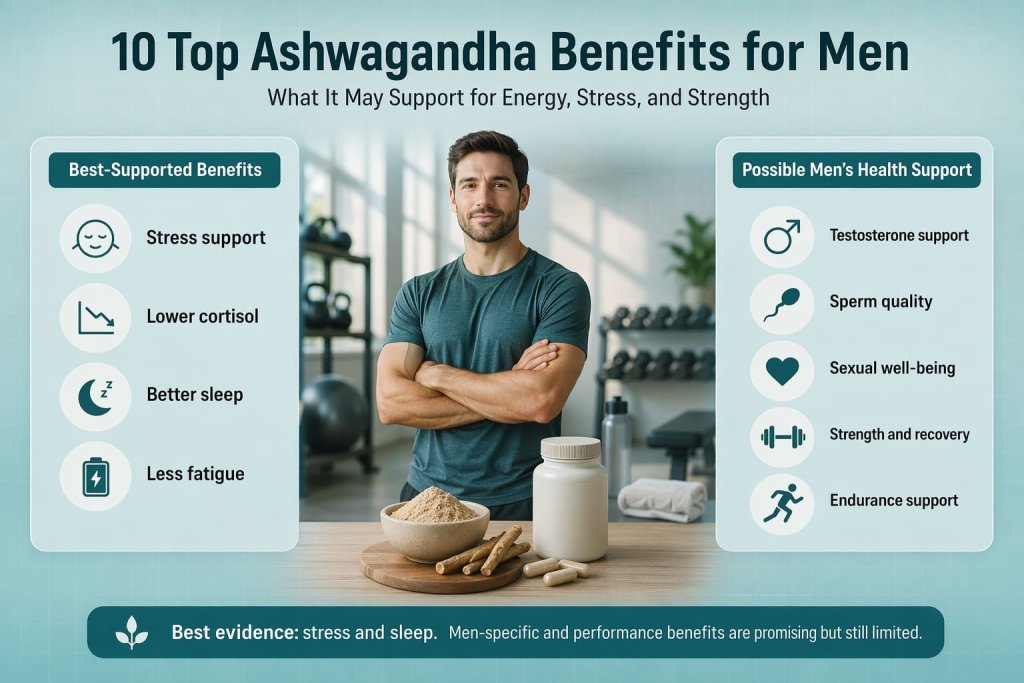
That distinction matters. A lot of online content makes ashwagandha sound like a shortcut for energy, testosterone, fertility, sleep, and gym performance all at once. The actual research is more nuanced. Some outcomes look encouraging, but many studies are still small, short, or use different extracts and doses, which makes sweeping claims unreliable.
What is ashwagandha, and why do men use it?
Ashwagandha, also called Withania somnifera, is an herb used in traditional Ayurvedic medicine and commonly marketed today for stress support, sleep, vitality, and exercise performance. Most commercial products use root extract, though some use both root and leaf, and different products are not interchangeable.
For men, interest usually centers on four big questions:
- Can it help with stress and sleep?
- Can it support energy or reduce fatigue?
- Can it help with testosterone, fertility, or sexual health?
- Can it improve strength, endurance, or recovery from training?
The evidence is not equally strong for all four. Stress and sleep have the best support. Testosterone, sperm quality, and sexual health are more limited. Fitness-related benefits look promising, but they are still not considered settled science.
What the studies actually used
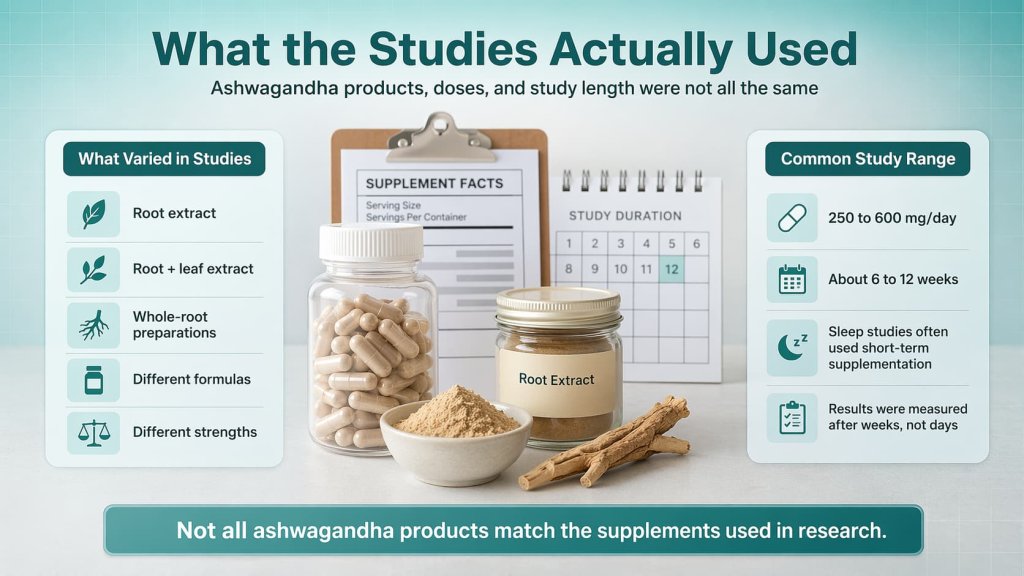
One practical detail is easy to miss: the research did not all use the same kind of ashwagandha. Clinical trials have used root extracts, root-and-leaf extracts, and in some cases whole-root preparations, with doses varying widely depending on the product. In sleep studies, common extract doses were often in the 250 to 600 mg per day range for about 6 to 12 weeks, while other trials used different formulas and strengths.
That matters because two products labeled “ashwagandha” may not match the same plant parts, extract strength, or withanolide content. A capsule you buy online is not automatically equivalent to the product used in a study. The safest takeaway is to avoid assuming that more is better, follow the product label carefully, and remember that benefits in studies were usually measured after several weeks, not after a few days.
Ashwagandha benefits for men at a glance
Here are the 10 benefits most often discussed in the research:
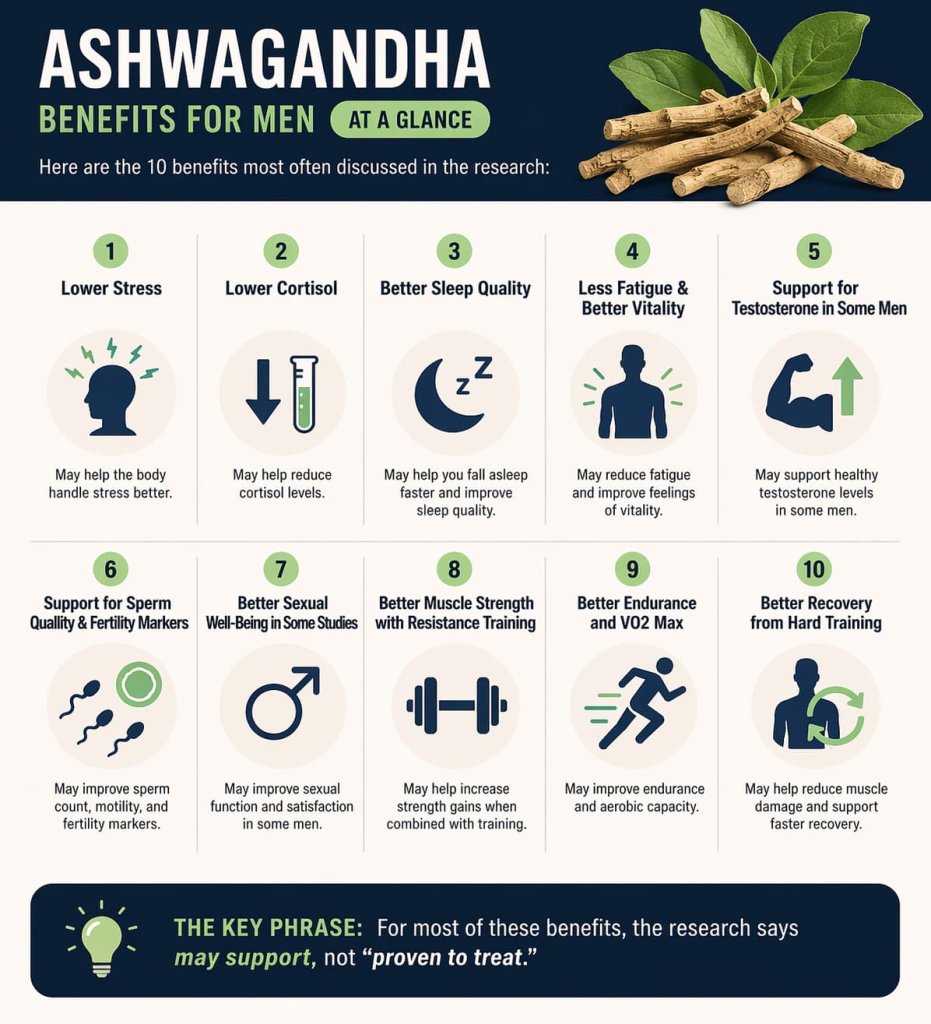
- Lower stress
- Lower cortisol
- Better sleep quality
- Less fatigue and better perceived vitality
- Support for testosterone in some men
- Support for sperm quality and fertility markers
- Better sexual well-being in some studies
- Better muscle strength with resistance training
- Better endurance and VO2 max
- Better recovery from hard training
The key phrase for most of these is may support, not “proven to treat.”
Best-supported ashwagandha benefits for men
1. Ashwagandha may help lower stress
This is the most convincing benefit. The NIH Office of Dietary Supplements says randomized trials suggest ashwagandha extracts may reduce perceived stress, anxiety-related symptoms, sleeplessness, and fatigue. A 2024 meta-analysis in the Journal of Affective Disorders Reports also found significant reductions in stress, anxiety, and cortisol compared with placebo across 9 studies involving 558 participants.
For men, this matters because chronic stress can spill into sleep, motivation, training consistency, mood, and sexual well-being. Ashwagandha is not a replacement for therapy, sleep habits, or stress management, but it is the area where the herb has the clearest short-term human evidence.
2. Ashwagandha may help lower cortisol
Cortisol is one of the body’s main stress hormones, and this is another reason ashwagandha gets attention in men’s health and fitness circles. Several trials found lower serum cortisol in people taking ashwagandha compared with placebo, and the 2024 meta-analysis found a significant reduction in cortisol overall.
That does not mean lower cortisol automatically leads to more testosterone, more muscle, or easier fat loss. It suggests that ashwagandha may help some people regulate stress physiology during short-term use.
3. Ashwagandha may improve sleep quality
Sleep is the second major area where the research is fairly encouraging. A PLOS One systematic review and meta-analysis found a small but significant improvement in overall sleep across 5 randomized trials with 400 adults. The effect looked stronger in people with insomnia and in studies using at least 8 weeks of treatment.
Better sleep can indirectly support a lot of things men care about, including energy, workout consistency, mood, and recovery. But it is still more accurate to say ashwagandha may help sleep than to say it fixes insomnia.
4. Ashwagandha may help with fatigue and perceived vitality
Some trials found reductions in fatigue along with lower stress and better sleep. A 2023 study also evaluated ashwagandha’s effects on stress, fatigue, and sex hormones in overweight or mildly obese adults with self-reported fatigue, adding to the idea that “feeling better” may be one of its more realistic benefits.
This is one reason ashwagandha gets marketed for energy, but that word can be misleading. It is not a stimulant like caffeine. It is better described as something that may improve perceived vitality in some people by helping with stress, sleep, and fatigue.
Men-specific ashwagandha benefits with limited but relevant evidence
5. Ashwagandha may support testosterone levels in some men
This is one of the most searched questions, and the answer needs care. The National Center for Complementary and Integrative Health says there is some limited evidence that taking ashwagandha for 2 to 4 months may increase testosterone levels. The NIH Office of Dietary Supplements also notes that ashwagandha use might increase testosterone in some contexts.
That still falls well short of saying ashwagandha reliably boosts testosterone in all men. The existing trials vary by age, baseline health, stress level, training status, and extract used. A small increase in a study does not mean every healthy man will notice a meaningful real-world effect.
6. Ashwagandha may support sperm quality and some fertility markers
This is another area where the evidence is promising but limited. NCCIH says there is some limited evidence that ashwagandha may improve sperm quality. Earlier clinical work in men with low sperm counts reported better sperm-related measures and higher testosterone and luteinizing hormone after treatment, and recent trials continue to explore semen-related outcomes.
This is useful, but it should not delay a proper infertility evaluation. Male fertility problems can be linked to hormonal issues, varicocele, medications, infection, genetics, heat exposure, smoking, alcohol, obesity, or other medical factors. A supplement is not a substitute for a urology or fertility workup.
7. Ashwagandha may improve some aspects of sexual well-being
Recent studies in healthy men have reported improvements in sexual desire, satisfaction, and some semen-related measures after several weeks of ashwagandha use. For example, a Frontiers in Reproductive Health study reported significant improvements across several sexual-function measures compared with placebo.
But this is exactly where overpromising becomes a problem. An older controlled study published in AYU found that ashwagandha was not effective for psychogenic erectile dysfunction compared with placebo. The honest takeaway is that ashwagandha may support some aspects of sexual well-being in certain men, but it is not proven as an erectile dysfunction treatment.
Training-related ashwagandha benefits for men
8. Ashwagandha may support muscle strength when paired with resistance training
This is one of the more interesting performance findings. A randomized controlled trial in the Journal of the International Society of Sports Nutrition reported that ashwagandha supplementation was associated with significant increases in muscle mass and strength during resistance training. A newer 2024 trial in active adults also found greater improvements in bench press, leg press, endurance, and muscle girth in the ashwagandha group than in placebo after 8 weeks of training.
That does not mean ashwagandha builds muscle on its own. The better way to frame it is that it may modestly improve training adaptations when paired with a structured resistance program.
9. Ashwagandha may support endurance and VO2 max
Endurance is another area with some encouraging data. A systematic review and meta-analysis in Nutrients found a significant improvement in VO2 max in healthy adults and athletes, and the 2024 training study also reported better endurance outcomes in the ashwagandha group.
Still, NCCIH says there is not enough evidence to determine whether ashwagandha is helpful for athletic performance overall. So this is best treated as a possible bonus, not a guaranteed performance enhancer.
10. Ashwagandha may support recovery from hard training
Recovery benefits are often discussed alongside strength gains. The 2015 resistance-training trial assessed muscle recovery using serum creatine kinase, a marker of muscle damage, and found more favorable changes in the ashwagandha group. A 2021 systematic review and Bayesian meta-analysis also concluded that ashwagandha outperformed placebo for physical performance variables in healthy adults.
In practical terms, this suggests ashwagandha may help some men handle training stress a bit better. But good recovery still depends much more on sleep, nutrition, training load, and enough rest between hard sessions.
What ashwagandha may not do
Ashwagandha is easier to understand when you are clear about its limits.
- It is not proven to treat erectile dysfunction.
- It is not guaranteed to raise testosterone in healthy men to a meaningful degree.
- It is not a replacement for fertility testing if you and your partner are trying to conceive.
- It is not a substitute for progressive training, enough protein, quality sleep, and stress management.
- It is not well studied for long-term daily use over many months or years.
Safety box: who should be careful before using ashwagandha
According to NCCIH, ashwagandha appears to be better studied for short-term use only, up to about 3 months. Common side effects include drowsiness, stomach upset, diarrhea, vomiting, nausea, and loose stools.
You should be especially cautious or avoid it if any of these apply:
- You have liver disease or a history of liver problems
- You have a thyroid disorder or take thyroid hormone medication
- You take medicines for diabetes, high blood pressure, seizures, or immune suppression, or you use sedatives
- You are scheduled for surgery
- You have an autoimmune condition
- You have hormone-sensitive prostate cancer
- You are pregnant or breastfeeding
A short-term side-effect list is helpful, but readers should also know the main warning signs that need prompt attention. Stop taking ashwagandha and seek medical care quickly if you develop yellowing of the skin or eyes, dark urine, itching, nausea, unusual fatigue, or upper abdominal discomfort. The NIH Office of Dietary Supplements and NIH LiverTox note that reported liver injury cases have often appeared within 2 to 12 weeks of starting the supplement. People with cirrhosis or advanced chronic liver disease should avoid ashwagandha altogether.
The liver warning deserves special attention. Both sources note rare but real cases of liver injury linked to ashwagandha supplements. Most reported cases improved after the product was stopped, but serious cases, including acute liver failure, have been described.
Product quality is another issue. The FDA explains in its dietary supplements guidance that dietary supplements are not approved before they are sold, and the agency advises consumers to talk with a healthcare professional and read labels carefully before using a supplement.
How to think about ashwagandha benefits for men realistically
The most practical takeaway is simple:
- Best-supported benefits: stress support and sleep support
- Promising but limited men-specific benefits: testosterone, sperm quality, sexual well-being
- Promising but still developing fitness benefits: strength, endurance, recovery
That is the most evidence-based way to frame ashwagandha benefits for men without overselling what the research can actually prove today.
How strong is the evidence overall?
The overall evidence is promising, but it is not equally strong across all claimed benefits. Stress and sleep have the best support so far. For testosterone, sperm quality, sexual well-being, and exercise performance, the research is more limited and often comes from small, short-term trials using different extracts and different study populations. That makes it harder to generalize the results to every healthy adult man.
The most realistic way to read the evidence is this: ashwagandha may offer modest short-term support in some situations, but it is not proven to create large, predictable changes in hormones, fertility, or athletic performance for everyone. That framing helps keep the article accurate and useful while still reflecting the encouraging parts of the research.
FAQ
Does ashwagandha increase testosterone in men?
It may in some men, but the evidence is still limited. NCCIH says there is some limited evidence suggesting that 2 to 4 months of ashwagandha may increase testosterone levels, but that is not the same as a guaranteed or clinically meaningful boost for every man.
Can ashwagandha help male fertility?
Possibly. Some studies and reviews suggest it may improve sperm-related measures in certain men, especially those with fertility problems, but it should not replace a full fertility evaluation.
Is ashwagandha good for building muscle?
It may help when combined with resistance training. Studies have reported better strength, muscle-size, and endurance outcomes than placebo in training programs, but it is not a substitute for good training and recovery habits.
Is it safe to take ashwagandha every day?
Short-term use appears better studied than long-term use. NCCIH says ashwagandha may be safe in the short term, up to about 3 months, but there is not enough information to draw conclusions about long-term safety.
Conclusion
Ashwagandha benefits for men are real in some areas, but they are often exaggerated online. The best-supported uses are stress support and better sleep, while evidence for testosterone, fertility, sexual well-being, strength, endurance, and recovery is more limited and should be described carefully. If you are thinking about trying it, the smartest next step is to review your medications, liver and thyroid history, and health goals with a qualified clinician first.
This content is for informational purposes only and not medical advice.
References
- Frontiers in Reproductive Health — Efficacy and safety of ashwagandha root extract on sexual function and semen parameters in healthy men
- AYU — Efficacy of Ashwagandha in th management of psychogenic erectile dysfunction
- Journal of the International Society of Sports Nutrition — Examining the effect of Withania somnifera supplementation on muscle strength and recovery: A randomized controlled trial
- Nutrients — Effects of Ashwagandha on VO2max: A systematic review and meta-analysis
- NIH LiverTox — Ashwagandha
- U.S. Food and Drug Administration — Questions and Answers on Dietary Supplements