
Ashwagandha for weight loss is not a proven fat-loss strategy. The best current evidence suggests it may help some people indirectly if chronic stress, food cravings, fatigue, or poor sleep are making weight management harder, but the strongest human evidence for ashwagandha is still around stress and sleep, not direct body-fat reduction. According to the NIH Office of Dietary Supplements and NCCIH, the research base is mixed, product types vary widely, and many studies are small.
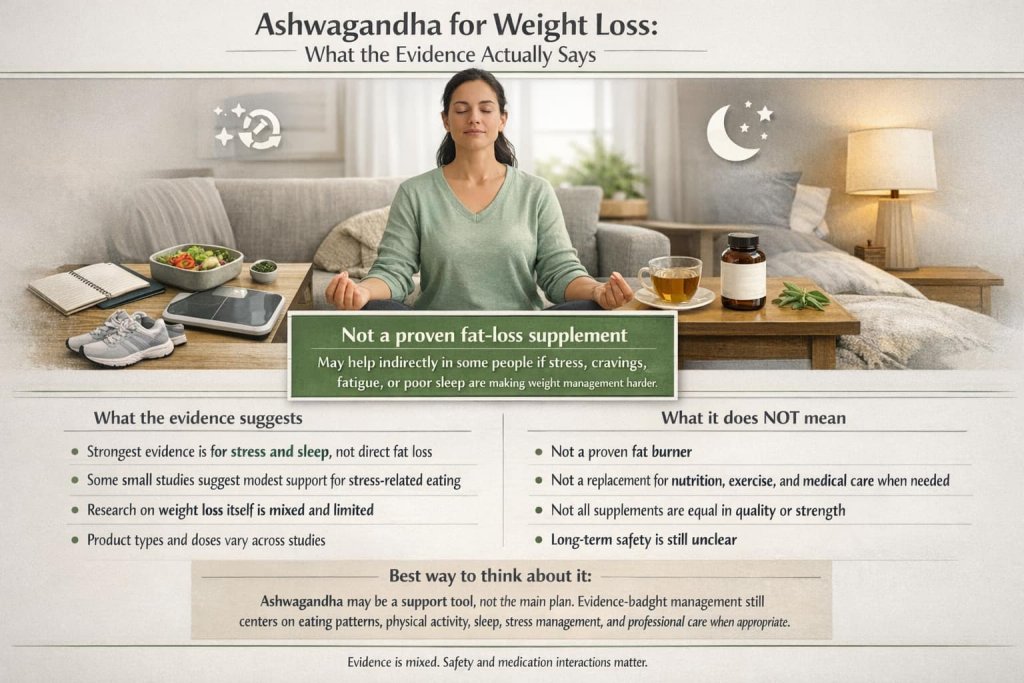
That distinction matters. Weight-loss supplements are often marketed as if they work on their own, but the NIH’s weight-management guidance still centers on eating patterns, physical activity, structured support, and, when appropriate, prescription treatment or bariatric surgery.
Ashwagandha may fit into a broader conversation about stress and wellness, but it should not replace an evidence-based weight-management plan.
Does ashwagandha help with weight loss?
Right now, the most accurate answer is: maybe a little in some stressed adults, but the evidence is too limited and inconsistent to call it an effective weight-loss supplement.
NCCIH notes that many ashwagandha trials have small sample sizes and use different preparations, and it says there is not enough evidence to judge ashwagandha as helpful for many other health conditions beyond areas like stress and insomnia.
The most commonly cited weight-related trial is a 2017 double-blind, randomized, placebo-controlled study in 52 adults under chronic stress. Participants took 300 mg of standardized ashwagandha root extract twice daily for 8 weeks.
Compared with placebo, the ashwagandha group had greater improvements in perceived stress, food cravings, emotional eating, body weight, and BMI.
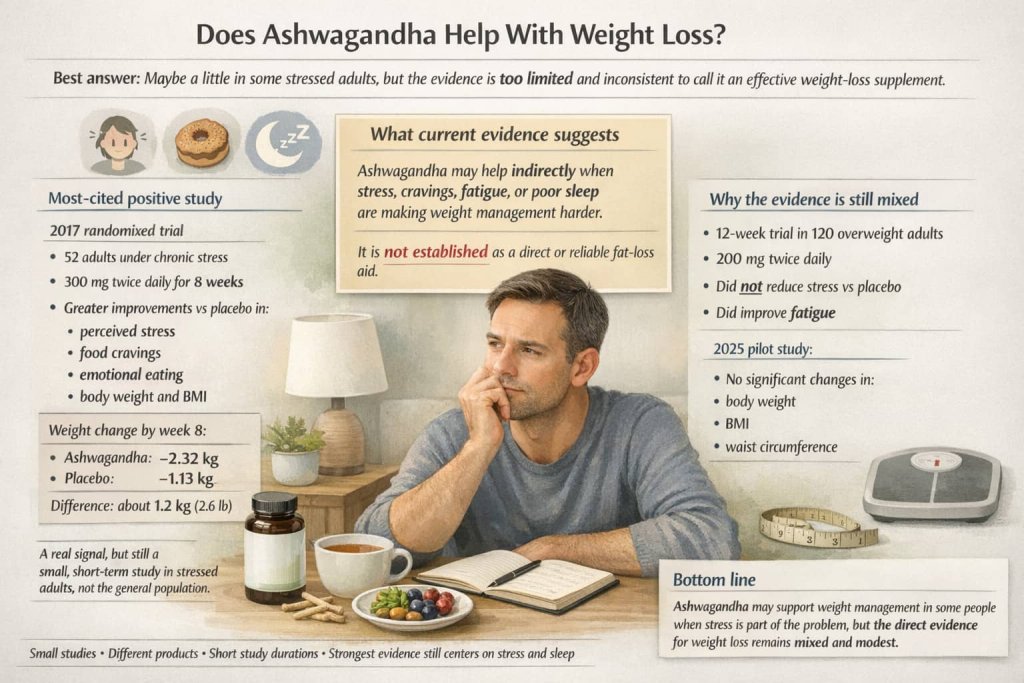
By week 8, average weight change was about -2.32 kg in the ashwagandha group versus -1.13 kg in the placebo group. That is a real signal, but it came from a small, short-term study in a very specific group: stressed adults, not the general population trying to lose weight.
More recent evidence is less impressive. The NIH ODS fact sheet describes a 12-week randomized trial in 120 overweight or mildly obese adults with low energy and fatigue using 200 mg twice daily of ashwagandha root extract. Compared with placebo, ashwagandha did not reduce perceived stress, although it did reduce fatigue.
That makes the weight-loss story less convincing, because even in a weight-relevant population, the benefits did not clearly translate into stronger outcomes on the main stress measure.
Newer evidence also adds caution. A 2025 double-blind pilot study in adults with overweight or obesity found no statistically significant changes in body weight, BMI, or waist circumference after 40 days of ashwagandha supplementation, even though some blood lipids improved. That does not prove ashwagandha never helps, but it does reinforce that the direct weight-loss evidence remains mixed.
So the best evidence-based conclusion is this: ashwagandha may support weight management for some people when stress is part of the problem, but it is not established as a direct or reliable weight-loss aid.
It also helps to put the result size in context. In the 2017 trial, both groups lost weight, and the difference between ashwagandha and placebo by week 8 was only about 1.2 kg, or 2.6 pounds. That is a modest short-term difference, not evidence of dramatic fat loss.
How ashwagandha for weight loss might work indirectly
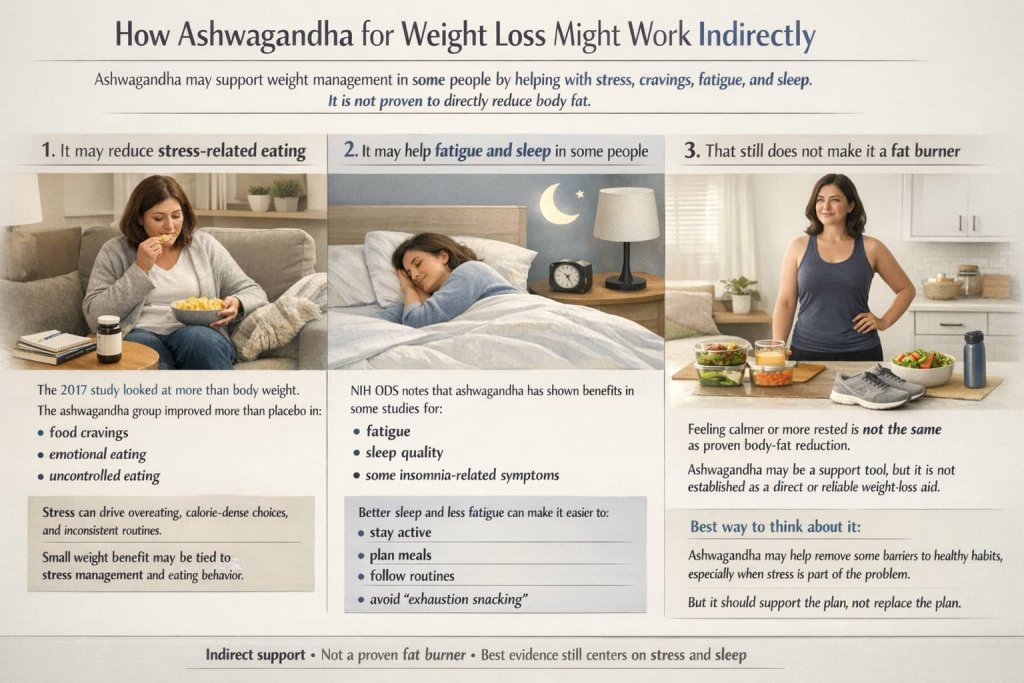
1. It may reduce stress-related eating
The 2017 study did not just look at scale weight. It also measured food cravings and eating behavior, and the ashwagandha group improved more than placebo on several craving-related measures and on emotional or uncontrolled eating.
That matters because stress can push people toward overeating, calorie-dense foods, and less consistent routines. In other words, the limited positive weight findings may have more to do with stress management and eating behavior than with any direct fat-burning effect.
2. It may help fatigue and sleep in some people
The NIH ODS summary says ashwagandha has shown benefits in some trials for fatigue, and evidence from a small number of studies suggests it may modestly improve several aspects of sleep, especially in people with insomnia. Better sleep and less fatigue can make it easier to stay active, plan meals, and avoid the “I’m exhausted, so I’ll just snack” cycle that often undermines weight goals.
3. That still does not make it a fat burner
Even if ashwagandha helps a stressed or tired person feel more balanced, that is not the same as proving that it directly reduces body fat. The NIH’s NIDDK still recommends that weight loss be built around sustainable lifestyle changes, structured support, and medical treatment when appropriate. That is why ashwagandha makes more sense as a possible support tool than as the main plan.
What dose do studies use?
There is no single, official “ashwagandha for weight loss” dose. The NIH ODS notes that human studies have used a wide range of products and doses, from 240 to 1,250 mg/day of extract, and even whole-root granules in one study.
The 2017 stress-and-weight trial used 300 mg twice daily of a root extract standardized to 5% withanolides, while the later overweight/mild-obesity trial used 200 mg twice daily of a root extract standardized to 1.5% withanolides. That means two products with the same milligram number may still be very different in composition and strength.
One more practical point: most of the evidence here comes from short studies, usually about 8 to 12 weeks. That is why it makes more sense to think of ashwagandha as a short-term trial to reassess, not an open-ended daily habit. If you do not notice a meaningful benefit in stress, sleep, cravings, or routine adherence within that window, there is little reason to keep taking it.
For readers, the practical point is simple: do not assume a social-media dose or a generic “600 mg” label matches the products used in clinical trials. Extract type, plant part, and standardization all matter.
Who might benefit most from ashwagandha for weight loss?
Based on the trial populations, the clearest possible use case is someone whose weight-management challenges are tightly linked to stress, cravings, poor sleep, or fatigue. That is an inference from the available studies, not proof that ashwagandha works broadly for weight loss. The positive study was in stressed adults, and the later trial involved overweight adults with stress and fatigue.
If your main issue is not stress-related eating or poor recovery, but rather calorie intake, meal structure, physical inactivity, medication-related weight gain, or a medical condition, ashwagandha is much less likely to be the missing piece.
Who should be careful or avoid it?
NCCIH says ashwagandha should be avoided during pregnancy and not used while breastfeeding. It is also not recommended for people who are about to have surgery or for those who have autoimmune or thyroid disorders. NCCIH also notes potential interactions with medications for diabetes, high blood pressure, immunosuppression, seizures, sedation, and thyroid hormone replacement.
People with cirrhosis or advanced chronic liver disease should be especially cautious. NIH’s LiverTox says clinically apparent liver injury from ashwagandha appears to be rare, but reported cases do exist, and it specifically advises avoiding use in people with significant underlying liver disease.
Safety and side effects
Safety box
Short-term ashwagandha use appears reasonably well tolerated in many studies, but both NIH ODS and NCCIH say long-term safety is still unclear. Common side effects include stomach upset, loose stools, nausea, diarrhea, vomiting, and drowsiness.
LiverTox reports that when liver injury happens, it has usually appeared 2 to 12 weeks after starting ashwagandha, often with jaundice and itching. If someone develops symptoms such as yellowing of the skin or eyes, dark urine, unusual itching, nausea, or upper abdominal discomfort, the supplement should be stopped and medical care sought promptly.
How to choose a supplement more carefully
If you still want to try ashwagandha, the quality section matters as much as the claim. The U.S. Food and Drug Administration states that dietary supplements are not approved by FDA before they are marketed, and FDA does not test them before sale in the way it reviews drugs. Manufacturers are responsible for safety, labeling, and compliance.
That means it is smart to:
- read the Supplement Facts panel closely
- check whether the product uses root only or root plus leaf
- note the withanolide standardization, if listed
- avoid products making illegal disease-treatment claims
- review the full ingredient list, not just the front-label marketing
- talk with a clinician or pharmacist if you take regular medications
What works better for weight loss than ashwagandha alone?
For most people, evidence-based weight loss still comes down to the basics the NIH recommends:
- a calorie-aware eating pattern you can sustain
- regular physical activity
- monitoring food intake, activity, and weight
- ongoing support, coaching, or counseling
- prescription treatment or bariatric options when medically appropriate
NIDDK notes that a reasonable initial goal may be losing about 5% of body weight over 6 months, depending on the individual and the plan developed with a health professional. That kind of approach has much stronger real-world support than relying on one supplement.
FAQ
Does ashwagandha burn belly fat?
There is no strong evidence that ashwagandha directly burns belly fat. The most favorable study involved stressed adults and suggested modest weight-related benefits alongside lower stress and fewer food cravings, but that is different from proving a direct fat-burning effect.
How long does ashwagandha take to work for weight loss?
The trials most often discussed in this area ran for about 8 to 12 weeks. Even then, results were mixed, so time alone does not guarantee weight loss.
Is ashwagandha tea good for weight loss?
There is no good evidence that ashwagandha tea specifically causes weight loss. The human studies summarized by NIH mostly used standardized extracts or other defined preparations, not tea in the way most people drink it at home.
Can you take ashwagandha every day?
Daily use has been studied in the short term, generally up to about 3 months, but NIH and NCCIH say long-term safety is not clear. Daily use should be discussed with a clinician if you have liver, thyroid, autoimmune, blood pressure, blood sugar, or medication concerns.
Final verdict on ashwagandha for weight loss
Ashwagandha for weight loss is best viewed as a possible support tool for stress-related eating and fatigue, not as a proven way to lose fat. If stress, poor sleep, or low energy are making healthy habits harder, it may be worth discussing with your clinician. But if your goal is meaningful, lasting weight loss, the stronger path is still a structured plan built around nutrition, activity, support, and medical care when needed.
Before buying a supplement, make sure the plan matches the problem you are trying to solve. That one step will do more for your results than chasing a shortcut label promise.
This content is for informational purposes only and not medical advice.
References
- Choudhary D, Bhattacharyya S, Joshi K. — Body Weight Management in Adults Under Chronic Stress Through Treatment With Ashwagandha Root Extract
- National Library of Medicine, LiverTox — Ashwagandha
- National Institute of Diabetes and Digestive and Kidney Diseases — Treatment for Overweight & Obesity
- U.S. Food and Drug Administration — Questions and Answers on Dietary Supplements
- PubMed — Effects of Ashwagandha Supplementation on Anthropometric Measurements and Biochemical Markers in Adults with Overweight and Obesity