
The right number of calories to eat each day depends on your body, your activity level, and your goal. Age, sex, height, weight, life stage, and how active you are all affect daily calorie needs, which is why there is no one calorie number that fits everyone. The USDA National Agricultural Library explains this clearly in its DRI Calculator, which estimates calorie needs using those personal factors.

For many adults, daily maintenance needs often fall somewhere within these broad official ranges:
- Adult females: about 1,600 to 2,400 calories a day
- Adult males: about 2,000 to 3,000 calories a day
Those ranges are only a starting point. They do not replace a personal estimate based on your body size, activity, and goals.
What Determines How Many Calories You Should Eat a Day?
The biggest factors are your age, sex, height, weight, and activity level. The USDA National Agricultural Library DRI Calculator uses those exact inputs to estimate daily calorie and nutrient needs, which is why two adults of the same age can still need very different calorie amounts.
Your life stage matters too. The Dietary Guidelines for Americans say healthy eating guidance should be tailored across the lifespan and describe a healthy dietary pattern as a customizable framework rather than a rigid prescription. Pregnancy, breastfeeding, adolescence, and older adulthood can all change calorie needs.
A Quick Calorie Range Guide for Adults
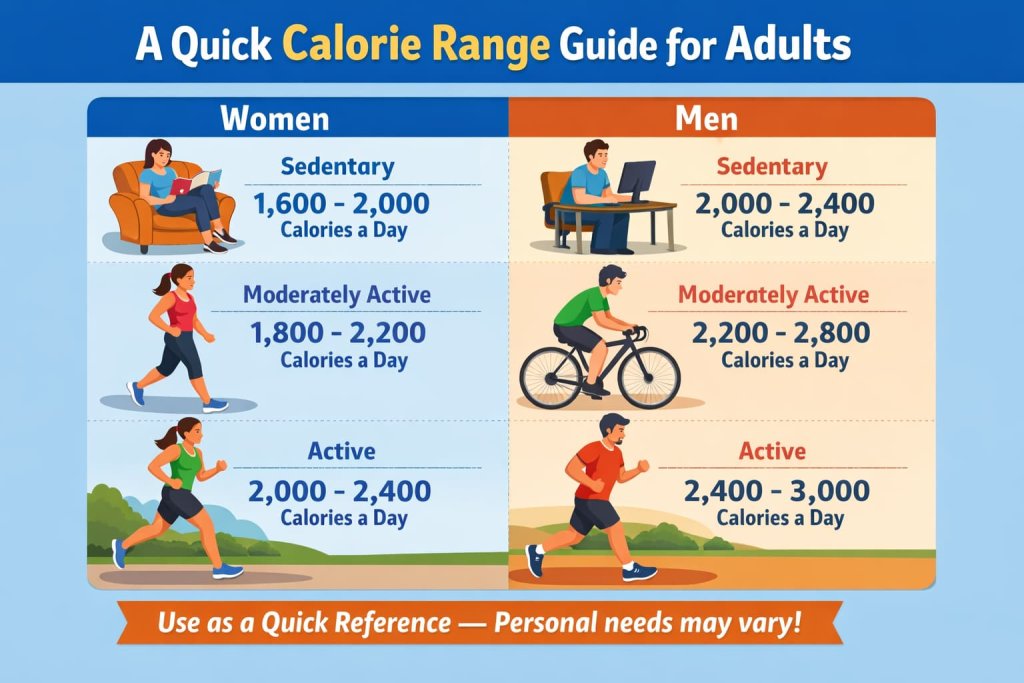
A simple way to think about calorie needs is to match them to activity level. Broad federal estimate tables commonly place adults in these maintenance ranges:
- Sedentary adult women: about 1,600 to 2,000 calories a day
- Moderately active adult women: about 1,800 to 2,200 calories a day
- Active adult women: about 2,000 to 2,400 calories a day
- Sedentary adult men: about 2,000 to 2,400 calories a day
- Moderately active adult men: about 2,200 to 2,800 calories a day
- Active adult men: about 2,400 to 3,000 calories a day
These numbers are most useful as a quick reference. A personal estimate is still more accurate than choosing a random target from a chart.
How to Estimate Your Daily Calorie Needs
A practical place to start is an official calculator. The National Institute of Diabetes and Digestive and Kidney Diseases Body Weight Planner helps adults estimate calories and physical activity for weight maintenance or weight change, and the USDA DRI Calculator estimates daily calorie and nutrient needs.
If your goal is maintenance, use that estimate as your baseline. If your goal is weight loss or weight gain, adjust from that baseline instead of picking a very low or very high calorie number without context. The U.S. Food and Drug Administration also notes that calorie needs vary by age, sex, height, weight, and physical activity level.
Is 2,000 Calories a Day Right for Everyone?
No. 2,000 calories is a reference point, not a universal target. It may be close to maintenance for some adults, too high for others, and too low for others, especially if they are more active, larger, or at a different life stage.
That is also why Nutrition Facts labels use 2,000 calories a day as a general nutrition reference. The U.S. Food and Drug Administration says your own calorie needs may be higher or lower.
How Activity Changes Your Calorie Needs
The more active you are, the more energy your body uses. The Centers for Disease Control and Prevention says adults need at least 150 minutes of moderate-intensity physical activity a week or 75 minutes of vigorous-intensity activity, plus at least 2 days a week of muscle-strengthening activity.
That matters for calorie planning too. A mostly desk-based adult and a very active adult can need very different calorie intakes to maintain the same weight.
What a Healthy Daily Calorie Pattern Looks Like
Calories matter, but so does food quality. The Dietary Guidelines for Americans recommend a nutrient-dense eating pattern built around vegetables, fruits, whole grains, protein foods, dairy or fortified soy alternatives, and oils. The same guidance says to keep added sugars below 10% of daily calories, saturated fat below 10% of daily calories, and sodium below 2,300 mg a day for adults and older teens.
In everyday terms, that usually means building meals around foods that offer more nutrition for the calories they contain, instead of relying heavily on sugary drinks, fried foods, sweets, or other foods high in added sugars, saturated fat, and sodium.
The Centers for Disease Control and Prevention Healthy Weight Growth guidance also notes that you can cut calories without feeling as hungry by using foods with more water and fiber, such as vegetables and fruit.
How Many Calories Should You Eat to Lose Weight?
For most adults, the safest approach is a moderate calorie reduction from maintenance, not an extreme cut. The Centers for Disease Control and Prevention weight-loss guidance emphasizes realistic, specific, and sustainable lifestyle changes rather than crash dieting.
That usually works better when you pair calorie awareness with habits that improve fullness and consistency, such as eating enough protein, choosing more fiber-rich foods, drinking fewer sugary beverages, and staying physically active.
How Many Calories Should You Eat to Gain Weight?
If your goal is to gain weight or support muscle growth, you usually need to eat more than your maintenance calories. The most practical approach is a controlled increase based on your maintenance estimate, along with regular strength training and a balanced eating pattern, rather than simply eating much larger amounts of low-quality food. This follows the same calorie-balance framework used in the USDA DRI Calculator and the NIDDK Body Weight Planner.
A slower, steady increase is usually easier to manage than a dramatic jump. Watching your weight trend, appetite, energy, and training recovery can help you tell whether your intake matches your goal.
Who Needs a Different Answer?
Children and teens
Children and teens should not use adult calorie targets. The American Academy of Pediatrics notes that calorie needs rise during adolescence and vary with age, sex, growth, and activity. It gives average figures of about 2,800 calories a day for boys and 2,200 calories a day for girls, but those are averages, not personal prescriptions. If a child or teen needs help with eating, growth, or weight concerns, a pediatrician or registered dietitian is the right place to start.
Pregnancy
Pregnancy changes calorie needs by trimester. The Office of Disease Prevention and Health Promotion says most women with a healthy pre-pregnancy weight need no extra calories in the first trimester, about 340 extra calories a day in the second trimester, and about 450 extra calories a day in the last trimester.
Breastfeeding
Breastfeeding usually raises calorie needs too. The Centers for Disease Control and Prevention breastfeeding guidance says well-nourished breastfeeding mothers generally need about 330 to 400 extra calories a day compared with what they were eating before pregnancy.
Older adults
Older adults often need to pay closer attention to nutrient density. The National Institute on Aging explains that getting the right nutrients and the right amount for your weight and activity level contributes to healthy aging. In practice, that often means fitting plenty of nutrition into a smaller calorie budget.
When a Low Calorie Target May Be a Warning Sign
Very low calorie diets are not standard self-directed plans. The National Institute of Diabetes and Digestive and Kidney Diseases says its Body Weight Planner is for adults age 18 and older and is not for younger people or for pregnant or breastfeeding women.
If you are under 18, pregnant, breastfeeding, taking medicines that affect blood sugar or weight, or dealing with a medical condition that changes appetite or metabolism, it is smart to get professional guidance before cutting calories aggressively.
A Simple Way to Find Your Best Calorie Target
Start with a personalized estimate from an official calculator. Then match that number to a balanced eating pattern and your real-life goal.
- Estimate your calorie needs with the USDA DRI Calculator or the NIDDK Body Weight Planner.
- Decide whether your goal is maintenance, gradual weight loss, or weight gain.
- Build most meals around nutrient-dense foods.
- Adjust your intake based on your activity, hunger, energy, and weight trend over time.
It also helps to review your calorie target after a few weeks instead of changing it every day. If your weight is moving in the wrong direction for your goal, your energy is consistently low, or you feel unusually hungry all the time, your current calorie level may not be the best fit. Small, steady adjustments are usually more realistic than sharp cuts or big jumps.
FAQs
How many calories should I eat a day to maintain weight?
There is no single maintenance number for everyone. For many adults, maintenance often falls within broad ranges of 1,600 to 2,400 calories for women and 2,000 to 3,000 calories for men, but your personal number depends on your age, body size, activity level, and life stage.
Is 2,000 calories a day enough?
For some people, yes. For others, no. It is best used as a label-reading reference point, not a universal personal target.
How many calories should a teen eat a day?
Teen calorie needs vary widely because growth and activity change quickly. The American Academy of Pediatrics gives average figures around 2,200 calories for girls and 2,800 calories for boys, but those are still averages, not exact targets for every teen.
Is 1,200 calories a day enough?
For some smaller, less active adults, it may fall within a structured plan, but it is too low for many adults. A personalized estimate is safer and more useful than copying a generic number. Teens, pregnant women, and breastfeeding women should not rely on adult low-calorie plans.
Bottom Line
The best answer to “how many calories should I eat a day” is your personal calorie need, not a one-size-fits-all number. Start with an official estimate, match it to your goal, and build it around nutrient-dense foods and realistic habits. That gives you a calorie target that is more useful, more sustainable, and safer than guessing.
This content is for informational purposes only and not medical advice.