
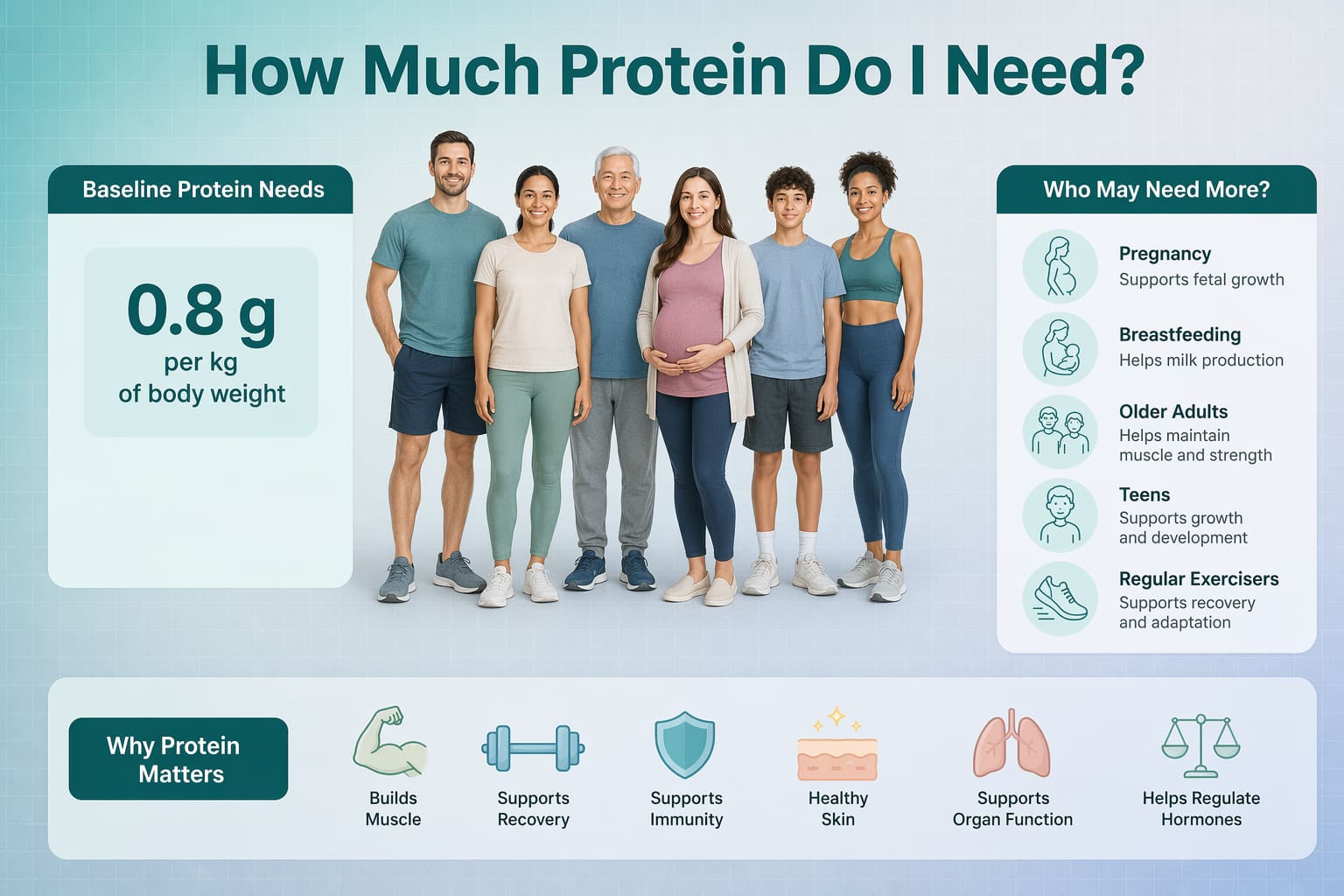
Most healthy adults need at least 0.8 grams of protein per kilogram of body weight per day, but your real protein needs can be higher if you are pregnant, breastfeeding, older, still growing, or exercising regularly. That matters because protein helps support muscle, skin, organs, hormones, immune function, and recovery. The current Dietary Guidelines for Americans, 2025–2030 also put protein in the bigger picture of a healthy eating pattern built around nutrient-dense foods, not just supplements or high-protein trends.
Quick Answer: How Much Protein Do I Need Per Day?
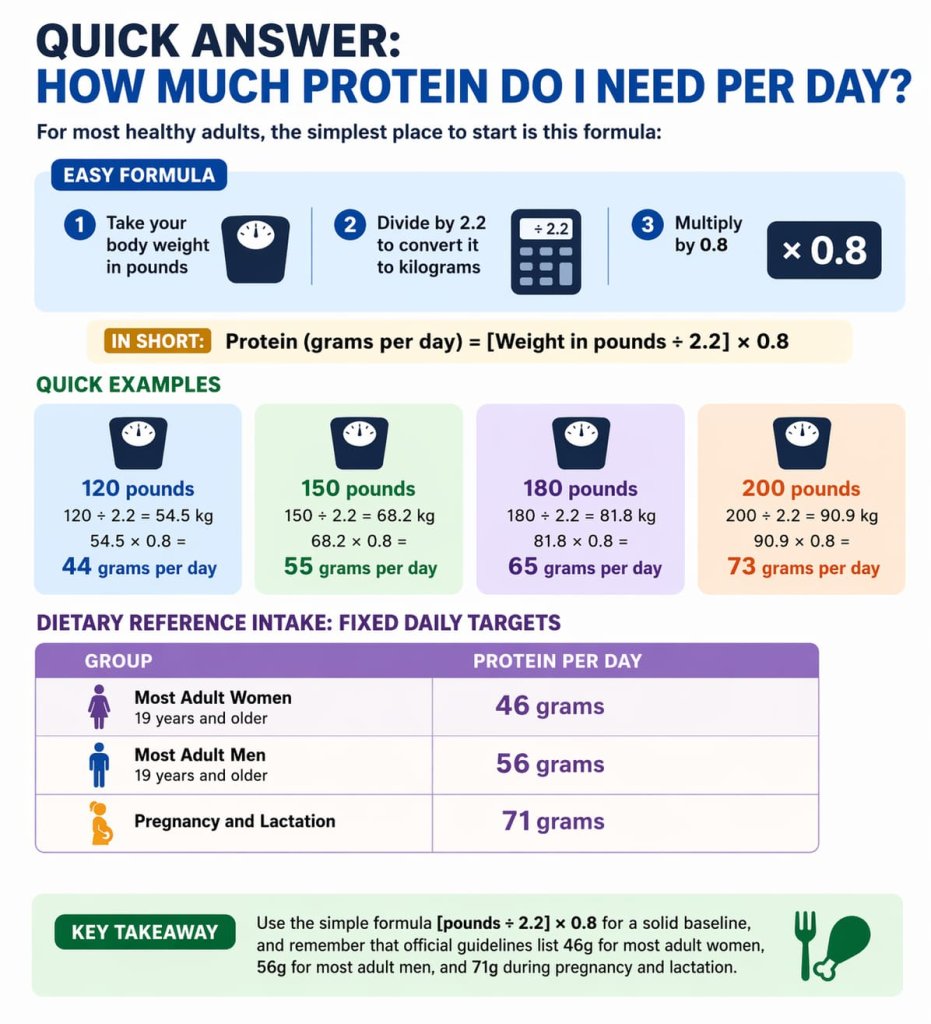
For most healthy adults, the simplest place to start is this formula:
- Take your body weight in pounds
- Divide by 2.2 to convert it to kilograms
- Multiply by 0.8
That gives you the standard adult baseline.
A few quick examples:
- 120 pounds: about 44 grams a day
- 150 pounds: about 55 grams a day
- 180 pounds: about 65 grams a day
- 200 pounds: about 73 grams a day
The Dietary Reference Intake tables also list fixed daily targets by age and life stage, including 46 grams for most adult women, 56 grams for most adult men, and 71 grams during pregnancy and lactation.
One important point often gets missed: the RDA is a baseline for nutritional adequacy, not a muscle-building target. The broader DRI framework explains that the Recommended Dietary Allowance is meant to meet the needs of nearly all healthy people. That is why exercise-focused protein advice is often higher than the general minimum.
Daily Protein Needs by Age and Life Stage
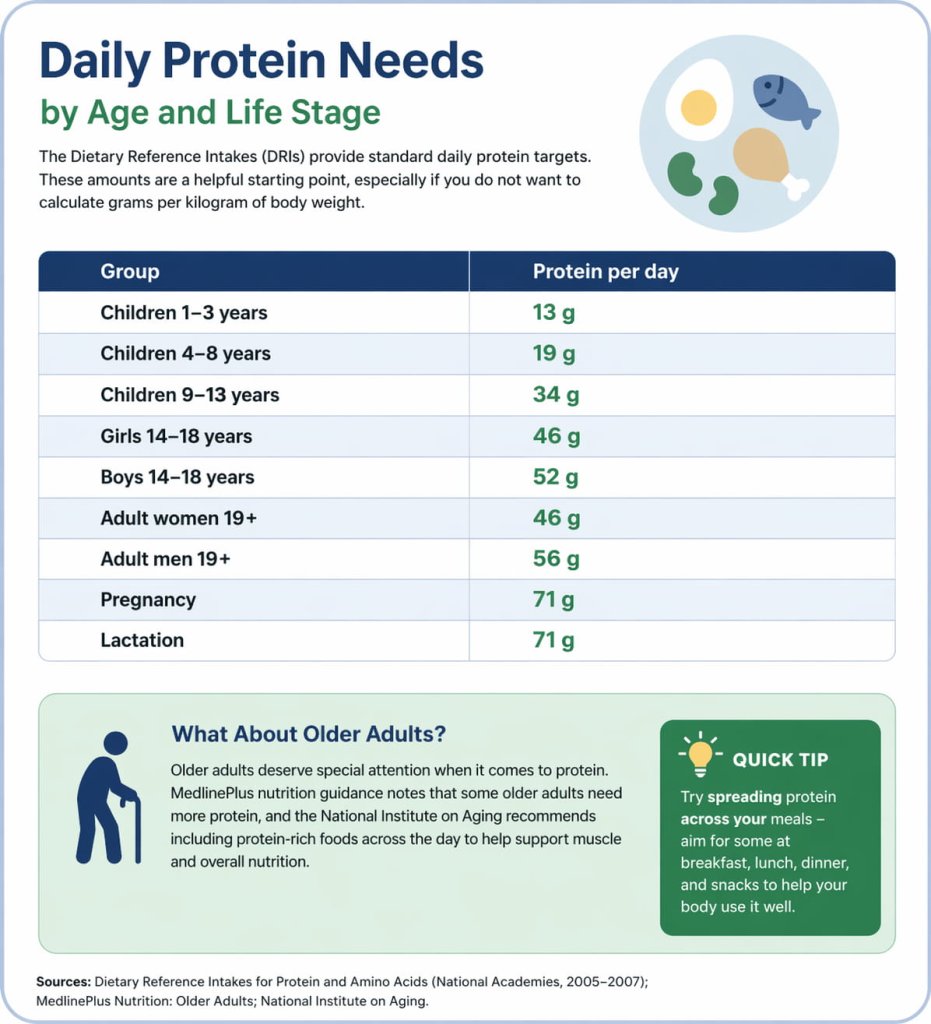
Here are the standard daily protein targets from the DRI reference tables:
| Group | Protein per day |
|---|---|
| Children 1–3 years | 13 g |
| Children 4–8 years | 19 g |
| Children 9–13 years | 34 g |
| Girls 14–18 years | 46 g |
| Boys 14–18 years | 52 g |
| Adult women 19+ | 46 g |
| Adult men 19+ | 56 g |
| Pregnancy | 71 g |
| Lactation | 71 g |
These are useful starting points, especially for people who do not want to calculate grams per kilogram.
What About Older Adults?
Older adults deserve special attention in any protein article. MedlinePlus nutrition guidance for older adults notes that some older adults need more protein, and the National Institute on Aging recommends including protein-rich foods across the day to help support muscle and overall nutrition.
In real life, that usually means being more intentional with meals and snacks, especially if appetite is lower than it used to be. Good options include eggs, yogurt, milk or fortified soy milk, fish, beans, lentils, tofu, poultry, nuts, and seeds. Unplanned weight loss, poor appetite, or trouble chewing or cooking are all signs that it may be worth getting individualized advice from a clinician or registered dietitian.
Protein as a Percent of Calories
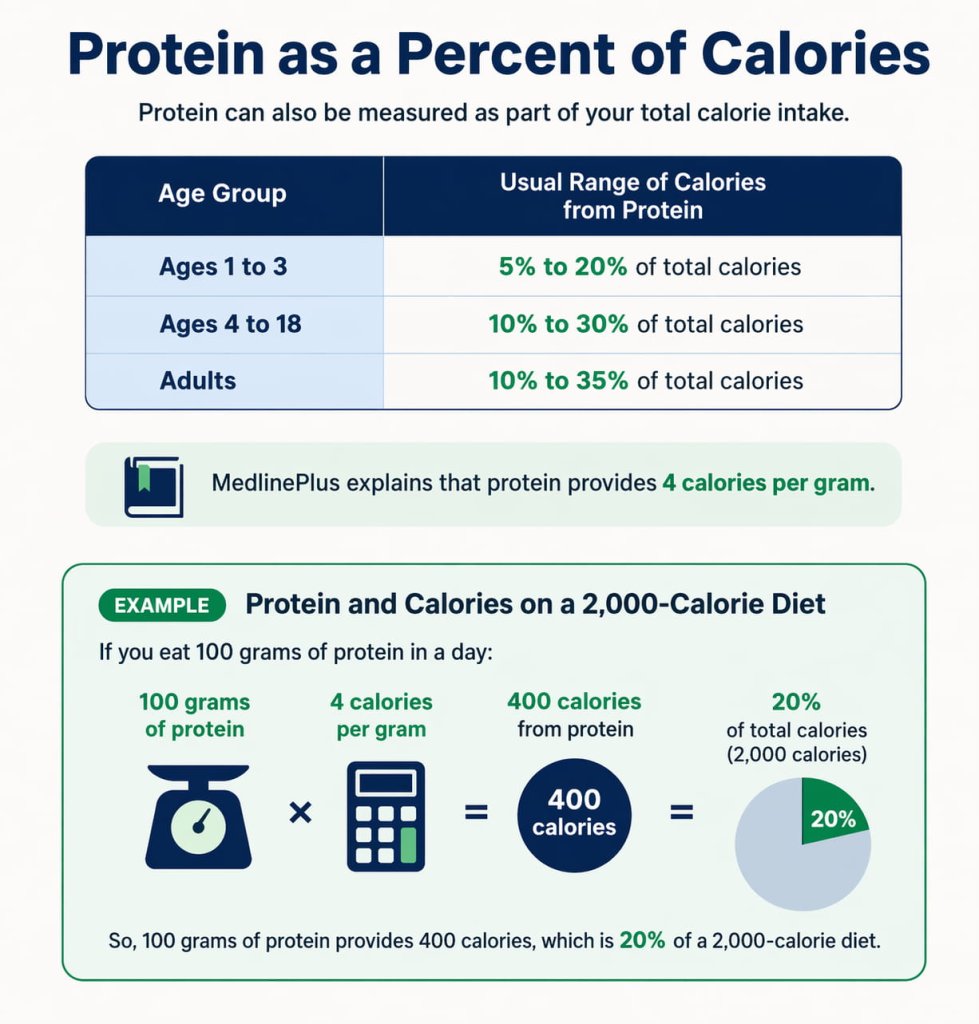
Protein can also be measured as part of your total calorie intake. According to MedlinePlus protein guidance, the usual range is:
- 5% to 20% of calories for ages 1 to 3
- 10% to 30% of calories for ages 4 to 18
- 10% to 35% of calories for adults
MedlinePlus also explains that protein provides 4 calories per gram. On a 2,000-calorie diet, 100 grams of protein would provide 400 calories, or 20% of total calories.
This helps explain why there is no one perfect number for everyone. A smaller, less active person may need much less than a larger or more active person.
How Much Protein Do I Need if I Exercise?
If you lift weights, train hard, or play sports regularly, your needs may be higher than the standard adult minimum. A widely used sports nutrition position stand published in the Journal of the International Society of Sports Nutrition reports that 1.4 to 2.0 grams per kilogram of body weight per day is enough for most healthy people who exercise and want to support training and muscle maintenance. The same paper also notes that spreading protein through the day is helpful, with many people doing well with about 20 to 40 grams per meal depending on body size and total needs.
For teens, the Academy of Nutrition and Dietetics makes an important point: athletes may need somewhat more protein than less active peers, but very high intakes do not magically build extra muscle. Consistency, total calories, training quality, and balanced meals matter too.
A Simple Protein Guide for Common Goals
A quick framework makes protein targets easier to use.
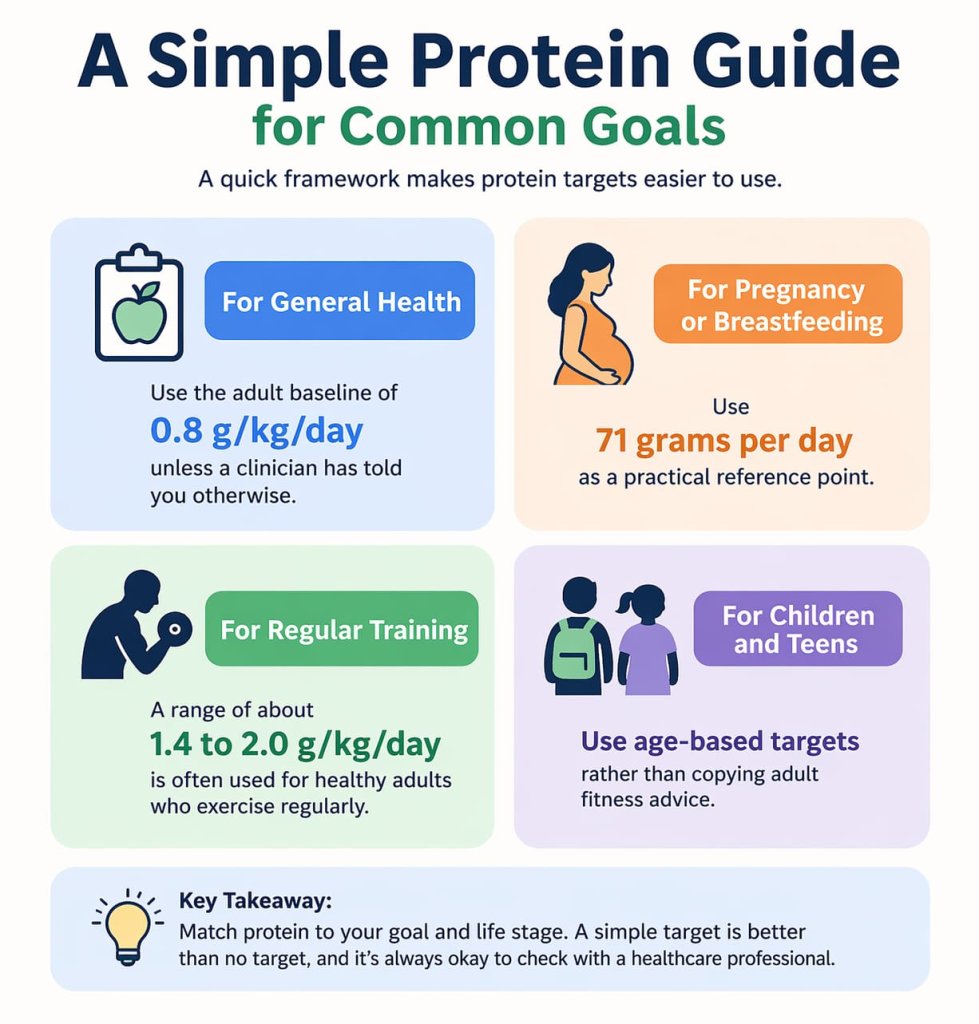
For general health
Use the adult baseline of 0.8 g/kg/day unless a clinician has told you otherwise.
For pregnancy or breastfeeding
Use 71 grams per day as a practical reference point.
For regular training
A range of about 1.4 to 2.0 g/kg/day is often used for healthy adults who exercise regularly.
For children and teens
Use age-based targets rather than copying adult fitness advice.
Best Protein Foods to Reach Your Goal
The USDA MyPlate guidance recommends varying your protein routine. Good choices include:
- Seafood
- Beans, peas, and lentils
- Soy foods
- Eggs
- Unsalted nuts and seeds
- Lean meats and poultry
MyPlate also uses ounce-equivalents. In practical terms, 1 ounce of protein foods can count as:
- 1 ounce seafood, lean meat, or poultry
- 1 egg
- 1 tablespoon peanut butter
- 1/4 cup cooked beans, peas, or lentils
- 1/2 ounce nuts or seeds
A few simple protein portions from MedlinePlus are also handy:
- 1 ounce of meat, fish, or poultry: about 7 grams
- 1 large egg: about 7 grams
- 1/4 cup tofu: about 7 grams
- 1/2 cup cooked beans or lentils: about 7 grams
If You Eat Mostly Plant-Based
You can absolutely meet your protein needs with mostly plant foods. MedlinePlus explains that many plant proteins are incomplete on their own, but eating a variety of plant protein foods over the course of the day helps provide the amino acids your body needs. You do not have to combine specific foods at the same meal.
A practical pattern is to rotate foods such as:
- Beans and lentils
- Tofu, tempeh, and soy milk
- Nuts and seeds
- Whole grains
- Peas and chickpeas
For most people, overall variety across the day matters more than perfect food pairing at one sitting.
Do You Need Protein Powder?
Not always. Many people can meet their needs with food alone.
Protein powder may be useful when:
- You have a high training load
- Your appetite is low
- You are short on time after exercise
- You regularly fall short of your protein goal from meals
It is usually less helpful when you already eat enough protein and are using supplements as a substitute for a balanced diet. For teens especially, the Academy of Nutrition and Dietetics emphasizes real food first.
How to Spread Protein Through the Day
Trying to eat all your protein at dinner is not the best strategy. Spreading it more evenly across meals is usually easier and may better support muscle maintenance and recovery.
A simple day might look like this:
- Breakfast: eggs, Greek yogurt, milk, tofu, or nut butter
- Lunch: chicken, tuna, beans, lentils, tofu, or cottage cheese
- Dinner: fish, poultry, lean meat, soy foods, or legumes
- Snacks: yogurt, milk, edamame, nuts, seeds, or hummus
This approach also works well for older adults and active people who want to avoid long gaps with very little protein.
How to Read Protein on Food Labels
The FDA Daily Value guide sets the Daily Value for protein at 50 grams. That number is useful for reading labels, but it is not a personalized target.
When you compare foods, focus on:
- Grams of protein per serving
- Serving size
- Added sugar
- Sodium
- Saturated fat
- Whether the food also provides fiber, vitamins, or minerals
In other words, the best protein choice is not always the product with the biggest number on the front of the package.
Who Should Be Careful With High-Protein Advice?
High-protein advice is not right for everyone. The National Institute of Diabetes and Digestive and Kidney Diseases says some people with chronic kidney disease may need to moderate protein intake, while people on dialysis may need more. That balance should be individualized.
It is smart to get professional advice if you:
- Have kidney disease
- Are on dialysis
- Are pregnant and struggling to eat enough
- Are an older adult with unplanned weight loss
- Are using supplements heavily instead of meals
- Are trying to gain or lose weight but are unsure how much to eat
More protein is not always better.
Frequently Asked Questions
Is 100 grams of protein a day too much?
Not necessarily. For some adults, 100 grams fits comfortably within the normal adult calorie range for protein. For others, especially smaller or less active people, it may be more than they need. Body size, activity, age, and health status all matter.
Can you get enough protein from plant foods?
Yes. Beans, lentils, soy foods, nuts, seeds, and whole grains can all help you meet your goal. USDA and MedlinePlus both recognize plant foods as valid protein sources.
How much protein do women need per day?
For most adult women, the reference intake is 46 grams per day. During pregnancy and lactation, the target rises to 71 grams per day.
How much protein do men need per day?
For most adult men, the reference intake is 56 grams per day. That is a baseline amount, not a universal performance target.
How much protein do teens need?
The DRI tables list 46 grams per day for girls ages 14 to 18 and 52 grams per day for boys ages 14 to 18. Athletes may need somewhat more, but huge protein intakes are not the goal.
Final Takeaway
The best answer to “how much protein do I need” is this: start with the standard baseline, then adjust for your age, life stage, activity level, and health needs. For most healthy adults, that means starting around 0.8 grams per kilogram per day. Pregnant and breastfeeding people, some older adults, and many regular exercisers may need more.
The smartest approach is simple: build meals around real protein foods, spread protein across the day, use labels wisely, and get personalized advice if a medical condition could change your needs.
References
- Office of Disease Prevention and Health Promotion — Dietary Guidelines for Americans, 2025–2030
- National Academies / NCBI Bookshelf — Dietary Reference Intake Tables
- MedlinePlus — Protein in Diet
- National Institute on Aging — Healthy Meal Planning Tips for Older Adults
- U.S. Food and Drug Administration — Daily Value on the Nutrition and Supplement Facts Labels
- National Institute of Diabetes and Digestive and Kidney Diseases — Healthy Eating for Adults with Chronic Kidney Disease
- Academy of Nutrition and Dietetics — How Teen Athletes Can Build Muscles with Protein
- Journal of the International Society of Sports Nutrition — Protein and Exercise Position Stand