
To build muscle, most adults who lift should aim for about 1.4 to 2.0 grams of protein per kilogram of body weight per day, with around 1.6 g/kg/day as a strong practical target. That is higher than the general adult protein RDA of 0.8 g/kg/day, which is designed to cover basic needs, not maximize muscle growth.
Understanding that difference helps you avoid both under-eating protein and wasting time chasing unnecessary extremes. National Academies protein reference intake, International Society of Sports Nutrition position stand on protein and exercise, and the NIH Office of Dietary Supplements exercise-performance guidance all support this general range, and a recent meta-analysis found that higher protein intake can add small benefits for lean mass and lower-body strength during resistance training.
How Much Protein Do I Need to Build Muscle Each Day?
For most people doing regular resistance training, 1.6 g/kg/day is a very practical sweet spot. A large meta-analysis found that gains in fat-free mass tended to level off around 1.6 g/kg/day, while the ISSN recommends 1.4 to 2.0 g/kg/day for most exercising people. That means more protein is not always better once you are already in the effective range. The Morton meta-analysis on protein and resistance training is one of the main reasons 1.6 g/kg/day is used so often in practice.
A simple way to use that target is to convert your body weight to kilograms, then multiply by 1.6. If you prefer pounds, divide your body weight by 2.2 first.
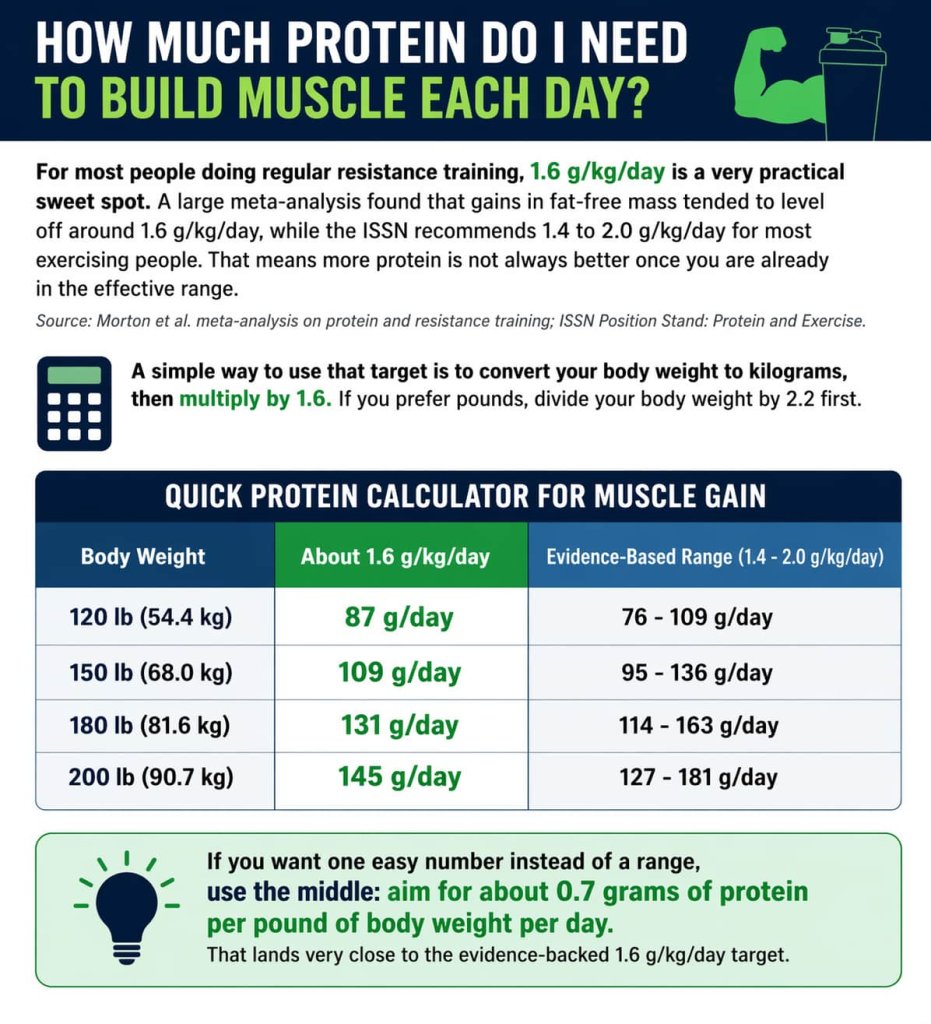
Quick Protein Calculator for Muscle Gain
| Body weight | About 1.6 g/kg/day | Evidence-based range |
|---|---|---|
| 120 lb (54.4 kg) | 87 g/day | 76-109 g/day |
| 150 lb (68.0 kg) | 109 g/day | 95-136 g/day |
| 180 lb (81.6 kg) | 131 g/day | 114-163 g/day |
| 200 lb (90.7 kg) | 145 g/day | 127-181 g/day |
If you want one easy number instead of a range, use the middle: aim for about 0.7 grams of protein per pound of body weight per day. That lands very close to the evidence-backed 1.6 g/kg/day target.
What Actually Builds Muscle
Protein helps, but protein alone does not build much muscle without resistance training. A 2022 dose-response meta-analysis found that protein intake improved muscle strength only when combined with resistance training, and the effect appeared to peak around 1.5 g/kg/day in that context. The CDC also recommends muscle-strengthening activities on 2 or more days per week that work all major muscle groups. This dose-response meta-analysis on protein plus strength training and the CDC adult physical activity guidance make the big picture clear: lifting is the main signal, and protein supports the adaptation.
So if you are asking how much protein you need to build muscle, the real answer is: enough protein plus consistent progressive training. If your training is inconsistent, doubling your protein will not make up for it.
You Also Need Enough Calories to Build Muscle Efficiently
Protein matters, but muscle gain is harder when you consistently under-eat. The MedlinePlus sports nutrition guidance notes that athletes are more likely to feel tired and perform poorly when they do not get enough calories or carbohydrates, and the American College of Sports Medicine guidance on healthy weight gain for athletes says a commonly recommended starting point for intentional weight gain is about a 500-calorie daily surplus, though individual needs vary. In practice, that means you do not need an aggressive bulk, but a modest calorie surplus often makes muscle gain easier than trying to add muscle while dieting hard.
How Much Protein Per Meal for Muscle Growth?
Daily protein matters most, but meal size matters too. The ISSN recommends about 0.25 g/kg per meal, or roughly 20 to 40 grams of high-quality protein per meal, spaced about every 3 to 4 hours across the day. For older adults, going closer to the top of that range often makes sense.
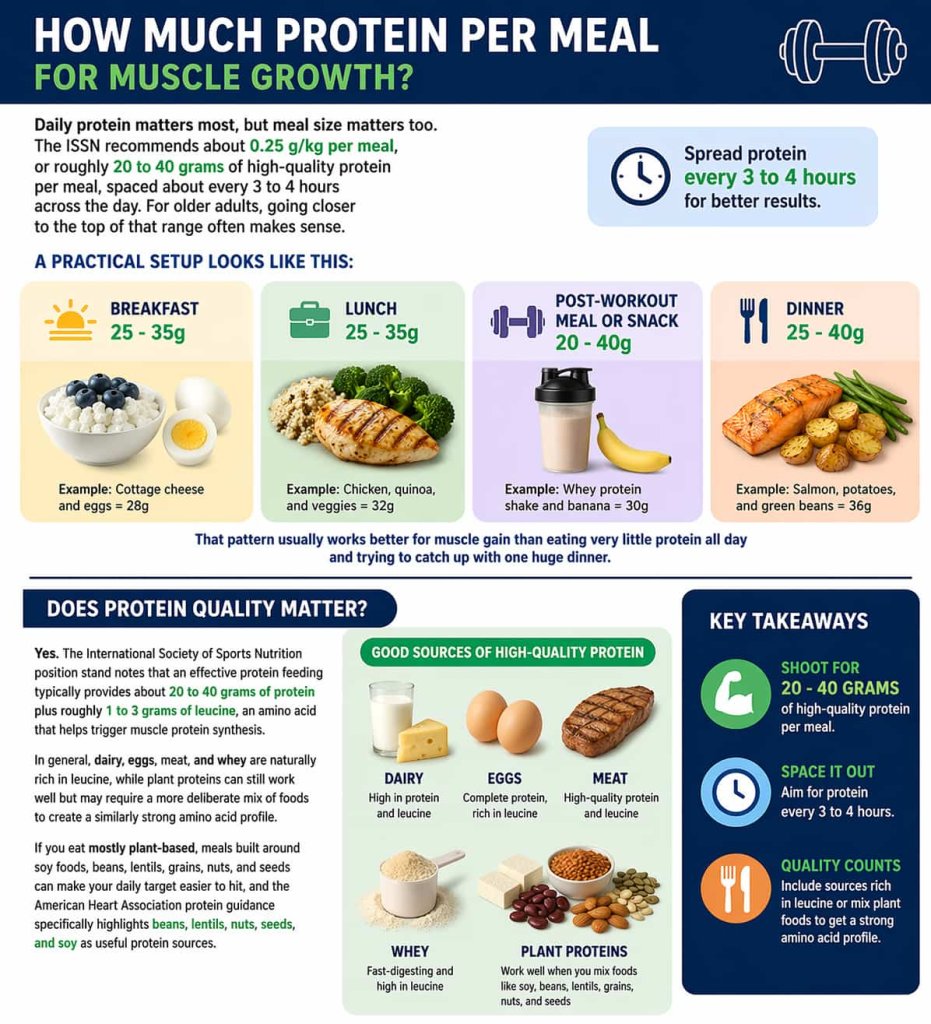
A practical setup looks like this:
- breakfast: 25 to 35 g
- lunch: 25 to 35 g
- post-workout meal or snack: 20 to 40 g
- dinner: 25 to 40 g
That pattern usually works better for muscle gain than eating very little protein all day and trying to catch up with one huge dinner.
Does Protein Quality Matter?
Yes. The International Society of Sports Nutrition position stand notes that an effective protein feeding typically provides about 20 to 40 grams of protein plus roughly 1 to 3 grams of leucine, an amino acid that helps trigger muscle protein synthesis. In general, dairy, eggs, meat, and whey are naturally rich in leucine, while plant proteins can still work well but may require a more deliberate mix of foods to create a similarly strong amino acid profile. If you eat mostly plant-based, meals built around soy foods, beans, lentils, grains, nuts, and seeds can make your daily target easier to hit, and the American Heart Association protein guidance specifically highlights beans, lentils, nuts, seeds, and soy as useful protein sources.
Does Protein Timing Matter?
Timing matters, but not as much as your total daily intake. The ISSN notes that protein before or after training can support muscle protein building, and that the anabolic effect of exercise lasts for at least 24 hours, even though it becomes less pronounced as time passes. That is why a shake immediately after every workout is optional, not mandatory.
What usually works best is simple: have one protein-rich meal within a reasonable window around training, then keep the rest of your day consistent. If evening training leaves a long gap before breakfast, 30 to 40 grams of casein before bed is one evidence-based option the ISSN highlights for overnight muscle protein support.
Best Protein Foods to Build Muscle
You do not need to rely on supplements. Many people can hit their protein goal with normal meals. Good options include dairy foods, eggs, fish, lean meat, poultry, soy foods, beans, lentils, nuts, and seeds. The American Heart Association encourages a variety of protein sources and especially highlights plant proteins such as beans, lentils, nuts, seeds, and soy, while the ISSN notes that whole foods can absolutely meet protein needs for active people.
Helpful muscle-building staples include Greek yogurt, cottage cheese, milk, eggs, chicken, fish, lean beef, tofu, tempeh, edamame, and bean-based meals paired with other protein-rich foods. The best choice is usually the one you can eat consistently while still enjoying your diet.
Do You Need Protein Powder?
No. Protein powder is a convenience tool, not a requirement. The ISSN states that active people can meet daily protein needs through whole foods, while supplements can help when food is inconvenient or when you want a quick, lower-calorie way to raise intake.
That means a protein shake can be useful if you train early, struggle to eat enough, or need something portable. But if your meals already cover your target, a powder will not magically build extra muscle.
Who May Need More Protein or a Different Plan?
Some people do better near the higher end of the range. According to the ISSN, protein needs can go up during calorie restriction or very demanding training blocks, and resistance-trained people cutting calories may benefit from about 2.3 to 3.1 g/kg/day to better retain lean mass. That is a special case, though, not the default target for everyone trying to gain muscle.
Older adults can also need a more deliberate approach because muscle becomes less responsive to small protein doses. In practice, that often means aiming for a solid protein serving at each meal instead of spreading tiny amounts across the day.
If you have chronic kidney disease, do not follow generic high-protein advice without medical guidance. The NIDDK nutrition guidance for chronic kidney disease notes that some people with CKD may need moderate protein intake so waste does not build up in the blood.
If you are otherwise healthy, higher protein intakes are not automatically dangerous. The ISSN reports that controlled studies in healthy resistance-trained adults using about 2.5 to 3.3 g/kg/day for up to a year did not show harmful changes in common markers of kidney or liver function. That does not mean you need to eat that much to build muscle. It simply means the evidence does not support treating effective muscle-building intakes like 1.6 to 2.0 g/kg/day as inherently unsafe in healthy people.
FAQ
Is 1 Gram of Protein Per Pound Necessary to Build Muscle?
Usually not. For most lifters, the evidence-supported range is 1.4 to 2.0 g/kg/day, and benefits often flatten around 1.6 g/kg/day. One gram per pound can work, but it is often more than you need.
Do I Need Protein Right After My Workout?
Not necessarily. Getting enough total protein across the day matters more. A protein-rich meal before or after training is reasonable, but there is no need to panic if you do not drink a shake the moment you finish.
Can I Build Muscle With Plant Protein?
Yes, in practical terms you can build muscle with plant-focused eating as long as you consistently hit your total protein target and train hard. A varied diet built around foods like soy, beans, lentils, nuts, seeds, and other protein-rich foods can help you get there.
Will Eating More Than 2.0 g/kg Build Muscle Faster?
Probably not for most people. Research suggests the return on extra protein gets smaller once intake is already high enough, especially around the 1.5 to 1.6 g/kg/day zone for many resistance-trained adults.
Bottom Line
If your goal is muscle growth, start with about 1.6 g/kg/day of protein, spread it across 3 to 5 meals, and pair it with consistent resistance training. That is the most practical evidence-based answer for most adults. You do not need extreme protein intake, and you do not need supplements unless they make your routine easier. Focus on hitting the target consistently, training hard, eating enough total calories to support growth, and choosing protein foods you can actually stick with.
This content is for informational purposes only and not medical advice.
References
- NIH Office of Dietary Supplements — Dietary Supplements for Exercise and Athletic Performance
- International Society of Sports Nutrition — Position Stand: Protein and Exercise
- PubMed — Systematic review and meta-analysis of protein intake to support muscle mass and function in healthy adults
- PMC — Systematic review, meta-analysis, and meta-regression of protein supplementation and resistance training
- Springer — Dose-response meta-analysis of protein intake and strength training
- American Heart Association — Protein and Heart Health
- MedlinePlus — Sports Nutrition
- American College of Sports Medicine — Healthy Weight Gain for Young Athletes