
The Russian Twist exercise strengthens your core and sculpts your obliques by engaging your torso through controlled rotation. It primarily targets the internal and external oblique muscles while stabilizing the spine and hips. Understanding how to perform the Russian Twist correctly is key to maximizing results and minimizing strain on your lower back. This guide explains how to do it safely, its benefits, variations, common mistakes, and science-backed insights.
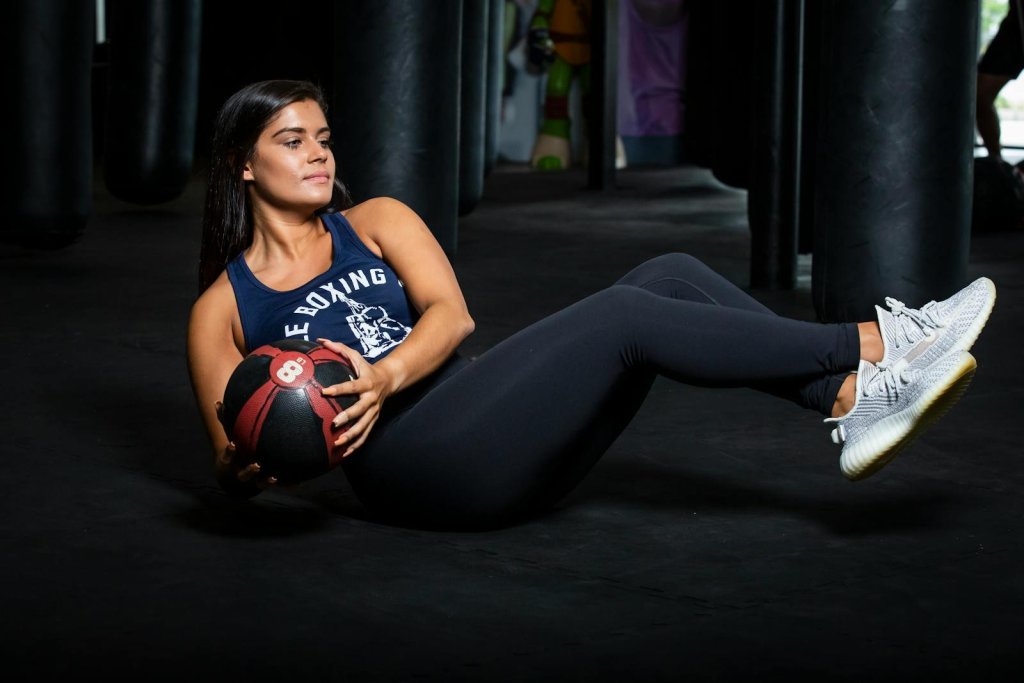
What Is the Russian Twist Exercise?
The Russian Twist is a core exercise that involves rotating your torso side to side while holding a static, reclined position. It challenges both rotational strength and core stability, making it more dynamic than traditional crunches or sit-ups.
- Main Muscles Worked: Obliques, rectus abdominis, transverse abdominis, hip flexors, and lower back stabilizers.
- Equipment Needed: None (optional medicine ball, dumbbell, or weight plate).
- Skill Level: Beginner to advanced, depending on variations and resistance.
How to Do the Russian Twist (Step-by-Step)
- Sit on the floor with your knees bent and feet flat.
- Lean back slightly until your torso forms about a 45° angle with the floor.
- Engage your core and lift your feet a few inches off the ground (optional for beginners).
- Clasp your hands together or hold a weight at chest level.
- Twist your torso to one side, bringing your hands toward the floor beside your hip.
- Return to the center and repeat on the opposite side.
- Continue alternating sides for 12–20 repetitions (6–10 each side).
Trainer Tip: Keep your spine long and chest lifted—avoid rounding your back. Move with control, not momentum, to protect your lower back and maximize muscle engagement.
Benefits of the Russian Twist Exercise
1. Strengthens Core and Obliques
The Russian Twist builds rotational strength in the obliques—crucial for sports, daily activities, and overall torso definition. A 2021 study reported that rotational core training significantly enhances lateral stability and trunk endurance in adults.
2. Improves Spinal Stability
The exercise strengthens deep core stabilizers like the transverse abdominis and erector spinae, which help maintain proper posture and reduce the risk of back pain.
3. Enhances Balance and Coordination
Maintaining control through rotation improves neuromuscular coordination and balance—especially when performed on an unstable surface or with lifted feet.
4. Boosts Athletic Performance
Rotational strength supports performance in sports requiring trunk movement, such as golf, tennis, and baseball.
5. Can Be Modified for All Levels
You can make the Russian Twist easier (feet on floor, no weight) or harder (weighted, decline surface, or slow tempo) to match your fitness level.
Variations of the Russian Twist
Below are the most effective Russian Twist variations, each offering a unique challenge to improve core strength, stability, and muscle endurance.
1. Seated Russian Twist (Bodyweight)
Why it works:
This foundational version strengthens your obliques and deep core stabilizers without stressing the lower back. It teaches proper control and rotation mechanics, ideal for beginners learning form.
Muscles worked:
Obliques, rectus abdominis, transverse abdominis, hip flexors.
How to do it:
- Sit with knees bent and feet on the floor.
- Lean back slightly to engage your core, maintaining a straight spine.
- Clasp your hands together and twist your torso side to side, touching the floor beside your hips.
- Perform 12–20 reps total (6–10 per side).
Trainer Tip:
Keep your chest lifted and rotate from your torso, not just your arms. Engage your abs to control each twist.
2. Weighted Russian Twist
Why it works:
Adding weight (like a dumbbell or medicine ball) increases resistance and intensity, helping build stronger obliques and improve rotational power.
Muscles worked:
External and internal obliques, rectus abdominis, transverse abdominis, shoulders.
How to do it:
- Hold a dumbbell, plate, or medicine ball at chest level.
- Lean back into a 45° angle and engage your core.
- Twist your torso side to side, lightly touching the weight beside each hip.
- Keep movements slow and controlled.
Trainer Tip:
Start with light resistance (2–4 kg) until your form is perfect. Don’t rush — control and tension are key.
3. Feet-Elevated Russian Twist
Why it works:
Lifting your feet adds instability, forcing your core and hip flexors to work harder for balance and control.
Muscles worked:
Obliques, rectus abdominis, hip flexors, erector spinae.
How to do it:
- Begin seated with knees bent and feet off the floor.
- Lean back slightly while keeping your spine neutral.
- Rotate your torso slowly side to side while maintaining balance.
- Avoid swinging or dropping your legs.
Trainer Tip:
Focus on small, controlled twists. If your lower back feels strained, place your feet back on the floor.
4. Decline Russian Twist
Why it works:
The decline bench increases gravitational resistance, intensifying abdominal engagement and building strength through a greater range of motion.
Muscles worked:
Rectus abdominis, obliques, transverse abdominis, lower back stabilizers.
How to do it:
- Sit on a decline bench with your feet secured under the pads.
- Lean back to engage your abs and hold your hands (or a weight) in front of you.
- Twist slowly side to side, keeping your core tight and spine neutral.
- Perform 10–15 controlled reps per side.
Trainer Tip:
Avoid leaning too far back — maintain a slight recline to protect your lower back. Breathe steadily throughout the movement.
5. Cable or Band Twist
Why it works:
This standing variation trains anti-rotation stability and functional core strength — ideal for improving athletic performance and injury prevention.
Muscles worked:
Obliques, transverse abdominis, rectus abdominis, glutes, lower back.
How to do it:
- Attach a resistance band or cable handle at chest height.
- Stand sideways to the anchor point, feet shoulder-width apart.
- Hold the handle with both hands extended in front of your chest.
- Rotate your torso away from the anchor point, keeping hips stable.
- Return slowly and repeat for 10–15 reps per side.
Trainer Tip:
Keep your hips and lower body still — rotation should come from your torso. Exhale as you twist for better core activation.
Common Mistakes to Avoid
- Rounding the Lower Back: Keep your spine neutral to avoid compression.
- Using Momentum: Move slowly to engage muscles fully.
- Over-Rotation: Only rotate until your torso aligns with your hips; excessive twisting can strain your spine.
- Holding Breath: Breathe steadily—exhale on each twist, inhale at the center.
Safety & Precautions
- Avoid if you have acute lower-back or spinal issues unless cleared by a professional.
- Beginners should start with feet on the floor to reduce stress on the lumbar region.
- Warm up before performing—light cardio and dynamic core activations help prepare your body.
- Stop immediately if you feel sharp or radiating pain.
Programming Tips
- Reps/Sets: 2–3 sets of 12–20 reps (6–10 per side).
- Frequency: 2–3 times per week within a balanced core routine.
- Rest: 30–45 seconds between sets.
- Pair With: Plank variations, bird dogs, and side planks for complete core balance.
FAQs
1. Is the Russian Twist good for beginners?
Yes. Start with feet on the floor and no weight, then progress gradually.
2. Does it reduce belly fat?
It strengthens your core but doesn’t spot-reduce fat. Combine with cardio and a balanced diet.
3. Can it hurt my back?
Only if done incorrectly. Keep your back straight and avoid over-rotating.
4. How many times per week should I do it?
Two to three times weekly is ideal for most people.
5. Is it better with or without weights?
Weights increase intensity, but beginners should master form first.
6. What muscles does it target most?
Mainly the obliques, rectus abdominis, and transverse abdominis.
7. What’s the best alternative if I can’t twist?
Try Pallof presses, dead bugs, or planks for anti-rotation core training.
Conclusion
The Russian Twist exercise is one of the most effective moves to build core strength, enhance stability, and define your obliques—but form matters more than speed. Start light, move with control, and integrate it into a full-body program for the best results.