
Medicine ball exercises are one of the most effective ways to train full-body strength, core stability, and explosive power using a single, versatile tool. By combining resistance with dynamic movement patterns—such as throws, slams, and rotational drills—medicine ball training challenges multiple muscle groups at once while reinforcing coordination and control.
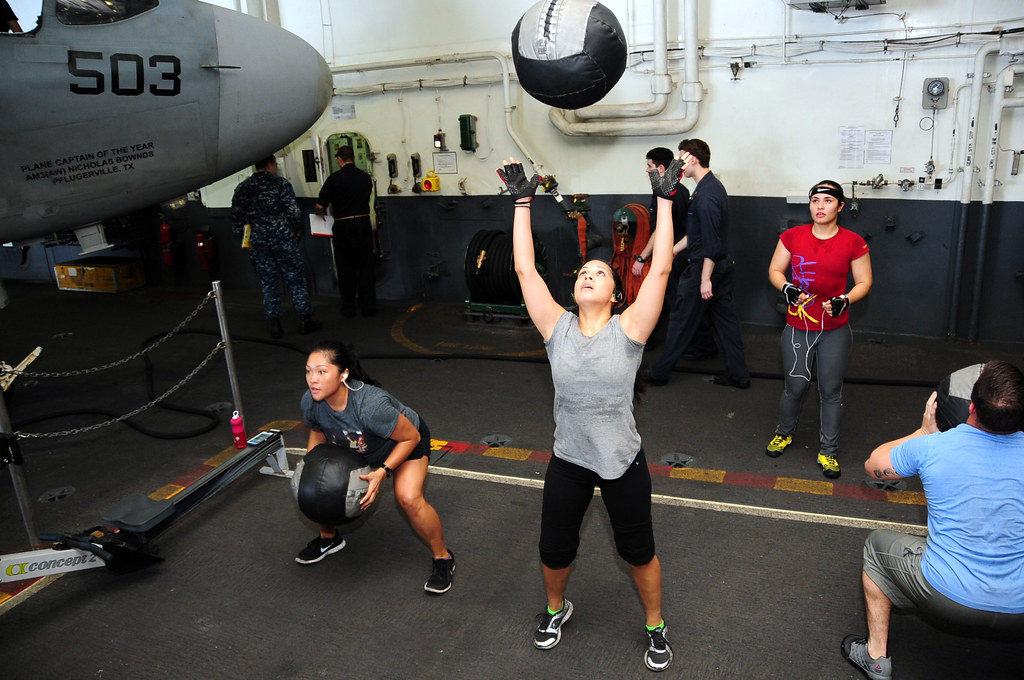
Understanding how medicine ball exercises work is important because they bridge the gap between traditional strength training and real-world movement. When programmed correctly, they can support strength development, athletic performance, and overall functional fitness using relatively simple equipment. This guide explains how medicine ball exercises work, which movements are most effective, how to use them safely, and how to structure them into a balanced routine.
What Are Medicine Ball Exercises?
Medicine ball exercises are strength and power movements performed using a weighted ball that can be lifted, thrown, rotated, or slammed. Unlike fixed machines, medicine balls allow free movement in multiple planes, encouraging natural coordination between the upper body, lower body, and core.
Most medicine ball exercises involve:
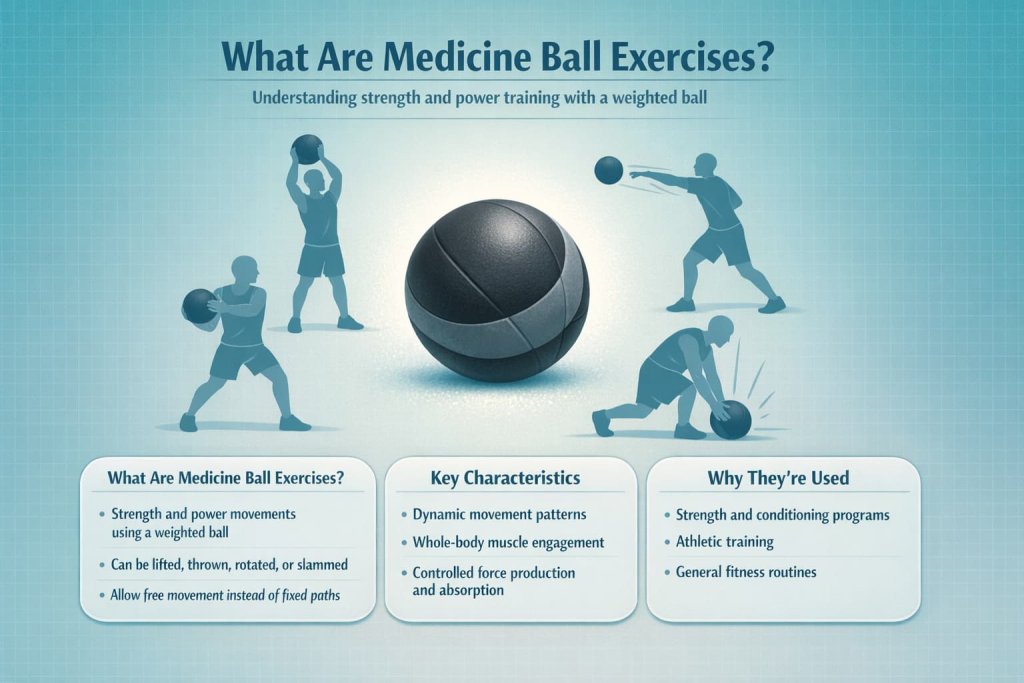
- Dynamic movement patterns
- Whole-body muscle engagement
- Controlled force production and absorption
Because of this, medicine ball training is commonly used in strength and conditioning programs, athletic training, and general fitness routines.
15 Best Medicine Ball Exercises for Full-Body Strength and Power
Below are 15 commonly used medicine ball exercises that collectively target the entire body. These can be mixed and matched depending on experience level and goals.
1. Medicine Ball Squat Press
How to do it:
- Hold the medicine ball at chest height with both hands
- Stand with feet shoulder-width apart
- Lower into a squat, keeping your chest upright
- As you stand up, press the ball overhead in one smooth motion
- Lower the ball back to chest level and repeat
Why it works:
This movement links lower-body strength with upper-body pushing while requiring core stabilization. The coordinated squat-to-press pattern mimics real-world lifting tasks and improves total-body force transfer.
Muscles worked:
Quadriceps, glutes, shoulders, triceps, core stabilizers
Trainer Tip:
Choose a ball weight that allows you to press smoothly overhead without arching your lower back.
2. Medicine Ball Slam
How to do it:
- Stand tall holding the ball overhead
- Brace your core and slightly bend your knees
- Forcefully slam the ball straight down to the floor
- Catch or pick up the ball and reset for the next rep
Why it works:
Slams emphasize rapid force production and full-body engagement, making them effective for power development and metabolic conditioning.
Muscles worked:
Lats, shoulders, core, glutes, quadriceps
Trainer Tip:
Exhale forcefully during the slam to reinforce core bracing and protect the spine.
3. Medicine Ball Russian Twist
How to do it:
- Sit on the floor with knees bent
- Hold the ball close to your chest
- Lean back slightly while keeping your spine neutral
- Rotate your torso side to side, moving the ball with control
Why it works:
This exercise trains rotational control and anti-rotation strength, which are key components of functional core stability.
Muscles worked:
Obliques, rectus abdominis, deep core stabilizers
Trainer Tip:
Avoid rushing the movement—slow, controlled rotations are more effective than speed.
4. Medicine Ball Chest Pass
How to do it:
- Hold the ball at chest level with elbows bent
- Stand facing a wall or training partner
- Forcefully push the ball forward like a chest pass
- Catch the ball on the rebound or receive it back
Why it works:
Chest passes develop upper-body power by training rapid pushing mechanics and coordination.
Muscles worked:
Chest, shoulders, triceps, core
Trainer Tip:
Use a lighter ball to maintain speed and crisp movement rather than grinding the rep.
5. Medicine Ball Overhead Throw
How to do it:
- Hold the ball overhead with arms extended
- Slightly hinge at the hips
- Explosively throw the ball forward or backward (space permitting)
- Reset before the next repetition
Why it works:
Overhead throws reinforce total-body power, particularly through the hips and trunk.
Muscles worked:
Glutes, hamstrings, shoulders, core
Trainer Tip:
Initiate the throw from the hips—not just the arms—to maximize power output.
6. Medicine Ball Wood Chop
How to do it:
- Hold the ball with both hands
- Start with the ball near one shoulder
- Rotate your torso diagonally downward across your body
- Return to the starting position and repeat on both sides
Why it works:
Wood chops train rotational strength and coordinated movement between the hips, trunk, and shoulders.
Muscles worked:
Obliques, shoulders, hips, core stabilizers
Trainer Tip:
Keep your hips and torso moving together to reduce strain on the lower back.
7. Medicine Ball Reverse Lunge With Rotation
How to do it:
- Hold the ball at chest height
- Step one leg back into a reverse lunge
- Rotate the ball toward the front leg
- Return to standing and alternate sides
Why it works:
This exercise combines lower-body strength with controlled rotation, improving balance and coordination.
Muscles worked:
Glutes, quadriceps, hamstrings, obliques
Trainer Tip:
Maintain an upright torso throughout the lunge to support spinal alignment.
8. Medicine Ball Deadlift
How to do it:
- Place the ball on the floor between your feet
- Hinge at the hips and bend your knees
- Grip the ball and stand up by driving through your heels
- Lower the ball back to the floor with control
Why it works:
This variation reinforces proper hip-hinge mechanics and posterior-chain engagement.
Muscles worked:
Glutes, hamstrings, lower back, core
Trainer Tip:
Focus on pushing the floor away rather than pulling with your arms.
9. Medicine Ball Push-Up (Hands on Ball)
How to do it:
- Place both hands on the medicine ball
- Extend your legs into a plank position
- Lower your chest toward the ball
- Press back up while maintaining a stable core
Why it works:
The unstable surface increases core demand and shoulder stabilization compared with floor push-ups.
Muscles worked:
Chest, shoulders, triceps, core stabilizers
Trainer Tip:
If balance is challenging, widen your feet to improve stability.
10. Medicine Ball Wall Toss
How to do it:
- Stand facing a wall holding the ball
- Rotate slightly away from the wall
- Explosively toss the ball into the wall
- Catch the rebound and repeat
Why it works:
Wall tosses develop rotational power and reactive coordination.
Muscles worked:
Obliques, shoulders, hips, core
Trainer Tip:
Keep your movements sharp and controlled—avoid over-rotating.
11. Medicine Ball Sit-Up and Throw
How to do it:
- Lie on your back holding the ball at your chest
- Perform a sit-up
- At the top, throw the ball forward or to a partner
- Reset and repeat
Why it works:
This movement blends trunk flexion with upper-body power for dynamic core engagement.
Muscles worked:
Abdominals, shoulders, hip flexors
Trainer Tip:
Engage your core before initiating the sit-up to reduce neck strain.
12. Medicine Ball Side Toss
How to do it:
- Stand sideways to a wall
- Hold the ball at waist height
- Rotate your torso and throw the ball into the wall
- Catch and repeat on both sides
Why it works:
Side tosses emphasize lateral power and trunk rotation, which are essential for athletic movement.
Muscles worked:
Obliques, hips, shoulders
Trainer Tip:
Allow your hips to rotate naturally with the throw for smoother force transfer.
13. Medicine Ball Squat Hold
How to do it:
- Hold the ball at chest level
- Lower into a squat
- Hold the position for a set duration
- Stand up slowly to finish
Why it works:
Isometric holds build endurance and reinforce proper squat positioning.
Muscles worked:
Quadriceps, glutes, core
Trainer Tip:
Keep your chest tall and knees tracking over your toes during the hold.
14. Medicine Ball Overhead Carry
How to do it:
- Hold the ball overhead with arms extended
- Walk forward with controlled steps
- Maintain a neutral spine and braced core
Why it works:
Overhead carries train shoulder stability, posture, and core endurance simultaneously.
Muscles worked:
Shoulders, upper back, core, hips
Trainer Tip:
If your lower back arches, lower the ball slightly until control improves.
15. Medicine Ball Figure-Eight Pass
How to do it:
- Stand with feet slightly wider than hip-width
- Pass the ball in a figure-eight pattern around your legs
- Keep your knees bent and torso stable
- Move smoothly in both directions
Why it works:
This drill improves coordination, grip endurance, and lower-body control.
Muscles worked:
Forearms, hips, glutes, core stabilizers
Trainer Tip:
Start slow and prioritize smooth transitions before increasing speed.
How to Choose the Right Medicine Ball Weight
Choosing the correct ball weight is essential for safety and effectiveness.
General guidelines commonly used in fitness programming include:
- Light (2–6 lb): Faster, explosive throws and rotational drills
- Moderate (8–12 lb): Controlled strength movements and core work
- Heavier (15 lb+): Slower strength-focused lifts when technique is solid
The American College of Sports Medicine emphasizes that load should allow proper form throughout the movement. If speed or posture breaks down, the ball is likely too heavy.
How to Structure a Medicine Ball Workout
Medicine ball exercises can be programmed in different ways depending on your goal.
Strength-Focused Session
- 6–8 exercises
- 3–4 sets per movement
- 8–12 controlled repetitions
- Moderate ball weight
Power-Focused Session
- 4–6 explosive exercises
- 3–5 sets
- 4–6 fast repetitions
- Lighter ball weight
- Longer rest periods (about 2–3 minutes) to maintain output
Conditioning Circuit
- 5–7 exercises
- 30–45 seconds per movement
- Short rest intervals
- Moderate pace with emphasis on control
Public health guidance from the Centers for Disease Control and Prevention recommends including muscle-strengthening activities at least two days per week, which medicine ball training can support when properly scaled.
Benefits of Medicine Ball Exercises for Full-Body Training
Medicine ball exercises offer several evidence-supported benefits when used appropriately.
Improve Total-Body Strength
Many medicine ball movements require the legs, hips, core, and upper body to work together. Squats, presses, and lunges with a medicine ball distribute load across multiple muscle groups rather than isolating a single area.
Support Core Stability and Rotation
Rotational throws, chops, and twists challenge the trunk to resist or produce movement, helping train core muscles that stabilize the spine during daily activities and sports.
Develop Power and Coordination
Explosive exercises like slams and throws emphasize speed and force production. Strength and conditioning guidance from the National Strength and Conditioning Association highlights medicine balls as a useful tool for power development when lighter loads and controlled technique are used.
Add Variety With Minimal Equipment
A single medicine ball can be used for dozens of exercises, making it a practical option for home workouts or limited training spaces.
Safety Tips for Medicine Ball Exercises
Medicine ball exercises are generally safe when performed with good technique, but a few precautions matter.
- Warm up hips, shoulders, and trunk before explosive movements
- Use enough space, especially for throws and slams
- Start with lighter weights when learning new exercises
- Avoid forcing speed if control is lost
- Stop any movement that causes joint pain
Individuals with existing shoulder, spine, or balance issues should begin with slower, controlled variations and may benefit from professional guidance.
Common Mistakes to Avoid
- Using a ball that is too heavy for explosive drills
- Rushing movements without control
- Over-rotating the spine during twisting exercises
- Skipping warm-up and mobility work
- Training power movements while fatigued
Avoiding these mistakes helps reduce injury risk and improves training quality.
Who Should Be Careful Before Doing Medicine Ball Exercises
Medicine ball exercises involve dynamic and sometimes explosive movements, which may not be suitable for everyone. Extra caution is advised for:
- People with recent or ongoing shoulder, back, hip, knee, or wrist injuries
- Individuals with balance or coordination difficulties
- Those with spinal conditions or persistent joint pain
- Beginners who are new to power or rotational training
Starting with lighter balls, slower movements, and controlled ranges of motion can help reduce risk. Stop any exercise that causes pain or loss of control.
FAQs About Medicine Ball Exercises
Are medicine ball exercises good for beginners?
Yes. Beginners can start with lighter balls and slower movements. Many exercises can be modified for comfort and control.
Can medicine ball exercises build muscle?
They can support muscle development when used with sufficient resistance and volume, especially for the core and supporting muscle groups.
How often should I do medicine ball training?
Most people can include medicine ball exercises 2–3 times per week, depending on overall training load.
Are medicine ball exercises good for core strength?
Yes. Many movements require the core to stabilize, rotate, or resist force, which supports functional core strength.
What is the difference between a medicine ball and a slam ball?
Medicine balls may bounce and are often used for throws and passes. Slam balls are designed not to bounce and are mainly used for slams.
Can medicine ball exercises replace weight training?
They complement traditional weight training but usually work best alongside resistance exercises like free weights or machines.
Conclusion
Medicine ball exercises offer a practical, effective way to train full-body strength, coordination, and power using a single piece of equipment. Whether your goal is general fitness, athletic performance, or movement variety, medicine ball training can be adapted to fit your needs.
If you’re building a balanced routine, start light, focus on quality movement, and gradually progress intensity over time. Used consistently, medicine ball exercises can become a valuable part of long-term strength and conditioning.
References
- CDC: Adult Physical Activity Guidelines (muscle-strengthening 2+ days/week)
- World Health Organization: Physical Activity Recommendations (strength training guidance)
- WHO 2020 Guidelines on Physical Activity and Sedentary Behaviour (full guideline on PMC)
- ACSM: Physical Activity Guidelines (evidence-based activity recommendations)
- American Heart Association: Physical Activity Recommendations for Adults
- NSCA: Basics of Strength and Conditioning Manual (training principles and facility/safety notes)
- ACSM Position Stand: Progression Models in Resistance Training for Healthy Adults (PubMed)
- Trunk Muscle Activity During the Side Medicine-Ball Throw (PubMed)