
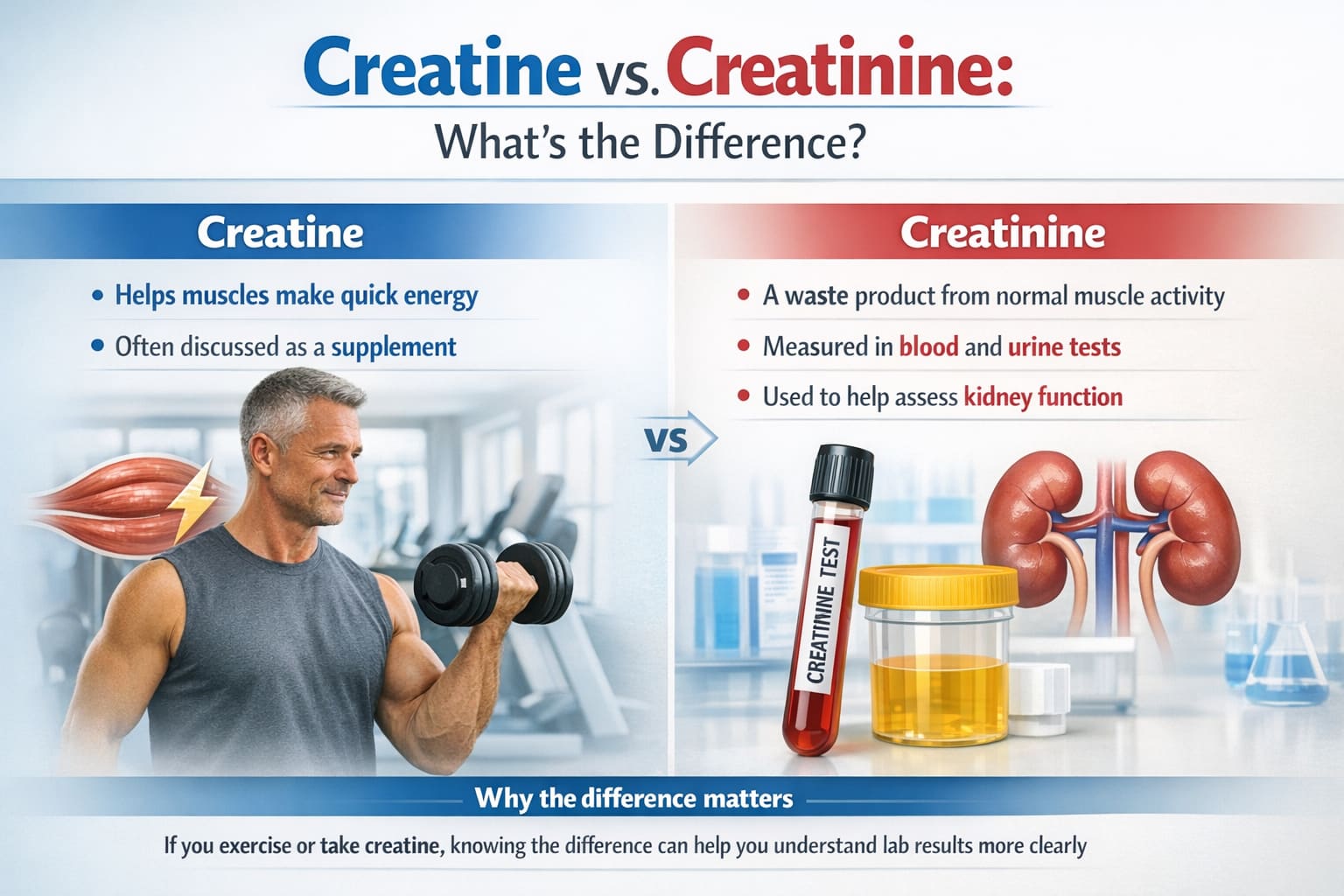
Creatine is a compound your body uses to help muscles make quick energy, while creatinine is a waste product your body makes from normal muscle activity and clears through the kidneys. That difference matters because creatine is usually discussed as a supplement, but creatinine is what shows up on blood and urine tests used to assess kidney function. If you exercise regularly or take creatine, knowing the difference can help you read lab results more accurately and avoid common misunderstandings.
Creatine vs Creatinine at a Glance
Here is the simplest way to separate the two:
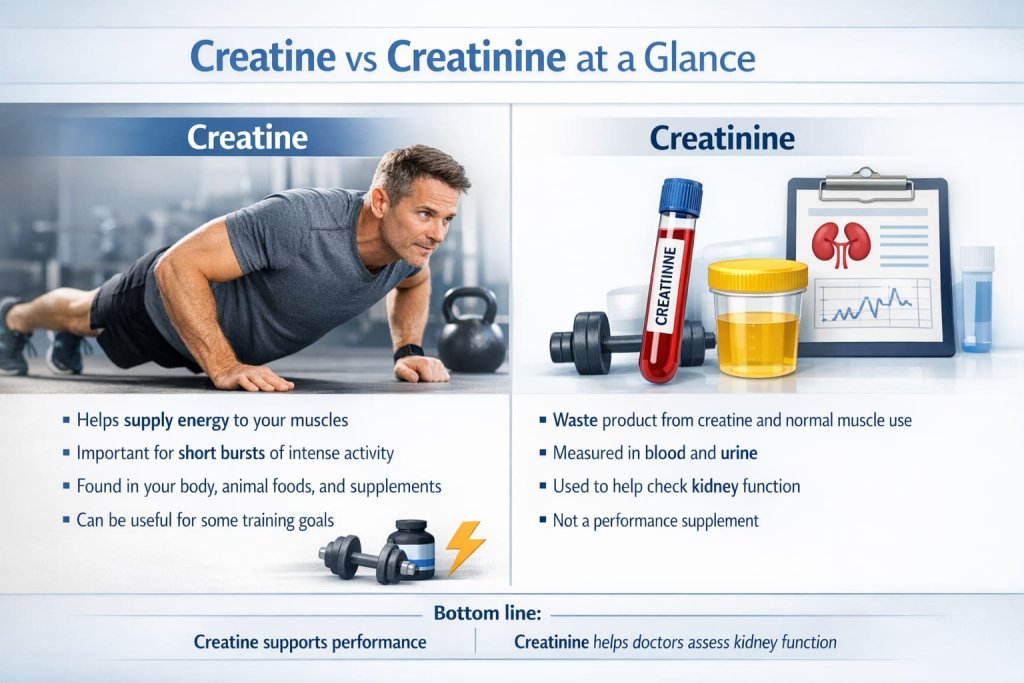
- Creatine helps supply energy to your muscles, especially during short bursts of intense activity.
- Creatinine is a waste product that comes from creatine and normal muscle use.
- Creatine is found in your body, in animal foods, and in supplements.
- Creatinine is measured in blood and urine to help check kidney function.
- Creatine can be useful for some training goals.
- Creatinine is not a performance supplement and is not something you take.
What Is Creatine?

According to the NIH Office of Dietary Supplements guide to exercise and athletic performance, creatine is a compound stored in your muscles that helps supply energy. Your body makes some creatine on its own, and you also get some from animal-based foods such as beef and salmon. In supplement form, creatine is most often used to support repeated short bursts of high-intensity exercise, such as sprinting or weight training. Creatine monohydrate is the most widely used and studied form.
In practical terms, creatine is about muscle energy and exercise performance, not kidney testing. It helps regenerate ATP, which is the quick energy source your muscles rely on during intense effort. That is why creatine shows up so often in sports nutrition conversations.
What Is Creatinine?
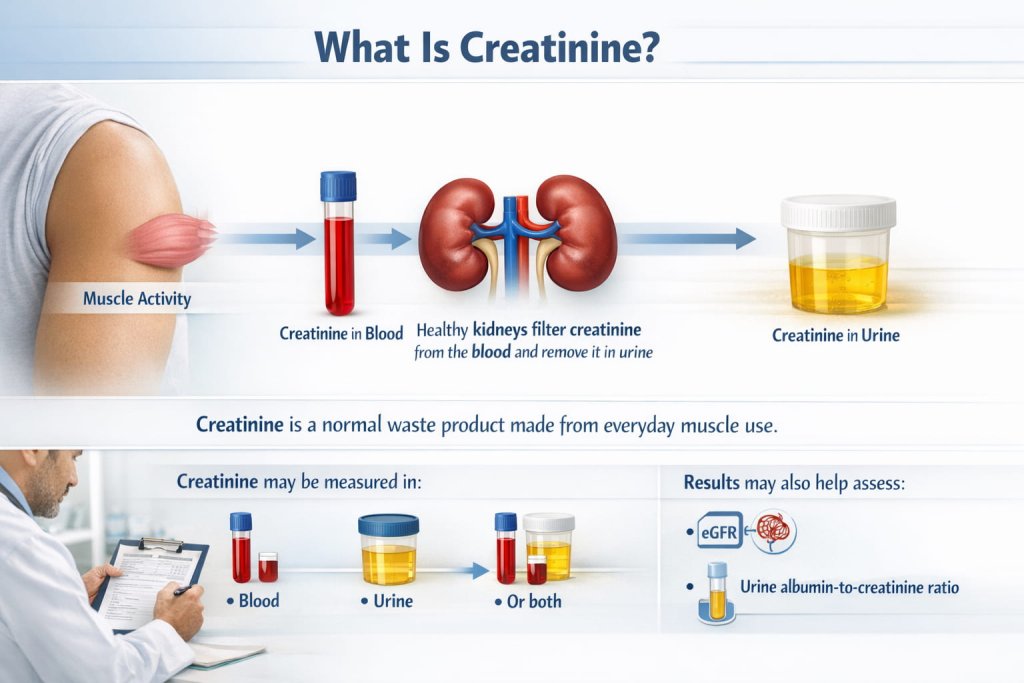
A MedlinePlus creatinine test overview explains that creatinine is a normal waste product made when you use your muscles and some muscle tissue breaks down. Your kidneys normally filter creatinine from your blood and remove it through urine. If kidney function drops, creatinine can build up in the blood.
This is why creatinine is used in routine health care. It is part of many kidney evaluations, but it is not interpreted in isolation. Creatinine can be measured in blood, urine, or both, and those results are often used to calculate other kidney markers such as estimated glomerular filtration rate, or eGFR, and urine albumin-to-creatinine ratio.
How Are Creatine and Creatinine Connected?
The two words sound similar because they are biologically related. As MedlinePlus explains in its creatinine clearance test page, creatinine is a waste product of creatine. Creatine helps supply energy to muscles, and over time some of it is converted into creatinine, which then circulates in the blood until the kidneys clear it.
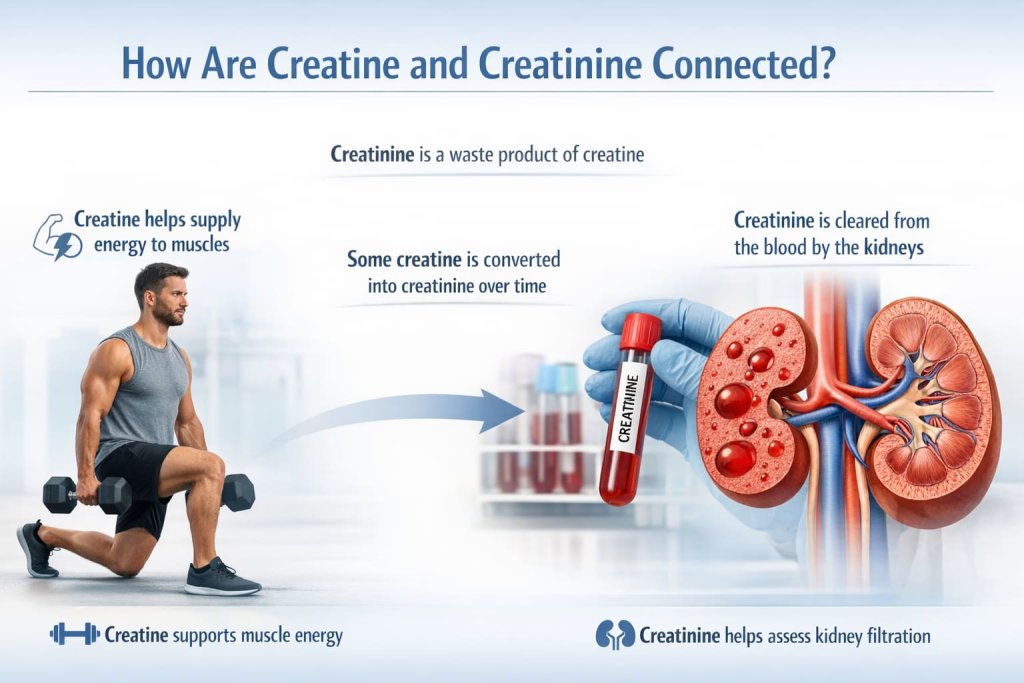
That connection is the main reason people mix them up. But the roles are very different:
- Creatine supports muscle energy.
- Creatinine helps clinicians assess how well the kidneys are filtering.
Can Creatine Supplements Raise Creatinine?
Yes, creatine supplements can affect how kidney blood tests look. MedlinePlus notes that certain medicines and supplements can affect creatinine test results, and NHS guidance warns that creatine supplements can affect kidney function test results and make them appear abnormal. That does not automatically mean the kidneys are damaged, but it does mean the result may need more context.
This is one of the biggest reasons people search for “creatine vs creatinine.” Someone starts taking creatine, gets routine lab work, sees creatinine on the report, and assumes the supplement has harmed their kidneys. That is too simple. A creatinine result has to be interpreted alongside other information, including eGFR, urine albumin, health history, medication use, muscle mass, and whether the person uses creatine supplements.
What to do before a creatinine or urine albumin test
If you use creatine, tell the clinician ordering the test before your blood draw or urine test. MedlinePlus says some people may be told not to eat meat for 24 hours before a creatinine test because meat can temporarily raise creatinine levels. For a urine albumin-to-creatinine ratio, the MedlinePlus microalbumin creatinine ratio page also notes that hard exercise can temporarily raise urine albumin, so it is worth asking how to prepare and whether any supplements or medicines could affect your results.
Does a High Creatinine Level Always Mean Kidney Disease?
No. A higher creatinine level does not always mean kidney disease. MedlinePlus says creatinine testing alone is not the best way to check kidney function because people make different amounts of creatinine depending on muscle mass, diet, age, and activity level. In other words, a muscular person, someone who recently ate a lot of meat, or someone using creatine supplements may have a result that needs careful interpretation rather than a quick conclusion.
That is also why creatinine trends over time are often more helpful than one isolated number. A clinician may look at whether the result is stable, rising, or paired with other abnormal findings such as albumin in the urine.
Which Kidney Tests Matter More Than Creatinine Alone?
For kidney screening and follow-up, creatinine is useful, but it is not the whole picture. MedlinePlus says eGFR is more accurate than creatinine alone for measuring kidney health, and the National Institute of Diabetes and Digestive and Kidney Diseases page on CKD tests and diagnosis identifies eGFR and urine albumin as key markers in kidney disease evaluation.
This matters because kidney disease can be present even when a creatinine result does not look dramatically abnormal. The NIDDK urine albumin assessment guidance notes that for many people, albuminuria is the earliest sign of chronic kidney disease, which is why urine albumin testing adds value that creatinine alone can miss.
A urine albumin-to-creatinine ratio, or UACR, is especially important because it can detect early kidney damage even when creatinine has not changed much yet. NIDDK notes that 30 mg/g or less is normal, while more than 30 mg/g may be a sign of kidney disease, and abnormal results are often repeated to confirm them.
NIDDK also states that using both creatinine and cystatin C to estimate GFR is preferred and more accurate than using serum creatinine alone, especially when the result is close to an important clinical decision point. Not every lab uses cystatin C routinely, but it can be helpful when a creatinine-based estimate may be misleading.
If a creatinine-based eGFR seems lower than expected in a muscular person or someone using creatine, the next step is usually not panic. A clinician may repeat the test, review diet and supplements, and in some cases order cystatin C or a combined creatinine-cystatin C eGFR, because the NIDDK eGFR equations for adults page says the combined approach is more accurate than serum creatinine alone, especially when the result is close to an important decision threshold.
Why Creatinine Can Be Harder to Interpret in Lifters and Creatine Users
Creatinine is affected by more than kidney filtration. The University Hospitals of North Midlands creatinine test page notes that creatinine values vary with muscle mass and dietary intake, including creatine supplements. MedlinePlus also says creatinine clearance can still be useful in people with very high muscle mass or major muscle loss, because standard estimates may be less straightforward in those situations.
That means athletes, bodybuilders, and regular gym-goers should be cautious about self-diagnosing from one lab number. A mildly abnormal creatinine level in a muscular person who uses creatine does not mean the same thing as the same number in a frail older adult with diabetes or high blood pressure. Context matters.
Creatine vs Creatinine vs Creatine Kinase
Another common mix-up is creatine kinase, often shortened to CK or CPK. A MedlinePlus creatine kinase test explanation explains that CK is an enzyme, not a supplement and not a kidney waste product. CK testing is mainly used to help diagnose or monitor muscle injury and diseases that damage muscle.
So the quick breakdown is:
- Creatine = muscle energy compound
- Creatinine = waste product used in kidney testing
- Creatine kinase = enzyme linked to muscle damage or muscle disease evaluation
Should You Be Worried About Creatine and Kidney Tests?
For healthy adults, the NIH Office of Dietary Supplements says creatine is generally safe when used for weeks or months and appears safe for long-term use over several years as well. Common side effects include weight gain from water retention and occasional gastrointestinal discomfort. In studies, people often use a loading phase of about 20 grams per day for 5 to 7 days, followed by 3 to 5 grams per day.
Still, “generally safe” does not mean “ignore your labs.” If you have known kidney disease, previous abnormal kidney tests, one kidney, or you take medicines that require kidney monitoring, it is smart to discuss creatine with a clinician before starting. It is also important to mention creatine use before lab testing, because supplements can affect how results are interpreted.
Safety Box
Who this is for: People trying to understand the difference between a common sports supplement and a common kidney lab marker.
Who should be more careful: Anyone with chronic kidney disease, abnormal kidney labs, a history of kidney problems, or a need for frequent kidney monitoring should not guess based on online lab ranges alone. Bring your supplement list, including creatine, to your clinician or testing appointment.
Supplement tip: Creatine monohydrate is the most widely studied form. Because sports supplements can vary in quality, products with independent third-party verification can offer extra reassurance about what is actually in the container.
FAQ: Creatine vs Creatinine
Is creatine the same as creatinine?
No. Creatine helps supply energy to muscles. Creatinine is a waste product that comes from creatine and normal muscle metabolism and is used in kidney testing.
Can creatine supplements make creatinine look high?
They can affect how kidney function tests are interpreted. That is why it is important to tell your clinician if you use creatine before blood or urine testing.
Does high creatinine always mean kidney failure?
No. A higher creatinine result can reflect many factors, including muscle mass, diet, activity, and supplements. Kidney disease is assessed more accurately with the full clinical picture, especially eGFR and urine albumin results.
Should I stop creatine before a kidney blood test?
Do not stop prescribed medicines on your own. If you take creatine, let the clinician ordering the test know ahead of time and follow their instructions, because supplements can affect the result.
Is creatine kinase the same thing as creatinine?
No. Creatine kinase is an enzyme measured mainly when muscle damage or muscle disease is suspected. It is different from both creatine and creatinine.
Bottom Line
Creatine and creatinine are related, but they are not interchangeable. Creatine supports muscle energy. Creatinine is a waste product used in kidney testing. That one distinction clears up most of the confusion. If you use creatine and your lab report includes creatinine, do not panic or self-diagnose from one number. Look at the full kidney picture, including eGFR and urine albumin, and make sure your clinician knows which supplements you take. That is the safest and most accurate way to understand your results.
This content is for informational purposes only and not medical advice.
References
- MedlinePlus — Creatinine Clearance Test
- MedlinePlus — Microalbumin Creatinine Ratio
- NIDDK — Chronic Kidney Disease Tests & Diagnosis
- NIDDK — Assess Urine Albumin
- NIDDK — eGFR Equations for Adults
- University Hospitals of North Midlands — Creatinine
- MedlinePlus — Creatine Kinase