
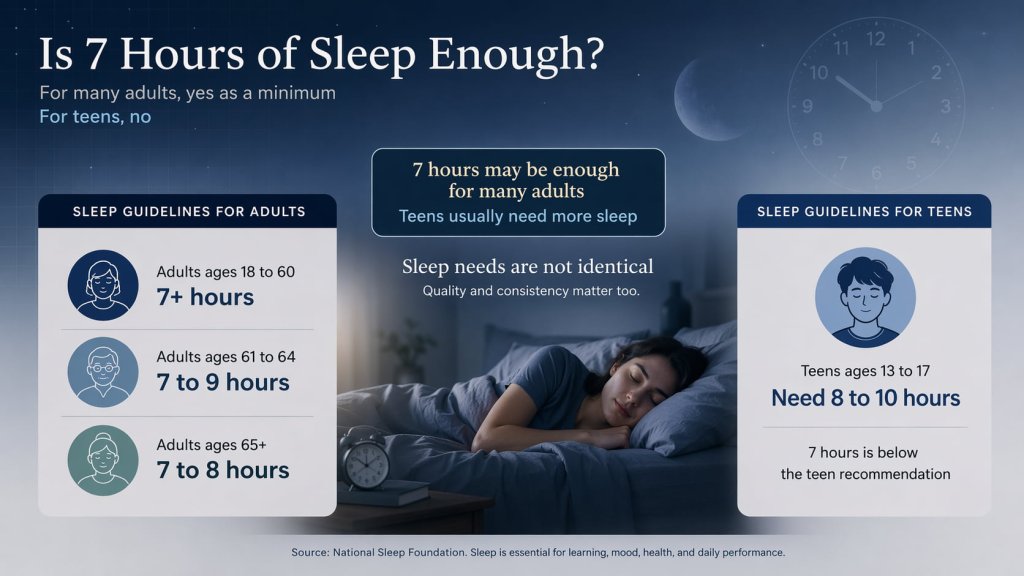
For most adults, yes, 7 hours of sleep is enough to meet the minimum recommended amount. But it is not enough for everyone, it is not enough for teens, and it only counts as healthy sleep if your sleep is regular, good quality, and leaves you functioning well during the day. The CDC says adults ages 18 to 60 should get 7 or more hours per night, while teens ages 13 to 17 need 8 to 10 hours.
That distinction matters because a lot of people ask “is 7 hours of sleep enough” when the real issue is something else: poor sleep quality, an irregular schedule, sleep debt, or an untreated sleep problem. The Office of Disease Prevention and Health Promotion notes that sleep should leave you feeling rested, not just add up to a certain number on paper.
One practical detail is easy to miss: 7 hours in bed is not always 7 hours of actual sleep. If it takes you a long time to fall asleep, you wake up often, or you lie awake in the early morning, your true sleep time may be much lower than the number on the clock. That is one reason someone can spend 7 hours in bed and still feel like they did not get enough sleep.
Is 7 hours of sleep enough for adults?
For many adults, yes. The CDC’s age-based guidance says adults ages 18 to 60 need 7 or more hours, adults ages 61 to 64 need 7 to 9 hours, and adults age 65 and older need 7 to 8 hours. So for a healthy adult, 7 hours is generally enough to meet the baseline recommendation.
Still, “enough” does not always mean “best for you.” The National Heart, Lung, and Blood Institute says adults generally need 7 to 9 hours a night, and the American Academy of Sleep Medicine says adults should sleep 7 or more hours on a regular basis to support optimal health, productivity, and daytime alertness. In other words, 7 hours is a solid floor for most adults, but some people function better closer to 8 or 9 hours.
When 7 hours of sleep may be enough and when it may not
In practical terms, 7 hours is more likely to be enough if you wake feeling reasonably rested, stay alert through the day, and keep a fairly regular sleep schedule. Good sleep is not just about duration. It also needs to be regular, refreshing, and reasonably uninterrupted.
Seven hours may not be enough if your sleep is broken up, you are repaying sleep debt, you work shifts, you are sick, or you routinely feel sleepy even after a full night in bed. NHLBI notes that lost sleep can build up as sleep debt, and sleeping much longer on days off can be a sign that you are not getting enough sleep during the week.
It is also worth noting that needing more than 7 hours for a while does not automatically mean something is wrong. After several short nights, illness, intense training, major stress, or a disrupted schedule, your body may need more sleep than usual to recover. In that situation, the better question is not just “Is 7 hours enough?” but also “Am I fully recovered, and am I sleeping well on a regular schedule?”
Is 7 hours of sleep enough for teens and kids?
No, not for teens. CDC guidance says teens ages 13 to 17 need 8 to 10 hours per night, and school-age children ages 6 to 12 need 9 to 12 hours. So if the person asking this question is 13, 15, or 17 years old, 7 hours is below the recommended range.
This matters in real life because too little sleep is common in adolescents. CDC data on high school students show that in 2021, the share of U.S. students not getting enough sleep ranged from 71% to 84% across states. That means 7 hours may feel normal to many teens, but it is still below the recommended amount.
Why regularly getting less than 7 hours matters
Regularly sleeping less than 7 hours is where official guidance starts to flag insufficient sleep in adults. CDC data show that more than 1 in 3 U.S. adults report not getting enough sleep.
The health side matters too. The CDC links short sleep with a higher risk of conditions such as type 2 diabetes, heart disease, high blood pressure, and stroke. NHLBI also links sleep deficiency with obesity, depression, poorer performance, and a greater risk of injury.
The performance side is just as important. Too little sleep can make it harder to learn, focus, react quickly, and make sound decisions. It can also raise the risk of mistakes at work or school and contribute to drowsy driving.
Signs 7 hours is not enough for you
A simple way to judge whether 7 hours is enough is to look at how you function, not just what the clock says. Warning signs include:
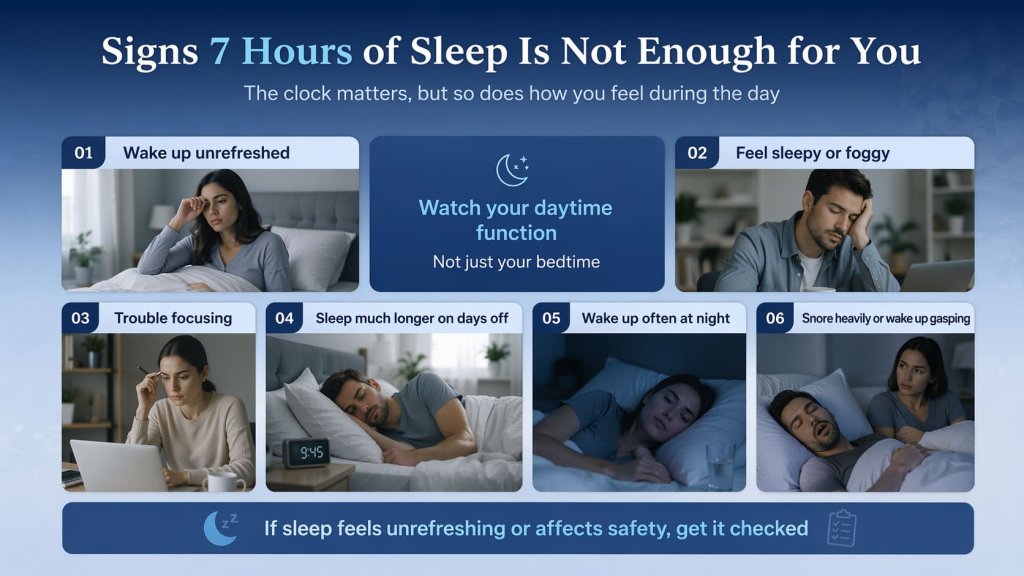
- Waking up feeling unrefreshed most mornings
- Feeling sleepy, foggy, or irritable during the day
- Having trouble focusing, remembering things, or reacting quickly
- Sleeping much longer on weekends or days off
- Waking up often during the night
- Snoring heavily, waking up gasping, or having breathing pauses during sleep
Those last signs matter because severe snoring, repeated awakenings, daytime sleepiness, and waking up gasping can point to a sleep disorder rather than simply “not enough hours.” MedlinePlus and other official sleep resources advise paying attention to persistent symptoms, not just sleep duration.
How to make 7 hours of sleep work better
If you already spend about 7 hours in bed, improving sleep quality may help more than simply trying to force a longer night. Healthy sleep habits that often make a real difference include:
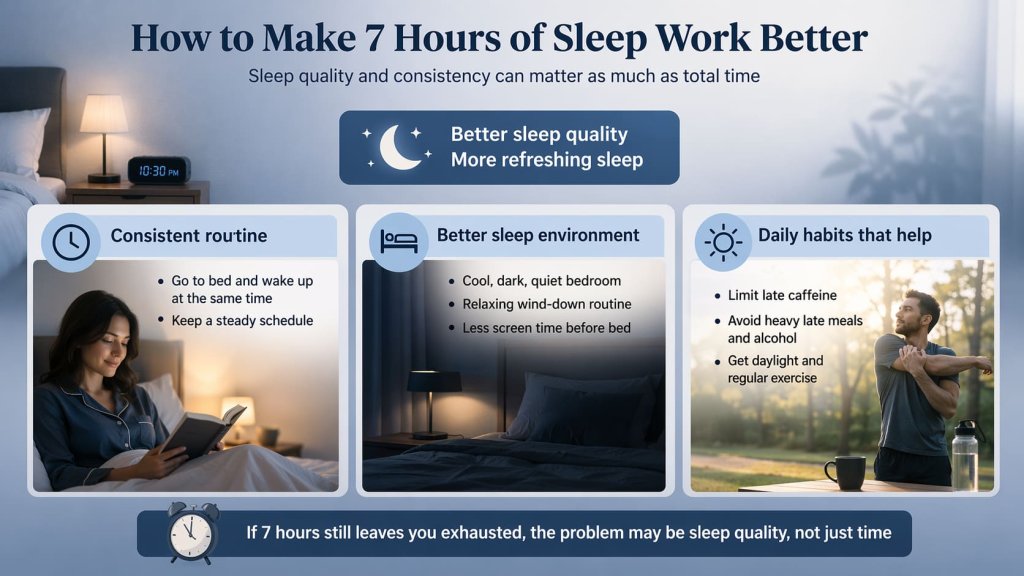
- Go to bed and wake up at the same time every day
- Keep your bedroom cool, dark, quiet, and relaxing
- Turn off phones, TVs, and other devices before bed
- Avoid caffeine later in the day
- Avoid alcohol and large meals close to bedtime
- Exercise regularly, but not too close to bedtime
- Get daylight exposure during the day
- If you cannot fall asleep after about 20 minutes, get up and do something relaxing before trying again
If these basics are in place and you still feel drained after 7 hours, the next step is not always “just sleep longer.” It may be more useful to look for insomnia, sleep apnea, an irregular schedule, medication effects, or another health issue affecting sleep quality.
When to talk to a doctor
It is worth talking to a clinician if you regularly get around 7 hours of sleep but still do not feel well rested, or if you have ongoing trouble falling asleep, staying asleep, snore heavily, or wake up choking or gasping. Persistent daytime sleepiness, poor concentration, and unrefreshing sleep can all be signs that something more than sleep length is going on.
It is also smart to get checked if tiredness is affecting driving, school, work, mood, or safety. Sleep problems are common, and some are very treatable once they are properly identified.
Do not ignore sleepiness that creates an immediate safety risk. If you are struggling to stay awake while driving, drifting out of your lane, nodding off during school or work, or falling asleep when you need to stay alert, treat that as a warning sign. Do not drive drowsy, and seek medical advice sooner rather than later if this keeps happening.
FAQ
Is 7 hours of sleep enough if I feel fine?
For many adults, yes. If you sleep about 7 hours consistently, wake up rested, and stay alert and functional during the day, that usually fits official adult recommendations. But if you feel “fine” only because you are used to functioning while tired, the picture can be misleading.
Is 7 hours of sleep enough for a 16-year-old?
No. A 16-year-old falls in the teen range, and teens need 8 to 10 hours per night. Seven hours is below the recommended amount.
Can I make up for too little sleep on weekends?
Only partly. Lost sleep can build into sleep debt, and while extra sleep may help with short-term alertness, it does not fully replace the benefits of regular nighttime sleep. Sleeping much longer on weekends can also be a sign that you are not getting enough sleep during the week.
A short nap may help with alertness in the moment, but it does not fully replace regular nighttime sleep. Long or late naps can also make it harder to fall asleep at night, which can keep the cycle going. If you nap, keeping it short and earlier in the day is usually the safer approach.
What if I seem to need more than 7 hours?
That can be normal. Sleep needs vary from person to person, and some adults simply do better with 8 or even 9 hours. Genetics, age, stress, illness, training load, and overall health can all affect how much sleep feels best for you.
Final answer
For most adults, 7 hours of sleep is enough to meet the minimum recommendation, but it is better to think of it as a baseline than a perfect target for everyone. If you feel rested, sleep well, and function well during the day, 7 hours may be enough for you. If you still feel tired, rely on catch-up sleep, or have symptoms like snoring, repeated awakenings, or daytime sleepiness, 7 hours may not be enough in practice, or your sleep quality may be the real problem.
Use the number as a guide, but pay even closer attention to how you actually feel and function. If 7 hours does not leave you feeling restored, focus on sleep quality and consistency first, and get medical advice if the problem keeps going.
References
- Centers for Disease Control and Prevention — About Sleep
- American Academy of Sleep Medicine — Adult Sleep Duration Health Advisory
- Office of Disease Prevention and Health Promotion — Get Enough Sleep
- Centers for Disease Control and Prevention — FastStats: Sleep in High School Students
- National Heart, Lung, and Blood Institute — Sleep Deprivation and Deficiency
- MedlinePlus — Healthy Sleep