
The Turkish get up is a full-body exercise that takes you from the floor to standing while holding a weight overhead, and it is one of the best moves for building strength, shoulder stability, core control, balance, and coordination when you learn it progressively.

It matters because the Turkish get up trains how your shoulders, hips, trunk, and legs work together, not just how one muscle works in isolation. ACE and NASM describe it as a complex, integrated movement, and ACE’s March 2025 coaching update stresses that most people should learn the pattern first with body weight or a very light object before adding load.
What Is the Turkish Get Up?
The Turkish get up is a controlled ground-to-standing exercise usually performed with a kettlebell, though ACE notes it can also be done with a dumbbell, SandBell, or even a barbell.
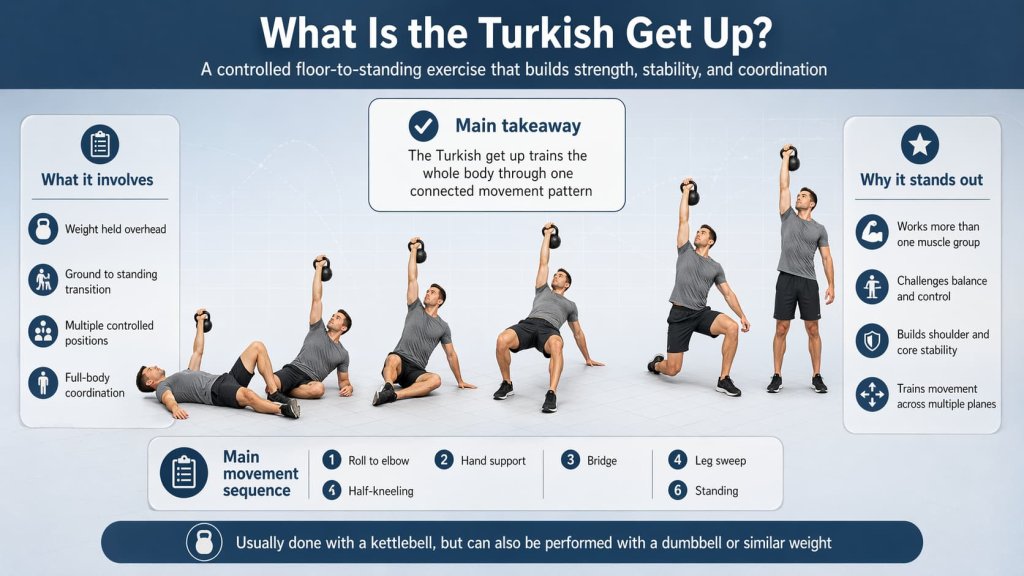
The movement passes through several positions, including roll to elbow, hand support, bridge, leg sweep, half-kneeling, and standing, all while the weight stays overhead. ACE’s exercise library and coaching article both emphasize that this multi-step pattern challenges coordination across multiple planes of motion rather than training only one joint or one muscle group.
Why the Turkish Get Up Works
What makes the Turkish get up special is that it blends mobility, stability, and strength in one sequence. ACE explains that successful execution requires hip mobility, thoracic mobility, lumbar stability, and a stable shoulder platform, while NASM highlights its value for core stabilization, balance, coordination, and spotting weak links such as stiff hips or undertrained shoulders. That combination is why the Turkish get up is often used as both a training exercise and a movement-quality check.
ACE also notes that the Turkish get up can work well as a warm-up before heavier lifting or as a stand-alone move on days when time is limited, because it asks so many systems to work together at once.
How to Do the Turkish Get Up With Proper Form
Why it works:
The Turkish get up teaches your body to create and keep tension while changing positions. Instead of only pressing, only squatting, or only bracing, you do all of those things in one connected pattern. ACE emphasizes this integrated, skill-based demand in its coaching guidance.
How to do it:
- Lie on your side, secure the kettlebell with both hands, then roll onto your back and press it overhead.
- If the weight is in your right hand, bend your right knee and plant the right foot. Let the left arm and left leg rest out at about a 45-degree angle.
- Keep your eyes on the kettlebell.
- Roll up onto your opposite elbow.
- Press from elbow to hand so you are in a tall posted position.
- Drive through the planted foot and posted hand to lift your hips into a bridge.
- Sweep the straight leg underneath you and place that knee on the floor.
- Come into a half-kneeling position with your torso upright.
- Stand up while keeping the weight locked out overhead.
- Reverse every step with control to return to the floor.
Trainer Tip:
Do not rush the sequence. ACE recommends learning the movement in pieces, keeping the shoulder packed, and letting your body follow your eyes by focusing on the kettlebell during the movement.
Turkish Get Up Muscles Worked
The Turkish get up is not a single-muscle exercise. According to the NSCA, the primary muscles trained include the gluteus maximus, hamstrings, quadriceps, rectus abdominis, transverse abdominis, internal and external obliques, deltoids, triceps, biceps, and pectoralis major. In practical terms, that means the move heavily involves:
- Glutes and hamstrings
- Quads
- Core muscles, including the deep trunk stabilizers and obliques
- Shoulders and upper-arm muscles
- Chest and grip support during the overhead hold
This broad muscle demand is one reason the Turkish get up is often described as a true full-body exercise.
Turkish Get Up Benefits
The biggest Turkish get up benefits are not just “more strength.” They are better total-body control.
- Builds full-body strength through one continuous sequence
- Trains shoulder stability while the arm stays overhead
- Challenges the core to resist collapsing, twisting, and overextending
- Improves coordination as you move from the floor to standing
- May help reveal side-to-side differences in mobility or control
- Can support hip and thoracic mobility when the movement is taught correctly
ACE and NASM both support these practical benefits from a coaching perspective.
There is also some limited clinical and review-based support for the movement in shoulder and mobility contexts. A 2019 clinical paper indexed in PubMed concluded that the Turkish get up can effectively load the cervical spine and shoulder isometrically with minimal space and equipment, and a 2024 review in PMC noted that dynamic kettlebell exercises such as Turkish get ups may support mobility and flexibility. Those findings are useful, but they should be interpreted carefully because they do not mean the Turkish get up is the right exercise for everyone or a substitute for individualized rehab.
Before You Start Turkish Get Ups
Because the Turkish get up is technique-heavy, your setup matters. NASM recommends practicing the movement without load, or even with a very light object, so you can focus on quality of movement first. ACE’s March 2025 article suggests a simple learning drill: make a fist as if you are holding a kettlebell and balance a shoe on top. That teaches you to keep the arm stable and the shoulder organized while you move.
A short warm-up helps too. Mayo Clinic Press recommends about 5 to 10 minutes of gentle movement for lower-intensity exercise and 10 to 15 minutes of dynamic stretching and mobility work before more vigorous activity. For Turkish get ups, that can mean easy hip mobility, shoulder positioning drills, and a few unloaded practice reps.
Be extra careful if you have shoulder pain, neck symptoms, difficulty getting up from the floor, or a chronic health condition that changes what kinds of exercise are safe for you. The CDC says moderate-effort activity is safe for most people, but people with chronic health conditions, long inactivity, disability, or overweight may need more individualized guidance before starting harder training.
Common Turkish Get Up Mistakes
Most Turkish get up problems come from trying to lift too much weight too soon or skipping position quality.
- Starting with too much load instead of learning the pattern first
- Letting the overhead elbow soften or the shoulder collapse
- Rushing from one phase to the next instead of owning each position
- Overextending the low back in the bridge instead of bracing the trunk
- Losing eye contact with the weight too early
- Using sloppy half-kneeling alignment before standing up
ACE covers these coaching points clearly, and NASM specifically says the goal is quality of movement over load or quantity.
Turkish Get Up Variations and Alternatives
1. Shoe Balance Turkish Get Up
Why it works:
This is one of the best beginner progressions because it teaches control, alignment, and shoulder stability without the risk of a heavy missed rep. ACE specifically recommends balancing a shoe on the fist while learning the sequence.
Muscles worked:
It still trains the core, hips, shoulders, and positional control, but the main focus is coordination, as described by NASM.
How to do it:
- Make a fist as if you are holding a kettlebell.
- Balance a shoe on top of the fist.
- Perform the Turkish get up slowly through each stage.
- Keep the shoe steady the whole time.
- Stop the rep if the shoe starts tipping or you lose shoulder position.
Trainer Tip:
This version is about control, not fatigue. If the shoe stays steady, your positions are probably improving.
2. Half Turkish Get Up
Why it works:
ACE recommends teaching the movement in parts and specifically notes that beginners can start with the first four steps and focus on reaching a stable bridge. That makes the half Turkish get up a practical stepping stone before doing the full rep.
Muscles worked:
Core, shoulder stabilizers, hip extensors, and the planted leg.
How to do it:
- Set up exactly like a normal Turkish get up.
- Roll to the elbow.
- Post to the hand.
- Lift into the bridge.
- Pause briefly with control.
- Reverse the sequence back to the floor.
Trainer Tip:
Master the bridge first. ACE notes that the floor gives useful feedback, especially when learning to push through the hand and foot without losing position.
3. Dumbbell Turkish Get Up
Why it works:
ACE notes that while kettlebells are common, the Turkish get up can also be done with other implements, including dumbbells. A dumbbell may be the more practical choice if that is what you already have at home.
Muscles worked:
The overall muscle demands are similar to the kettlebell version: shoulders, trunk, hips, and legs all contribute.
How to do it:
- Grip one dumbbell securely and press it overhead from the floor setup.
- Keep the wrist stacked over the elbow and shoulder.
- Move through the same get-up sequence you would use with a kettlebell.
- Use a lighter weight than you think you need until the path feels smooth and steady.
Trainer Tip:
Choose the version that lets you stay stable. The best tool is the one you can control safely through every stage.
How Many Reps and Sets Should You Do?
The Turkish get up is usually programmed in low reps because technique matters more than chasing fatigue. ACE recommends starting with sets of 2 to 4 repetitions. That is a good fit for a skill-heavy exercise where every rep includes many small transitions.
For general strength training, Mayo Clinic notes that many standard exercises can be effective around 12 to 15 repetitions with the proper resistance, but the Turkish get up is different because it is a technical full-body sequence, not a simple single-pattern lift. In practice, that is why many coaches keep Turkish get ups in low rep ranges and focus on crisp reps rather than high volume.
Where the Turkish Get Up Fits in a Workout
The Turkish get up can fit well near the start of a strength session because it reinforces shoulder positioning, core tension, and controlled movement through the hips. ACE even notes that it can work as a warm-up before heavy lifting or as a stand-alone move when time is short. For overall health, the CDC still recommends adults aim for 150 minutes of moderate-intensity activity each week plus at least 2 days of muscle-strengthening activity, so the Turkish get up is best viewed as one useful strength tool inside a broader routine.
Who Should Be Careful Before Trying It?
The Turkish get up is not a good exercise to force. Be cautious if you have:
- Current shoulder pain or a recent shoulder injury
- Neck symptoms that worsen with overhead work
- Significant hip mobility limits
- Difficulty getting up and down from the floor
- A chronic health condition that changes what type or amount of exercise is appropriate for you
The caution around overhead loading and clinical use is discussed in PubMed, while NASM supports the idea of starting with lighter progressions and better movement quality first.
If any of those apply, start with a lighter progression, reduce the range, or get help from a qualified coach or healthcare professional before loading the movement.
FAQs About the Turkish Get Up
What does the Turkish get up work?
It works many major muscle groups at once, especially the glutes, hamstrings, quads, core, shoulders, triceps, and chest, while also training coordination and stability, as outlined by the NSCA.
Is the Turkish get up good for beginners?
Yes, but beginners should usually start with body weight, a shoe balance drill, or a very light load first. Both ACE and NASM recommend learning the sequence before adding serious weight.
Should I use a kettlebell or a dumbbell?
A kettlebell is the classic choice, but ACE says the exercise can also be done with a dumbbell and other implements. Use the one you can control safely.
How heavy should the weight be?
Start lighter than you think. The safest choice is a load you can keep stable overhead through every phase without losing your shoulder position or rushing the movement. ACE and NASM both emphasize progression and movement quality before load.
How many Turkish get ups should I do?
A practical starting point is low-volume practice. ACE’s March 2025 article suggests sets of 2 to 4 repetitions.
Can Turkish get ups replace other strength exercises?
Not completely. The Turkish get up is excellent for integrated strength and control, but the CDC supports having a well-rounded routine that includes regular aerobic work and muscle-strengthening sessions across the week.
Conclusion
The Turkish get up earns its reputation because it trains something many exercises miss: the ability to stay strong and organized while moving through several positions in one rep. Start simple, own each phase, and treat it like a skill before you treat it like a strength test. Done well, the Turkish get up can become one of the most valuable full-body exercises in your program. If you are adding it to your routine, begin with the unloaded pattern, then build up gradually once every position feels stable.
References
- American Council on Exercise (ACE) — Turkish Get-up Exercise Library
- American Council on Exercise (ACE) — The ACE Do It Better Series: The Turkish Get-up
- National Academy of Sports Medicine (NASM) — Mastering the Turkish Get-Up
- National Strength and Conditioning Association (NSCA) — Turkish Get-Up
- American Council on Exercise (ACE) — Half Turkish Get-up Exercise Library
- Centers for Disease Control and Prevention (CDC) — Adding Physical Activity as an Adult
- Mayo Clinic Press — How to Warm Up and Cool Down for Exercise
- PubMed — Clinical Application of the Turkish Get-Up to an Acute Care Physical Therapy Setting