
Thoracic mobility exercises are simple drills that improve how your mid-to-upper back (T-spine) moves in extension and rotation, which can help you reach overhead, rotate more smoothly, and keep your neck and low back from “doing the job” instead. Getting your thoracic spine moving matters because it supports everyday posture, comfortable breathing mechanics, and efficient shoulder positioning during training.

The thoracic spine is the middle portion of your spine (T1–T12) and connects to your ribs, which is why it often feels stiff if you sit for long periods. The Cleveland Clinic explains how this region supports posture, breathing mechanics, and upper-body movement.
What Are Thoracic Mobility Exercises?
Thoracic mobility exercises are controlled movements that focus on:
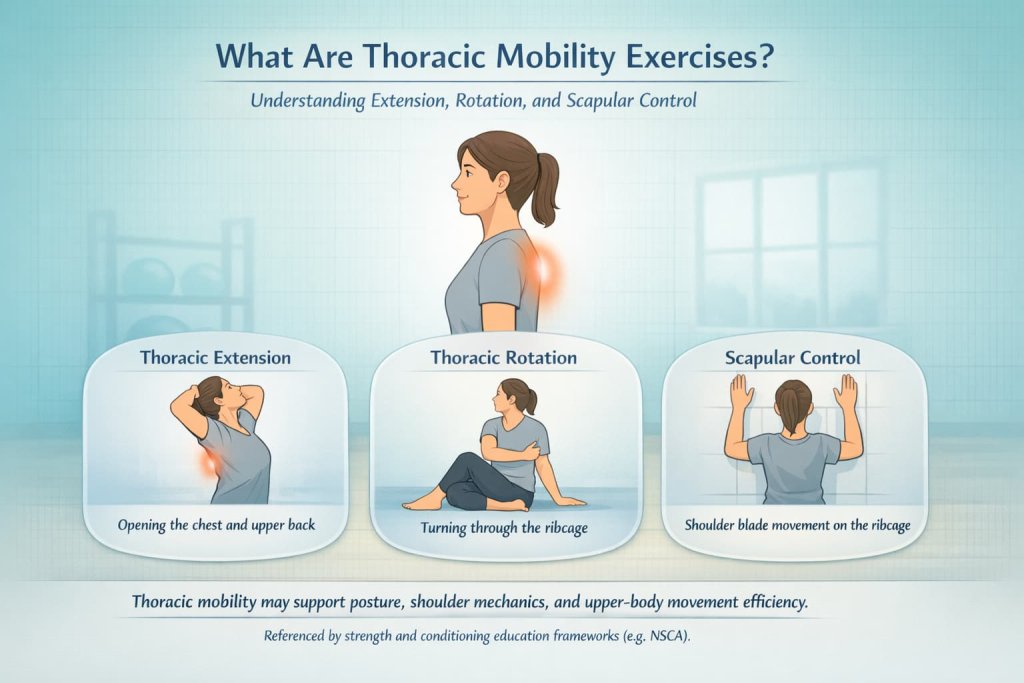
- Thoracic extension (opening the chest and upper back)
- Thoracic rotation (turning through the ribcage without twisting the low back)
- Scapular control (how your shoulder blades move on your ribcage)
Strength and conditioning educators often highlight thoracic mobility because it can influence shoulder mechanics and upper-body force transfer. The NSCA discusses how thoracic positioning plays a role in athletic performance and overhead mechanics.
Why Thoracic Mobility Matters for a Stiff Upper Back
The thoracic spine is designed to rotate and extend. When it becomes stiff — often from prolonged sitting or rounded posture — the upper back can feel tight and restricted. Improving thoracic mobility may support smoother movement and reduce unnecessary strain on the neck and lower back.
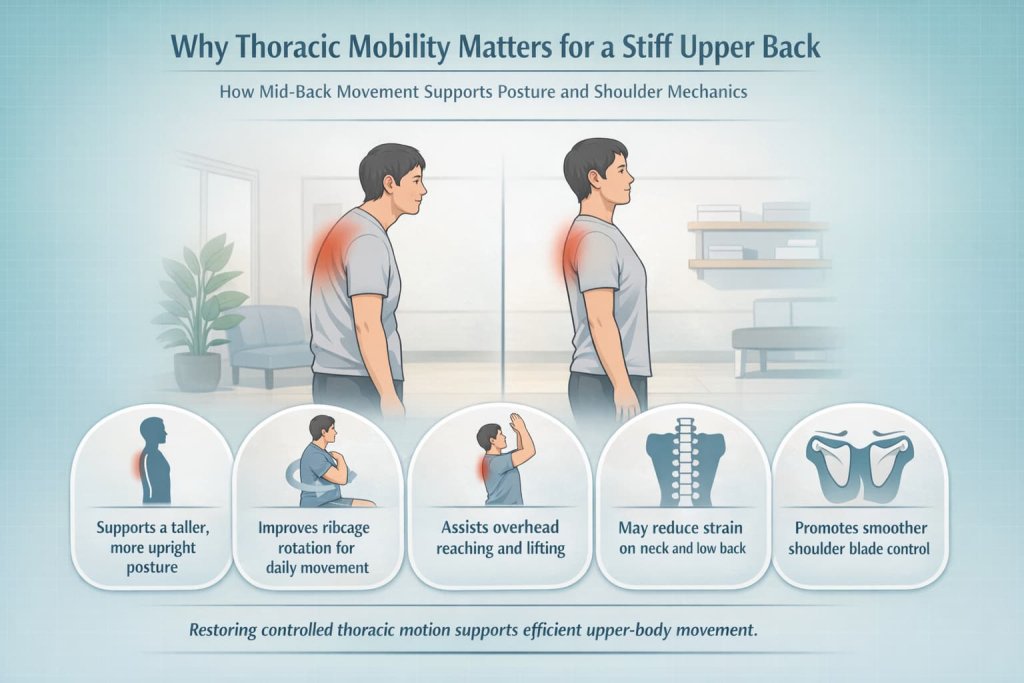
Better thoracic mobility can help:
- Support upright posture
- Improve rotation for daily activities
- Assist overhead reaching and lifting mechanics
- Reduce compensation from the neck and lower back
- Promote smoother shoulder blade movement
Restoring controlled motion in the mid-back helps your body move more efficiently and comfortably throughout the day.
10 Best Thoracic Mobility Exercises
Improve upper back flexibility and rotation with these 10 best thoracic mobility exercises designed to support posture and smoother overhead movement. These simple, controlled drills help reduce stiffness and promote better mid-back mobility for daily life and training.
1) Foam Roller Thoracic Extension
How to do it:
- Sit on the floor with a foam roller positioned behind your upper back.
- Lie back so the roller rests across your mid-to-upper back (not your lower back).
- Support your head gently with your hands.
- Keep your ribs down and hips grounded.
- Slowly extend your upper back over the roller.
- Pause briefly, then return to neutral.
- Perform 6–10 slow, controlled reps.
Why it works:
This drill promotes thoracic extension, a movement many people lose due to prolonged sitting and rounded posture. Improving extension can help restore a more upright upper-back position and support smoother overhead movement.
Muscles worked:
Thoracic spinal erectors assist the extension movement, while the posterior shoulder and chest tissues experience a light stretch effect as the ribcage opens.
Trainer Tip:
Keep your hips on the floor and lightly brace your core to avoid turning this into a lower-back arch.
2) Open Book Stretch
How to do it:
- Lie on your side with hips and knees bent and stacked.
- Extend both arms straight in front of you, palms together.
- Slowly open the top arm across your body.
- Allow your upper back to rotate while keeping knees together.
- Follow your moving hand with your eyes.
- Return with control.
- Perform 6–10 reps per side.
Why it works:
This movement builds thoracic rotation while keeping the pelvis stable. It teaches you to rotate through the ribcage instead of twisting through the lower back.
Muscles worked:
Mid-back rotators and obliques contribute to the motion, while the chest muscles experience a gentle opening stretch.
Trainer Tip:
Place a pillow between your knees if needed to maintain hip stability and prevent pelvic rotation.
3) Thread the Needle
How to do it:
- Start on hands and knees with a neutral spine.
- Slide one arm underneath your torso.
- Allow your upper back to rotate gently.
- Pause briefly at the end range.
- Return slowly to the starting position.
- Perform 6–10 reps per side.
Why it works:
This supported quadruped position allows safe thoracic rotation with reduced load on the spine, making it accessible for many people.
Muscles worked:
Thoracic rotators guide the movement, while the serratus anterior helps stabilize the shoulder blade.
Trainer Tip:
Keep the motion slow and controlled rather than forcing depth.
4) Quadruped T-Spine Rotation (Hand Behind Head)
How to do it:
- Begin on hands and knees.
- Place one hand lightly behind your head.
- Rotate your elbow upward toward the ceiling.
- Keep hips square and stable.
- Return slowly.
- Perform 6–10 reps per side.
Why it works:
Adding core control to rotation improves coordination and helps prevent excessive movement from the lower back.
Muscles worked:
Obliques provide rotational control, while mid-back rotators assist the movement.
Trainer Tip:
Exhale as you rotate upward to improve ribcage motion and control.
5) Wall Angels
How to do it:
- Stand with your back against a wall.
- Keep ribs controlled and spine neutral.
- Raise arms into a goalpost position.
- Slowly slide arms upward.
- Lower back down with control.
- Perform 6–10 reps.
Why it works:
This drill combines thoracic extension with scapular control, which supports smoother overhead positioning.
Muscles worked:
Mid and lower trapezius, along with serratus anterior, help guide controlled arm movement.
Trainer Tip:
If full wall contact causes compensation, reduce range or perform on the floor.
6) Bench Thoracic Extension
How to do it:
- Kneel in front of a bench.
- Place elbows on the bench shoulder-width apart.
- Sit hips slightly back.
- Allow your chest to drop gently between the arms.
- Return slowly.
- Perform 6–10 reps.
Why it works:
This position encourages upper-back extension while providing arm support, making it easier to isolate thoracic movement.
Muscles worked:
Lats experience a stretch effect, while thoracic extensors assist in controlled extension.
Trainer Tip:
Avoid aggressive lower-back arching; keep the motion smooth and controlled.
7) Seated Thoracic Rotation
How to do it:
- Sit tall with feet flat on the floor.
- Cross arms over your chest.
- Rotate slowly to one side.
- Keep hips facing forward.
- Return to center.
- Perform 6–10 reps per side.
Why it works:
This desk-friendly drill trains thoracic rotation in an upright posture, making it practical for daily resets.
Muscles worked:
Thoracic rotators and obliques guide the turning motion.
Trainer Tip:
Think “lengthen first, then rotate” to avoid leaning back.
8) Cat-Cow (Thoracic Focus)
How to do it:
- Start on hands and knees.
- Round your upper back (cat).
- Gently extend your upper back (cow).
- Move smoothly between positions.
- Perform 8–12 controlled reps.
Why it works:
This exercise improves spinal awareness and segmental control without heavy loading.
Muscles worked:
Spinal stabilizers and scapular support muscles assist with controlled movement.
Trainer Tip:
Focus on the mid-back rather than exaggerating lower-back extension.
9) Side-Lying Windmill
How to do it:
- Lie on your side with the top knee supported.
- Reach the top arm upward toward the ceiling.
- Slowly trace a large circular motion.
- Keep hips stable.
- Perform 4–6 reps per side.
Why it works:
This movement trains controlled thoracic rotation combined with shoulder coordination.
Muscles worked:
Thoracic rotators and posterior shoulder muscles contribute to the motion.
Trainer Tip:
Reduce the circle size if shoulder discomfort appears.
10) Prone Y-T-W
How to do it:
- Lie face down with forehead supported.
- Lift arms into a Y position, then lower.
- Repeat in T and W positions.
- Perform 6–10 reps each pattern.
Why it works:
Mobility improvements are reinforced when paired with upper-back endurance work that supports posture.
Muscles worked:
Mid and lower trapezius, rhomboids, and rear deltoids assist in maintaining scapular control.
Trainer Tip:
Keep the neck relaxed and avoid shrugging the shoulders.
How to Use These Thoracic Mobility Exercises
For most people:
- 5–10 minutes
- 3–5 days per week
- Slow, controlled repetitions
- Steady breathing
- Gradual range progression
If you lift weights, use 2–4 of these drills in your warm-up. If you sit for long hours, add a quick reset once or twice daily.
Signs Your Upper Back Mobility May Need Work
Common signs include:
- Overhead reaching feels tight through the chest or upper back
- You arch your low back to lift your arms overhead
- Rotating to check blind spots feels limited
- Neck tension increases during pressing or desk work
- Rounded-shoulder posture feels hard to correct
Safety Rules Before You Start
Thoracic mobility work should feel controlled and gentle — not sharp or worsening pain.
Be cautious and consider professional guidance if you have:
- A recent fall or spinal injury
- Persistent numbness, tingling, or weakness
- Pain that worsens with breathing or rotation
- A known spinal condition with movement restrictions
A sports-focused clinical framework published on PubMed Central emphasizes that thoracic exercise selection should match individual mobility, control, and strength needs rather than relying only on stretching.
Simple 7-Minute Thoracic Mobility Routine
- Foam Roller Thoracic Extension – 8 reps
- Open Book – 8 reps per side
- Quadruped T-Spine Rotation – 8 reps per side
- Wall Angels – 8 reps
- Prone Y-T-W – 6 reps each
Common Mistakes
- Moving through the low back instead of the thoracic spine
- Forcing range of motion
- Holding breath during rotation
- Skipping strength/endurance drills
Who Should Modify or Avoid These Exercises?
Modify or seek guidance if you have:
- Acute back or rib pain
- Recent spinal trauma
- Osteoporosis or bone-health concerns
- Shoulder pain that worsens during drills
General back-care guidance from Mayo Clinic recommends starting gently and stopping movements that increase pain.
FAQs
1) How often should I do thoracic mobility exercises?
3–5 days per week works well for most people.
2) How long until I feel improvement?
Some notice short-term relief immediately. Long-term improvement usually requires consistent practice.
3) Should mobility work hurt?
No. Mild stretching is normal, but sharp pain is not.
4) Can thoracic mobility help overhead lifting?
Improved upper-back positioning may support better overhead mechanics.
5) Do I need equipment?
No. Many drills require only floor space.
6) Can this fix posture alone?
Mobility helps, but combining it with strength and daily habit changes typically produces better results.
Conclusion
Thoracic mobility exercises are simple, time-efficient tools that can help you move more freely through your upper back. Start with the 7-minute routine, stay consistent, and focus on controlled, pain-free motion.