
Most adults take about 2,000 to 2,500 steps to walk one mile, with about 2,100 to 2,300 steps being a common estimate for many people. The exact number depends on your height, step length, walking speed, terrain, and whether you are walking or running.
Understanding how many steps are in a mile can help you estimate distance, set realistic walking goals, and use your fitness tracker more accurately. A mile is 5,280 feet, so the math is simple: the shorter your steps, the more steps you need to cover a mile.
How Many Steps in a Mile?
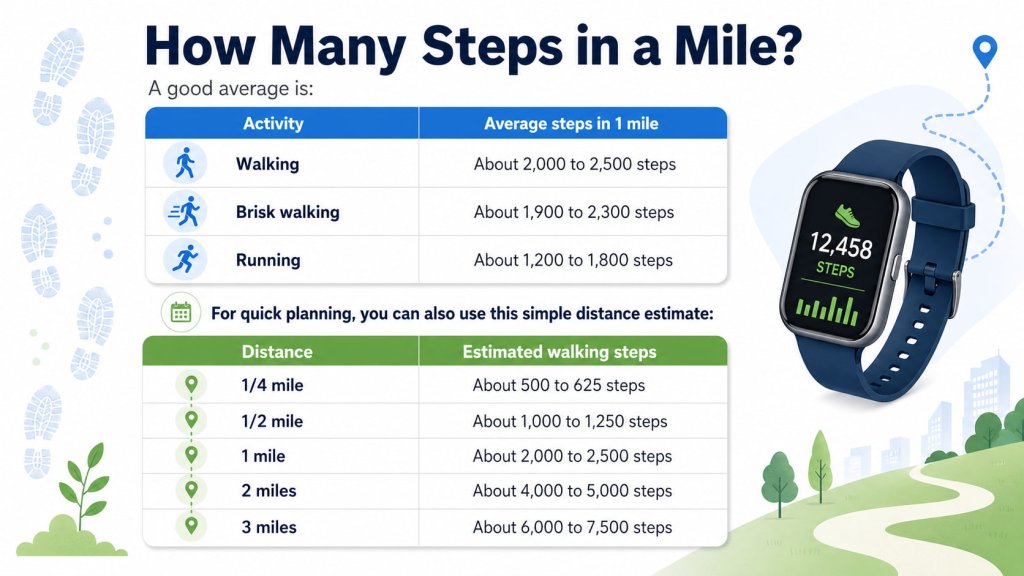
A good average is:
| Activity | Average steps in 1 mile |
|---|---|
| Walking | About 2,000 to 2,500 steps |
| Brisk walking | About 1,900 to 2,300 steps |
| Running | About 1,200 to 1,800 steps |
For quick planning, you can also use this simple distance estimate:
| DistanceEstimated walking steps | |
|---|---|
| 1/4 mile | About 500 to 625 steps |
| 1/2 mile | About 1,000 to 1,250 steps |
| 1 mile | About 2,000 to 2,500 steps |
| 2 miles | About 4,000 to 5,000 steps |
| 3 miles | About 6,000 to 7,500 steps |
These numbers are helpful for estimating neighborhood walks, treadmill sessions, school or work commutes, and daily step goals. Your actual number may be slightly different if your stride is shorter or longer than average.
For most walkers, 2,000 steps per mile is a simple estimate. But if you are shorter, walk slowly, or take smaller steps, your number may be closer to 2,400 or 2,500 steps per mile. If you are taller or walk with a longer stride, you may need fewer steps.
The University of Iowa Student Health notes that 10,000 steps is close to about 5 miles for many people, depending on stride length. That works out to roughly 2,000 steps per mile as a general estimate.
Why Steps Per Mile Are Different for Everyone
Your step count per mile is mainly affected by your step length. A person with a longer step length covers more ground with each step, so they need fewer steps to complete a mile.
The University of Oklahoma Health Sciences Center explains that step length is the distance from one foot contact to the opposite foot contact, while stride length is the distance from one foot contact to the next contact of the same foot. For estimating steps in a mile, step length is usually the more useful number.
Several factors can change your steps per mile:
| Factor | How it affects steps per mile |
|---|---|
| Height | Taller people often have longer steps and fewer steps per mile |
| Pace | Faster walking often slightly increases step length |
| Fitness level | Comfortable walkers may take smoother, longer steps |
| Terrain | Hills, trails, and uneven ground can shorten steps |
| Fatigue | Steps may become shorter as you get tired |
| Walking vs running | Running usually uses longer strides and fewer steps per mile |
Average Steps Per Mile by Step Length
Since one mile equals 5,280 feet, you can estimate your steps per mile by dividing 5,280 by your average step length in feet.
| Average step length | Estimated steps in 1 mile |
|---|---|
| 2.0 feet | 2,640 steps |
| 2.1 feet | 2,514 steps |
| 2.2 feet | 2,400 steps |
| 2.3 feet | 2,296 steps |
| 2.4 feet | 2,200 steps |
| 2.5 feet | 2,112 steps |
| 2.6 feet | 2,031 steps |
| 2.7 feet | 1,956 steps |
| 2.8 feet | 1,886 steps |
This is why two people can walk the same mile and finish with different step counts. One person may need 2,500 steps, while another may need closer to 2,000.
Average Steps Per Mile by Height
Height is not a perfect predictor, but it is one of the easiest ways to estimate steps per mile. Taller people usually have longer legs and longer natural steps. Shorter people usually take more steps to cover the same distance.
| Height | Estimated walking steps per mile |
|---|---|
| 5’0″ | About 2,550 steps |
| 5’2″ | About 2,470 steps |
| 5’4″ | About 2,400 steps |
| 5’6″ | About 2,320 steps |
| 5’8″ | About 2,260 steps |
| 5’10” | About 2,190 steps |
| 6’0″ | About 2,130 steps |
| 6’2″ | About 2,070 steps |
| 6’4″ | About 2,010 steps |
These are estimates, not fixed rules. Your real number may be higher or lower depending on your walking style, shoes, speed, and route.
These height-based estimates are mostly designed for adults. Children, teens, older adults, and people using mobility aids may have very different step lengths. For the most accurate number, it is better to measure your own steps over a known distance instead of relying only on a general chart.
How Many Steps in a Mile by Walking Speed?
Walking speed can change your steps per mile because your step length often changes with pace. Slow walking usually involves shorter steps. Brisk walking often creates a slightly longer, more efficient step.
| Walking pace | Speed | Estimated steps per mile |
|---|---|---|
| Easy walk | 2 mph | About 2,300 to 2,600 steps |
| Moderate walk | 3 mph | About 2,100 to 2,400 steps |
| Brisk walk | 3.5 to 4 mph | About 1,900 to 2,300 steps |
| Very fast walk | 4.5 mph | About 1,800 to 2,100 steps |
The Centers for Disease Control and Prevention describes moderate-intensity activity using the talk test: during moderate activity, you can usually talk but not sing. That is a helpful way to judge whether your walk is easy, moderate, or brisk without needing a fitness watch.
How Many Steps Are in a Mile Walking vs Running?
Running usually takes fewer steps per mile than walking because each stride covers more distance. A runner may take anywhere from about 1,200 to 1,800 steps per mile, depending on speed, height, cadence, and running form.
| Movement type | Estimated steps per mile |
|---|---|
| Slow walking | About 2,300 to 2,600 steps |
| Average walking | About 2,000 to 2,500 steps |
| Brisk walking | About 1,900 to 2,300 steps |
| Jogging | About 1,500 to 1,900 steps |
| Faster running | About 1,200 to 1,700 steps |
A fitness tracker may show different numbers for walking and running even on the same one-mile route. That does not automatically mean it is wrong. Your body simply moves differently at different speeds.
How to Calculate Your Own Steps Per Mile
You can estimate your personal steps per mile with this formula:
Steps per mile = 5,280 ÷ your step length in feet
If you measure your step length in inches, use this version instead:
Steps per mile = 63,360 ÷ your step length in inches
For example, if your average step length is 28 inches:
63,360 ÷ 28 = about 2,263 steps per mile
This version is often easier because many people measure step length with a tape measure in inches rather than feet.
You can also calculate distance from steps:
Miles = total steps ÷ your steps per mile
For example, if your average is 2,200 steps per mile:
| Steps | Estimated miles |
|---|---|
| 2,200 steps | 1 mile |
| 5,000 steps | 2.3 miles |
| 7,000 steps | 3.2 miles |
| 10,000 steps | 4.5 miles |
| 12,000 steps | 5.5 miles |
How to Measure Your Step Length Accurately
The most accurate way to know how many steps are in your mile is to measure your own step length.
Here is a simple method:
- Find a measured distance, such as a track, hallway, sidewalk, or marked path.
- Walk normally, not with exaggerated steps.
- Count your steps across the measured distance.
- Divide the distance by your number of steps.
For example, if you walk 100 feet and count 43 steps:
100 ÷ 43 = 2.33 feet per step
Then calculate:
5,280 ÷ 2.33 = about 2,266 steps per mile
For better accuracy, use a longer distance. Garmin Support recommends walking a known distance and counting your steps when setting a custom stride length, with at least 400 meters suggested for calibration.
How Many Miles Are 5,000, 7,000, and 10,000 Steps?
If you use 2,000 steps per mile as a simple estimate, step goals are easy to convert. But many walkers actually fall closer to 2,200 or 2,400 steps per mile.
| Step count | At 2,000 steps per mile | At 2,200 steps per mile | At 2,400 steps per mile |
|---|---|---|---|
| 5,000 steps | 2.5 miles | 2.3 miles | 2.1 miles |
| 7,000 steps | 3.5 miles | 3.2 miles | 2.9 miles |
| 8,000 steps | 4.0 miles | 3.6 miles | 3.3 miles |
| 10,000 steps | 5.0 miles | 4.5 miles | 4.2 miles |
| 12,000 steps | 6.0 miles | 5.5 miles | 5.0 miles |
So, 10,000 steps is often called 5 miles, but for many people it may be closer to 4 to 5 miles.
Do Steps Automatically Count as Exercise?
Steps are a useful way to measure movement, but they do not always show exercise intensity. A slow day of walking around the house may add steps, but it may not raise your heart rate enough to count as moderate-intensity activity.
That is why pace still matters. A brisk walk usually feels slightly challenging, raises your breathing, and still lets you talk in short sentences. If your goal is better fitness, focus on both total steps and purposeful walking time, not just the final number on your tracker.
Is 10,000 Steps a Day Necessary?
No, 10,000 steps is not a requirement for everyone. It can be a useful goal, but it is not the only number that matters.
The National Institutes of Health summarized research showing that adults who took 8,000 or more steps per day had a lower risk of death during follow-up than adults who took 4,000 steps per day. This does not mean 8,000 steps guarantees better health, but it does support the idea that higher daily step counts are associated with better health outcomes.
More recent research in The Lancet Public Health found that about 7,000 steps per day was associated with meaningful health benefits compared with very low step counts. The study also noted that 10,000 steps can still be a reasonable target for people who are already active.
The practical takeaway is simple: more movement is usually better than less, but your best step goal depends on your current fitness level.
How Many Steps Should You Aim for Each Day?
A realistic daily step goal depends on your starting point. If you currently walk 3,000 steps a day, jumping straight to 10,000 may feel overwhelming. A better approach is to increase gradually.
| Current average | Realistic next goal |
|---|---|
| Under 3,000 steps/day | Add 500 to 1,000 steps/day |
| 3,000 to 5,000 steps/day | Aim for 5,000 to 6,000 steps/day |
| 5,000 to 7,000 steps/day | Aim for 7,000 to 8,000 steps/day |
| 8,000 or more steps/day | Maintain or build based on your goals |
The Centers for Disease Control and Prevention recommends that adults get at least 150 minutes of moderate-intensity aerobic activity each week, plus 2 days of muscle-strengthening activity. Walking can count toward that weekly aerobic activity goal when it raises your heart rate and breathing.
How Long Does It Take to Walk a Mile?
How long it takes to walk a mile depends on pace.
| Walking speed | Approximate time for 1 mile |
|---|---|
| 2 mph | 30 minutes |
| 2.5 mph | 24 minutes |
| 3 mph | 20 minutes |
| 3.5 mph | 17 minutes |
| 4 mph | 15 minutes |
A casual mile may take 20 to 30 minutes. A brisk mile often takes about 15 to 20 minutes.
The American College of Sports Medicine supports the common public-health goal of regular moderate-intensity aerobic activity and strength training. For many adults, brisk walking is one of the simplest ways to build that habit.
Are Fitness Trackers Accurate for Steps Per Mile?
Fitness trackers can be helpful, but they are not perfect. Watches and phones estimate steps using motion sensors, GPS, height data, and walking patterns. Accuracy can vary if you push a stroller, hold a phone still, walk on uneven terrain, use a treadmill, or move your arms differently than usual.
To make your tracker more accurate:
- Enter your correct height and weight.
- Update your custom stride length if your device allows it.
- Use GPS for outdoor walks when available.
- Compare your device against a known one-mile route.
- Measure your own step length and adjust settings if needed.
Small differences are normal. A tracker is usually most useful for watching trends over time rather than treating every step count as exact.
Simple Ways to Add More Steps Without Overdoing It
You do not need to complete all your steps in one long walk. Small walking breaks throughout the day can add up.
Try these simple ideas:
- Take a 5- to 10-minute walk after meals.
- Park farther from the entrance when it is safe.
- Walk while talking on the phone.
- Use stairs when practical.
- Take a short walk during study or work breaks.
- Walk one extra block before heading home.
- Set a gentle reminder to stand and move every hour.
Start with what feels manageable. Consistency matters more than chasing a perfect number.
Who Should Be Careful With Step Goals?
Walking is safe and accessible for many people, but step goals should be adjusted for your body and health situation.
Be more careful if you:
- Are new to regular exercise
- Have chest pain, dizziness, or unusual shortness of breath
- Have a recent injury
- Have balance problems
- Have foot, knee, hip, or back pain
- Are recovering from surgery or illness
- Have been told by a healthcare professional to limit activity
If walking causes pain that does not improve with rest, reduce your intensity and consider getting medical guidance. Step goals should support your health, not pressure you into pushing through warning signs.
FAQ About How Many Steps Are in a Mile
How many steps are in a mile for the average person?
Most adults take about 2,000 to 2,500 steps to walk one mile. A common estimate is about 2,100 to 2,300 steps per mile, but your exact number depends on your step length.
Is 2,000 steps always one mile?
No. For some people, 2,000 steps is close to one mile. For others, especially shorter walkers or slower walkers, one mile may take closer to 2,300 to 2,500 steps.
How many steps are in 2 miles?
For most walkers, 2 miles is about 4,000 to 5,000 steps.
How many miles is 10,000 steps?
For many people, 10,000 steps is about 4 to 5 miles. If you average 2,000 steps per mile, it equals about 5 miles. If you average 2,400 steps per mile, it equals about 4.2 miles.
How many steps are in a mile for a 5’4″ person?
A 5’4″ person may take roughly 2,400 steps per mile, depending on walking style and pace.
How many steps are in a mile for a 6-foot person?
A 6-foot person may take roughly 2,100 to 2,200 steps per mile while walking, depending on step length and speed.
Does walking faster mean fewer steps per mile?
Usually, yes. Faster walking often increases step length slightly, which may reduce steps per mile. But cadence also changes, so the difference is not the same for everyone.
How many steps are in a mile on a treadmill?
A treadmill mile usually takes about the same number of steps as an outdoor mile if your walking speed and step length are similar. However, handrail use, incline, and treadmill belt movement can affect your natural stride.
Conclusion
Most adults take about 2,000 to 2,500 steps in a mile, but your personal number depends on your height, step length, walking pace, and terrain. The most accurate method is to walk a known distance, count your steps, and calculate your own step length.
Use the averages as a helpful starting point, not a strict rule. Whether your goal is 5,000, 7,000, or 10,000 steps a day, the best target is one you can build gradually and maintain consistently.
This content is for informational purposes only and not medical advice. If you have a medical condition, injury, or symptoms during exercise, talk with a qualified healthcare professional before changing your activity routine.
Sources/References
- University of Iowa Student Health — Taking Strides Frequently Asked Questions
- University of Oklahoma Health Sciences Center — Stride Analysis
- Garmin Support — The Step Distance Recorded on My Garmin Watch Is Wrong
- Centers for Disease Control and Prevention — How to Measure Physical Activity Intensity