
No, whey protein does not automatically make you gain weight. Weight gain happens when you take in more calories than your body uses over time, and protein still counts toward that total because it provides 4 calories per gram. That is why whey can help, hurt, or make no real difference at all depending on your overall diet, activity level, and how you use it.
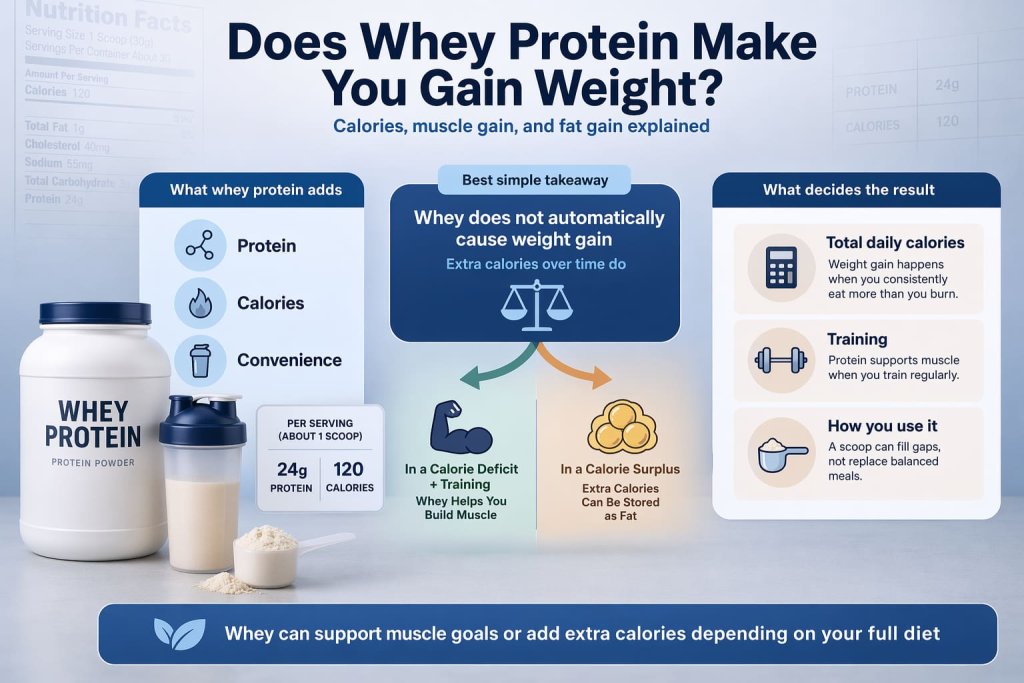
Understanding this matters because people use whey for very different goals. Some want to build muscle. Some want to stay full while dieting. Others just want an easy breakfast or post-workout shake. The result is not built into the powder itself. It depends on whether whey is helping you meet your needs or quietly pushing your calories too high.
Does whey protein make you gain weight?
Whey protein is best thought of as a food or supplement that adds protein and calories, not as a special weight-gain ingredient. If it helps push you into a calorie surplus, your body weight can go up. If it replaces less filling foods, helps you control hunger, or simply helps you hit your protein target without overshooting calories, it may not cause weight gain at all.
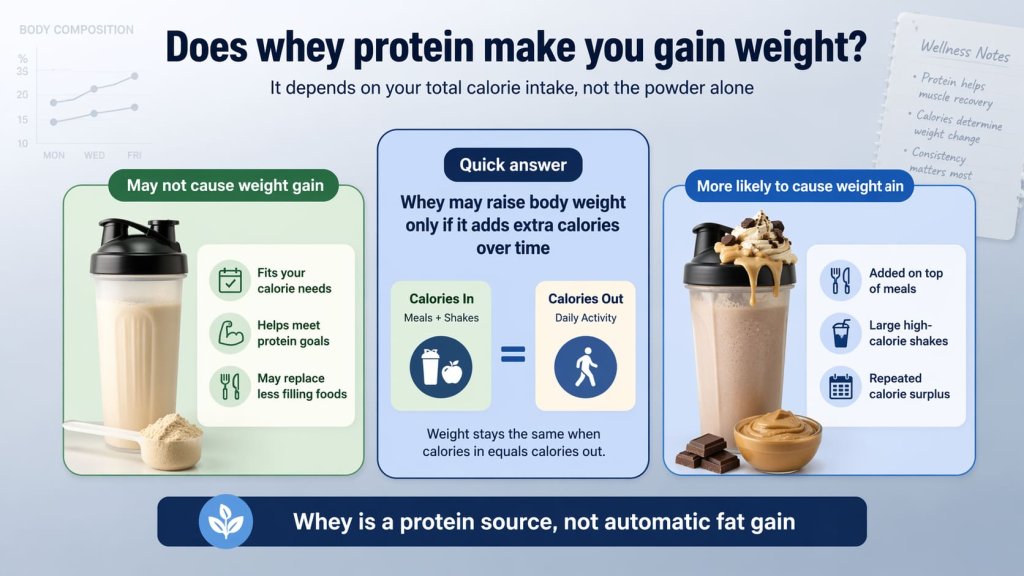
The phrase “gain weight” also hides an important difference: scale weight can go up from fat gain, lean mass gain, or both. That is why two people can take the same whey product and get different results. One may gain muscle while lifting consistently. Another may just be drinking extra calories on top of an already adequate diet.
Why whey can increase body weight for some people
The simplest reason is calories. A shake may look small, but once you add milk, peanut butter, oats, sweeteners, or multiple scoops, the total can climb quickly. If those calories are extra rather than replacing something else, weight gain becomes more likely. The National Heart, Lung, and Blood Institute explains that an energy imbalance over time leads to weight gain.
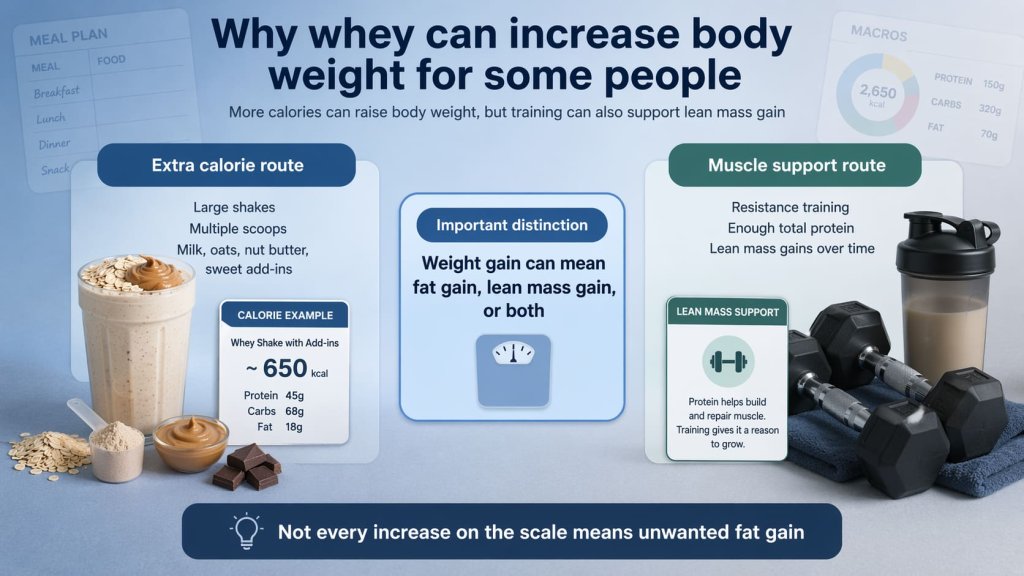
Another reason is that whey often gets used during muscle-building phases. The International Society of Sports Nutrition position stand on protein and exercise says a total daily protein intake of about 1.4 to 2.0 grams per kilogram of body weight is sufficient for most exercising people, and a large systematic review and meta-analysis on PMC found that increasing daily protein intake can improve lean body mass gain. In other words, some weight gain from whey use may actually be the outcome people want: more lean mass.
That said, whey is not magic muscle. A PubMed meta-analysis on whey supplementation and body composition found whey improved body composition by modestly increasing lean mass without significantly changing fat mass. That supports a more accurate takeaway: whey is more likely to help with body composition when it is paired with the right training and total diet, not when it is treated like a shortcut.
Will whey protein make you gain weight if you do not work out?
It can, but not for the reason many people assume. Without exercise, whey is less likely to create the lean-mass gain people usually want from protein powder and more likely to function as just another calorie source. Research showing the benefits of protein supplementation is generally stronger when training is included. A systematic review in postmenopausal women found whey did not significantly improve body weight loss or lean mass without resistance training, while the combination with resistance training was more effective.
This does not mean whey is useless if you do not work out. It may still help you reach your protein goal, make a meal more convenient, or keep you fuller than a lower-protein snack. But if your main question is whether whey alone turns into fat, the answer is still the same: only excess calories do that.
When whey is more likely to cause unwanted fat gain
Whey is more likely to work against you when:
- You add it on top of meals instead of using it to replace or support part of a meal
- You make very large shakes with high-calorie extras
- You take multiple scoops without checking the label
- You assume a protein product must be low-calorie
- You start supplementing even though your regular diet already covers your protein needs
That label check matters because not every protein powder is a plain whey product. Some blends add substantial carbohydrates, fats, sweeteners, or larger manufacturer-set serving sizes, which can raise the calorie load quickly. Two products that both say whey can therefore affect body weight very differently, especially if one is used as a simple scoop in water and the other is used as a large meal-style shake.
One practical problem is labeling and serving size. The FDA’s dietary supplement guidance notes that dietary supplements are not approved by FDA before marketing, and serving sizes are not standardized by FDA in the way many consumers assume. That makes label-reading especially important with whey powders and blended products.
How to use whey protein without gaining unwanted fat
A few simple habits make the biggest difference:
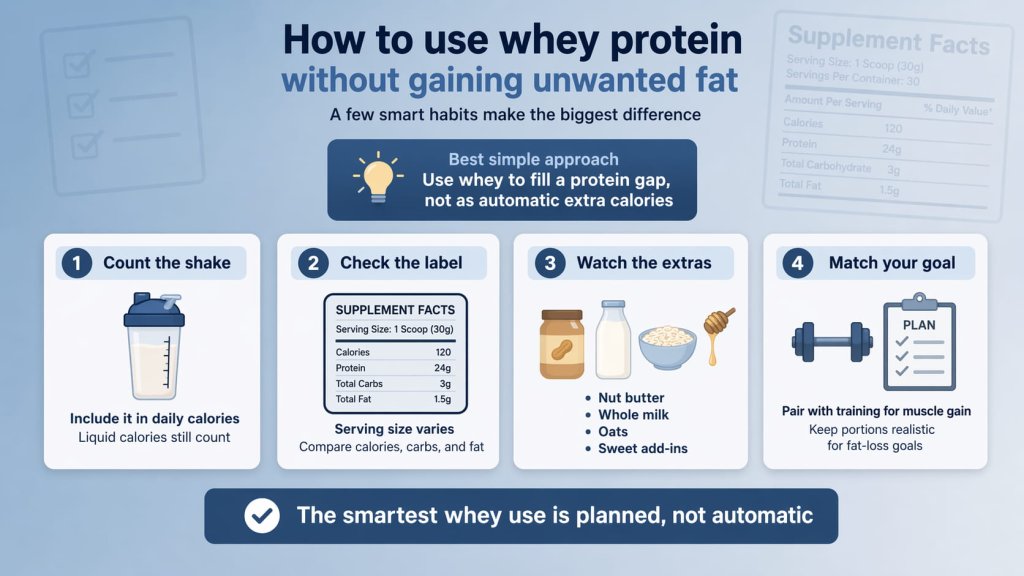
- Count the shake as part of your daily intake. Do not treat it like it does not count because it is liquid.
- Check the label every time you switch products. Serving sizes vary by manufacturer.
- Use whey to fill a protein gap. It works best as a convenient tool, not as an automatic extra.
- Keep mix-ins realistic. The powder may be moderate in calories, but the full shake may not be.
- Pair it with resistance training if your goal is muscle gain. Protein works better for lean-mass goals when the training stimulus is there.
- Look for quality testing. The NIH Office of Dietary Supplements says some independent groups, including NSF and U.S. Pharmacopeia, offer quality testing seals, though those seals do not guarantee a product is safe or effective.
How much whey protein do you actually need?
There is no single whey dose that everyone needs. The better question is how much total daily protein you need from all sources.
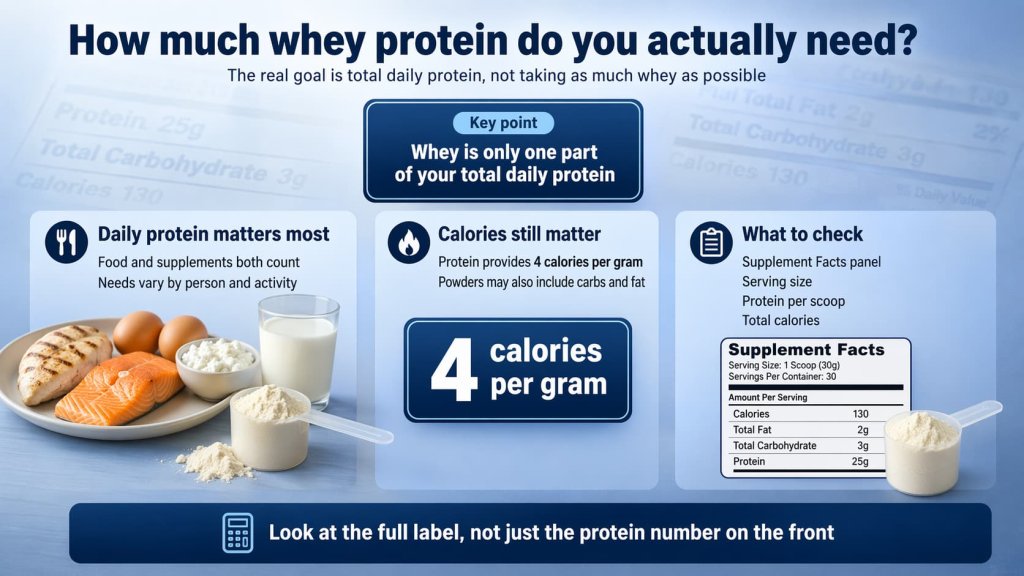
For healthy adults, MedlinePlus says protein generally makes up about 10% to 35% of total calories. For people who train regularly, the ISSN position stand says about 1.4 to 2.0 grams of protein per kilogram of body weight per day is sufficient for most exercising individuals. That total includes food and supplements together, not whey alone.
One practical check helps here: protein itself provides 4 calories per gram, but the total calories in a whey product can be much higher once the powder also contains carbohydrates and fat. So when people ask whether whey will make them gain weight, the most accurate place to look is the full Supplement Facts panel, not just the protein grams on the front of the tub.
In practice, whey is most useful when food alone is not convenient enough. It can help you close a gap, but it is not required for muscle gain, fat loss, or general health if you already meet your protein needs with regular meals.
Can whey protein help with weight loss?
Sometimes, yes. Whey is not a weight-loss supplement by itself, but it can fit a fat-loss plan when it helps you control calories, stay full, and keep protein intake adequate.
The evidence is mixed but encouraging in some settings. A PubMed review on whey protein in overweight and obese adults reported that whey supplementation appeared to improve body weight, total fat mass, and some cardiometabolic risk factors. Other analyses found little or no major effect on body weight or fat mass unless whey was paired with resistance training or used in a structured calorie-controlled plan. That is why the most accurate answer is that whey may help, but only in the context of the overall diet and activity pattern.
Who should be careful with whey protein?
People with lactose intolerance
Because whey products can be dairy-based, some people get stomach symptoms after using them. MedlinePlus explains lactose intolerance as a condition that can cause bloating, cramps, diarrhea, gas, and nausea, often within 30 minutes to 2 hours after milk products.
It also helps to know that product type can affect tolerance. Research on whey processing suggests that filtration can remove some unwanted components such as lactose and minerals, so more filtered whey products may be easier for some people to tolerate than less filtered ones. If a shake repeatedly causes bloating, cramps, gas, diarrhea, or nausea within a few hours, it is worth checking whether lactose or other added ingredients may be the real issue rather than blaming protein itself.
People with a milk allergy
This is different from lactose intolerance. A milk allergy can cause hives, swelling, vomiting, wheezing, trouble breathing, and, in rare cases, anaphylaxis. That is a medical issue, not just a digestive inconvenience. MedlinePlus information on food allergy notes that food allergy symptoms can start within minutes to two hours after eating the trigger food.
People with chronic kidney disease
Protein is not automatically harmful for healthy kidneys, but kidney disease changes the picture. The National Institute of Diabetes and Digestive and Kidney Diseases explains that protein breakdown creates waste the kidneys must remove, and some people with chronic kidney disease may need moderate protein intake to avoid extra strain. If you have chronic kidney disease, ask your clinician or dietitian before using whey regularly.
Anyone taking several supplements or medicines
It is smart to tell your health care providers about all supplements you use, especially if you have a medical condition or take prescription medicine.
Quick answers to common questions
Does whey protein make your belly fat?
No specific food targets belly fat on its own. If whey increases your long-term calorie surplus, it can contribute to overall fat gain, which may include abdominal fat. If it fits your calorie needs, it does not automatically cause belly fat.
Is whey protein better than whole-food protein?
Not necessarily. Whey is mainly about convenience. Whole foods can provide protein along with other nutrients, while whey can be useful when time, appetite, or workout timing makes regular food less practical.
Do you need whey protein to build muscle?
No. You need enough total protein, progressive training, and time. Whey can make that easier, but it is a tool, not a requirement.
Can whey make the scale go up even if it is helping?
Yes. If you are lifting and eating well, body weight can rise because lean mass is increasing. That is different from gaining body fat.
Bottom line
Whey protein does not automatically make you gain weight. It can contribute to weight gain only when it adds enough calories to create a surplus. For some people, that means unwanted fat gain. For others, especially those doing resistance training, it may support lean mass and better body composition instead.
Use whey based on your goal, not the marketing. Check the label, count the shake, and look at your full diet before blaming or praising the powder.
Safety box
- Whey may not be a good fit if you have a milk allergy, lactose intolerance, or chronic kidney disease
- Choose products carefully and read labels closely
- Talk to a qualified health professional if you have a medical condition, digestive symptoms, or questions about how much protein is right for you
This content is for informational purposes only and not medical advice.
References
- PMC — Systematic review and meta-analysis of protein intake to support muscle mass and function in healthy adults
- PubMed — Effect of whey protein supplementation on body composition, muscle strength, and functional capacity in pre-conditioned older women
- PubMed — Effect of Whey Protein Supplementation in Postmenopausal Women: A Systematic Review and Meta-Analysis
- FDA — Questions and Answers on Dietary Supplements
- NIH Office of Dietary Supplements — Dietary Supplements: What You Need to Know
- PubMed — Whey Protein Supplementation Improves Body Composition and Cardiovascular Risk Factors in Overweight and Obese Individuals
- MedlinePlus — Food Allergy
- National Institute of Diabetes and Digestive and Kidney Diseases — Healthy Eating for Adults with Chronic Kidney Disease
- PMC — Whey processing and composition review