
A 5K is 3.1 miles, or exactly 5 kilometers. More precisely, 5K equals about 3.1069 miles, so most runners, walkers, and race organizers round it to 3.1 miles.
If you are wondering how many miles is a 5K because you are signing up for your first race, the good news is that it is one of the most beginner-friendly distances. You can run it, walk it, jog it, or use a run-walk plan. The key is knowing the distance, choosing a realistic pace, and building up gradually.
How Many Miles Is a 5K?
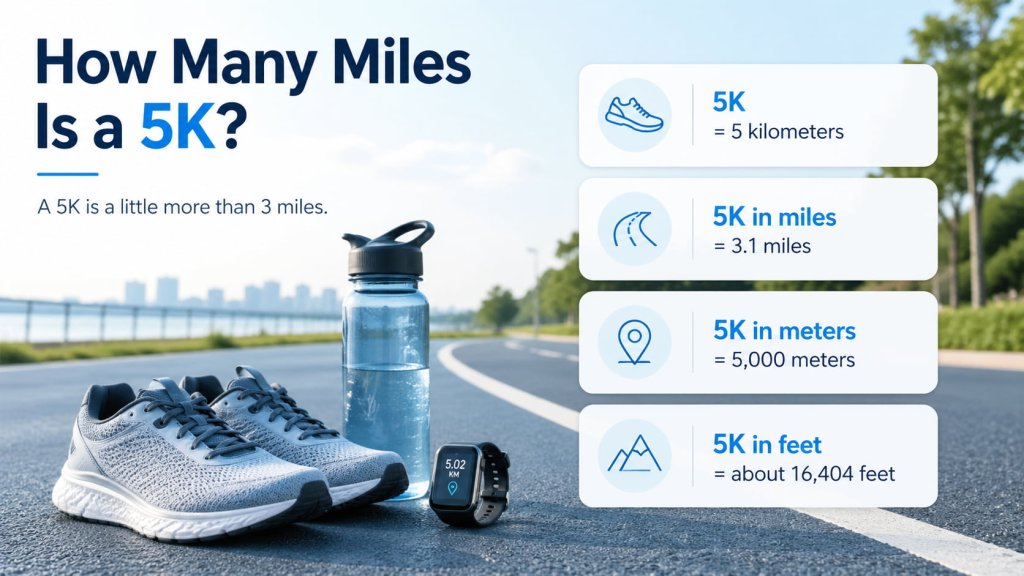
A 5K is 5 kilometers, which equals 3.1 miles.
According to the National Institute of Standards and Technology, 1 mile equals 1.609344 kilometers. Using that conversion, 5 kilometers equals about 3.1069 miles.
| Distance | Equivalent |
|---|---|
| 5K | 5 kilometers |
| 5K in miles | 3.1 miles |
| 5K in meters | 5,000 meters |
| 5K in feet | About 16,404 feet |
So, when someone says they are running a 5K, they are covering a little more than 3 miles.
Is a 5K Exactly 3 Miles?
No. A 5K is not exactly 3 miles. It is slightly longer.
A 5K is about 3.1069 miles, which means it is roughly 0.1 mile longer than 3 miles. That extra distance is about 565 feet, or a little less than two football fields.
For everyday conversation, saying “a 5K is 3.1 miles” is accurate enough.
How Far Is a 5K on a Treadmill?
On a treadmill, a 5K is still 3.1 miles. If your treadmill shows distance in miles, stop when it reaches 3.10 miles. If it shows kilometers, stop when it reaches 5.00 km.
Some treadmills display distance with only one decimal place. In that case, 3.1 miles is the closest practical setting for a full 5K.
How Many Laps Is a 5K on a Track?
A 5K is equal to 12.5 laps on a standard 400-meter outdoor track.
World Athletics explains that the 5,000-meter track event takes place on a standard 400-meter track and requires 12 and a half laps. A road 5K is the same distance, but it is usually measured on streets, paths, parks, or race courses instead of a track.
How Long Does It Take to Complete a 5K?
How long a 5K takes depends on your pace. A beginner walker may take close to an hour, while a steady jogger may finish in 30 to 40 minutes. Faster runners may finish much sooner.
| Pace per mile | Estimated 5K time |
|---|---|
| 20 minutes per mile | About 1 hour 2 minutes |
| 18 minutes per mile | About 56 minutes |
| 15 minutes per mile | About 47 minutes |
| 12 minutes per mile | About 37 minutes |
| 10 minutes per mile | About 31 minutes |
| 8 minutes per mile | About 25 minutes |
If your watch, treadmill, or race app uses kilometers instead of miles, this chart may be easier to use:
| Pace per kilometer | Estimated 5K time |
|---|---|
| 12 minutes per km | About 1 hour |
| 10 minutes per km | About 50 minutes |
| 8 minutes per km | About 40 minutes |
| 7 minutes per km | About 35 minutes |
| 6 minutes per km | About 30 minutes |
| 5 minutes per km | About 25 minutes |
These are estimates, not rules. Your route, hills, weather, fitness level, and whether you walk or run can all change your finish time.
Average 5K Time for Beginners
A realistic beginner 5K time is often somewhere between 35 and 60 minutes, depending on whether you walk, jog, run, or use intervals.
Here is a simple way to think about it:
| Type of 5K participant | Common finish range |
|---|---|
| Casual walker | 50 to 70 minutes |
| Brisk walker | 45 to 55 minutes |
| Run-walk beginner | 35 to 50 minutes |
| Steady beginner jogger | 30 to 40 minutes |
| More experienced runner | Under 30 minutes |
For your first 5K, finishing comfortably is a better goal than chasing a specific time. You can always work on speed later.
Can You Walk a 5K?
Yes, you can absolutely walk a 5K.
Many community 5K events welcome walkers, beginners, families, and run-walk participants. If you walk at a comfortable pace of around 18 to 20 minutes per mile, you may finish a 5K in about 56 to 62 minutes.
If you are signing up for an organized event, check the race details for course time limits. Most casual 5K races allow enough time for walkers, but it is still smart to confirm before race day.
Do 5K Races Have Time Limits?
Some 5K races have time limits, but many beginner-friendly community events allow enough time for walkers. A common walking finish time is around 45 to 70 minutes, depending on pace.
Before signing up, check the event page for details such as:
- Course closing time
- Walker-friendly policy
- Stroller or dog rules
- Start time and packet pickup instructions
- Whether roads reopen after a certain time
This is especially helpful if you plan to walk the full 5K or complete it at an easy pace.
Is a 5K Good for Beginners?
Yes. A 5K is one of the best race distances for beginners because it is challenging but manageable.
You do not need to be fast. You do not need to run the whole distance. You can train with walking, jogging, short running intervals, or a mix of all three.
The Mayo Clinic notes that a beginner 5K plan can include a mix of running, walking, and resting, which can help reduce injury risk, stress, and fatigue.
How Long Should You Train for a 5K?
Most beginners do well with 6 to 9 weeks of gradual training, depending on their starting point.
If you already walk regularly, you may need less time. If you are starting from very little activity, give yourself more time and begin with short walks.
The NHS Couch to 5K plan builds beginners over 9 weeks with 3 runs per week, alternating walking and running with rest days between sessions.
Simple Beginner 5K Training Approach
You do not need a complicated plan to prepare for a 5K. A simple weekly structure can work well.
Start with walking
If you are new to exercise, begin with comfortable walks. Try 15 to 30 minutes at a pace that feels manageable.
Once walking feels easier, add short jogging intervals.
Use run-walk intervals
Run-walk intervals are ideal for beginners. For example:
| Level | Example interval |
|---|---|
| Very beginner | Walk 2 minutes, jog 30 seconds |
| Beginner | Walk 2 minutes, jog 1 minute |
| Building endurance | Walk 1 minute, jog 2 minutes |
| More confident | Walk 1 minute, jog 4 minutes |
Repeat the pattern for 20 to 30 minutes. Over time, slowly increase the jogging time and reduce the walking time.
Train about 3 days per week
Three sessions per week is enough for many beginners. It gives you practice without overloading your body.
A simple week might look like this:
| Day | Workout |
|---|---|
| Monday | Walk or run-walk for 25 to 30 minutes |
| Tuesday | Rest or gentle stretching |
| Wednesday | Walk or run-walk for 25 to 30 minutes |
| Thursday | Rest |
| Friday | Short easy walk |
| Saturday | Longer walk or run-walk |
| Sunday | Rest |
Rest days matter. They give your body time to recover and adapt.
Beginner 5K Pace Tips
Your first 5K should feel controlled, not rushed.
A good beginner pace is one that lets you keep moving without feeling exhausted too early. The Centers for Disease Control and Prevention describes the talk test this way: during moderate-intensity activity, you can talk but not sing; during vigorous activity, you cannot say more than a few words without pausing for breath.
For most first-time 5K participants, starting at a moderate effort is the smartest choice.
Start slower than you think
Many beginners start too fast because of race-day excitement. Try to begin at a pace that feels almost too easy. You can always speed up in the final mile if you feel good.
Use mile markers
A 5K has three full miles plus a little extra. Mentally, you can break it down like this:
| Segment | Goal |
|---|---|
| Mile 1 | Start easy and settle in |
| Mile 2 | Stay steady |
| Mile 3 | Keep moving and focus on form |
| Final 0.1 mile | Finish strong if you can |
Focus on effort, not speed
Your pace may change based on hills, heat, wind, crowds, and energy level. That is normal. Try to keep your effort steady instead of forcing a perfect pace.
What to Do Before Your First 5K
A little preparation can make race day feel much easier.
Practice the full distance
Before race day, try to complete 3.1 miles at least once in training. You can walk it, jog it, or use intervals. This helps you feel confident because you already know what the distance feels like.
Wear comfortable shoes
Use shoes that feel supportive and comfortable during your training walks or runs. Race day is not the best time to try brand-new shoes.
Keep food simple
Eat foods you already tolerate well. Avoid experimenting with a new meal, drink, or supplement right before your 5K.
Arrive early
Give yourself time to park, use the bathroom, warm up, and find the start area. Feeling rushed can make the event more stressful than it needs to be.
Warm up gently
Start with 5 to 10 minutes of easy walking. Add light movement if it feels good, but avoid doing anything intense before the race starts.
Safety Tips for Training for a 5K
A 5K is approachable, but it is still smart to build up gradually.
The Centers for Disease Control and Prevention says adults need 150 minutes of moderate-intensity physical activity each week and 2 days of muscle-strengthening activity. If you are just getting started, you can build toward that slowly.
Safety box
Keep these safety tips in mind:
- Start with short, easy sessions if you are new to exercise.
- Increase distance or time gradually.
- Take rest days seriously.
- Stop if you feel chest pain, dizziness, faintness, or unusual shortness of breath.
- Talk with a healthcare professional before starting vigorous activity if you have a chronic health condition, have been inactive, or are unsure what level of exercise is safe for you.
- For younger runners, follow guidance from a parent, coach, school program, or healthcare professional.
What Is a Good First 5K Goal?
A good first 5K goal is simple: finish feeling proud and in control.
Your goal might be:
- Walk the whole 5K.
- Finish without stopping.
- Use planned run-walk intervals.
- Jog the full distance slowly.
- Finish under 45 minutes.
- Finish under 30 minutes if you already run regularly.
There is no single “right” first 5K goal. Choose one that matches your current fitness and keeps the experience positive.
Common 5K Mistakes to Avoid
Starting too fast
This is one of the most common beginner mistakes. A fast first mile can make the rest of the race feel much harder.
Skipping rest days
More training is not always better. Rest helps your muscles recover and lowers your risk of overuse discomfort.
Comparing yourself to others
A 5K includes people of many speeds and experience levels. Your race is your own.
Trying something new on race day
Avoid new shoes, new foods, new drinks, or a brand-new pacing strategy. Stick with what worked in training.
5K Distance Compared With Other Race Distances
A 5K is shorter than many common road races, which is one reason it is so popular with beginners.
| Race distance | Miles |
|---|---|
| 1K | 0.62 miles |
| 5K | 3.1 miles |
| 10K | 6.2 miles |
| Half marathon | 13.1 miles |
| Marathon | 26.2 miles |
A 10K is exactly twice the distance of a 5K. A half marathon is more than four times longer than a 5K.
FAQ About How Many Miles Is a 5K
How many miles is a 5K run?
A 5K run is 3.1 miles. More precisely, it is about 3.1069 miles.
Is a 5K 3 miles or 3.1 miles?
A 5K is 3.1 miles, not exactly 3 miles. It is about 0.1 mile longer than 3 miles.
How long does it take to walk a 5K?
Many walkers finish a 5K in about 45 to 70 minutes, depending on pace, terrain, and fitness level.
How long does it take to run a 5K?
A beginner jogger may finish in about 30 to 40 minutes. Faster runners may finish in under 25 minutes, while run-walk beginners may take 35 to 50 minutes.
Can a beginner do a 5K?
Yes. A 5K is beginner-friendly, especially if you train gradually and use walking or run-walk intervals.
How many steps are in a 5K?
A 5K is often around 6,000 to 7,500 steps, depending on your height, stride length, walking speed, and running form.
Do you have to run the whole 5K?
No. You can walk, jog, run, or use intervals. Many people complete their first 5K with a run-walk strategy.
Conclusion
A 5K is 3.1 miles, making it a realistic and rewarding distance for beginners. You can walk it, run it, or combine both. The best approach is to train gradually, pace yourself, rest when needed, and focus on finishing strong.
If you are preparing for your first 5K, start with easy movement this week and build from there. Small, consistent steps can get you to the finish line.
Sources/References
- National Institute of Standards and Technology — Guide to the SI, Appendix B.9
- World Athletics — 5000 Metres
- Mayo Clinic — 5K Run: 7-Week Training Schedule for Beginners
- NHS — Couch to 5K Running Plan
This content is for informational purposes only and not medical advice.