
Squats with weights are one of the best lower-body exercises for building stronger legs and glutes when you use proper form, controlled depth, and a weight you can manage safely. They train the quads, glutes, hamstrings, core, and stabilizing muscles at the same time.
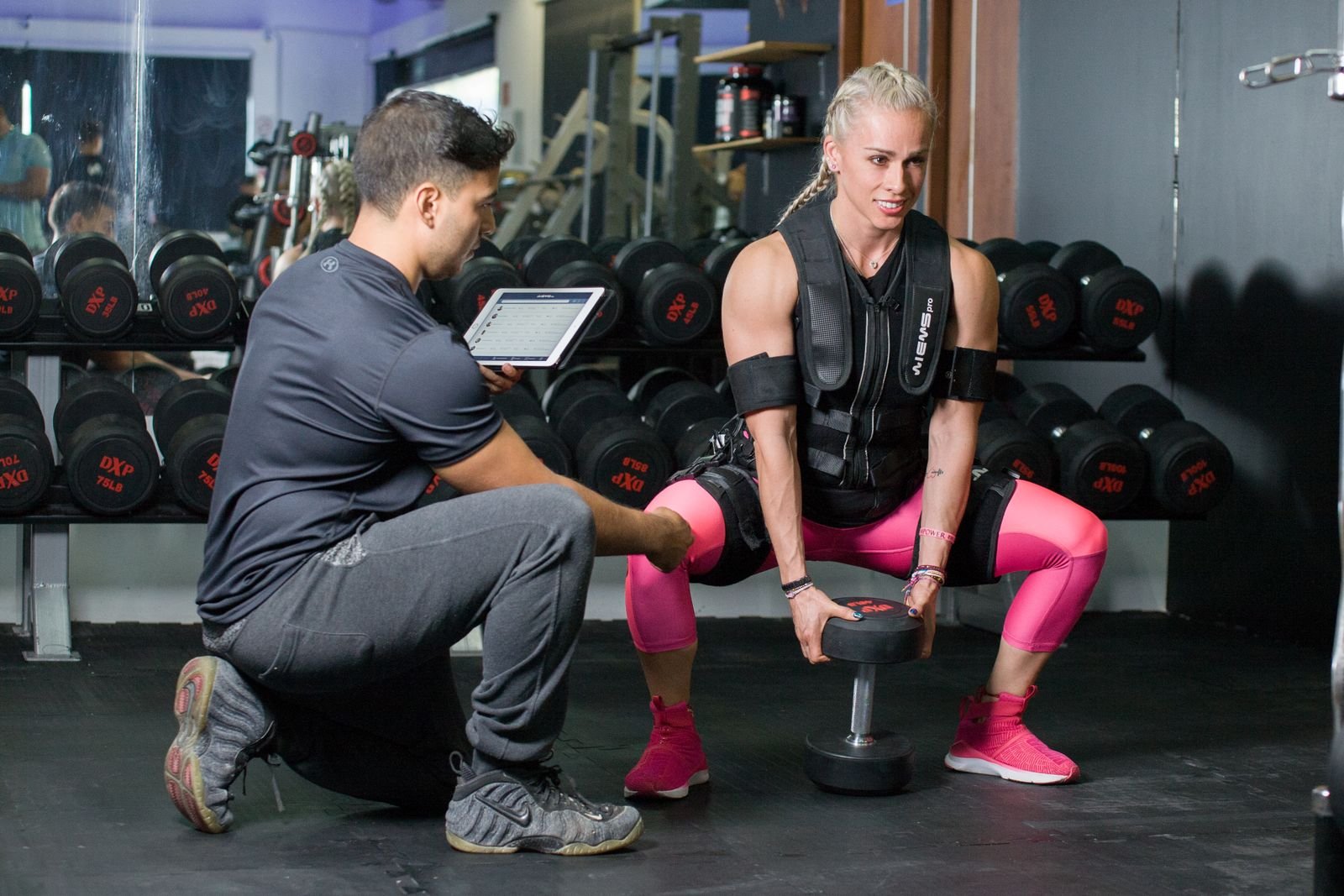
This guide covers the best weighted squat variations, how to do them, muscles worked, form tips, beginner-friendly progressions, and common mistakes to avoid. For general strength training, the CDC recommends muscle-strengthening activity at least 2 days per week, along with regular aerobic activity.
What Are Squats With Weights?
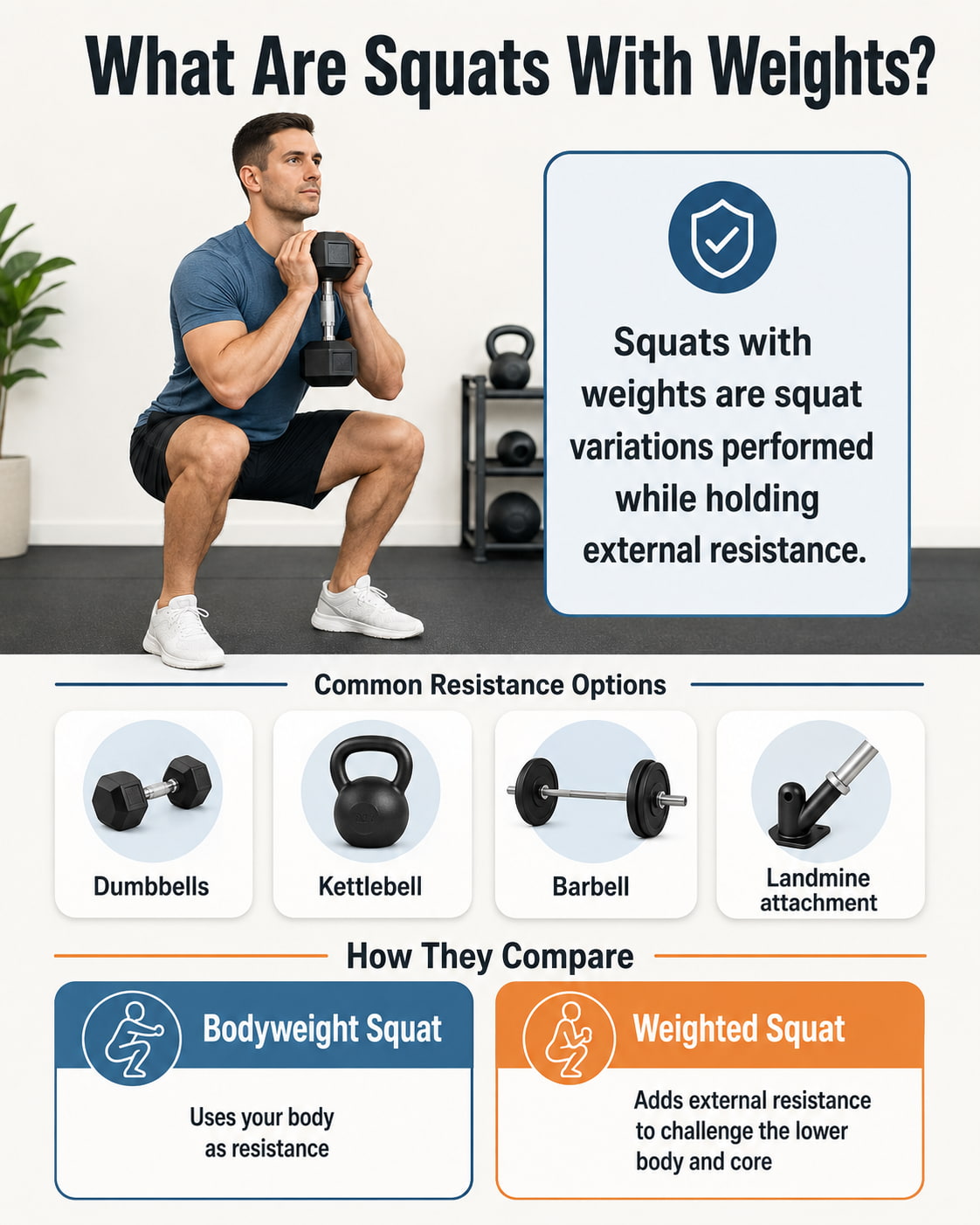
Squats with weights are squat variations performed while holding external resistance, such as dumbbells, kettlebells, a barbell, or a landmine attachment.
Instead of using only body weight, weighted squats add more resistance to challenge your lower body and core.
Common weighted squat options include:
- Goblet squats
- Dumbbell squats
- Barbell back squats
- Front squats
- Box squats
- Sumo squats
- Bulgarian split squats
- Zercher squats
- Landmine squats
- Overhead squats
The best version depends on your goal, equipment, mobility, and experience level.
Muscles Worked During Weighted Squats
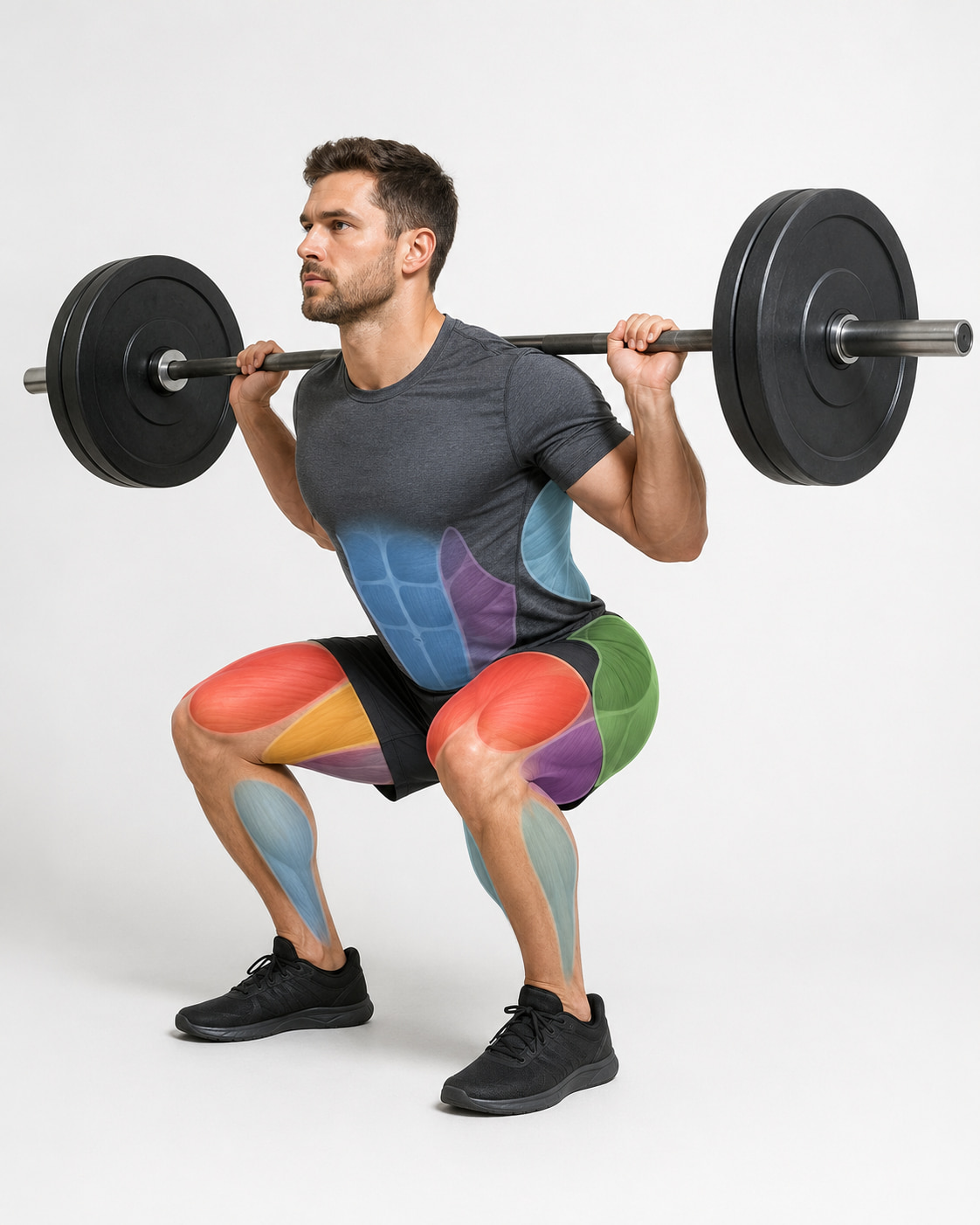
Weighted squats mainly target the lower body, but they also require strong trunk control.
Primary muscles worked:
- Quadriceps
- Gluteus maximus
- Hamstrings
- Adductors
- Calves
Secondary muscles worked:
- Core muscles
- Spinal stabilizers
- Upper back muscles
- Hip stabilizers
- Grip muscles, depending on the variation
Different squat variations shift emphasis. For example, front squats usually demand more upright posture and core control, while sumo squats place more emphasis on the inner thighs and glutes.
10 Best Weighted Squats to Build Strong Legs and Glutes
Below are the best weighted squat variations, from beginner-friendly to more advanced.
1. Goblet Squat
The goblet squat is one of the best weighted squats for beginners. You hold one dumbbell or kettlebell close to your chest, which helps you stay upright and control your depth.
Why it works:
The front-held weight encourages better posture and core bracing. It also makes it easier to learn proper squat mechanics before moving to heavier barbell squats.
Muscles worked:
The goblet squat works the quads, glutes, hamstrings, adductors, calves, core, and upper back.
How to do it:
- Stand with feet about shoulder-width apart.
- Hold one dumbbell or kettlebell close to your chest.
- Brace your core and keep your elbows pointing slightly down.
- Push your hips back and bend your knees.
- Lower until you reach a comfortable depth.
- Keep your knees tracking in line with your toes.
- Press through your midfoot and heel to stand back up.
- Squeeze your glutes lightly at the top without over-arching your back.
Trainer Tip:
Keep the weight close to your body. If the dumbbell drifts forward, your lower back and shoulders may work harder than needed.
2. Dumbbell Squat
The dumbbell squat is a simple weighted squat variation where you hold one dumbbell in each hand at your sides.
Why it works:
This version is easy to set up, beginner-friendly, and useful for home or gym workouts. It also lets you train your legs without putting a barbell on your back.
Muscles worked:
The dumbbell squat works the quads, glutes, hamstrings, calves, core, forearms, and upper traps.
How to do it:
- Stand with feet about shoulder-width apart.
- Hold one dumbbell in each hand at your sides.
- Keep your shoulders relaxed and chest tall.
- Brace your core before each rep.
- Lower into a squat with control.
- Keep the dumbbells close to your sides.
- Push through your feet to return to standing.
- Avoid swinging the weights as you move.
Trainer Tip:
Do not let the dumbbells pull your shoulders forward. Keep your chest open and your grip strong.
3. Barbell Back Squat
The barbell back squat is a classic strength exercise. The bar rests across your upper back while you squat.
Why it works:
The back squat allows heavier loading than many other squat variations. It is excellent for building lower-body strength when your technique, mobility, and setup are solid.
Muscles worked:
The back squat works the quads, glutes, hamstrings, adductors, calves, core, spinal stabilizers, and upper back.
How to do it:
- Set the barbell at upper-chest height in a squat rack.
- Step under the bar and position it across your upper back.
- Grip the bar evenly with both hands.
- Step back carefully and set your feet.
- Brace your core before lowering.
- Squat down with control.
- Keep your knees tracking with your toes.
- Drive through your midfoot and heel to stand.
- Re-brace before the next rep.
Trainer Tip:
Use safety bars in the rack when possible. Start lighter than you think you need, especially while learning bar position and depth.
4. Front Squat
The front squat places the barbell across the front of your shoulders instead of your upper back.
Why it works:
The front-loaded position encourages a more upright torso and increases the demand on your core. It is a strong choice for training quads and posture control.
Muscles worked:
The front squat works the quads, glutes, hamstrings, upper back, core, and spinal stabilizers.
How to do it:
- Set the barbell at shoulder height.
- Rest the bar across the front of your shoulders.
- Keep your elbows lifted.
- Brace your core and set your feet.
- Lower into a squat while keeping your torso tall.
- Keep the bar over your midfoot.
- Press through the floor to stand back up.
- Keep your elbows from dropping as you rise.
Trainer Tip:
If the front rack position feels uncomfortable, try a crossed-arm grip or use straps attached to the bar for better control.
5. Box Squat
The box squat uses a box or bench behind you as a depth target.
Why it works:
The box gives you a clear stopping point, which can help beginners learn depth and control. It can also help lifters practice sitting back without guessing their range.
Muscles worked:
The box squat works the glutes, quads, hamstrings, adductors, calves, core, and hip stabilizers.
How to do it:
- Place a sturdy box or bench behind you.
- Hold a dumbbell, kettlebell, or barbell.
- Stand with feet about shoulder-width apart.
- Brace your core.
- Push your hips back and lower toward the box.
- Lightly touch the box without relaxing fully.
- Press through your feet to stand back up.
- Keep each rep controlled.
Trainer Tip:
Do not collapse onto the box. Treat it as a depth guide, not a chair.
6. Sumo Squat
The sumo squat uses a wider stance with the toes turned slightly outward.
Why it works:
The wide stance can increase inner-thigh and glute involvement. It is also a useful option for people who feel better squatting with a wider base.
Muscles worked:
The sumo squat works the glutes, adductors, quads, hamstrings, calves, and core.
How to do it:
- Stand with feet wider than shoulder-width.
- Turn your toes slightly outward.
- Hold a dumbbell or kettlebell in front of your body.
- Brace your core.
- Lower your hips straight down.
- Keep your knees tracking in line with your toes.
- Press through your feet to stand tall.
- Keep your torso controlled throughout the rep.
Trainer Tip:
Do not force an extreme toe angle. Choose a stance that lets your knees track naturally and comfortably.
7. Bulgarian Split Squat
The Bulgarian split squat is a single-leg squat variation with your back foot elevated on a bench or box.
Why it works:
This variation builds single-leg strength, balance, and glute control. It is especially useful for finding and improving left-right strength differences.
Muscles worked:
The Bulgarian split squat works the quads, glutes, hamstrings, calves, core, and hip stabilizers.
How to do it:
- Stand a few feet in front of a bench.
- Place the top of one foot on the bench behind you.
- Hold dumbbells at your sides or use body weight first.
- Brace your core.
- Lower your back knee toward the floor.
- Keep your front foot planted.
- Push through the front leg to stand.
- Complete all reps, then switch sides.
Trainer Tip:
Start without weights first. This exercise is harder than it looks, and balance matters more than load.
8. Zercher Squat
The Zercher squat is done by holding a barbell in the crooks of your elbows.
Why it works:
The front-loaded position challenges your core, upper back, and legs. It can also help some lifters stay more upright compared with a back squat.
Muscles worked:
The Zercher squat works the quads, glutes, hamstrings, core, upper back, biceps, and spinal stabilizers.
How to do it:
- Set a barbell around waist height in a rack.
- Place the bar in the crooks of your elbows.
- Keep your hands close together or clasped.
- Brace your core and step back carefully.
- Squat down with control.
- Keep your elbows close to your body.
- Press through your feet to stand.
- Keep the bar close throughout the movement.
Trainer Tip:
Use a pad or towel if the bar feels uncomfortable on your arms. Keep the load moderate while learning the setup.
9. Landmine Squat
The landmine squat uses a barbell anchored at one end, with the other end held near your chest.
Why it works:
The angled bar path makes this variation feel more guided than a free barbell squat. It is a good option for beginners who want to add load while keeping the movement controlled.
Muscles worked:
The landmine squat works the quads, glutes, hamstrings, calves, core, shoulders, and upper back.
How to do it:
- Place one end of a barbell in a landmine attachment or secure corner.
- Hold the free end of the bar near your chest.
- Stand with feet about shoulder-width apart.
- Brace your core.
- Lower into a squat while keeping the bar close.
- Keep your knees aligned with your toes.
- Press through your feet to stand.
- Keep your torso tall and controlled.
Trainer Tip:
Let the bar guide you, but do not lean your whole body into it. Stay balanced over your feet.
10. Overhead Squat
The overhead squat is an advanced squat variation where you hold a weight overhead while squatting.
Why it works:
This variation challenges mobility, balance, core strength, shoulder stability, and full-body control. It is best for experienced lifters with good technique.
Muscles worked:
The overhead squat works the quads, glutes, hamstrings, calves, core, shoulders, upper back, and hip stabilizers.
How to do it:
- Start with a light bar, PVC pipe, or empty training bar.
- Hold the weight overhead with arms locked out.
- Set your feet in a comfortable squat stance.
- Brace your core.
- Keep the weight stacked over your midfoot.
- Lower into a controlled squat.
- Keep your arms stable overhead.
- Stand back up without letting the weight drift forward.
Trainer Tip:
Do not rush to load this exercise. Master shoulder position, core control, and squat depth first.
Benefits of Squats With Weights
Weighted squats are popular because they train strength, balance, coordination, and full-body control in one movement.
Key benefits include:
- Build stronger quads, glutes, and hamstrings
- Improve lower-body power for sports and daily movement
- Strengthen the core through bracing
- Support better hip, knee, and ankle control
- Help reduce left-right strength imbalance when using single-leg variations
- Offer many beginner, intermediate, and advanced progressions
The Cleveland Clinic describes squats as a foundational exercise for building strength in the legs, glutes, quads, and core muscles.
How to Choose the Right Weight for Squats
Choose a weight that feels challenging but does not break your form.
A good beginner rule is to start with a load you can control for 8–12 clean reps. If you are completely new to resistance training, start even lighter and practice the movement first.
The Mayo Clinic recommends starting with a weight you can lift comfortably for 12 to 15 repetitions, then increasing gradually as your technique stays strong.
Use this simple guide:
| Goal | Suggested reps | Suggested sets | Load |
|---|---|---|---|
| Beginner form practice | 10–15 reps | 1–3 sets | Light |
| Muscle building | 8–12 reps | 2–4 sets | Moderate |
| Strength focus | 3–6 reps | 3–5 sets | Heavier, only with solid form |
| Conditioning | 12–20 reps | 2–4 sets | Light to moderate |
How to Do Squats With Weights Safely
Before adding heavy weight, learn the basic squat pattern.
The American Council on Exercise recommends bracing the core, keeping the chest lifted, shifting the hips back, and controlling the knees as you squat.
Basic weighted squat form:
- Stand with feet about shoulder-width apart.
- Brace your core before you lower.
- Keep your chest open and spine neutral.
- Push your hips back and bend your knees.
- Keep your knees tracking in line with your toes.
- Lower only as far as you can control.
- Press through your midfoot and heel to stand tall.
- Finish each rep with control, not a bounce.
A 2024 biomechanical review in PubMed Central notes that squat mechanics can change based on stance width, foot rotation, trunk position, shin position, and depth. That means there is no single perfect squat stance for everyone.
Best Weighted Squat Variations by Fitness Level
| Fitness level | Best options |
|---|---|
| Beginner | Goblet squat, dumbbell squat, box squat, landmine squat |
| Intermediate | Front squat, sumo squat, Bulgarian split squat |
| Advanced | Barbell back squat, Zercher squat, overhead squat |
| Home workout | Goblet squat, dumbbell squat, sumo squat |
| Glute focus | Sumo squat, Bulgarian split squat, box squat |
| Quad focus | Front squat, goblet squat, heel-elevated squat |
| Core challenge | Front squat, Zercher squat, overhead squat |
Common Weighted Squat Mistakes
Weighted squats are effective, but poor form can make them less useful and more stressful on the body.
Common mistakes include:
- Using too much weight too soon
- Letting the knees cave inward
- Rounding the lower back
- Lifting the heels off the floor
- Dropping too fast into the bottom position
- Bouncing out of the bottom
- Holding your breath too long without control
- Forcing a depth your body cannot control
- Ignoring warm-up sets
- Training heavy squats too often without recovery
How Many Sets and Reps Should You Do?
Your sets and reps should match your goal and experience level.
1. For beginners, a good starting point is:
- 2–3 sets
- 8–12 reps
- 1–2 minutes of rest
- 2 days per week
2. For muscle building:
- 3–4 sets
- 8–12 reps
- 60–120 seconds of rest
- Moderate load with clean form
3. For strength:
- 3–5 sets
- 3–6 reps
- 2–3 minutes of rest
- Heavier load with excellent technique
4. For conditioning:
- 2–4 sets
- 12–20 reps
- Shorter rest
- Light to moderate load
Do not train heavy weighted squats every day. Your muscles, joints, and nervous system need recovery between hard lower-body sessions.
How to Add Weighted Squats to Your Workout
Weighted squats usually work best near the beginning of your workout, after your warm-up. That is when your energy, coordination, and focus are highest.
Sample beginner lower-body workout:
| Exercise | Sets | Reps |
|---|---|---|
| Goblet squat | 3 | 8–12 |
| Dumbbell Romanian deadlift | 3 | 8–12 |
| Step-up | 2 | 8–10 per leg |
| Glute bridge | 2 | 10–15 |
| Plank | 2 | 20–40 seconds |
Sample intermediate lower-body workout:
| Exercise | Sets | Reps |
|---|---|---|
| Barbell back squat | 4 | 5–8 |
| Bulgarian split squat | 3 | 8–10 per leg |
| Sumo squat | 3 | 10–12 |
| Hamstring curl | 3 | 10–15 |
| Standing calf raise | 3 | 12–15 |
Who Should Be Careful With Squats With Weights?
Weighted squats are not the right starting point for everyone. Some people may need modifications, lighter loads, or professional guidance.
Be careful or get guidance first if you have:
- Current knee, hip, ankle, or back pain
- Recent surgery
- Balance problems
- A history of falls
- Sharp pain during squats
- Pain that gets worse as you continue
- Numbness, tingling, or unusual weakness
- Poor control with bodyweight squats
A safer starting option may be a bodyweight squat, box squat, supported squat, or goblet squat with a light weight.
Weighted Squat Safety Tips
Use these tips to make squats with weights safer and more effective:
- Warm up for 5–10 minutes before lifting.
- Practice bodyweight squats before adding weight.
- Start with light loads.
- Use a controlled tempo.
- Keep your knees aligned with your toes.
- Stop if you feel sharp or worsening pain.
- Use a squat rack with safety bars for barbell squats.
- Increase weight gradually.
- Keep at least one rest day between hard lower-body sessions.
- Ask a qualified trainer for feedback if your form feels unstable.
FAQs About Squats With Weights
Are squats with weights good for glutes?
Yes, squats with weights can help build stronger glutes, especially when you use good depth, controlled form, and progressive loading. Sumo squats, Bulgarian split squats, goblet squats, and box squats are especially useful glute-focused options.
Are weighted squats bad for your knees?
Weighted squats are not automatically bad for your knees. Problems are more likely when the weight is too heavy, the knees collapse inward, the heels lift, or the movement is rushed. Use a controlled range of motion and stop if pain sharpens or worsens.
What is the best weighted squat for beginners?
The goblet squat is usually the best weighted squat for beginners. It is easier to learn than a barbell squat, helps keep the torso upright, and teaches good bracing.
How heavy should I squat as a beginner?
Start with a weight you can lift for 8–12 controlled reps without losing form. If your knees cave in, your back rounds, or you cannot control the bottom position, the weight is too heavy.
Can I do weighted squats every day?
Heavy weighted squats should not be done every day. Most people do better with 2–3 lower-body strength sessions per week, depending on total volume, recovery, and training experience.
Which weighted squat is best for quads?
Front squats, goblet squats, and heel-elevated squat variations are strong options for quad emphasis. Keep the movement controlled and choose a depth you can maintain safely.
Which weighted squat is best for home workouts?
Goblet squats, dumbbell squats, and sumo squats are excellent for home workouts because they require minimal equipment and are easy to scale.
Conclusion
Squats with weights are a powerful way to build stronger legs and glutes, but the best results come from smart progression. Start with goblet squats or dumbbell squats, master your form, then move toward more advanced variations like front squats, back squats, Zercher squats, and overhead squats.
Choose the variation that matches your current strength, mobility, and equipment. Keep your reps controlled, increase weight gradually, and prioritize clean movement over lifting heavier too soon.
This content is for informational purposes only and not medical advice.