
Trap exercises for women can help build upper-back strength, support better posture, and improve shoulder control when they are trained with balanced, evidence-based movements. The key is not just doing shrugs. A better plan includes upper-, middle-, and lower-trap exercises so your shoulders and shoulder blades work more smoothly together. Guidance from the CDC, the Office on Women’s Health, and ACE supports regular muscle-strengthening work and balanced back training rather than relying on one movement alone.
Understanding this matters because many women look for trap exercises to “tone” the upper back or improve posture, but overemphasizing only the upper traps can leave training incomplete. Research reviews available through PubMed show that different positions and movements change how much the upper, middle, and lower trapezius contribute, which is why a mix of rows, raises, carries, and scapular-control work makes more sense than shrugging alone.
Why trap exercises matter for women
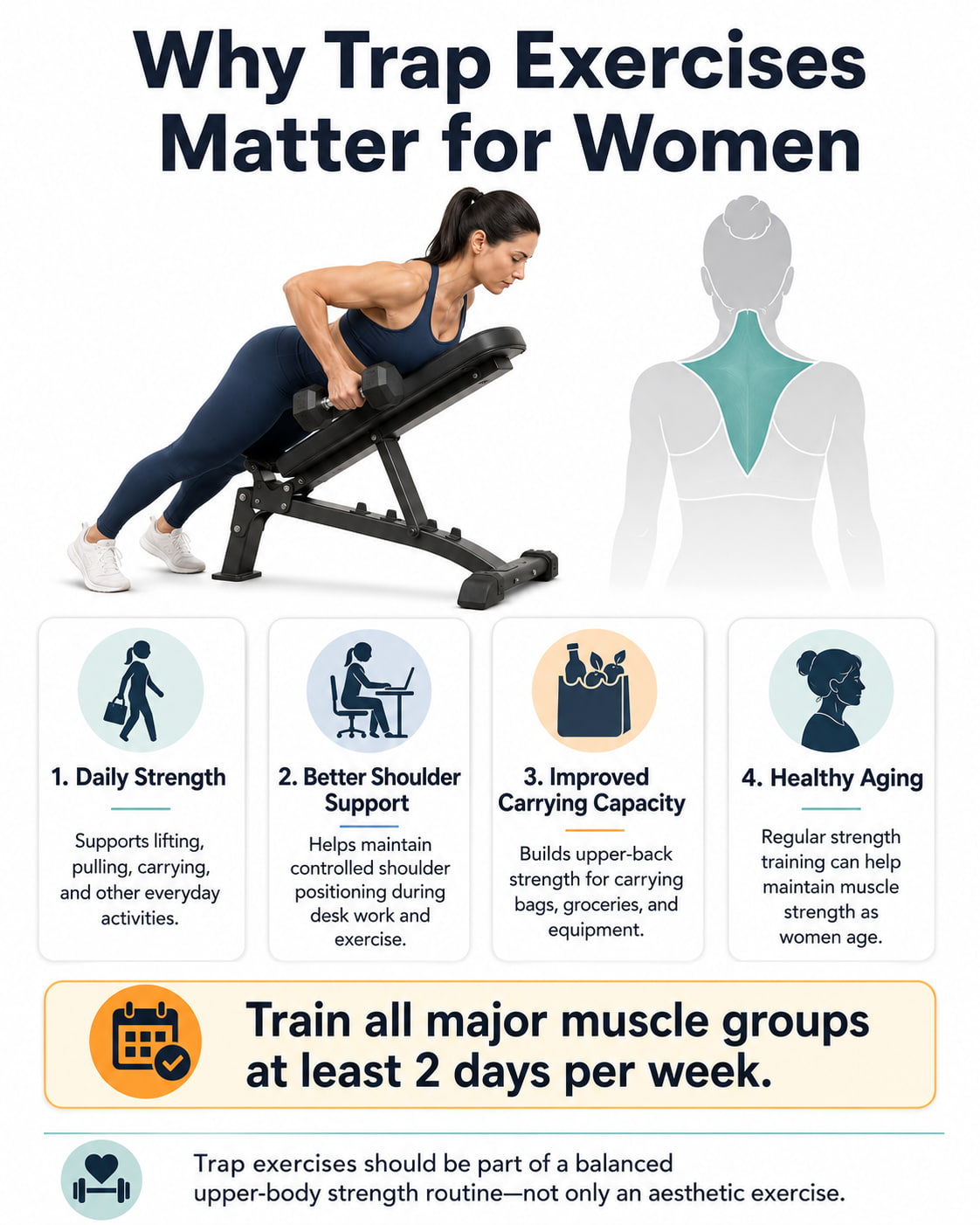
Women benefit from trap training for the same broad reasons anyone does: stronger muscles support daily function, lifting capacity, and long-term physical health. The Office on Women’s Health recommends muscle-strengthening activity at least two days per week, and the CDC recommends strength work for all major muscle groups on two or more days weekly. For many women, trap training can also support better shoulder positioning during desk work, carrying bags, pulling exercises, and general upper-body training.
There is also a practical aging and wellness angle. The Office on Women’s Health notes that muscle mass and strength can decline with age, and staying physically active helps support strength over time. That makes regular upper-back and shoulder-girdle training a useful part of a broader strength plan, not just an aesthetic extra.
10 best trap exercises for women
Build a stronger upper back with these 10 best trap exercises for women designed to support better posture, shoulder control, and balanced strength. This list includes beginner-friendly movements that target the upper, middle, and lower traps for more complete results.
1. Dumbbell Shrug
How to do it
- Stand tall with a dumbbell in each hand at your sides.
- Keep your arms straight and your shoulders relaxed at the start.
- Lift your shoulders straight up toward your ears.
- Pause briefly at the top without rolling the shoulders.
- Lower slowly to the start.
Why it works
The dumbbell shrug is a simple way to train the upper traps directly. It can help build strength for carrying, supporting heavier upper-body lifts, and improving awareness of shoulder elevation control.
Muscles worked
Upper trapezius, forearms, grip.
Trainer Tip
Do not roll your shoulders in circles. Lift straight up, pause, and lower with control.
2. Bent-Over Dumbbell Row
How to do it
- Hold a dumbbell in each hand and hinge at the hips.
- Keep your spine neutral and your chest slightly lifted.
- Pull the elbows back toward your hips.
- Squeeze the shoulder blades together at the top.
- Lower the weights slowly.
Why it works
Research highlighted by ACE found the bent-over row was one of the most effective back exercises tested and performed especially well for the middle trapezius while also strongly recruiting the lower trapezius. It is one of the best high-value exercises for trap-focused training.
Muscles worked
Middle trapezius, lower trapezius, rhomboids, lats, rear deltoids, biceps.
Trainer Tip
Do not let the shoulders round forward. Mayo Clinic specifically cues keeping the shoulder from rolling forward during the row.
3. Reverse Fly
How to do it
- Sit or hinge forward with a light dumbbell in each hand.
- Keep a small bend in your elbows.
- Raise the arms out to the sides until the elbows reach shoulder level.
- Pause briefly, then lower slowly.
Why it works
The reverse fly trains the upper back in a way that helps many women feel the rear shoulder and mid-back muscles working together. Mayo Clinic includes the reverse fly as a standard upper-body strength exercise and notes you should feel tension across the upper back.
Muscles worked
Middle trapezius, rear deltoids, rhomboids.
Trainer Tip
Use lighter weights than you expect. This exercise works better with control than with momentum.
4. Face Pull
How to do it
- Set a cable or band at about upper-chest to face height.
- Grab the handles or band with palms facing inward or down.
- Pull toward your face while letting your elbows flare out.
- Finish with your shoulder blades squeezed back.
- Return slowly.
Why it works
The face pull is useful because it trains scapular retraction and external-rotation support together. That makes it a practical option for posture-focused upper-body work, especially if your training already includes pressing exercises.
Muscles worked
Middle trapezius, lower trapezius, rear deltoids, rotator cuff support muscles.
Trainer Tip
Think “pull apart and back,” not just “pull to the face.”
5. Prone Y Raise
How to do it
- Lie face down on a bench or incline bench with light weights or no weight.
- Let your arms hang down, then raise them overhead in a Y shape.
- Keep thumbs pointed up.
- Pause briefly at the top.
- Lower slowly.
Why it works
Research discussed by ACE found I-Y-T raises were highly effective overall, and lower-trapezius results were especially strong. This makes the Y raise one of the best lower-trap-focused choices in a balanced trap program.
Muscles worked
Lower trapezius, middle trapezius, rear deltoids.
Trainer Tip
Keep the movement small and clean. Lower-trap work often feels harder than it looks.
6. Prone T Raise
How to do it
- Lie face down on a bench with light weights or bodyweight only.
- Lift your arms out to the sides to form a T.
- Squeeze the shoulder blades together at the top.
- Pause briefly.
- Lower under control.
Why it works
The T raise is a strong option for the middle traps and upper-back control. It pairs well with Y raises because together they cover different parts of the trapezius.
Muscles worked
Middle trapezius, rear deltoids, rhomboids.
Trainer Tip
Keep your neck long and relaxed instead of craning upward.
7. Seated Cable Row
How to do it
- Sit tall with your feet planted and hold the cable handle.
- Start with shoulders down and chest up.
- Pull the handle toward your lower ribs or mid-torso.
- Squeeze the shoulder blades together.
- Return slowly without rounding hard at the shoulders.
Why it works
Findings reviewed by ACE showed the seated row was among the top exercises for middle trapezius activation. It is also easy to scale for beginners because the setup is stable and repeatable.
Muscles worked
Middle trapezius, rhomboids, lats, rear deltoids, biceps.
Trainer Tip
Do not turn it into a low-back swing. Keep the movement smooth.
8. Single-Arm Dumbbell Row
How to do it
- Place one hand and one knee on a bench for support.
- Hold a dumbbell in the other hand.
- Keep your back flat and core braced.
- Pull the elbow back toward your hip.
- Lower slowly and repeat before switching sides.
Why it works
This row variation lets you focus on one side at a time, which can help clean up side-to-side differences in control and strength. The ACE exercise library cues bracing the torso and keeping the back flat, which makes it a useful choice for controlled trap and upper-back training.
Muscles worked
Middle trapezius, lower trapezius, rhomboids, lats, biceps.
Trainer Tip
Do not twist your body to lift the weight. Let the back muscles do the work.
9. Farmer’s Carry
How to do it
- Hold a heavy dumbbell or kettlebell in each hand.
- Stand tall with ribs stacked over pelvis.
- Walk slowly with short, steady steps.
- Keep shoulders level and grip firm.
- Stop before your posture starts collapsing.
Why it works
The farmer’s carry trains the traps in a very functional way because the muscles must stabilize the shoulders while you stay tall and resist slouching. It is especially useful for posture, grip, and total-body tension.
Muscles worked
Upper trapezius, middle trapezius, grip, core.
Trainer Tip
Think “tall and steady,” not “fast and sloppy.”
10. Incline Dumbbell Shrug
How to do it
- Lie chest-down on an incline bench with dumbbells hanging underneath.
- Keep your arms straight.
- Shrug the shoulders upward in line with the bench angle.
- Pause briefly.
- Lower slowly.
Why it works
This variation can feel smoother than a standing shrug for some lifters because the bench helps reduce body sway. It is a useful way to train the traps while keeping the torso more fixed.
Muscles worked
Upper trapezius, middle trapezius.
Trainer Tip
Use a lighter load than your normal shrug weight until the pattern feels natural.
Which trap exercises are best for posture?
For posture support, the best trap exercises are usually the ones that train scapular retraction and upward-rotation support, not just elevation. In practice, that means bent-over rows, seated rows, face pulls, Y raises, and T raises often deserve more attention than heavy shrugs alone. This matches exercise testing discussed by ACE and research reviews showing that exercise position influences which trapezius fibers are emphasized.
Common mistakes women make with trap training
Doing only shrugs
Shrugs are useful, but a trap routine built only around upper-trap elevation can miss the middle and lower fibers that matter for shoulder-blade control.
Using too much weight
Trap exercises often work best when the shoulder blades move well. If the weight is too heavy, reps turn into neck tension and swinging.
Letting the neck take over
Many people tense the neck when training traps. Keep the jaw relaxed, neck long, and shoulders controlled.
Skipping lower-trap work
Y raises and similar movements may look easy, but they help fill an important gap in many upper-body programs.
Trap workout plan for women
A simple starting plan is to train traps 2 times per week as part of a broader back or upper-body routine. That matches the general muscle-strengthening guidance from the CDC and the Office on Women’s Health.
Beginner trap workout
- Bent-over dumbbell row: 2 to 3 sets of 8 to 12 reps
- Reverse fly: 2 to 3 sets of 10 to 15 reps
- Prone Y raise: 2 sets of 8 to 12 reps
- Farmer’s carry: 2 to 3 rounds of 20 to 40 seconds
Intermediate trap workout
- Dumbbell shrug: 3 sets of 10 to 15 reps
- Seated cable row: 3 sets of 8 to 12 reps
- Face pull: 3 sets of 10 to 15 reps
- Prone T raise: 2 to 3 sets of 10 to 15 reps
How often should women train traps?
Most women do well with trap work 1 to 3 times per week, depending on total training volume. If you already do rows, pulldowns, carries, and rear-delt work, your traps are probably getting some indirect training too. A focused trap session only needs a few well-chosen movements, done consistently.
Who should be careful with trap exercises?
Use extra caution if you have a current neck injury, recent shoulder injury, nerve symptoms, or pain that worsens during upper-body training. The Office on Women’s Health advises starting slowly and staying safe with activity, and it is smart to get individualized guidance if symptoms are significant or persistent.
FAQs about trap exercises for women
Do trap exercises make women bulky?
Not automatically. Muscle gain depends on total training, nutrition, recovery, and time. For most women, trap training is more likely to improve strength and upper-back shape than cause sudden bulk.
Are shrugs enough for trap training?
No. Shrugs mainly emphasize upper-trap elevation. A balanced trap routine should also include rows, raises, and scapular-control work.
What trap exercises help posture the most?
Rows, face pulls, Y raises, and T raises are usually the best starting point because they train important upper-back and shoulder-blade functions.
Can beginners do trap exercises safely?
Yes, especially with lighter weights, slower reps, and controlled form. Rows, reverse flies, and bodyweight or very light Y raises are common beginner-friendly options.
How many trap exercises should women do in one workout?
Usually 2 to 4 trap-focused movements are enough in one session, especially if they target different parts of the trapezius.
Should women train traps if they already do back workouts?
Usually yes, but they may not need a separate long trap workout. Many back exercises already train the traps indirectly.
Conclusion
Trap exercises for women work best when the program is balanced. Instead of focusing only on shrugs, use a mix of rows, raises, carries, and face pulls to train the upper, middle, and lower traps. That approach is more useful for posture, upper-back strength, and shoulder support. Start with clean form, moderate resistance, and consistent weekly training, then build from there.