
The best inverted row alternatives are suspension trainer rows, seated cable rows, chest-supported rows, and other horizontal pulling exercises that train the lats, upper back, rear shoulders, and arms. The right choice depends on your equipment, experience, lower-back tolerance, and training goal.
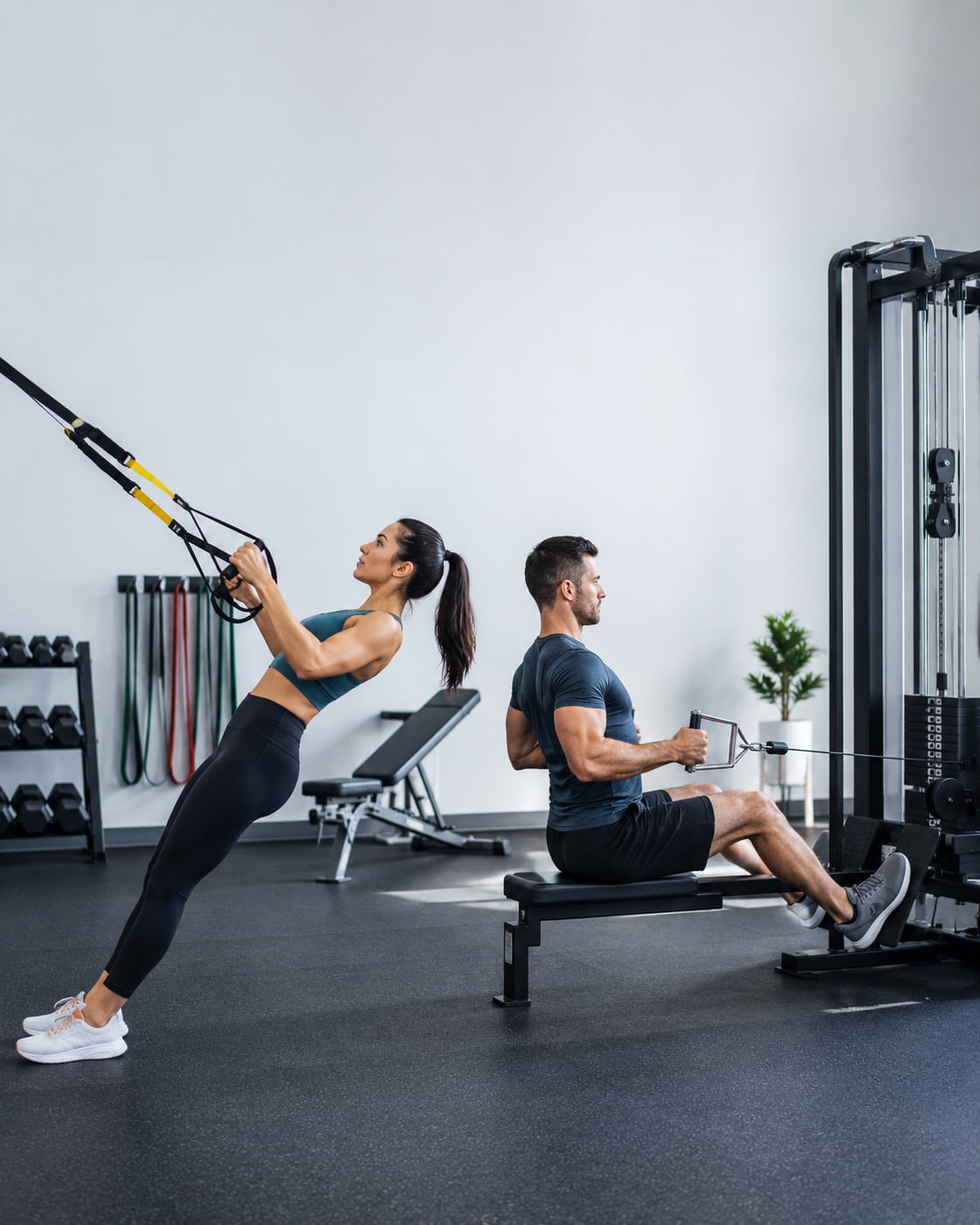
Inverted rows are effective because they combine a horizontal pulling movement with bodyweight resistance and trunk stabilization. However, you may need a substitute if you do not have a secure bar, find the setup uncomfortable, or want an exercise that is easier to load progressively.
This guide compares nine practical inverted row alternatives for home and gym workouts, including bodyweight, dumbbell, barbell, cable, resistance-band, and machine options.
What Is the Best Alternative to Inverted Rows?
The suspension trainer row is the closest overall alternative because it keeps the bodyweight-based horizontal pulling pattern. You can make it easier or harder by changing your body angle.
Other strong options include:
- Seated cable row: Best for controlled, adjustable resistance
- Chest-supported dumbbell row: Best for reducing lower-back fatigue
- Resistance-band row: Best for home and travel workouts
- Bent-over barbell row: Best for developing heavier rowing strength
- Machine row: Best for beginners and stable muscle-building sets
Horizontal rows are generally closer substitutes than pull-ups or lat pulldowns. Pull-ups and pulldowns are useful back exercises, but they use a more vertical pulling path.
Research from the American Council on Exercise found that the inverted row, seated row, and bent-over row were among the stronger exercises tested for middle-trapezius activation. The inverted row and bent-over row also performed well for several other back and shoulder muscles.
9 Best Inverted Row Alternatives
These nine inverted row alternatives train the lats, upper back, rear shoulders, and arms through similar horizontal pulling patterns. Choose the option that best fits your equipment, experience level, and need for bodyweight, free-weight, cable, or machine resistance.
1. Suspension Trainer Row
Why it works: The suspension trainer row closely reproduces the inverted row because your body acts as the resistance while your arms pull horizontally. Walking your feet closer to the anchor makes the exercise harder, while standing more upright makes it easier.
Muscles worked: The lats, rhomboids, middle trapezius, posterior deltoids, biceps, forearms, and trunk stabilizers all contribute.
How to do it:
- Secure the suspension trainer to an anchor designed to support bodyweight exercise.
- Hold the handles with your palms facing each other and walk your feet forward.
- Lean backward with your arms extended and keep your body straight from head to heels.
- Pull your chest toward the handles while driving your elbows backward.
- Pause briefly, then extend your arms under control.
Trainer Tip: Avoid pushing your hips forward or letting them sag. Start with 2–4 sets of 8–15 controlled repetitions.
2. Seated Cable Row
Why it works: The seated cable row maintains a horizontal pulling path while allowing you to select resistance in small, manageable increments. The seated position also removes much of the balance demand found in inverted rows.
Muscles worked: The lats, rhomboids, middle trapezius, posterior deltoids, biceps, brachialis, and forearms are the main contributors.
How to do it:
- Sit at the cable station with your feet supported and knees slightly bent.
- Hold the attachment with your arms extended and sit tall.
- Brace your torso and pull the handle toward your lower ribs or upper abdomen.
- Keep your elbows close to your sides without shrugging your shoulders.
- Extend your arms slowly without allowing the weight stack to slam down.
Trainer Tip: Do not turn the movement into a repeated forward-and-back torso swing. Use 3 sets of 8–15 repetitions with a weight you can control through the full range.
3. Chest-Supported Dumbbell Row
Why it works: Supporting your chest on an incline bench reduces the need to hold a prolonged hip hinge. This makes it easier to concentrate on pulling with the upper back instead of ending the set because your lower back becomes tired.
Muscles worked: The lats, rhomboids, trapezius, posterior deltoids, biceps, brachialis, and forearms perform most of the work.
How to do it:
- Set an adjustable bench to a low or moderate incline.
- Lie face down with your chest supported and hold a dumbbell in each hand.
- Let your arms hang straight without rounding your shoulders excessively.
- Pull the dumbbells toward your lower ribs while driving your elbows backward.
- Lower the weights until your arms are extended.
Trainer Tip: Keep your chest against the bench throughout the repetition. Perform 3–4 sets of 8–15 repetitions.
4. Single-Arm Dumbbell Row
Why it works: The single-arm dumbbell row trains each side independently, making it useful for improving unilateral strength and control. It also requires minimal equipment and is easy to progress by using a heavier dumbbell.
Muscles worked: The lats, rhomboids, middle trapezius, posterior deltoids, biceps, forearms, and trunk stabilizers are involved.
How to do it:
- Place one hand on a stable bench and stagger your feet.
- Hold a dumbbell in the free hand with your arm extended.
- Keep your spine controlled and your hips facing the floor.
- Pull the dumbbell toward your hip or lower ribs.
- Lower it slowly without rotating your torso toward the floor.
Trainer Tip: Think about moving your elbow backward rather than lifting the dumbbell straight upward. Use 3 sets of 8–12 repetitions per side.
5. Bent-Over Barbell Row
Why it works: The bent-over barbell row offers high loading potential and trains the upper and lower back while you maintain a hip-hinged position. It is a strong option for experienced lifters who want to develop overall pulling strength.
Muscles worked: The lats, rhomboids, trapezius, posterior deltoids, biceps, spinal erectors, glutes, hamstrings, and abdominal muscles contribute.
How to do it:
- Hold the bar slightly wider than shoulder-width.
- Push your hips backward and bend your knees slightly.
- Maintain a controlled spine and let the bar hang beneath your shoulders.
- Pull the bar toward your upper abdomen while keeping your torso stable.
- Lower the bar until your elbows are straight.
The ACE exercise library similarly recommends hinging at the hips, maintaining a controlled back position, and pulling the bar toward the abdomen.
Trainer Tip: Choose a load that allows you to maintain your torso position. For strength and size, perform 3–4 sets of 6–10 repetitions.
A small 2009 study involving seven healthy men compared inverted, bent-over, and one-arm cable rows. The bent-over row produced substantial back-muscle activity but also created the highest measured lumbar-spine load of the three exercises. Because the sample was small, the findings provide biomechanical context rather than proving that one exercise is universally better.
6. Resistance-Band Row
Why it works: A securely anchored resistance band can reproduce a horizontal pulling movement without requiring a cable machine or heavy weights. It is portable, inexpensive, and suitable for beginners or higher-repetition back training.
Muscles worked: The lats, rhomboids, middle trapezius, rear deltoids, biceps, and forearms are involved.
How to do it:
- Attach the band to a secure anchor approximately around chest height.
- Hold one end in each hand and step backward until the band is lightly stretched.
- Stand tall or sit with your torso stable and arms extended.
- Pull your hands toward your lower ribs while squeezing your shoulder blades.
- Return your arms slowly without allowing the band to snap back.
Trainer Tip: Resistance increases as the band stretches, so control the final part of the pull. Use 2–4 sets of 12–20 repetitions.
Inspect the band and anchor before every session. Do not use a damaged band or attach it to unstable furniture.
7. Chest-Supported T-Bar Row
Why it works: The chest-supported T-bar row combines the stability of a supported exercise with the ability to use heavier resistance. This can make it useful for building back strength and muscle without requiring your lower back to hold an unsupported hinge.
Muscles worked: The lats, trapezius, rhomboids, posterior deltoids, biceps, brachialis, and forearms are the main muscles involved.
How to do it:
- Adjust the machine so your chest is firmly supported by the pad.
- Grip the handles and begin with your arms extended.
- Pull the handles toward your torso while driving your elbows backward.
- Pause without lifting your chest away from the support.
- Lower the weight under control until your arms are extended.
Trainer Tip: Use the handle that lets your wrists and shoulders feel comfortable. Perform 3–4 sets of 6–12 repetitions.
8. Landmine Row
Why it works: The landmine row provides a loadable rowing pattern with a fixed bar path. Depending on the handle and stance, it can be performed as a two-arm row or a unilateral row.
Muscles worked: The lats, rhomboids, middle trapezius, posterior deltoids, biceps, forearms, spinal erectors, glutes, and hamstrings contribute.
How to do it:
- Secure one end of a barbell in a landmine attachment.
- Straddle the bar and hinge forward with your knees slightly bent.
- Grip a suitable landmine or close-grip handle.
- Brace your torso and pull the loaded end toward your chest or upper abdomen.
- Lower the bar slowly without losing your hip-hinge position.
Trainer Tip: Do not stand more upright each time you pull. Use 3–4 sets of 6–12 repetitions with a manageable load.
9. Machine Row
Why it works: A selectorized or plate-loaded rowing machine provides a stable movement path and simple resistance adjustments. It is especially useful for beginners, higher-volume training, and sets performed after demanding free-weight exercises.
Muscles worked: The lats, rhomboids, trapezius, rear deltoids, biceps, brachialis, and forearms are primarily involved.
How to do it:
- Adjust the seat and chest pad so the handles are within comfortable reach.
- Sit tall with your feet supported and chest against the pad when provided.
- Pull the handles toward your torso without shrugging.
- Pause briefly while keeping your wrists neutral.
- Extend your arms slowly until you feel a controlled stretch.
Trainer Tip: Adjust the seat before adding more weight. Perform 3 sets of 8–15 repetitions without allowing the weight stack to slam between reps.
How to Choose the Right Alternative
Closest Bodyweight Alternative
Choose the suspension trainer row. It preserves the bodyweight resistance and horizontal pulling pattern of the inverted row.
Best Alternative for Beginners
The machine row and seated cable row provide stable setups and allow small weight adjustments. This makes it easier to learn the pulling motion without managing a demanding body position.
Best Alternative for Home Workouts
Use a resistance-band row with a secure anchor or a single-arm dumbbell row with stable support. Avoid improvised bodyweight-row setups.
Best Alternative for Back Strength
The bent-over barbell row, landmine row, and chest-supported T-bar row allow substantial resistance to be added over time.
Best Alternative for Muscle Size
Cable, machine, and chest-supported rows are practical choices because they provide stability and make it easier to perform controlled sets close to muscular fatigue.
This does not mean they are automatically superior to bodyweight or free-weight exercises. The best option is the one you can perform consistently, progress safely, and feel in the intended muscles.
Best Alternative When Your Lower Back Fatigues
Choose the chest-supported dumbbell row, chest-supported T-bar row, or machine row with a chest pad. These reduce the need to maintain an unsupported hip hinge.
How to Program Inverted Row Alternatives
You do not need to perform all nine exercises. Most readers should choose one or two rowing variations that fit their equipment and goals.
A practical starting point is:
| Goal | Sets | Repetitions | Rest |
|---|---|---|---|
| Beginner technique | 2–3 | 10–15 | 60–90 seconds |
| Muscle size | 3–4 | 6–15 | 60–120 seconds |
| General strength | 3–4 | 5–10 | 90–180 seconds |
| Band or endurance work | 2–4 | 12–20 | 45–90 seconds |
On March, 2026, the American College of Sports Medicine published updated resistance-training guidance based on an overview of 137 studies involving more than 30,000 participants. The recommendations emphasize consistency, individualized programming, and training major muscle groups at least twice per week. ACSM also notes that approximately 10 weekly sets per muscle group can be a useful hypertrophy target and that bodyweight, bands, machines, and free weights can all be effective.
Approximately 10 sets refers to total weekly training volume for a muscle group, not 10 sets of every row variation.
Progress Your Rows Gradually
Progress when you can complete every repetition with stable form. You can:
- Add a small amount of weight.
- Use a stronger resistance band.
- Perform one or two additional repetitions.
- Add a set when needed.
- Increase the suspension-row body angle.
- Pause briefly in the contracted position.
- Slow the lowering phase.
You do not have to reach complete muscular failure on every set. Stop when you have approximately one to three good repetitions remaining, especially on unsupported barbell and landmine rows.
Sample Back Workouts Without Inverted Rows
Simple Home Back Workout
- Single-arm dumbbell row: 3 sets of 8–12 reps per side
- Resistance-band row: 3 sets of 12–20 reps
- Band pulldown or assisted pull-up: 2–3 sets of 8–15 reps
The first two exercises provide horizontal pulling, while the final movement adds a vertical pulling angle.
Simple Gym Back Workout
- Bent-over barbell row: 3 sets of 6–8 reps
- Seated cable row: 3 sets of 8–12 reps
- Lat pulldown or pull-up: 3 sets of 8–12 reps
Use a lighter load on the second row if your back and arms are already fatigued from the first exercise.
Common Rowing Mistakes
Using Too Much Momentum
Rocking the torso can help move more weight, but it may reduce control and make it difficult to judge whether the back muscles are performing the work. Lower the resistance and keep the movement deliberate.
Shrugging the Shoulders
Avoid pulling your shoulders toward your ears. Keep the neck relaxed and guide your elbows backward.
Pulling Only With the Arms
The biceps assist every row, but the movement should also include controlled motion of the upper arms and shoulder blades. Think about moving your elbows behind you rather than curling the handle.
Shortening the Range of Motion
Use the greatest comfortable range you can control. Extend your arms without allowing the shoulders or spine to collapse, then pull until the elbows reach the torso or slightly pass it.
Losing the Hip Hinge
During barbell and landmine rows, maintain a stable hip-hinged position. Do not turn every repetition into a partial deadlift.
Using an Unsafe Anchor
Only use bands and suspension trainers with anchors designed to tolerate the exercise. Check the equipment before every session.
Frequently Asked Questions
What exercise can replace inverted rows?
Suspension trainer rows, cable rows, chest-supported dumbbell rows, resistance-band rows, and machine rows can all replace inverted rows. Choose a horizontal row that matches your available equipment and training goal.
What is the closest alternative to an inverted row?
A suspension trainer row is the closest alternative because it uses bodyweight resistance and a similar horizontal pulling path.
Can dumbbell rows replace inverted rows?
Yes. Single-arm and chest-supported dumbbell rows train many of the same back and arm muscles. However, they provide less whole-body stabilization than a traditional inverted row.
Are pull-ups a good substitute for inverted rows?
Pull-ups train the back effectively, but they are not an exact substitute. A pull-up is primarily a vertical pull, while an inverted row is a horizontal pull. A balanced program can include both.
What is the best inverted row alternative at home?
Resistance-band rows and single-arm dumbbell rows are practical home options. Suspension rows also work when the trainer is attached to a properly installed and secure anchor.
Which row is easiest on the lower back?
Chest-supported dumbbell rows, chest-supported T-bar rows, and chest-supported machine rows generally require less unsupported lower-back work than bent-over rows.
Can you build a strong back without inverted rows?
Yes. Inverted rows are useful, but they are not required. Consistently training horizontal and vertical pulling movements with progressive resistance can build back strength and muscle.
Final Thoughts
The best inverted row alternative is the exercise that matches your equipment, experience, and goal while allowing consistent progression.
Choose a suspension trainer row for the closest bodyweight substitute, a chest-supported row when you want less lower-back demand, or a barbell, landmine, or T-bar row when heavier loading is the priority.
Start with controlled repetitions, use a stable setup, and increase the difficulty only after your technique remains consistent. Stop if an exercise causes sharp, worsening, or unusual pain, and seek guidance from a qualified professional when training around an existing shoulder, elbow, wrist, or back condition.
References
- American College of Sports Medicine. (2026). Resistance Training Prescription for Muscle Function, Hypertrophy, and Physical Performance in Healthy Adults
- Fenwick, C. M. J., Brown, S. H. M., and McGill, S. M. (2009). Comparison of Different Rowing Exercises: Trunk Muscle Activation and Lumbar Spine Motion, Load, and Stiffness
- Youdas, J. W., et al. (2016). Activation of Spinal Stabilizers and Shoulder Complex Muscles During an Inverted Row
- Schoenfeld, B. J., Grgic, J., Ogborn, D., and Krieger, J. W. (2017). Strength and Hypertrophy Adaptations Between Low- Versus High-Load Resistance Training
- Grgic, J., Schoenfeld, B. J., Orazem, J., and Sabol, F. (2022). Effects of Resistance Training Performed to Repetition Failure or Non-Failure on Muscular Strength and Hypertrophy
- American College of Sports Medicine. (2026). ACSM Publishes Updated Resistance Training Guidelines