
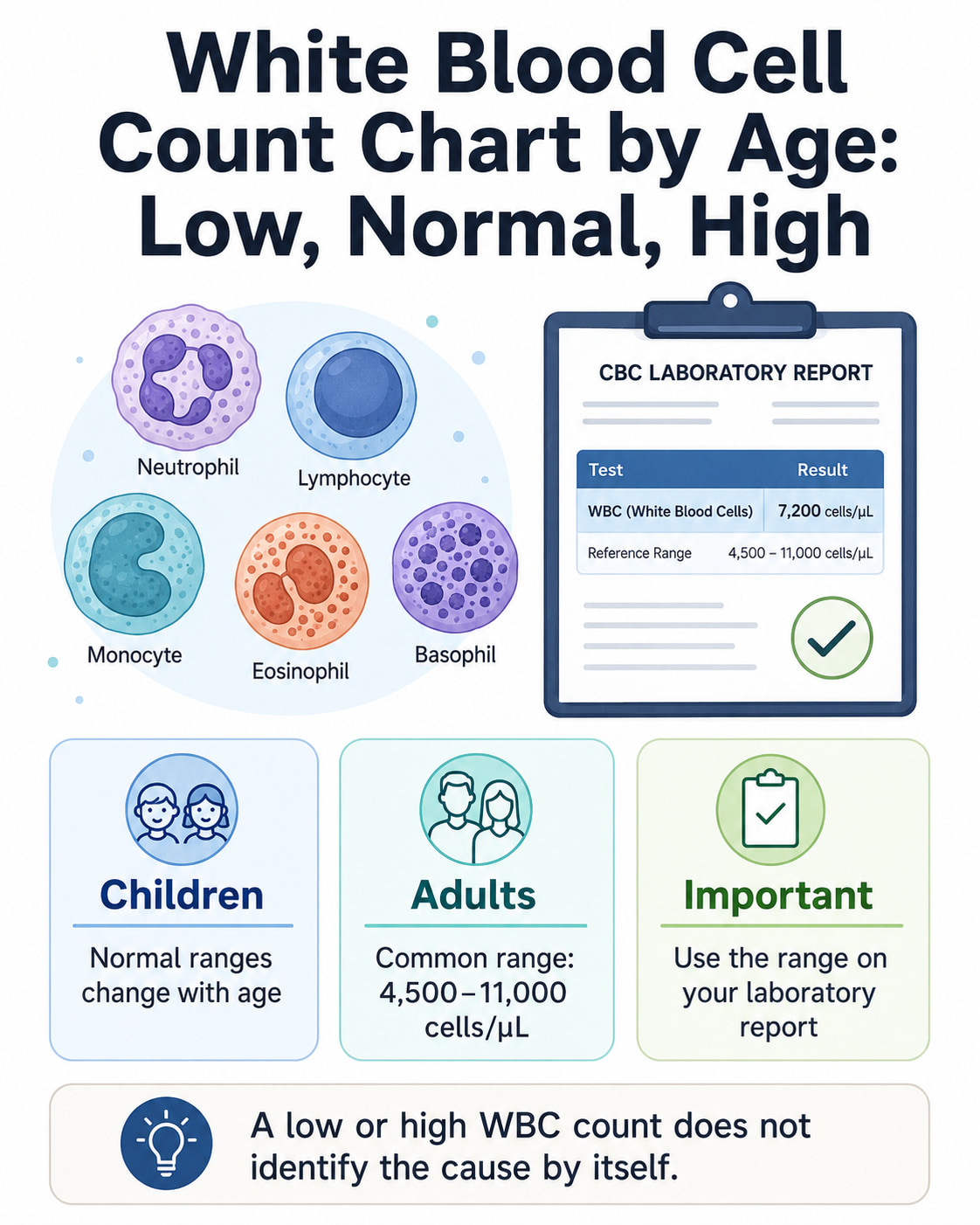
For most adults, a common normal white blood cell count is 4,500 to 11,000 cells per microliter, but normal values are higher in newborns and young children. A white blood cell count chart by age can help you understand a CBC result, but the reference range printed on your laboratory report should always take priority.
White blood cell levels can change because of infections, inflammation, medicines, pregnancy, smoking, stress, immune disorders, and bone marrow conditions. A low or high result does not identify the cause by itself. Doctors usually interpret it alongside symptoms, previous results, and a white blood cell differential.
White Blood Cell Count Chart by Age
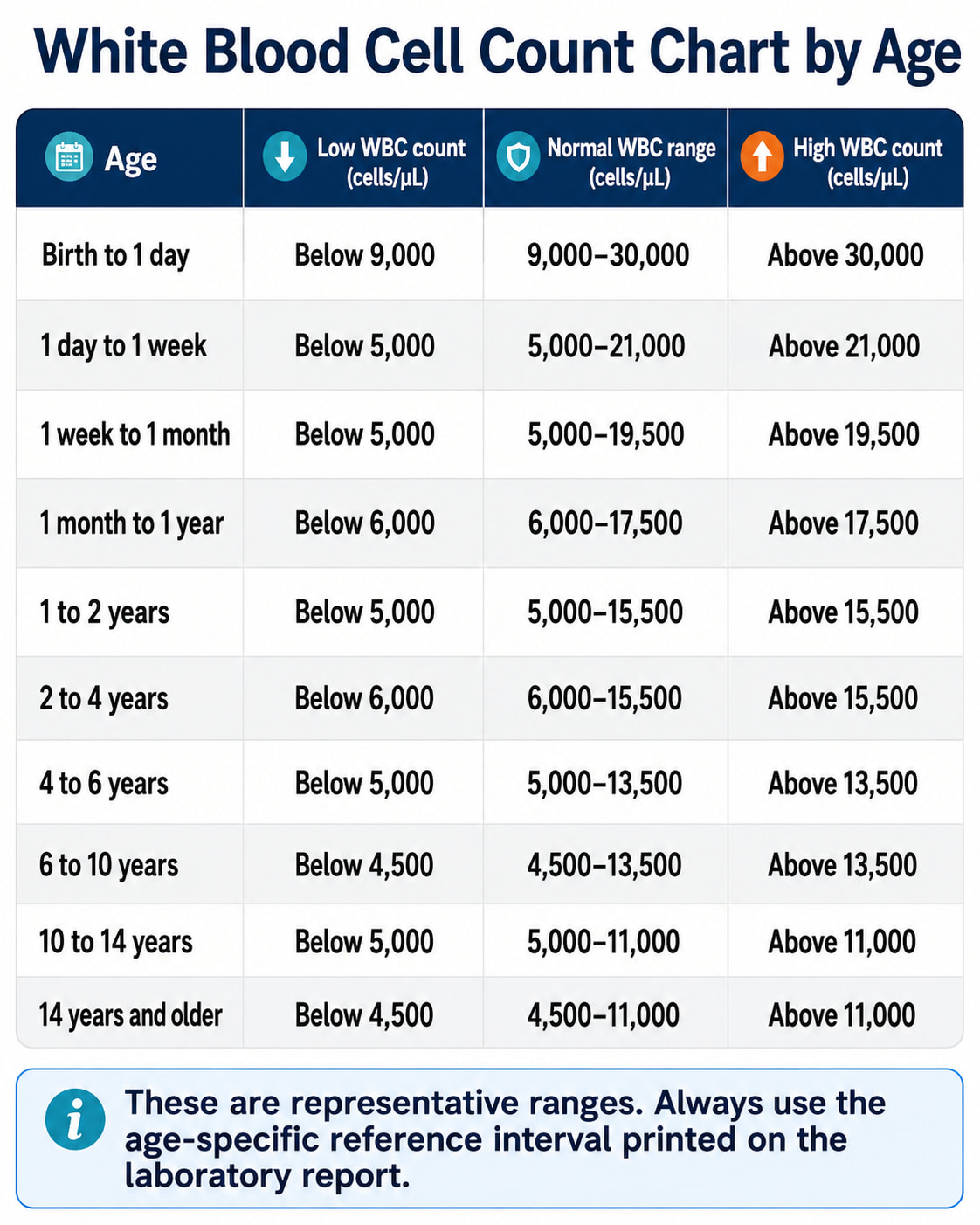
The following chart uses representative reference intervals from the Seattle Children’s Hospital CBC test catalog, accessed August, 2026. These values apply to both males and females in that laboratory’s catalog.
| Age | Low WBC count | Normal WBC range | High WBC count |
|---|---|---|---|
| Birth to 1 day | Below 9,000 | 9,000–30,000 | Above 30,000 |
| 1 day to 1 week | Below 5,000 | 5,000–21,000 | Above 21,000 |
| 1 week to 1 month | Below 5,000 | 5,000–19,500 | Above 19,500 |
| 1 month to 1 year | Below 6,000 | 6,000–17,500 | Above 17,500 |
| 1 to 2 years | Below 5,000 | 5,000–15,500 | Above 15,500 |
| 2 to 4 years | Below 6,000 | 6,000–15,500 | Above 15,500 |
| 4 to 6 years | Below 5,000 | 5,000–13,500 | Above 13,500 |
| 6 to 10 years | Below 4,500 | 4,500–13,500 | Above 13,500 |
| 10 to 14 years | Below 5,000 | 5,000–11,000 | Above 11,000 |
| 14 years and older | Below 4,500 | 4,500–11,000 | Above 11,000 |
**All values are white blood cells per microliter of blood.
These are representative ranges, not universal diagnostic cutoffs. A hospital or laboratory may use slightly different age groups and limits based on its equipment, testing method, and reference population.
How to Read WBC Units
Laboratories may report white blood cell counts in several equivalent formats:
- 4,500 cells/µL
- 4.5 K/µL
- 4.5 K/CMM
- 4.5 × 10⁹/L
These values describe the same concentration.
For example:
4.5 × 10⁹/L = 4,500 cells/µL
Always check the unit before comparing your result with an online WBC chart.
What Is a White Blood Cell Count?
A white blood cell count measures the total number of leukocytes, or white blood cells, in a blood sample. These cells form an important part of the immune system and help the body respond to infections, injuries, inflammation, and abnormal cells.
A WBC count is usually included in a complete blood count, commonly called a CBC.
The five major types of white blood cells are:
- Neutrophils
- Lymphocytes
- Monocytes
- Eosinophils
- Basophils
A total WBC result combines all five types into one number. A CBC with differential measures each type separately.
Why Normal WBC Counts Change With Age
Newborns
Newborns normally have much higher white blood cell counts than adults. During the first day of life, the representative range in the chart is 9,000 to 30,000 cells/µL.
A newborn result that appears very high compared with an adult range may therefore be normal for the baby’s age.
Infants and young children
WBC counts generally decrease during infancy and early childhood. However, children can still have upper limits well above the common adult cutoff.
For example, a count of 14,000 cells/µL may fall within the reference range for a toddler but would be above the common adult range.
Older children and teenagers
By late childhood and adolescence, normal ranges move closer to adult values. In the representative chart, children ages 10 to 14 have a range of 5,000 to 11,000 cells/µL.
Adults and older adults
The MedlinePlus WBC reference page, updated February, 2025, lists a commonly used adult range of 4,500 to 11,000 cells/µL. It also notes that normal ranges can vary among laboratories.
There is no separate universal WBC range for adults over 60 or 65. Older adults should generally use the adult interval shown on their own laboratory report.
What Is Considered a Low White Blood Cell Count?
A WBC result below the laboratory’s age-specific lower limit is called leukopenia.
Using the common adult reference range, a result below 4,500 cells/µL may be labeled low. However, a laboratory that uses a different lower limit may classify the same number differently.
Possible causes of a low white blood cell count include:
- A recent viral infection
- Bone marrow suppression or damage
- Chemotherapy or radiation therapy
- Certain antibiotics and other medicines
- Autoimmune disorders such as lupus
- HIV
- Conditions affecting the liver or spleen
- Cancers or other disorders involving the bone marrow
- Severe bacterial infection
- Significant nutritional deficiencies
The MedlinePlus white blood count guide explains that a low result cannot confirm a diagnosis. Doctors consider medical history, symptoms, medicines, and other blood test results when investigating the cause.
Does a low WBC count cause symptoms?
A low count may not cause symptoms by itself. Symptoms often come from an infection or from the condition responsible for the abnormal result.
Possible infection symptoms include:
- Fever
- Chills
- Persistent cough
- Sore throat
- Mouth sores
- Painful urination
- Redness, swelling, or drainage around a wound
- Unusual weakness
A mildly low result without symptoms may only require a repeat CBC. A very low neutrophil count or a low count accompanied by fever may require urgent evaluation.
What Is Considered a High White Blood Cell Count?
A result above the laboratory’s age-specific upper limit is called leukocytosis.
For an adult laboratory using 4,500 to 11,000 cells/µL as its range, a result above 11,000 may be labeled high. Children, especially newborns and infants, can normally have higher values.
Possible causes of a high WBC count include:
- Bacterial or viral infection
- Inflammation
- Autoimmune disease
- Allergic reactions
- Recent surgery, burns, or tissue injury
- Physical or emotional stress
- Smoking
- Pregnancy
- Corticosteroids or other medicines
- Leukemia, lymphoma, or another blood disorder
A mildly elevated WBC count often occurs temporarily during an infection, inflammation, stress, or recovery from surgery. A high result does not automatically mean leukemia or another serious disorder.
Doctors may repeat the CBC or review the differential to determine which white blood cell type is elevated.
WBC Count Versus WBC Differential
A total WBC count tells you how many white blood cells are present. It does not show which cell type caused the increase or decrease.
A blood differential from MedlinePlus measures the amount or percentage of each white blood cell type. Measuring the cells separately can help doctors understand whether the pattern is more consistent with infection, allergy, inflammation, medication effects, or a blood disorder.
| White blood cell type | Main role |
|---|---|
| Neutrophils | Help defend against bacterial and fungal infections |
| Lymphocytes | Support immune responses, including responses to viruses |
| Monocytes | Help remove damaged cells and microorganisms |
| Eosinophils | Participate in allergic reactions and responses to some parasites |
| Basophils | Release chemicals involved in allergy and inflammation |
An abnormal percentage does not always mean the absolute number of that cell type is abnormal. Absolute counts often provide a clearer picture.
Why the Absolute Neutrophil Count Matters
The absolute neutrophil count, or ANC, measures the number of neutrophils in the blood. Neutrophils are especially important for protection against bacterial and fungal infections.
A person can have a low total WBC count without severe neutropenia. Another person may have a total WBC result near the normal range but still have a low ANC.
Common neutropenia categories are:
| Absolute neutrophil count | Classification |
|---|---|
| 1,000–1,500 cells/µL | Mild neutropenia |
| 500–1,000 cells/µL | Moderate neutropenia |
| Below 500 cells/µL | Severe neutropenia |
The National Cancer Institute’s ANC guidance states that an ANC below 500 cells/µL is associated with a high risk of infection.
These categories require clinical context. Age, medical treatment, how long the count remains low, other immune problems, and the presence of fever all affect risk.
How to Interpret an Abnormal WBC Result
Use these steps when reviewing your result.
1. Check the reference range on the report
Do not compare a child’s result with an adult range. Use the age-specific interval listed by the laboratory that performed the test.
2. Confirm the unit
Make sure you know whether the report uses cells/µL, K/µL, K/CMM, or × 10⁹/L.
3. Review the differential and ANC
The total WBC number may not show which cell type is abnormal. Neutrophil, lymphocyte, eosinophil, monocyte, and basophil results can provide important context.
4. Compare with previous CBC results
A stable result that has been slightly outside the range for years may have a different meaning from a rapid or substantial change.
5. Consider recent events
Tell your healthcare professional about:
- Recent illness or fever
- Surgery or injury
- Pregnancy
- Smoking
- Heavy exercise
- Major physical or emotional stress
- Chemotherapy or radiation
- Prescription medicines
- Over-the-counter medicines and supplements
6. Ask whether the test should be repeated
WBC counts can change over a short period. A clinician may repeat the CBC after an illness resolves or after reviewing a medicine that could affect blood cell production.
When Should You Contact a Doctor?
Contact a healthcare professional promptly when an abnormal WBC result occurs with:
- Fever or chills
- Repeated or unusual infections
- Shortness of breath
- Persistent cough
- Painful urination
- Mouth sores
- Unexplained bruising or bleeding
- Swollen lymph nodes
- Unexplained weight loss
- Severe or worsening weakness
- A rapidly rising or falling blood count
People receiving chemotherapy need specific fever instructions from their oncology team. The Centers for Disease Control and Prevention advises people undergoing chemotherapy to call their doctor immediately for a temperature of 100.4°F or 38°C or higher, because fever may be the only sign of a serious infection.
Do not wait for a scheduled appointment when your oncology or hematology team has given you instructions to report fever immediately.
Is There a Dangerous WBC Count?
There is no single total WBC number that is dangerous for everyone.
The seriousness of a result depends on:
- Age
- Symptoms
- The cause of the abnormal count
- The WBC differential
- The ANC
- How quickly the count changed
- How long it remains abnormal
- Chemotherapy or immune-suppressing treatment
- Other CBC abnormalities
For infection risk, the ANC is usually more informative than the total WBC count. An ANC below 500 cells/µL represents severe neutropenia and requires close medical guidance.
A very high WBC count also requires professional interpretation, especially when it persists, rises rapidly, or occurs with abnormal or immature blood cells.
Frequently Asked Questions
What is a normal white blood cell count by age?
Newborns can normally have WBC counts as high as 30,000 cells/µL during the first day of life. The upper limit gradually decreases through childhood. A commonly used adult range is 4,500 to 11,000 cells/µL, although individual laboratory ranges vary.
Why is a newborn’s WBC count higher than an adult’s?
Newborns normally have age-related blood cell patterns that differ from those of adults. Therefore, newborn results must be compared with neonatal reference ranges rather than adult cutoffs.
What WBC count is considered low in adults?
A count below 4,500 cells/µL is low according to one commonly used adult range. However, some laboratories use a different lower limit, so check the interval printed beside your result.
What WBC count is considered high in adults?
A result above 11,000 cells/µL is high when the laboratory uses 4,500 to 11,000 as its adult reference range. Infection, inflammation, stress, smoking, pregnancy, medicines, and blood disorders can all raise the count.
Does a high white blood cell count always mean infection?
No. Infection is a common cause, but inflammation, allergies, tissue injury, stress, smoking, pregnancy, corticosteroids, and certain blood disorders can also increase WBC levels.
What is the difference between WBC and ANC?
The WBC count measures all white blood cells together. The ANC measures only neutrophils. Because neutrophils play an important role in preventing bacterial and fungal infections, the ANC often provides better information about infection risk.
Do older adults have a different normal WBC range?
There is no separate universal range for older adults. Most laboratories apply their adult reference interval to older adults, but the range shown on the individual CBC report should guide interpretation.
Conclusion
A white blood cell count chart by age shows why newborn, child, and adult results cannot be interpreted using the same limits. Newborns and young children normally have higher WBC counts, while values generally move toward the adult range with age.
Start by checking the age-specific reference range and unit on the laboratory report. Then review the differential, ANC, symptoms, medicines, and previous results with a healthcare professional. One low or high result does not diagnose a specific condition, but persistent abnormalities or signs of infection deserve appropriate follow-up.
This content is for informational purposes only and not medical advice.