
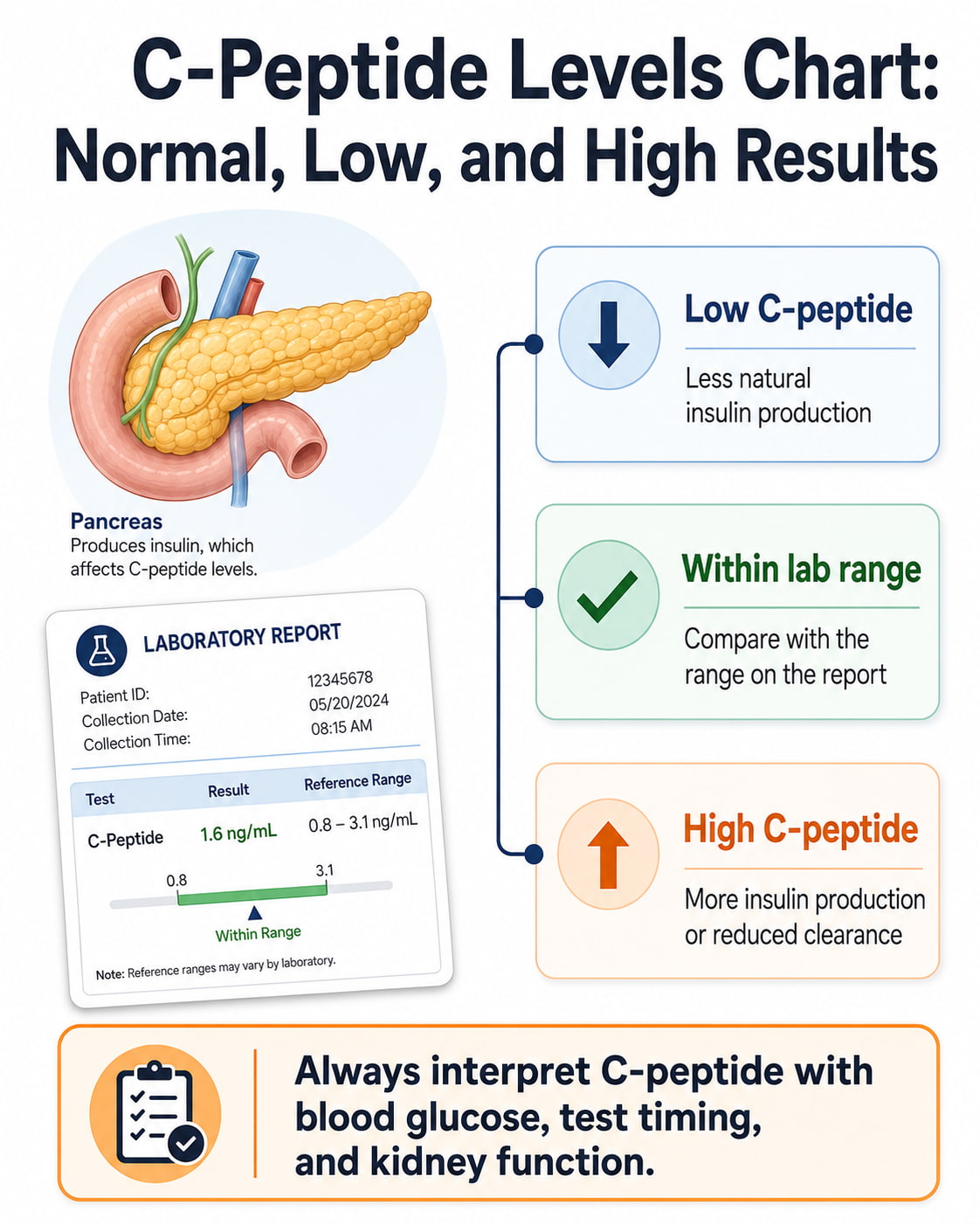
A normal C-peptide level is a result within the reference range listed by the laboratory that performed your test. There is no single universal normal range because results vary with the testing method, fasting status, recent food intake, blood glucose level, and kidney function.
For fasting blood tests, major laboratories use ranges such as 0.5–3.3 ng/mL or 1.1–4.4 ng/mL. A low result may indicate reduced insulin production, while a high result may reflect insulin resistance, kidney impairment, certain diabetes medicines, or excessive insulin production. Your doctor must interpret C-peptide alongside your blood glucose and medical history.
C-Peptide Levels Chart at a Glance
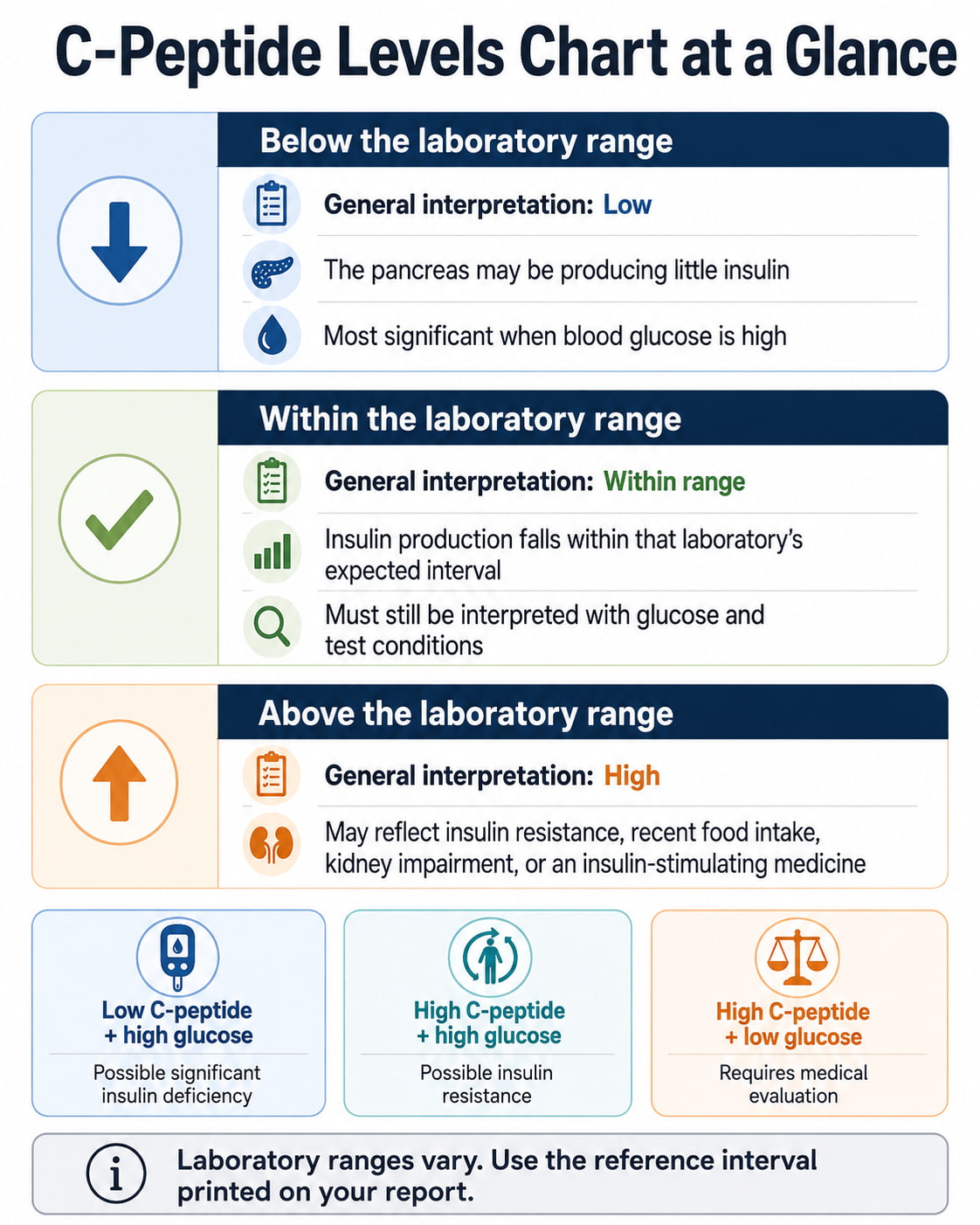
The following chart provides a general way to understand fasting C-peptide results. Always compare your number with the reference range printed on your own laboratory report.
| C-peptide result | General interpretation | Possible meaning |
|---|---|---|
| Below the laboratory range | Low | The pancreas may be producing little insulin |
| Within the laboratory range | Within range | Insulin production falls within that laboratory’s expected fasting interval |
| Above the laboratory range | High | The pancreas may be producing more insulin, or C-peptide may not be clearing normally |
| Low C-peptide with high glucose | Inappropriately low | May indicate significant insulin deficiency |
| High C-peptide with high glucose | Inappropriately high | Often suggests insulin resistance |
| High C-peptide with low glucose | Inappropriately high | May indicate excessive insulin production or an insulin-stimulating medicine |
A “normal” number does not always mean insulin production is appropriate. For example, a C-peptide result near the bottom of the laboratory range may be too low if blood glucose is very high.
What Is C-Peptide?
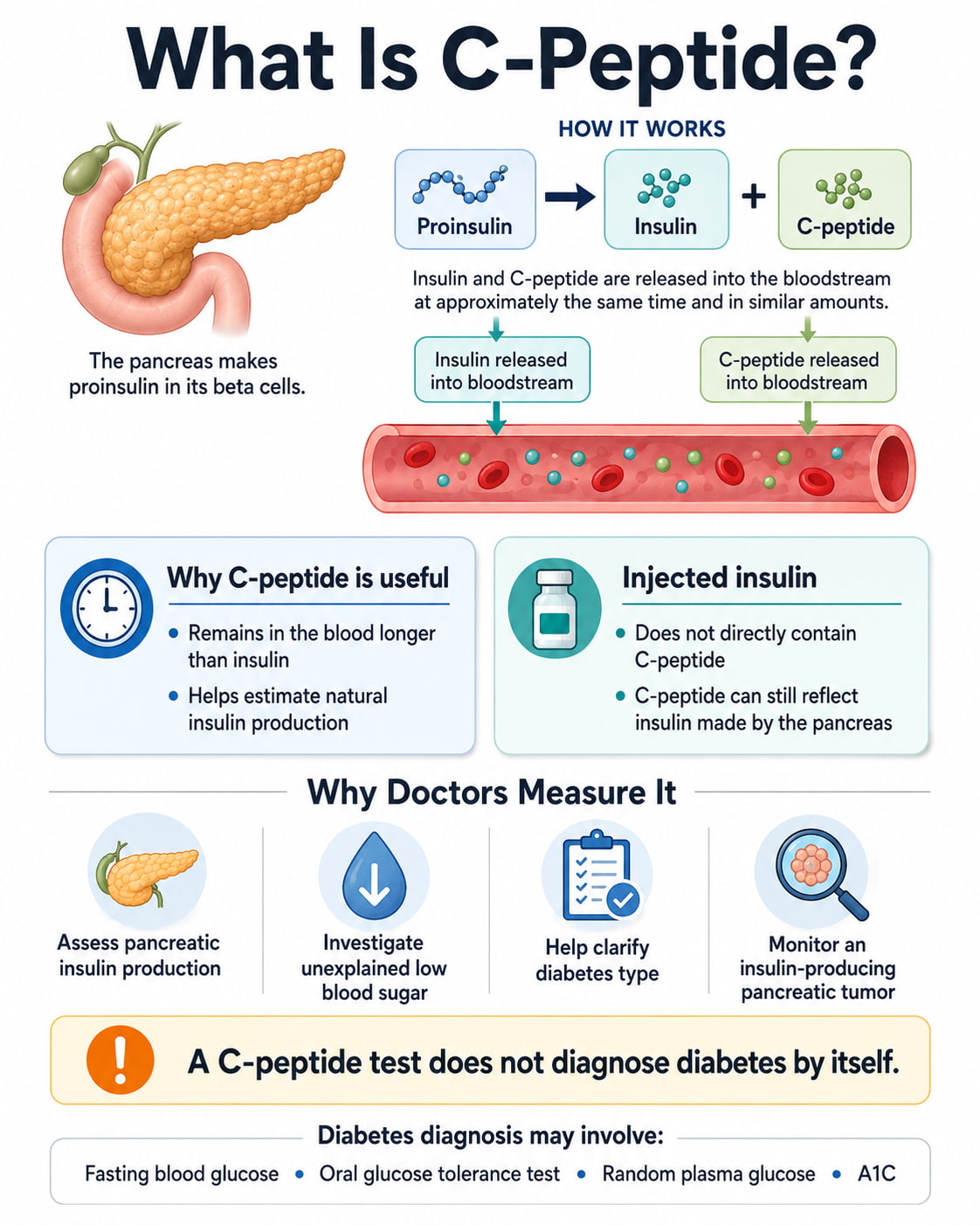
C-peptide is a small chain of amino acids produced when the pancreas converts proinsulin into insulin. The pancreas releases insulin and C-peptide into the bloodstream at approximately the same time and in similar amounts.
C-peptide remains in the blood longer than insulin. Injected insulin also does not directly contain C-peptide. For these reasons, measuring C-peptide can provide a clearer estimate of how much insulin your pancreas produces naturally, even when you use insulin medication.
According to the National Library of Medicine’s MedlinePlus C-peptide guide, clinicians may use the test to assess pancreatic insulin production, investigate unexplained low blood sugar, help clarify diabetes type, or monitor an insulin-producing pancreatic tumor.
A C-peptide test does not diagnose diabetes by itself. Doctors diagnose diabetes using tests such as fasting blood glucose, an oral glucose tolerance test, random plasma glucose, or A1C.
What Is a Normal C-Peptide Level?
There is no universal normal C-peptide level. Each laboratory establishes its own reference interval based on its testing equipment, methods, and patient preparation requirements.
Examples of current fasting serum reference ranges include:
| Laboratory | Fasting C-peptide reference range | Approximate SI range |
|---|---|---|
| ARUP Laboratories | 0.5–3.3 ng/mL | 0.17–1.09 nmol/L |
| Mayo Clinic Laboratories | 1.1–4.4 ng/mL | 0.36–1.46 nmol/L |
| Labcorp | 1.1–4.4 ng/mL | 0.36–1.46 nmol/L |
ARUP Laboratories identifies 0.5–3.3 ng/mL as its fasting serum interval and instructs users to multiply ng/mL by 0.33 to estimate nmol/L.
Mayo Clinic Laboratories uses a fasting interval of 1.1–4.4 ng/mL. Mayo also provides the conversion 1 ng/mL = 331 pmol/L, which equals approximately 0.331 nmol/L.
These differences explain why you should not compare your result with an online chart without checking your laboratory report.
Common C-Peptide Units
Laboratories may report C-peptide in:
- ng/mL
- nmol/L
- pmol/L
Useful conversions include:
- 1 ng/mL ≈ 0.331 nmol/L
- 1 ng/mL ≈ 331 pmol/L
- 1 nmol/L ≈ 3.02 ng/mL
Check the unit carefully before comparing two results. A value reported in pmol/L will look much larger than the same result reported in ng/mL.
Clinical C-Peptide Thresholds for Insulin Production
Doctors sometimes use clinical thresholds to estimate how much insulin a person with diabetes can still produce. These thresholds are different from standard laboratory reference ranges.
| C-peptide level | Equivalent value | Possible clinical interpretation |
|---|---|---|
| Below 0.24 ng/mL | Below 80 pmol/L | Very low insulin production |
| Below 0.60 ng/mL | Below 200 pmol/L | Marked insulin deficiency may be present |
| 0.60–1.80 ng/mL | 200–600 pmol/L | Intermediate insulin production |
| At least 1.80 ng/mL | At least 600 pmol/L | Substantial natural insulin production remains |
These thresholds apply mainly to diabetes classification and insulin-reserve assessment. They should not replace the range on a standard fasting laboratory report.
The American Diabetes Association Standards of Care in Diabetes—2026 identifies 200–600 pmol/L, or approximately 0.6–1.8 ng/mL, as an intermediate range. This result can occur in type 1 diabetes or monogenic diabetes, but it may also occur in insulin-treated type 2 diabetes, particularly after many years of disease.
A result below 200 pmol/L often suggests severe insulin deficiency, but the test conditions, glucose level, diabetes duration, and treatment history remain important.
What Does a Low C-Peptide Level Mean?
A low C-peptide result means the pancreas released relatively little insulin around the time of testing.
Possible causes include:
- Type 1 diabetes
- Long-standing type 2 diabetes with declining beta-cell function
- Pancreatic disease or injury
- Previous pancreatic surgery
- Fasting or low blood glucose
- Suppression of natural insulin production after taking insulin
- Severe illness in some cases
A low result is most concerning when blood glucose is high. High glucose normally stimulates the pancreas to produce insulin. Therefore, low C-peptide combined with high glucose may indicate that the pancreas cannot produce enough insulin.
A low value during fasting or hypoglycemia may be an appropriate response. The body normally reduces insulin production when glucose is low.
Low C-Peptide in Type 1 Diabetes
People with type 1 diabetes lose insulin-producing beta cells because of an autoimmune process. C-peptide levels often decline as beta-cell function decreases.
However, some people continue producing small amounts of insulin for months or years after diagnosis. A detectable result does not automatically rule out type 1 diabetes.
Doctors may also consider:
- Islet autoantibody results
- Age at diagnosis
- Speed of symptom development
- Ketone production
- Personal and family history
- Insulin requirements
Low C-Peptide in Type 2 Diabetes
C-peptide may be normal or high during the earlier stages of type 2 diabetes because the pancreas produces extra insulin to overcome insulin resistance.
Over time, the insulin-producing cells may lose function. Someone with long-standing type 2 diabetes can therefore develop a low C-peptide level and require insulin treatment.
What Does a High C-Peptide Level Mean?
A high result means the pancreas is producing a relatively large amount of insulin or the body is not clearing C-peptide efficiently.
Possible causes include:
- Insulin resistance
- Early or established type 2 diabetes
- Overweight or obesity
- A recent meal
- Kidney impairment
- Sulfonylureas or other insulin-stimulating medicines
- Insulinoma, which is uncommon
- Certain hormone disorders
A high C-peptide result does not mean insulin is working effectively. In insulin resistance, the pancreas may produce large amounts of insulin while blood glucose remains elevated.
Mayo Clinic Laboratories notes that kidney failure can increase both insulin and C-peptide because the kidneys play an important role in clearing C-peptide from the circulation. Obesity, glucose intolerance, early type 2 diabetes, insulinoma, and sulfonylurea exposure may also raise results.
High C-Peptide With High Blood Glucose
This combination commonly suggests that the pancreas is still producing insulin, but the body does not respond to it efficiently.
It may occur with:
- Insulin resistance
- Prediabetes
- Type 2 diabetes
- Obesity
- Medicines that stimulate insulin release
C-peptide cannot independently diagnose insulin resistance. A clinician may also review fasting glucose, A1C, cholesterol levels, blood pressure, body composition, and other metabolic findings.
High C-Peptide With Low Blood Glucose
When blood glucose is low, the pancreas should reduce insulin production. A C-peptide level that remains high during confirmed hypoglycemia may suggest that the body is releasing insulin inappropriately.
Possible explanations include:
- An insulin-producing pancreatic tumor
- Sulfonylurea or similar medication exposure
- Another cause of endogenous hyperinsulinemia
Clinicians usually measure glucose, insulin, C-peptide, proinsulin, and diabetes-medication levels from the same blood sample during the low-glucose episode. A high C-peptide result taken when glucose is normal does not diagnose an insulinoma.
How to Read C-Peptide and Glucose Together
C-peptide becomes much more useful when interpreted with blood glucose collected at the same time.
| C-peptide | Blood glucose | General interpretation |
|---|---|---|
| Low | High | The pancreas may not be producing enough insulin |
| Low | Low | Insulin production may be appropriately suppressed |
| High | High | Insulin resistance or an insulin-stimulating medicine may be present |
| High | Low | Excessive natural insulin production requires evaluation |
| Normal | High | The result may still be too low for the degree of hyperglycemia |
| Normal | Normal | Insulin production may be appropriate, depending on test conditions |
The relationship matters more than either value alone. Meal timing, diabetes medicines, fasting duration, kidney function, and recent illness also affect the interpretation.
Fasting vs. Random vs. Stimulated C-Peptide
Fasting C-Peptide
A fasting test measures baseline insulin production after a period without food. MedlinePlus states that some people may need to fast for 8–12 hours, although laboratories can provide different instructions.
Do not choose your own fasting period. Follow the instructions from the laboratory or ordering clinician because an incorrect fasting time can make comparison with the reference range unreliable.
Random C-Peptide
A random test may be collected without a formal fast. The result depends strongly on:
- When you last ate
- What you ate
- Your blood glucose level
- Diabetes medicines
- Recent insulin use
The ADA’s 2026 adult diabetes-classification pathway allows a random C-peptide collected within five hours of eating when glucose is measured at the same time. This approach is mainly intended to assess insulin production in insulin-treated adults whose diabetes type remains uncertain.
Stimulated C-Peptide
A stimulated test measures the pancreas’s response after a controlled stimulus, such as:
- A mixed meal
- Glucagon
- A standardized glucose-containing drink
Stimulated values are normally higher than fasting values. Do not compare a stimulated result directly with a fasting laboratory range.
Factors That Can Affect C-Peptide Results
Several factors can raise, lower, or complicate the interpretation of a C-peptide result.
Recent Food Intake
Eating raises glucose and normally stimulates insulin and C-peptide production. A nonfasting result may therefore be higher than a fasting result.
Blood Glucose Level
A C-peptide value must be judged against the glucose level at collection. A low value during high glucose has a different meaning from the same value during hypoglycemia.
Kidney Function
The kidneys remove much of the circulating C-peptide. Reduced kidney function can raise the level even when pancreatic insulin production has not increased.
Diabetes Medicines
Sulfonylureas and meglitinides stimulate the pancreas to release insulin and may raise C-peptide. Injected insulin does not directly add C-peptide, although it may suppress the pancreas’s own insulin production.
Recent Hyperglycemic Emergency
The ADA advises against testing C-peptide within two weeks of a hyperglycemic emergency, such as diabetic ketoacidosis, when temporary metabolic changes may make the result misleading.
Sample Problems
Hemolysis, which occurs when red blood cells break apart in the blood sample, can falsely lower C-peptide. Laboratories may reject a severely hemolyzed specimen or recommend repeating the test.
Laboratory Method
Different assays can produce slightly different values. For follow-up testing, using the same laboratory may make trends easier to compare.
Why Doctors Order a C-Peptide Test
A clinician may order C-peptide to:
- Estimate remaining natural insulin production
- Help distinguish between diabetes types when the diagnosis is uncertain
- Decide whether an insulin-treated person may still have substantial insulin reserve
- Investigate unexplained hypoglycemia
- Evaluate possible excessive insulin production
- Monitor pancreatic or islet-cell transplant function
- Assess pancreatic function after surgery
Doctors do not usually order C-peptide for routine day-to-day diabetes monitoring. Blood glucose, continuous glucose-monitoring data, and A1C are more appropriate for tracking glucose control.
Blood and Urine C-Peptide Are Not Interchangeable
C-peptide can be measured in blood or in urine collected over 24 hours. These tests use different units and reference ranges.
Blood results are usually reported in ng/mL, nmol/L, or pmol/L. A 24-hour urine test may be reported in micrograms per day.
Do not compare a urine result directly with a serum C-peptide chart. Use the range provided specifically for the specimen type and laboratory method.
When Should You Discuss the Result With a Doctor?
Review the result with the ordering clinician when:
- C-peptide falls outside the laboratory range
- Blood glucose was high while C-peptide was low
- Blood glucose was low while C-peptide was high
- Your diabetes type remains uncertain
- Your insulin needs have changed significantly
- You have kidney disease
- You take a medicine that stimulates insulin release
- The result does not match your symptoms or other tests
Do not reduce or stop insulin based on a C-peptide result without medical guidance. A person with severe insulin deficiency can develop dangerous hyperglycemia or diabetic ketoacidosis if insulin is stopped.
Seek prompt medical care for severe low-blood-sugar symptoms such as confusion, seizure, loss of consciousness, or inability to swallow safely.
Frequently Asked Questions
What is a good C-peptide level?
A good result is one that fits the reference range, blood glucose level, testing conditions, and reason for ordering the test. Major laboratories use fasting intervals such as 0.5–3.3 ng/mL or 1.1–4.4 ng/mL, so the range on your report should guide interpretation.
Is a C-peptide level of 1.0 ng/mL normal?
It may be normal under one laboratory’s fasting range and low under another. A result of 1.0 ng/mL also has different implications when glucose is normal, low, or high.
Does low C-peptide always mean type 1 diabetes?
No. Type 1 diabetes commonly causes low C-peptide, but long-standing type 2 diabetes, pancreatic disease, pancreatic surgery, fasting, low glucose, and recent insulin use can also lower it.
Does high C-peptide mean type 2 diabetes?
Not necessarily. High C-peptide often occurs with insulin resistance or type 2 diabetes, but kidney impairment, recent food intake, insulin-stimulating medicines, obesity, and uncommon insulin-producing tumors can also raise it.
Can you have normal C-peptide with diabetes?
Yes. Someone with early type 2 diabetes may have normal or high C-peptide. A person with type 1 diabetes may also retain measurable insulin production, especially near diagnosis. C-peptide does not diagnose or exclude diabetes by itself.
Can C-peptide show whether insulin is working?
C-peptide estimates how much insulin the pancreas produces. It does not directly measure how effectively the body responds to insulin. High C-peptide combined with high glucose may suggest that insulin resistance is present.
Should I fast before a C-peptide test?
It depends on the test ordered. Some blood tests require fasting, while others intentionally measure random or stimulated C-peptide. Follow the preparation instructions from your clinician or laboratory.
Conclusion
A C-peptide levels chart can help explain whether your pancreas is producing a low, expected, or high amount of insulin, but no single range applies to everyone. Major laboratories use different fasting intervals, and the result must be interpreted with blood glucose, meal timing, kidney function, diabetes medicines, and clinical history.
Check the units and reference range on your report, then discuss unexpected results with your healthcare professional. Never change insulin or diabetes medication based only on an online chart.
This content is for informational purposes only and not medical advice.