
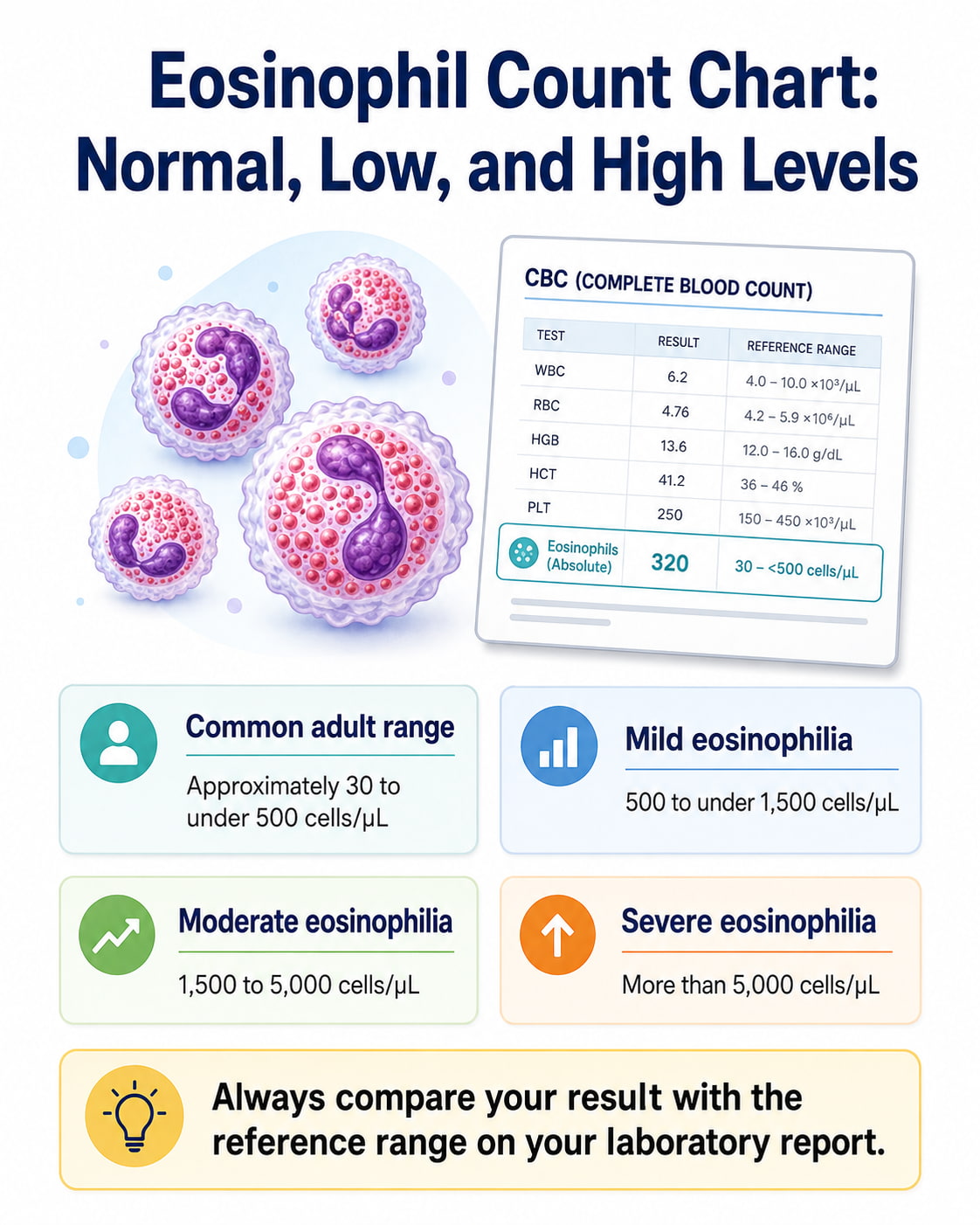
An absolute eosinophil count below 500 cells/µL generally does not meet the usual definition of eosinophilia in adults. Counts from 500 to under 1,500 are considered mildly high, 1,500 to 5,000 are moderately high, and more than 5,000 cells/µL is severe eosinophilia.
A low eosinophil count usually means the result falls below your laboratory’s reference range. Unlike high eosinophils, however, low levels do not have universally accepted severity categories and rarely cause problems by themselves.
Always compare your result with the reference interval on your own laboratory report. Laboratories may use different testing methods, units, age ranges, and cutoff values.
Eosinophil Count Chart
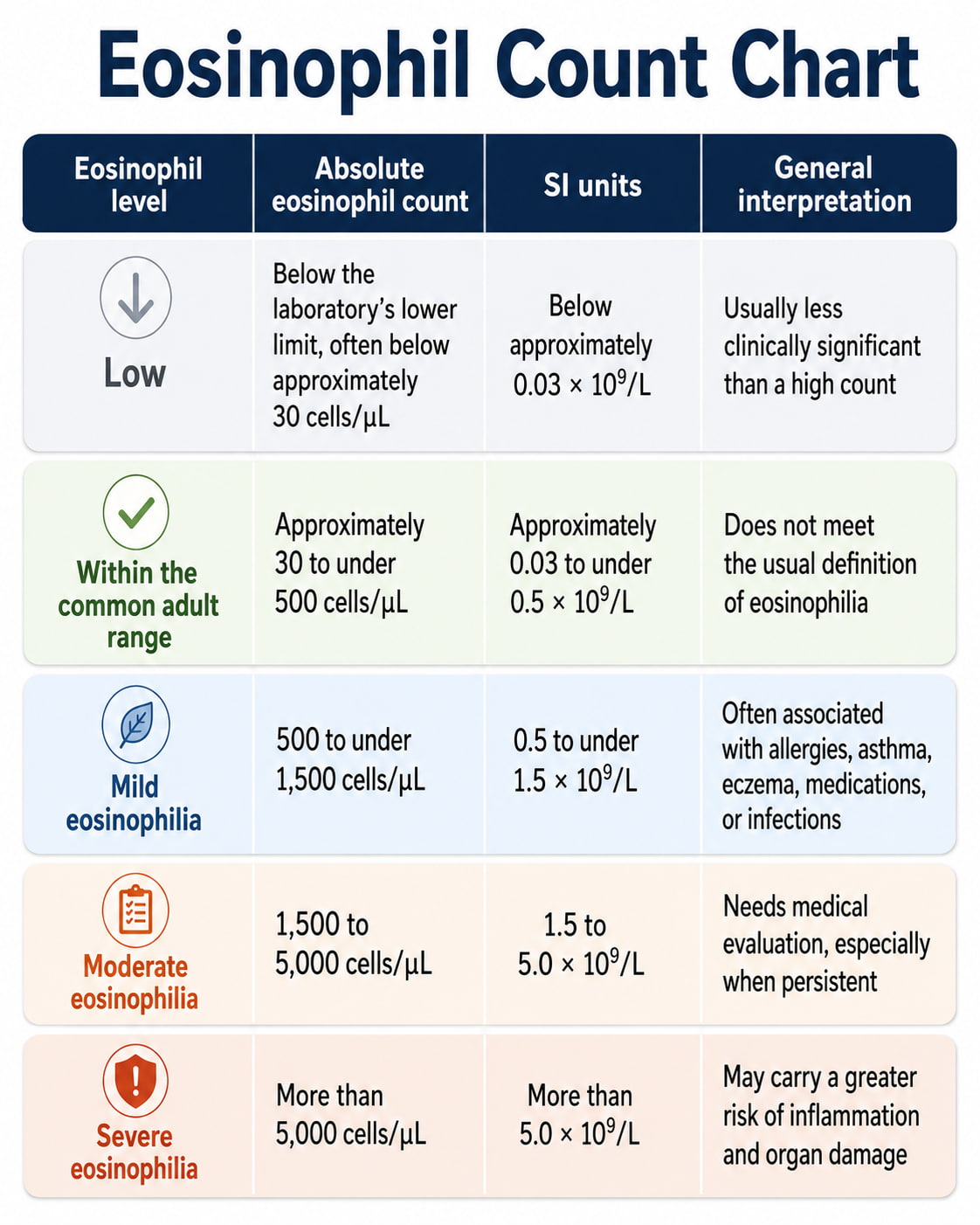
The absolute eosinophil count, sometimes abbreviated as AEC, EOS absolute, or Abs eos, provides the most useful measurement for interpreting eosinophil levels.
| Eosinophil level | Absolute eosinophil count | SI units | General interpretation |
|---|---|---|---|
| Low | Below the laboratory’s lower limit, often below approximately 30 cells/µL | Below approximately 0.03 × 10⁹/L | Usually less clinically significant than a high count |
| Within the common adult range | Approximately 30 to under 500 cells/µL | Approximately 0.03 to under 0.5 × 10⁹/L | Does not meet the usual definition of eosinophilia |
| Mild eosinophilia | 500 to under 1,500 cells/µL | 0.5 to under 1.5 × 10⁹/L | Often associated with allergies, asthma, eczema, medications, or infections |
| Moderate eosinophilia | 1,500 to 5,000 cells/µL | 1.5 to 5.0 × 10⁹/L | Needs medical evaluation, especially when persistent |
| Severe eosinophilia | More than 5,000 cells/µL | More than 5.0 × 10⁹/L | May carry a greater risk of inflammation and organ damage |
The Merck Manual’s eosinophilia guidance uses 500, 1,500, and 5,000 cells/µL as the main clinical thresholds. Mayo Clinic Laboratories currently lists an adult reference interval of 0.03–0.48 × 10⁹/L, equal to approximately 30–480 cells/µL.
Important: A result can fall slightly outside one laboratory’s reference range without crossing a recognized eosinophilia threshold. For example, 490 cells/µL may appear high on a report with an upper limit of 480, but it remains below the commonly used 500-cell threshold.
What Are Eosinophils?
Eosinophils are a type of white blood cell produced in the bone marrow. They participate in immune responses involving:
- Allergic reactions
- Asthma and other inflammatory conditions
- Certain parasitic infections
- Immune regulation
- Inflammation within tissues
Eosinophils normally make up only a small proportion of circulating white blood cells. They can move from the bloodstream into tissues such as the skin, lungs, and digestive tract, where they may contribute to inflammation.
An abnormal eosinophil result is a laboratory finding, not a diagnosis. A count alone cannot show whether the cause is an allergy, infection, medication reaction, inflammatory disease, or another condition.
How Is an Eosinophil Count Measured?
Doctors usually measure eosinophils through a complete blood count with differential, commonly called a CBC with differential.
The differential measures several types of white blood cells, including:
- Neutrophils
- Lymphocytes
- Monocytes
- Eosinophils
- Basophils
Your report may show eosinophils as both a percentage and an absolute number.
Absolute Eosinophil Count vs. Eosinophil Percentage
Absolute eosinophil count
The absolute eosinophil count shows the actual number of eosinophils in a specific volume of blood. It may appear on a report as:
- EOS absolute
- Absolute eosinophils
- Abs eos
- AEC
- Eosinophil number
This value is usually reported in cells/µL, K/µL, or × 10⁹/L.
Eosinophil percentage
The eosinophil percentage shows how many of your total white blood cells are eosinophils. Many laboratories use a percentage range around 0%–5%, although the exact interval varies.
The percentage may be misleading when the total white blood cell count is unusually high or low. For this reason, clinicians generally rely more heavily on the absolute count.
How to calculate the absolute eosinophil count
Use this formula:
Absolute eosinophil count = total WBC count × eosinophil percentage ÷ 100
According to MedlinePlus, laboratories calculate the absolute count by multiplying the eosinophil percentage by the total white blood cell count.
Example 1
- Total WBC count: 8,000 cells/µL
- Eosinophils: 6%
8,000 × 6 ÷ 100 = 480 cells/µL
The percentage may be flagged as high, but the absolute count remains below 500 cells/µL.
Example 2
- Total WBC count: 15,000 cells/µL
- Eosinophils: 4%
15,000 × 4 ÷ 100 = 600 cells/µL
The percentage may appear normal, but the absolute result falls within the mild eosinophilia range.
Eosinophil Count Unit Conversion
Laboratories may report the same result in several formats.
| Cells per microliter | K/µL | × 10⁹/L |
|---|---|---|
| 30 cells/µL | 0.03 K/µL | 0.03 × 10⁹/L |
| 100 cells/µL | 0.10 K/µL | 0.10 × 10⁹/L |
| 500 cells/µL | 0.50 K/µL | 0.50 × 10⁹/L |
| 1,500 cells/µL | 1.50 K/µL | 1.50 × 10⁹/L |
| 5,000 cells/µL | 5.00 K/µL | 5.00 × 10⁹/L |
To convert × 10⁹/L or K/µL to cells/µL, multiply by 1,000.
For example:
0.7 × 10⁹/L = 700 cells/µL
Cells/µL and cells/mm³ represent the same concentration.
What Is a Normal Eosinophil Count?
A commonly used adult eosinophil range is approximately 30–500 cells/µL, although some laboratories use lower or upper limits that differ slightly.
For example, Mayo Clinic Laboratories’ CBC reference values list an adult range of 30–480 cells/µL. Pediatric intervals differ by age and may be higher during infancy.
A result within the reference range means the blood sample does not show an increased circulating eosinophil count. It does not completely rule out an eosinophilic condition because eosinophils may accumulate in tissues even when the blood level is normal.
Your healthcare professional will consider the count together with:
- Your symptoms
- Age
- Medical history
- Allergy or asthma history
- Medications
- Travel and infection exposures
- Other CBC results
- Whether the count remains abnormal over time
What Does a Low Eosinophil Count Mean?
A low eosinophil count is called eosinopenia. A result may be labeled low when it falls below the laboratory’s lower reference limit, which is often around 30 cells/µL in adults.
There is no universally accepted eosinophil “danger zone” on the low end. Some healthy people may temporarily have very few or no measurable circulating eosinophils.
Possible causes of low eosinophils
Low levels may occur with:
- Corticosteroid medicines, such as prednisone
- Naturally high cortisol levels
- Cushing syndrome
- Severe acute infections, including sepsis
- Physical stress related to serious illness
The MSD Manual notes that low eosinophil counts generally do not cause problems because other parts of the immune system compensate.
Should you worry about low eosinophils?
A single low result usually requires no treatment by itself. The underlying situation matters more than the number.
For example, a low count may be expected in someone taking a prescribed corticosteroid. Do not stop a steroid or change its dose based only on an eosinophil result. Suddenly stopping some corticosteroids can be harmful.
A clinician may investigate further when the low result appears alongside significant symptoms, other abnormal blood counts, or signs of severe infection.
What Does a High Eosinophil Count Mean?
A high eosinophil count is called eosinophilia. The meaning depends on how elevated the count is, how long it remains elevated, and whether the person has symptoms or signs of organ inflammation.
Mild eosinophilia: 500 to under 1,500 cells/µL
Mild eosinophilia is the most common category. It frequently occurs with:
- Seasonal allergies
- Allergic rhinitis
- Asthma
- Eczema
- Medication reactions
- Certain infections
Mild eosinophilia itself generally does not cause symptoms. The symptoms usually come from the underlying condition.
A clinician may repeat the CBC, particularly if the result is unexpected or there is no obvious explanation.
Moderate eosinophilia: 1,500 to 5,000 cells/µL
Moderate eosinophilia requires closer attention, especially when the result:
- Persists on repeat testing
- Continues to increase
- Has no clear explanation
- Occurs with breathing, skin, digestive, heart, or neurologic symptoms
- Appears with other abnormal blood-cell results
Persistent counts at or above 1,500 cells/µL may contribute to tissue inflammation and organ damage in some people. The risk depends on the cause and duration, not just the number.
Severe eosinophilia: more than 5,000 cells/µL
More than 5,000 cells/µL is generally classified as severe eosinophilia.
This level does not automatically identify a specific disease, but it usually warrants timely medical investigation. Clinicians may look for serious medication reactions, parasitic infections, autoimmune conditions, eosinophilic organ disorders, and blood or bone marrow diseases.
Common Causes of High Eosinophils
High eosinophils have many possible causes. The count cannot identify the cause on its own.
| Cause category | Examples and clues |
|---|---|
| Allergic and atopic conditions | Asthma, allergic rhinitis, eczema, and other allergic disorders |
| Medication reactions | A new medicine followed by rash, fever, swelling, or organ-related symptoms |
| Parasitic infections | More likely with relevant travel, food, soil, or animal exposure; not every parasite raises eosinophils |
| Skin conditions | Atopic dermatitis and some inflammatory or blistering skin diseases |
| Autoimmune and inflammatory diseases | Certain forms of vasculitis, connective-tissue disease, and systemic inflammation |
| Eosinophilic organ disorders | Eosinophilic asthma, pneumonia, esophagitis, gastritis, or colitis |
| Adrenal disorders | Adrenal insufficiency can sometimes increase eosinophils |
| Blood and bone marrow disorders | Certain leukemias, lymphomas, and myeloid neoplasms |
| Other cancers | Some solid tumors may cause reactive eosinophilia, but this is less common than allergic or reactive causes |
The National Library of Medicine lists allergic disorders, skin conditions, parasitic and fungal infections, autoimmune diseases, some cancers, and bone marrow disorders among recognized causes of increased eosinophils.
Can allergies cause high eosinophils?
Yes. Asthma, hay fever, eczema, and other allergic conditions are among the most common explanations for mild or moderate eosinophilia.
However, an eosinophil count cannot prove that allergies are the cause. Someone with allergies may have a normal count, while someone with an elevated count may have another explanation.
Can medications raise eosinophils?
Yes. Antibiotics, seizure medicines, anti-inflammatory medicines, and many other medications can cause eosinophilia in susceptible people.
A mild elevation without symptoms may only require monitoring. A new medication followed by fever, a widespread rash, facial swelling, swollen lymph nodes, breathing problems, yellowing of the skin, or other serious symptoms requires urgent medical attention.
Do not stop an essential prescription medicine without professional guidance unless emergency medical personnel instruct you to do so.
Can parasites cause eosinophilia?
Some tissue-invasive parasites can raise the eosinophil count. The likelihood depends on travel history, geographic location, food and water exposure, animal contact, and other symptoms.
An elevated count alone does not justify taking an antiparasitic medicine. Some infections require specific testing and carefully selected treatment.
Hypereosinophilia vs. Hypereosinophilic Syndrome
These terms do not mean the same thing.
Hypereosinophilia
A commonly used definition of blood hypereosinophilia is an eosinophil count above 1,500 cells/µL on at least two occasions at least four weeks apart.
Hypereosinophilia may be:
- Reactive or secondary: Caused by allergies, infections, medications, inflammation, or another illness
- Primary or clonal: Caused by abnormal blood-forming cells
- Idiopathic: No underlying cause can be identified
Mayo Clinic Laboratories uses this repeated-count definition and explains that hypereosinophilia may be reactive, neoplastic, or unexplained.
Hypereosinophilic syndrome
Hypereosinophilic syndrome, or HES, involves eosinophilia that causes organ damage or dysfunction.
Possible affected areas include:
- Skin
- Lungs
- Heart
- Digestive tract
- Nervous system
- Blood vessels
A single result over 1,500 cells/µL does not automatically mean someone has HES. Doctors must evaluate persistence, symptoms, possible secondary causes, and evidence of organ involvement.
The current classification of eosinophilic disorders also considers blood-cell appearance, bone marrow findings, genetic abnormalities, and whether the eosinophilia is reactive or clonal.
How Doctors Evaluate an Abnormal Eosinophil Count
The next step depends on the count, symptoms, medical history, and whether the result persists.
1. Confirm the result
A clinician may order another CBC with differential to determine whether the abnormality was temporary or persistent.
Counts can fluctuate with:
- Medications
- Allergic activity
- Recent infections
- Physical stress
- Time of day
- Changes in other white blood cells
2. Review medications and supplements
The clinician may ask about:
- New prescription medicines
- Antibiotics
- Seizure medicines
- Anti-inflammatory drugs
- Over-the-counter products
- Herbal products
- Recent injections or infusions
Provide the names and start dates of all products rather than assuming only prescription medicines matter.
3. Review allergy, asthma, and skin history
Asthma symptoms, nasal allergies, eczema, itching, and recurring rashes may help identify an allergic or inflammatory cause.
4. Review travel and exposure history
Relevant information may include:
- International travel
- Walking barefoot on contaminated soil
- Untreated water
- Raw or undercooked food
- Animal exposure
- Immigration or long-term residence in areas where certain parasites are common
5. Check for organ-related symptoms
The clinician may ask about:
- Wheezing or shortness of breath
- Persistent cough
- Chest pain
- Rash or swelling
- Abdominal pain
- Trouble swallowing
- Diarrhea
- Numbness or weakness
- Fever
- Unintentional weight loss
- Night sweats
- Enlarged lymph nodes
6. Order targeted tests
Depending on the findings, testing may include:
- Repeat CBC and blood smear
- Kidney and liver tests
- Tests for selected parasites
- Allergy or asthma evaluation
- Chest imaging
- Heart testing
- Autoimmune testing
- Bone marrow or genetic testing when a blood disorder is suspected
Not everyone with a mildly elevated count needs extensive testing. Doctors choose tests based on the most likely causes and the level of clinical concern.
When to Contact a Healthcare Professional
Arrange a medical appointment when:
- Your eosinophil count remains high on repeat testing
- The count reaches approximately 1,500 cells/µL or higher
- The result continues to rise
- The count exceeds 5,000 cells/µL
- You have unexplained fever, weight loss, or night sweats
- Other white cells, red cells, or platelets are abnormal
- You have persistent breathing, skin, digestive, or neurologic symptoms
- You recently started a medication and developed new symptoms
Seek urgent or emergency medical care for:
- Severe trouble breathing
- Chest pain
- Fainting
- New confusion or severe weakness
- Facial or throat swelling
- A widespread blistering or peeling rash
- A new rash with fever after starting a medication
- Signs of a severe allergic reaction
The eosinophil count should support clinical evaluation rather than replace it. Severe symptoms require attention regardless of the number on the laboratory report.
Frequently Asked Questions
Is an eosinophil count of zero normal?
A count of zero may occur temporarily and does not always indicate a health problem. Low results have less standardized clinical meaning than high results, and other immune cells can compensate.
Your clinician may review medications, cortisol exposure, recent illness, and other CBC results if the value is unexpected or repeatedly low.
Is 500 eosinophils high?
A count of 500 cells/µL is generally the point at which eosinophilia begins. Some laboratories may flag a slightly lower number because their reference range ends below 500.
A result around 500 is usually classified as mild and must be interpreted with symptoms, medications, and medical history.
What eosinophil level is dangerous?
There is no single count that is dangerous for everyone.
More than 5,000 cells/µL is classified as severe eosinophilia. Persistent levels at or above 1,500 cells/µL may also become concerning when they cause inflammation or organ damage.
Symptoms and organ involvement often matter more than the number alone.
Does a high eosinophil count mean cancer?
No. Allergies, asthma, eczema, medication reactions, and infections are more common explanations.
Some blood, bone marrow, and other cancers can cause eosinophilia, but no eosinophil level confirms cancer. Doctors use additional blood tests, imaging, tissue examination, and sometimes bone marrow or genetic testing when cancer is a concern.
Can stress raise or lower eosinophils?
Severe physical stress and increased cortisol activity may temporarily lower circulating eosinophils. Ordinary emotional stress does not usually provide enough information to explain an abnormal count without considering other factors.
Which is more important: EOS percentage or EOS absolute?
The absolute eosinophil count is usually more useful because it accounts for the total white blood cell count.
A percentage can appear elevated when another type of white blood cell is low, or appear normal when the total WBC count is high.
Can high eosinophils return to normal?
Yes. Eosinophils may return to the reference range after an allergy flare settles, an infection resolves, a responsible medication is addressed, or the underlying condition is managed.
The appropriate approach depends on the cause. The laboratory number itself is not treated in isolation.
Conclusion
An eosinophil count chart helps place a laboratory result into a general category, but the number is only one part of the evaluation. In adults, counts below 500 cells/µL usually do not meet the standard definition of eosinophilia. Counts from 500 to under 1,500 are mildly high, 1,500 to 5,000 are moderately high, and more than 5,000 cells/µL is severe.
Check whether your report shows the absolute count or only a percentage, confirm the units, and use the laboratory’s own reference range. Discuss persistent, unexplained, or substantially elevated results with a qualified healthcare professional rather than trying to identify the cause from the count alone.
This content is for informational purposes only and not medical advice.