
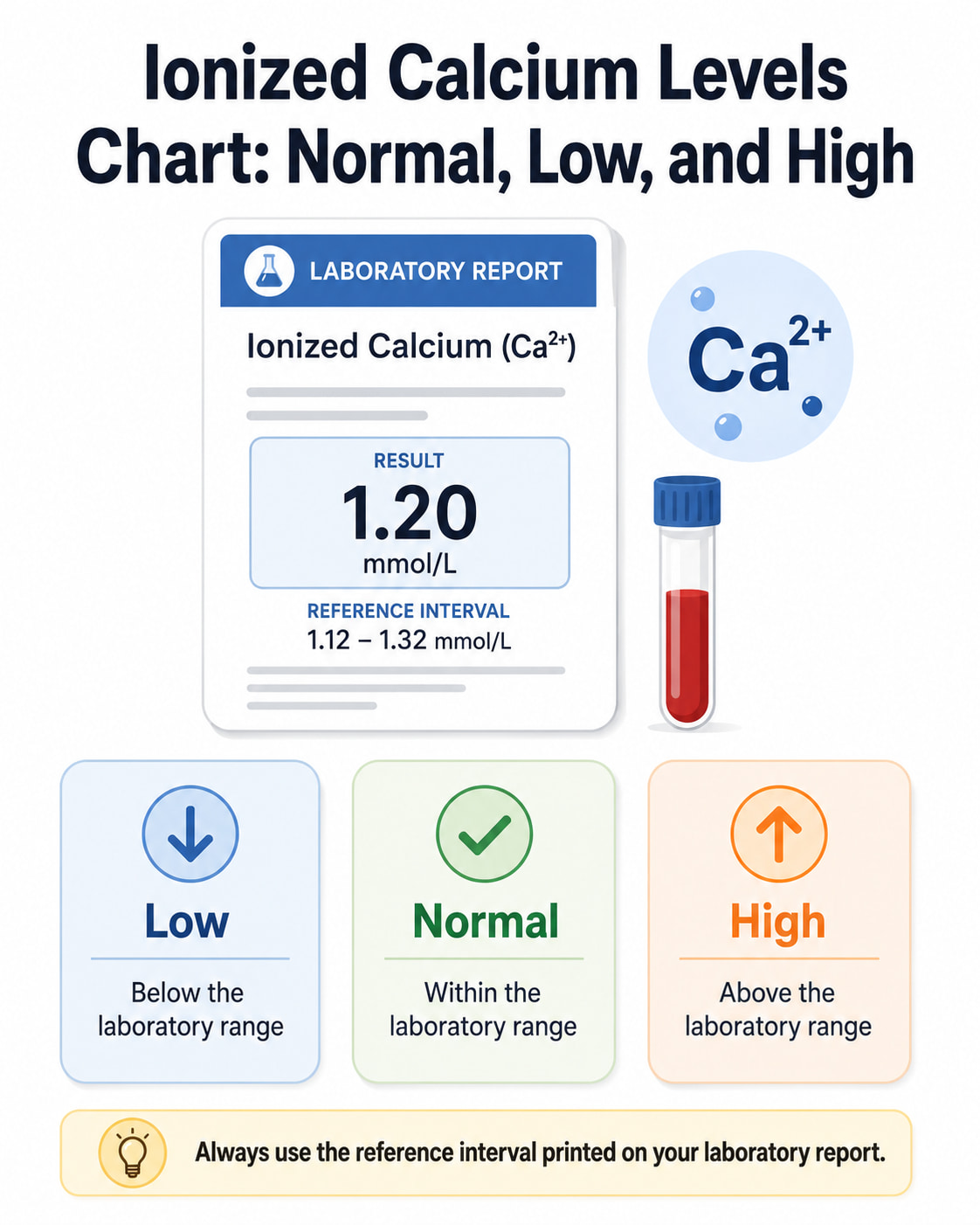
A common adult ionized calcium range is approximately 4.8–5.6 mg/dL, or 1.20–1.40 mmol/L, but the normal range printed on your laboratory report is the one you should use. Laboratories may report different limits because testing methods, specimen types, patient age, and blood pH can affect the result.
An ionized calcium levels chart can help you recognize whether a result is low, within range, or high. However, the number alone cannot identify the cause. Healthcare professionals usually interpret it alongside symptoms, parathyroid hormone levels, kidney function, magnesium, phosphorus, vitamin D, and other test results.
Ionized Calcium Levels Chart
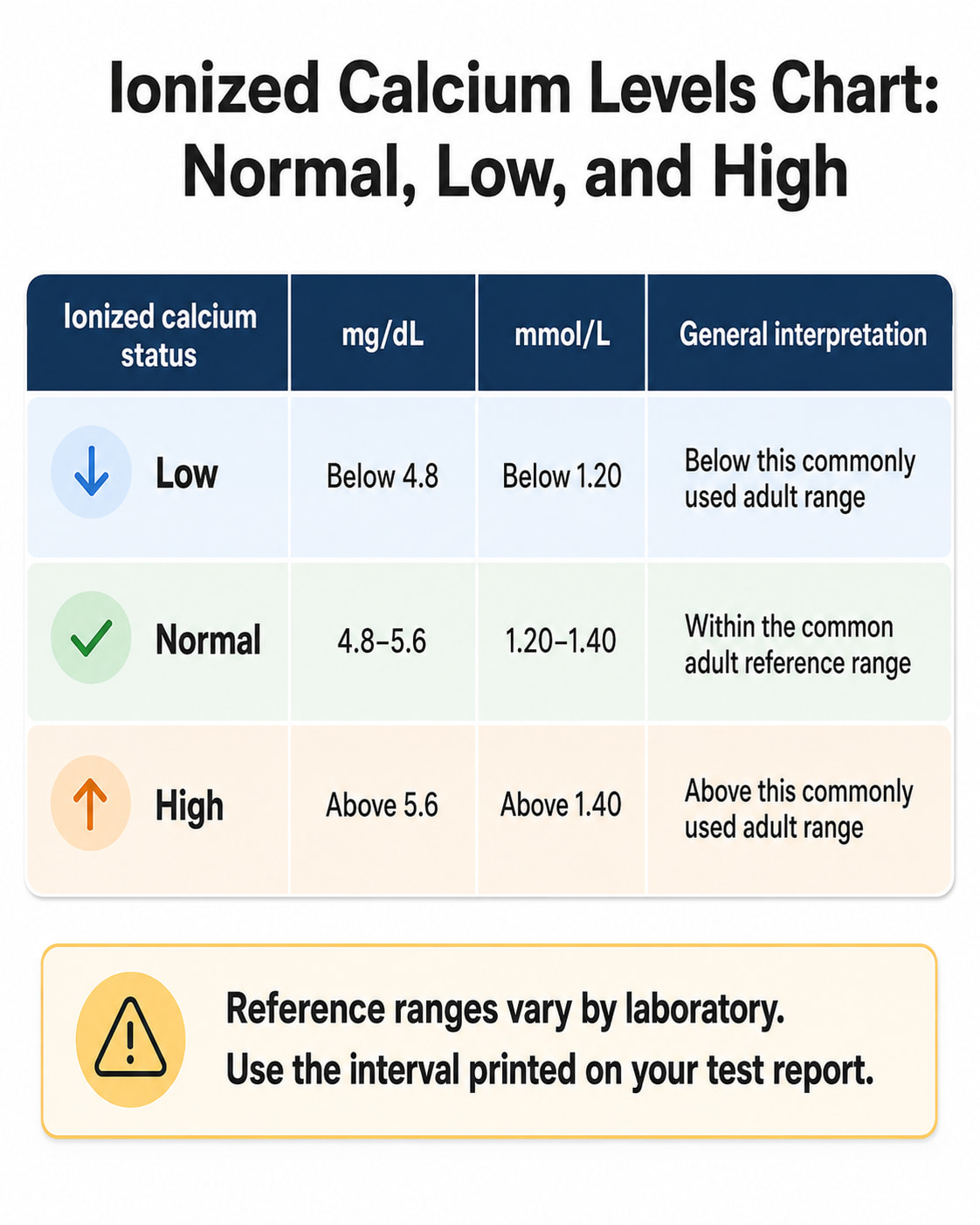
The following chart uses the common adult reference interval published by MedlinePlus. Your laboratory may use a somewhat different range.
| Ionized calcium status | mg/dL | mmol/L | General interpretation |
|---|---|---|---|
| Low | Below 4.8 | Below 1.20 | Ionized calcium is below this commonly used adult range |
| Normal | 4.8–5.6 | 1.20–1.40 | Within the common adult reference range |
| High | Above 5.6 | Above 1.40 | Ionized calcium is above this commonly used adult range |
Important: Do not label a result as abnormal using this chart alone. For example, some major laboratories use adult intervals that begin below 4.8 mg/dL. Always compare your number with the reference range beside the result on your report.
Why Ionized Calcium Normal Ranges Vary
There is no universal ionized calcium reference range. The analyzer, specimen type, pH adjustment, handling procedures, patient age, and reference population can all influence the interval a laboratory uses.
The differences among major sources illustrate why your report’s range matters:
| Source | Published adult reference interval |
|---|---|
| MedlinePlus | 4.8–5.6 mg/dL or 1.20–1.40 mmol/L |
| Mayo Clinic Laboratories, ages 24–97 | 4.57–5.43 mg/dL |
| ARUP Laboratories | 1.09–1.30 mmol/L |
A result of 1.18 mmol/L, for example, would be slightly below the MedlinePlus example but within ARUP Laboratories’ interval. It should therefore be interpreted according to the laboratory that performed the test, not a general online chart.
What Is Ionized Calcium?
Calcium in the bloodstream exists in two main forms:
- Bound calcium, which is attached mainly to proteins such as albumin
- Ionized calcium, which circulates freely and is not attached to proteins
Ionized calcium is also called free calcium. It is the physiologically active form involved in many essential body functions. Total calcium measures both bound and free calcium, while an ionized calcium test measures only the free portion.
A total calcium test is more common and is usually included in a basic or comprehensive metabolic panel. An ionized calcium test may be ordered when:
- Total calcium is abnormal or difficult to interpret
- Albumin or blood-protein levels are abnormal
- A person is critically ill or undergoing major surgery
- Kidney or parathyroid disease is suspected
- Calcium needs to be monitored after thyroid or parathyroid surgery
- Symptoms suggest a calcium imbalance
Ionized Calcium Levels by Age
Ionized calcium can be higher during infancy, childhood, and young adulthood. Laboratories may therefore use age-specific reference intervals.
The following serum ranges are current examples from Mayo Clinic Laboratories:
| Age | Ionized calcium reference interval |
|---|---|
| Birth through 13 days | Not established |
| 14 days to younger than 1 year | 5.21–5.99 mg/dL |
| 1 to younger than 2 years | 5.04–5.84 mg/dL |
| 2 to younger than 3 years | 4.87–5.67 mg/dL |
| 3–23 years | 4.83–5.52 mg/dL |
| 24–97 years | 4.57–5.43 mg/dL |
| 98 years and older | Not established |
These are method-specific Mayo Clinic Laboratories values, not universal pediatric or adult limits. Newborn and infant results require particular care because calcium physiology and appropriate ranges change rapidly during early life.
What Does a Low Ionized Calcium Level Mean?
A result below the laboratory’s lower limit is called low ionized calcium or hypocalcemia. Mild or slowly developing hypocalcemia may not cause noticeable symptoms.
Possible Symptoms of Low Ionized Calcium
Symptoms may become more apparent as the level falls or when it decreases quickly. They can include:
- Tingling around the lips, tongue, fingers, or feet
- Muscle cramps, stiffness, or spasms
- Twitching
- An irregular heartbeat
- Seizures when calcium is extremely low
Long-lasting calcium abnormalities may also be associated with dry skin, coarse hair, or nails that break easily. These symptoms are not specific to hypocalcemia, so testing and clinical evaluation are necessary.
Common Causes of Low Ionized Calcium
Possible causes include:
- Hypoparathyroidism: The parathyroid glands do not produce enough parathyroid hormone.
- Vitamin D deficiency: Too little vitamin D can reduce calcium absorption.
- Kidney disease or kidney failure: The kidneys help regulate vitamin D, phosphorus, and calcium balance.
- Low magnesium: Severe magnesium deficiency can interfere with parathyroid hormone release and action.
- Malabsorption: Digestive conditions or surgery may reduce calcium and vitamin D absorption.
- Pancreatitis: Acute pancreatic inflammation can lower calcium.
- Rickets or osteomalacia: These conditions may be associated with vitamin D or mineral abnormalities.
A low result does not automatically mean that a person needs more calcium. The correct response depends on why the level is low.
What Does a High Ionized Calcium Level Mean?
A result above the laboratory’s upper limit is called high ionized calcium or hypercalcemia. Some people have no symptoms, particularly when the increase is mild or develops gradually.
Possible Symptoms of High Ionized Calcium
High calcium may be associated with:
- Constipation
- Nausea, vomiting, or reduced appetite
- Abdominal discomfort
- Increased thirst
- Frequent urination
- Fatigue or muscle weakness
- Bone or joint discomfort
- Confusion or difficulty concentrating
- Kidney stones
The severity of symptoms does not always match the number exactly. How quickly calcium increased, the underlying cause, kidney function, and overall health also matter.
Common Causes of High Ionized Calcium
Possible causes include:
- Primary hyperparathyroidism: Excess parathyroid hormone is a common cause of high calcium.
- Certain cancers: Some cancers affect bones or produce substances that raise calcium.
- Excess vitamin D or vitamin A
- Milk-alkali syndrome: This can occur with excessive intake of calcium-containing products, often with vitamin D.
- Hyperthyroidism
- Sarcoidosis and other granulomatous conditions
- Thiazide diuretics or lithium
- Certain inherited calcium-regulation disorders
- Prolonged immobility in selected cases
Do not stop prescription medicine or discontinue a medically recommended supplement based only on one result. Discuss the finding with the healthcare professional who ordered the test.
Ionized Calcium vs. Total Calcium
Total calcium and ionized calcium are related, but they do not always tell the same story.
| Test | What it measures | When it may be useful |
|---|---|---|
| Total calcium | Bound calcium plus free calcium | Routine screening and metabolic panels |
| Ionized calcium | Free, biologically active calcium | Abnormal albumin, uncertain total calcium, serious illness, surgery, or suspected calcium-regulation disorder |
Low albumin can make total calcium appear low even when the active ionized calcium level is within range. Ionized calcium does not require adjustment for albumin, which can make it more informative when blood-protein levels are abnormal.
Healthcare professionals sometimes use an albumin-corrected total calcium calculation. However, that is not the same as directly measuring ionized calcium. Mayo Clinic Laboratories notes that calculations intended to estimate ionized calcium from total calcium, albumin, and pH may not reliably match a direct measurement.
How Blood pH Affects Ionized Calcium
Ionized calcium is sensitive to pH:
- When blood or sample pH rises, more calcium tends to bind to proteins, lowering the ionized portion.
- When pH falls, less calcium binds to proteins, increasing the measured ionized portion.
Mayo Clinic Laboratories reports that ionized calcium increases by approximately 0.2 mg/dL for each 0.1-unit decrease in specimen pH. Its reported serum result is adjusted to a pH of 7.40 to account for changes that may occur during transport.
This relationship helps explain why someone with rapid breathing and respiratory alkalosis may develop tingling or muscle spasms even when total calcium has not changed substantially.
Sample Handling Can Affect the Result
Ionized calcium testing requires careful specimen handling. Air exposure, delayed processing, and changes in sample pH can alter the result.
ARUP Laboratories instructs collection sites to keep the tube closed, avoid exposing the specimen to air, and centrifuge it with the stopper in place within one hour. ARUP also notes that delayed processing may artificially decrease specimen pH, while air exposure may increase it.
A result that does not fit the person’s symptoms or other test findings may need to be repeated, particularly when collection or transportation problems are possible.
Tests Used to Find the Cause of an Abnormal Result
An abnormal ionized calcium value identifies a calcium imbalance but usually does not explain why it occurred.
According to ARUP Consult, an initial evaluation may include:
- Repeat calcium or ionized calcium
- Total calcium and albumin
- Intact parathyroid hormone
- Magnesium
- Phosphorus
- Creatinine and kidney-function testing
- 25-hydroxyvitamin D
- Urinary calcium and creatinine in selected cases
The relationship between calcium and parathyroid hormone is especially useful:
| Calcium result | PTH result | Possible interpretation |
|---|---|---|
| Low | Low or inappropriately normal | Hypoparathyroidism or magnesium-related impairment |
| Low | High | Vitamin D deficiency, chronic kidney disease, or reduced PTH response |
| High | Low | Non-parathyroid cause, such as malignancy, vitamin D excess, or another condition |
| High | Normal or high | Primary hyperparathyroidism or certain inherited disorders |
These patterns narrow the possibilities but do not confirm a diagnosis by themselves.
When Is an Ionized Calcium Level Critical?
A result can be outside the normal range without reaching a laboratory’s critical-notification threshold. Critical limits are set so the laboratory can quickly alert the ordering healthcare team, and the limits vary by laboratory and testing method.
For example, the Mayo Clinic Laboratories Critical Values List, updated in June 2026, uses these ionized-calcium alert limits:
| Age | Critical low | Critical high |
|---|---|---|
| Younger than 1 year | 2.0 mg/dL or lower | 6.0 mg/dL or higher |
| 1 year and older | 3.0 mg/dL or lower | 6.5 mg/dL or higher |
Mayo’s Florida laboratory uses slightly different upper limits because its testing method differs. These numbers are examples of one laboratory system’s notification policy—not universal emergency cutoffs. A less extreme result may still need urgent attention when symptoms are severe or calcium has changed rapidly.
Seek urgent medical care for an abnormal result accompanied by:
- Seizures
- Severe or repeated muscle spasms
- A new irregular heartbeat
- Marked confusion
- Rapidly worsening weakness
How to Read Your Ionized Calcium Test Result
Use these steps instead of comparing the number with a general chart alone:
- Check the measurement unit. Laboratories commonly use mg/dL or mmol/L.
- Find the reference interval on the report. Do not substitute a range from another laboratory.
- Check whether the value is measured or adjusted to pH 7.4.
- Review total calcium, albumin, magnesium, phosphorus, kidney function, vitamin D, and PTH when available.
- Consider symptoms and medical history. Recent surgery, kidney disease, parathyroid disease, serious illness, and supplements may affect interpretation.
- Ask whether repeat testing is appropriate. This may be useful when an unexpected result conflicts with the clinical picture.
Do not start high-dose calcium or vitamin D solely to change the number. Excessive supplementation may cause harm, particularly in people with kidney disease or an already elevated calcium level.
Frequently Asked Questions
What is a normal ionized calcium level for adults?
A commonly published adult range is 4.8–5.6 mg/dL, or 1.20–1.40 mmol/L. However, some major laboratories use lower or narrower intervals. The range shown on your test report should guide interpretation.
Is an ionized calcium level of 1.18 mmol/L low?
It depends on the laboratory. It is slightly below the MedlinePlus example range of 1.20–1.40 mmol/L but falls within ARUP Laboratories’ interval of 1.09–1.30 mmol/L. Check the reference interval printed beside your result.
Is ionized calcium more accurate than total calcium?
Neither test is always better. Total calcium works well for routine screening, while ionized calcium directly measures active calcium and may be more informative when albumin is abnormal, total calcium is uncertain, or a person is seriously ill.
Does low albumin lower ionized calcium?
Low albumin often lowers total calcium because less calcium is protein-bound. Ionized calcium may remain normal. This is one reason direct ionized-calcium testing can help clarify an unexpectedly low total calcium result.
Can blood pH change ionized calcium?
Yes. Higher pH generally lowers ionized calcium because more calcium binds to proteins. Lower pH generally raises the ionized portion. Sample air exposure and processing delays can also change pH and affect the measurement.
Do you need to fast for an ionized calcium test?
Usually, no special preparation is needed for a calcium blood test. Fasting may be necessary when other tests are ordered at the same time. Tell your healthcare professional about all medicines and supplements, but do not stop them unless instructed.
Should you take calcium supplements when ionized calcium is low?
Not without identifying the cause. Low ionized calcium may result from parathyroid disease, low magnesium, vitamin D deficiency, kidney disease, malabsorption, pancreatitis, or another problem. Taking calcium alone may not address the underlying issue and may be inappropriate for some people.
Conclusion
An ionized calcium levels chart provides a useful starting point, but the reference interval on your laboratory report should always come first. A common adult range is 4.8–5.6 mg/dL, or 1.20–1.40 mmol/L, although reputable laboratories use different limits.
Review an abnormal result with the healthcare professional who ordered the test, especially when you have symptoms, kidney or parathyroid disease, recent neck surgery, or major differences between total and ionized calcium. Proper interpretation usually depends on more than one number.
This content is for informational purposes only and not medical advice.