
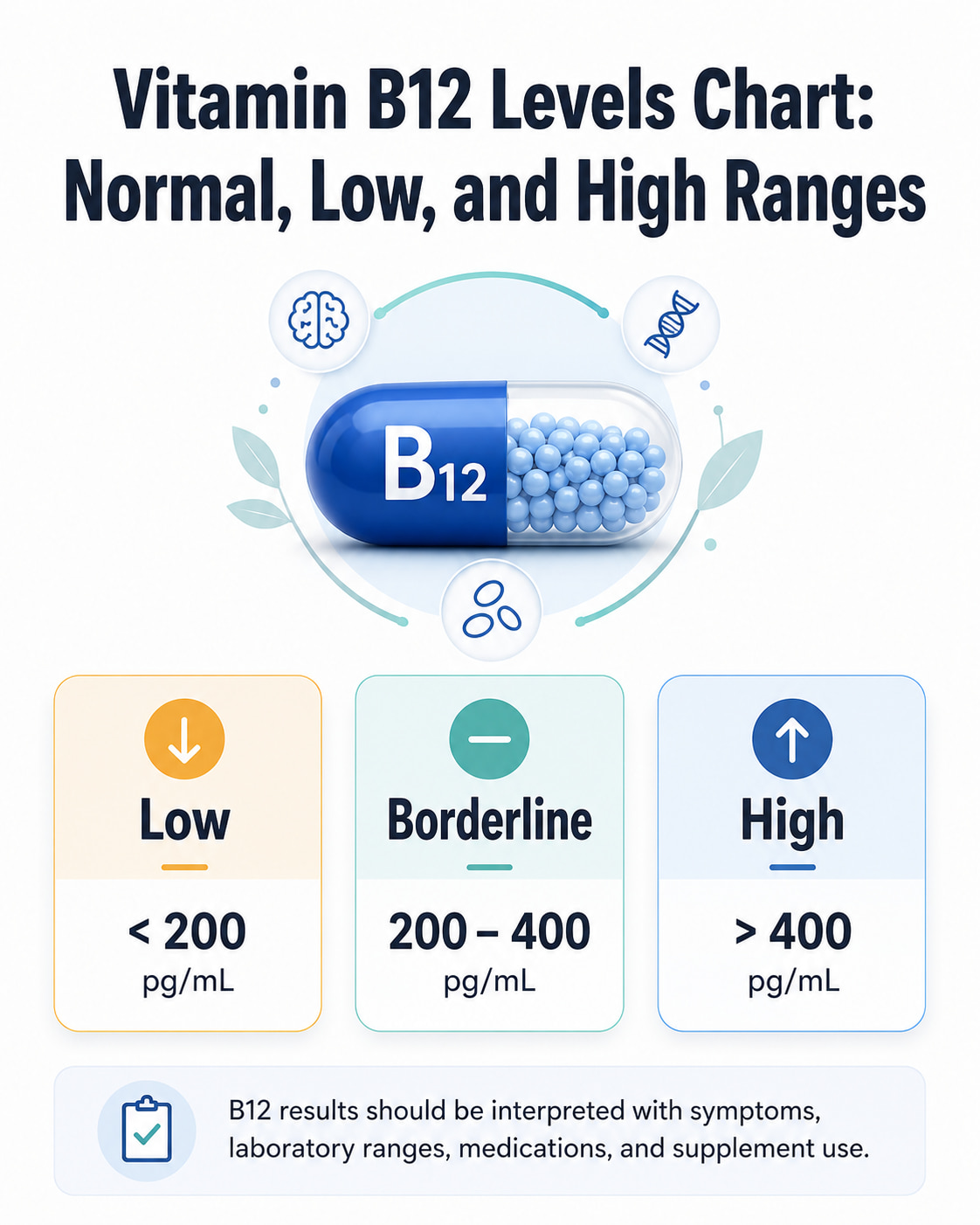
A vitamin B12 level below 180 pg/mL generally indicates deficiency, 180–350 pg/mL is considered borderline or indeterminate, and a result above 350 pg/mL makes deficiency less likely in adults and people age 16 or older. However, vitamin B12 reference ranges vary between laboratories, so the range printed on your test report should guide the final interpretation.
A B12 result should not be interpreted by itself. Your symptoms, medications, supplement use, medical history, blood count, and follow-up tests can all affect what the number means.
Vitamin B12 Levels Chart
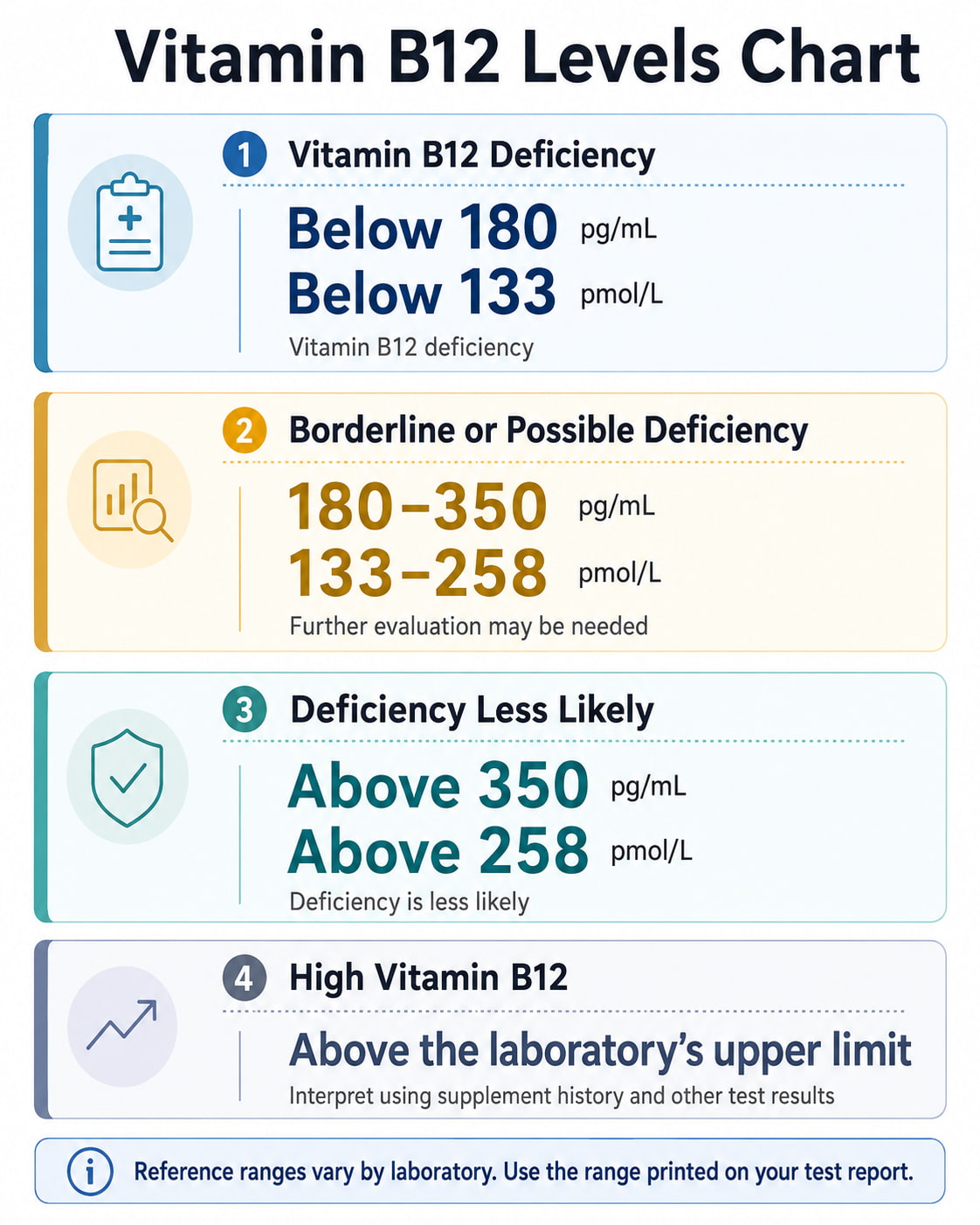
The following vitamin B12 levels chart uses the diagnostic thresholds in the 2024 NICE vitamin B12 deficiency guideline for total B12 testing in people age 16 and older. Local laboratories may use different cutoffs.
| Vitamin B12 level | Level in pmol/L | General interpretation |
|---|---|---|
| Below 180 pg/mL | Below 133 pmol/L | Vitamin B12 deficiency |
| 180–350 pg/mL | 133–258 pmol/L | Borderline or possible deficiency |
| Above 350 pg/mL | Above 258 pmol/L | Deficiency is less likely |
| Above the laboratory’s upper limit | Varies by laboratory | High B12 level requiring clinical context |
This chart is a guide rather than a universal diagnostic rule. For example, Mayo Clinic Laboratories lists a reference interval of 180–914 pg/mL, while MedlinePlus gives an example range of 299–1,054 pg/mL. Both sources emphasize that normal ranges differ among laboratories.
Vitamin B12 Unit Conversion
Vitamin B12 may appear on your report in different units:
- pg/mL means picograms per milliliter.
- ng/L means nanograms per liter.
- pmol/L means picomoles per liter.
A result in pg/mL has the same numerical value in ng/L. To estimate pmol/L, multiply the pg/mL value by approximately 0.738.
For example:
- 180 pg/mL is approximately 133 pmol/L.
- 300 pg/mL is approximately 221 pmol/L.
- 500 pg/mL is approximately 369 pmol/L.
What Is a Normal Vitamin B12 Level?
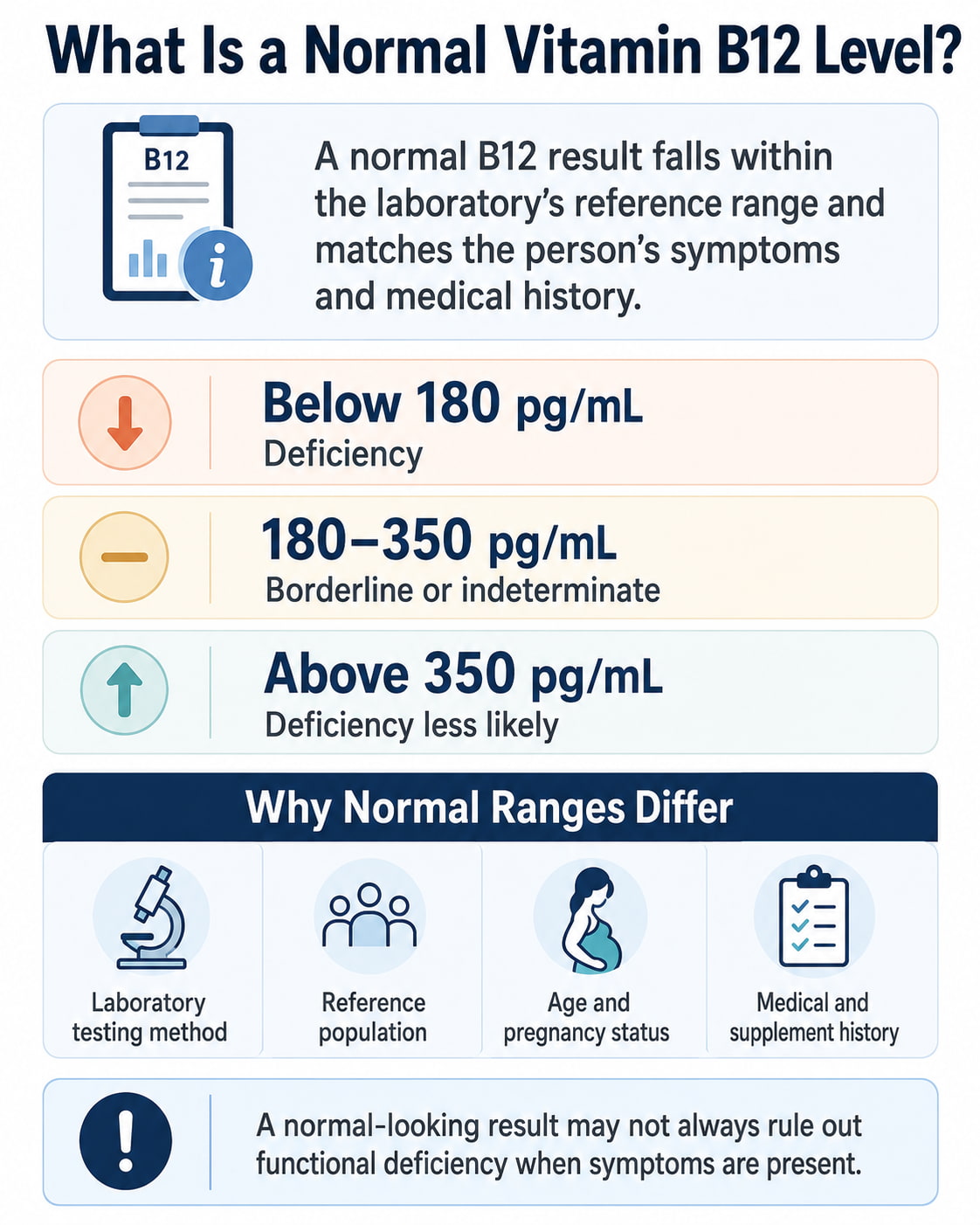
A normal vitamin B12 level is generally a result that falls within your laboratory’s reference interval and is consistent with your symptoms and medical history.
Using the NICE interpretation:
- Below 180 pg/mL suggests deficiency.
- Between 180 and 350 pg/mL is indeterminate.
- Above 350 pg/mL makes deficiency less likely.
However, some laboratories set their lower limit at 200, 250, or nearly 300 pg/mL. The NIH Office of Dietary Supplements notes that most laboratories consider serum levels below approximately 200 or 250 pg/mL to be subnormal.
A result within the stated normal range does not always rule out a functional deficiency. Follow-up testing may be appropriate when symptoms strongly suggest a problem, particularly when the result is close to the lower end of the range.
What Is Considered a Low Vitamin B12 Level?
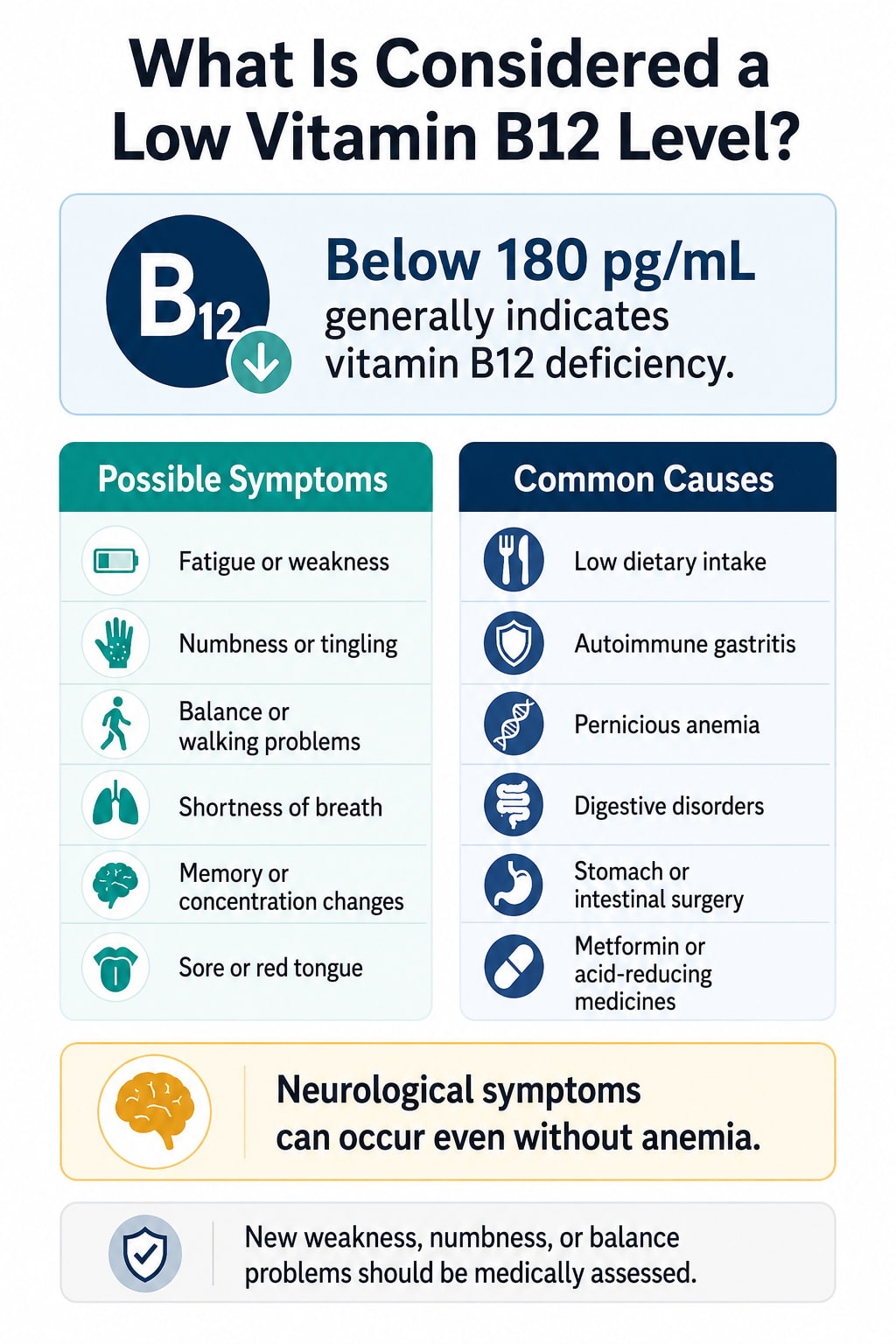
A total B12 level below 180 pg/mL is classified as deficient under the NICE thresholds for people age 16 and older. Mayo Clinic Laboratories considers a result below 150 pg/mL evidence of deficiency and describes 150–400 pg/mL as a borderline range that may require functional testing.
A low result can mean that you are not consuming enough B12, your digestive system is not absorbing it properly, or a medication or medical condition is affecting your level.
Possible Symptoms of Low Vitamin B12
Vitamin B12 supports normal red blood cell production and nervous system function. Deficiency may cause:
- Unusual fatigue or weakness
- Shortness of breath
- Heart palpitations
- Pale skin
- A sore, smooth, or red tongue
- Reduced appetite
- Numbness or tingling in the hands and feet
- Muscle weakness
- Problems with walking, coordination, or balance
- Memory or concentration difficulties
- Mood or behavioral changes
Neurological symptoms can develop even when a complete blood count does not show anemia. Mayo Clinic Laboratories notes that neuropathy, poor coordination, weakness, and other neurological changes may occur without macrocytic anemia.
New numbness, worsening weakness, loss of balance, walking difficulty, or significant cognitive changes should be assessed promptly. Delaying evaluation may increase the risk of lasting nerve problems.
Common Causes of Low Vitamin B12
Low Dietary Intake
Vitamin B12 occurs naturally in animal-derived foods, including:
- Meat
- Fish and shellfish
- Poultry
- Eggs
- Milk and other dairy products
People following vegan diets and some vegetarian diets may not consume enough unless they regularly use fortified foods or an appropriate supplement.
Autoimmune Gastritis and Pernicious Anemia
The body needs a stomach protein called intrinsic factor to absorb B12 efficiently. Autoimmune gastritis can damage the cells that produce intrinsic factor.
When a lack of intrinsic factor causes vitamin B12 deficiency and related anemia, the condition is commonly called pernicious anemia.
Digestive Disorders
Conditions that interfere with absorption may reduce B12 levels. Examples include:
- Celiac disease
- Crohn’s disease
- Diseases affecting the small intestine
- Severe or long-term digestive inflammation
Stomach or Intestinal Surgery
Bariatric surgery, partial stomach removal, or surgery involving the end of the small intestine may reduce B12 absorption.
Medications
Some medicines can lower B12 absorption or affect test results, including:
- Metformin
- Proton pump inhibitors
- H2 receptor blockers
- Colchicine
- Certain anticonvulsants
Do not stop a prescribed medicine because of a B12 result unless your healthcare professional advises you to do so. MedlinePlus lists metformin and acid-reducing medicines among the medications that can affect B12 testing.
Pregnancy
Total serum B12 may decrease during pregnancy. A low result during pregnancy therefore needs to be interpreted using pregnancy-appropriate clinical context rather than a single general cutoff.
What Does a Borderline Vitamin B12 Level Mean?
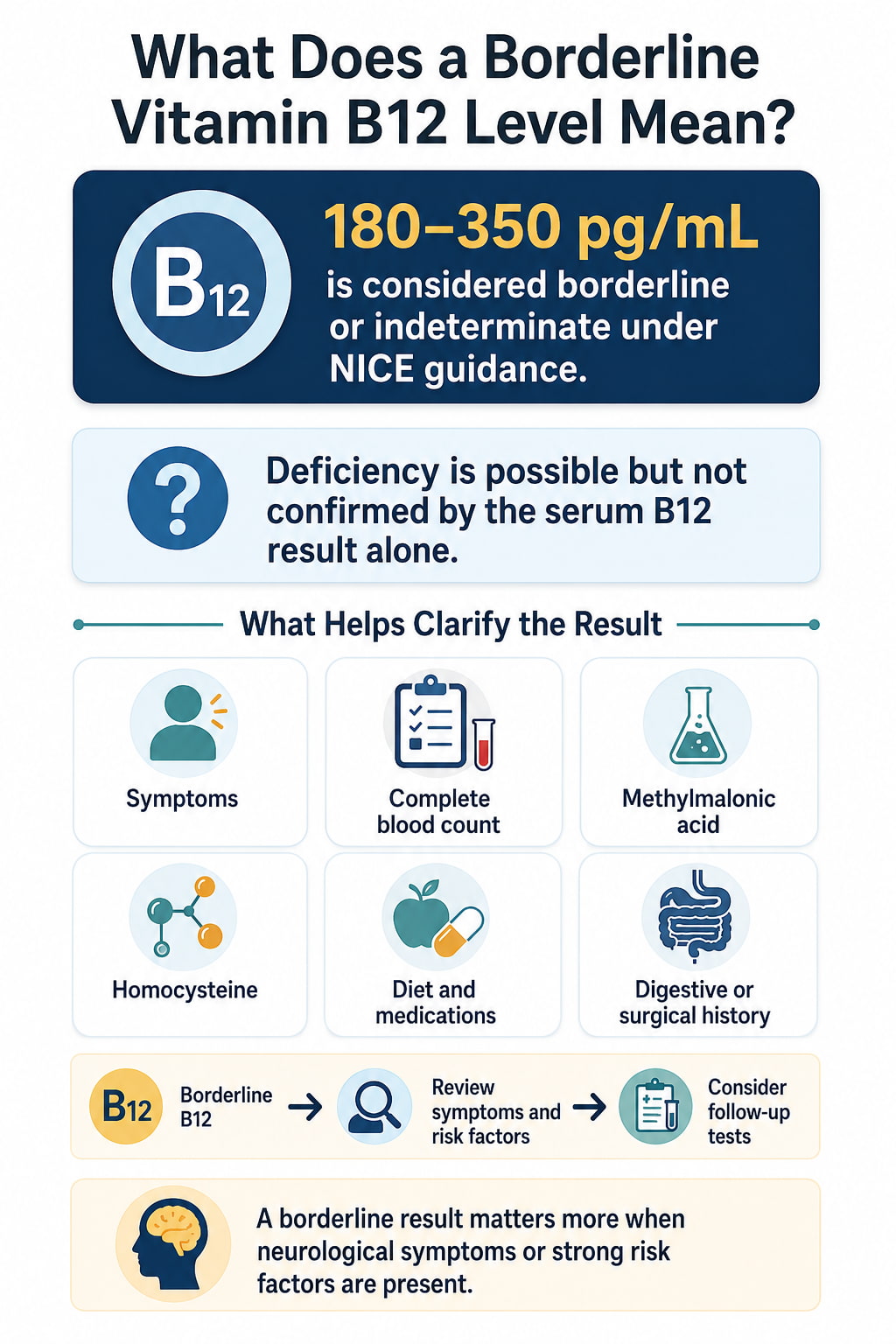
A borderline result means that vitamin B12 deficiency is possible but has not been clearly confirmed.
Using the NICE thresholds, the borderline or indeterminate range is 180–350 pg/mL. Other organizations and laboratories may use a wider range. The NIH recommends considering a methylmalonic acid test when serum B12 is between 150 and 399 pg/mL.
A healthcare professional may consider your:
- Symptoms
- Complete blood count
- Mean corpuscular volume, or MCV
- Folate level
- Diet
- Digestive history
- Medication use
- Pregnancy status
- Previous stomach or intestinal surgery
- B12 supplement or injection use
A borderline result is more significant when neurological symptoms or strong risk factors are present.
Tests That May Confirm Vitamin B12 Deficiency
Methylmalonic Acid
Methylmalonic acid, commonly called MMA, is one of the most useful follow-up tests when a serum B12 result is borderline.
Cells need vitamin B12 to process MMA. When usable B12 is insufficient, MMA may build up in the blood.
An elevated MMA level may support a diagnosis of functional vitamin B12 deficiency. However, kidney impairment and older age can also raise MMA, so the result still requires interpretation. The NIH notes that MMA is a sensitive marker but can be affected by renal function.
Homocysteine
Homocysteine can also rise when vitamin B12 is low. However, it is less specific than MMA because it may also be affected by:
- Folate deficiency
- Vitamin B6 status
- Kidney function
- Age
- Certain medical conditions
Mayo Clinic Laboratories recommends considering MMA and/or homocysteine when serum B12 is in the borderline range.
Complete Blood Count
A complete blood count, or CBC, may identify changes associated with B12 deficiency, such as:
- Low hemoglobin
- Low red blood cell count
- Enlarged red blood cells
- An elevated MCV
A normal CBC does not completely exclude B12 deficiency, especially when nerve-related symptoms are present.
Intrinsic Factor Antibody Test
An intrinsic factor antibody test may be ordered when a clinician suspects autoimmune gastritis or pernicious anemia.
A positive result supports an autoimmune cause of impaired B12 absorption. A negative result does not always rule it out, so additional evaluation may be needed when clinical suspicion remains high.
Active Vitamin B12
Some laboratories measure active B12, also called holotranscobalamin, instead of total serum B12.
NICE uses the following active B12 thresholds:
| Active B12 level | Interpretation |
|---|---|
| Below 25 pmol/L | Deficiency |
| 25–70 pmol/L | Borderline or possible deficiency |
| Above 70 pmol/L | Deficiency is less likely |
Active B12 and total B12 are different tests. Their numbers and reference ranges should not be compared directly.
What Is Considered a High Vitamin B12 Level?
A high B12 result is a value above the upper reference limit listed by the laboratory.
There is no universal high cutoff. For example:
- Mayo Clinic Laboratories uses an upper reference limit of 914 pg/mL.
- The example MedlinePlus range extends to 1,054 pg/mL.
A result of 950 pg/mL might therefore be flagged as high by one laboratory but not another. Always use the range provided beside your result.
Common Reasons for High B12
Supplements and Injections
A high level is often explained by:
- B12 tablets
- Multivitamins
- Energy products containing B12
- Sublingual B12
- Prescription injections
Tell the clinician interpreting your result about every supplement you take, including the dose and how recently you used it.
Mayo Clinic Laboratories advises that testing within two weeks of a B12 injection may produce a falsely elevated or clinically misleading result.
Liver or Kidney Problems
High serum B12 may sometimes occur with liver-cell injury or reduced kidney function. These conditions can change how B12 and its carrier proteins are stored, released, or cleared.
Blood and Bone Marrow Disorders
Certain myeloproliferative and other blood disorders may be associated with elevated B12. A high result alone does not diagnose one of these conditions.
When the elevation is unexpected or persists without supplement use, a clinician may review it alongside:
- A complete blood count
- Liver enzyme tests
- Kidney function tests
- Medication and supplement history
- Symptoms and physical findings
Does High B12 Mean Vitamin Toxicity?
Not necessarily. A high blood level and excessive intake are not the same thing.
Vitamin B12 has a relatively low potential for toxicity, and the U.S. Food and Nutrition Board has not established a tolerable upper intake level. A high result is often related to recent supplementation or may act as a marker of another issue rather than directly causing harm. The evidence connecting high circulating B12 with specific diseases remains mixed and does not prove that B12 itself caused the condition.
Do not assume that an unexplained high result is harmless, but do not panic based on one number. Discuss whether the test should be repeated and whether additional blood work is appropriate.
Can You Have Vitamin B12 Deficiency With a Normal Result?
Yes, it is possible in certain situations.
A normal-looking serum result may not accurately reflect the amount of B12 available to cells. This is sometimes described as functional deficiency.
Possible reasons include:
- A result near the lower end of the normal range
- Recent supplement or injection use
- Intrinsic factor antibodies interfering with the laboratory assay
- Symptoms that do not match the measured level
- Differences between laboratory testing methods
Mayo Clinic Laboratories warns that intrinsic factor antibodies can occasionally produce falsely elevated B12 results. MMA testing may be useful when the serum result does not match the clinical picture.
Does Vitamin B12 Level Change With Age?
Most adult laboratories do not use separate B12 reference ranges for each age group. Adults and older adults are usually evaluated using the same laboratory interval.
However, the risk of deficiency increases with age because older adults are more likely to have:
- Reduced stomach acid
- Autoimmune gastritis
- Long-term acid-reducing medication use
- Metformin use
- Digestive disorders
- Previous gastrointestinal surgery
- Lower intake of B12-rich foods
Children and teenagers may have age-specific reference intervals. Pediatric results should be compared with the range supplied by the testing laboratory rather than the adult chart above.
How to Prepare for a Vitamin B12 Blood Test
Preparation instructions can vary. Follow the directions provided by your laboratory or healthcare professional.
MedlinePlus advises fasting for approximately six to eight hours for the B12 test it describes. Other laboratories may not require fasting.
Before testing, report:
- B12 tablets or injections
- Multivitamins
- Fortified drinks or energy products
- Metformin
- Proton pump inhibitors
- H2 blockers
- Anticonvulsants
- Pregnancy
- Recent gastrointestinal surgery
Do not stop medicine or supplements unless the clinician ordering the test tells you to do so.
What to Do After Receiving Your B12 Result
If Your Result Is Low
Discuss the result with a healthcare professional, especially when you have neurological symptoms, anemia, digestive disease, or a history of gastrointestinal surgery.
The next step is usually to identify why the level is low. Management may differ depending on whether the cause is inadequate intake, medication use, or poor absorption.
If Your Result Is Borderline
Ask whether MMA, homocysteine, a complete blood count, folate, or another follow-up test is appropriate.
A borderline number should not be dismissed when symptoms or strong risk factors are present.
If Your Result Is High
Review all supplements and injections first. When supplementation does not explain the level, ask whether repeating the test or checking your blood count, liver function, and kidney function would be useful.
If Your Symptoms Are Significant
Seek prompt medical evaluation for new or worsening:
- Numbness or tingling
- Muscle weakness
- Balance problems
- Difficulty walking
- Confusion
- Significant shortness of breath
- Rapid or irregular heartbeat
These symptoms have many possible causes and should not be attributed to B12 without appropriate assessment.
Frequently Asked Questions
Is 200 pg/mL a low vitamin B12 level?
A result of 200 pg/mL is above the NICE deficiency cutoff of 180 pg/mL but remains within its borderline range of 180–350 pg/mL. Some laboratories may flag 200 pg/mL as low. Symptoms and follow-up tests such as MMA can help clarify the result.
Is 300 pg/mL a good B12 level?
A result of 300 pg/mL is often within a laboratory’s reference interval, but it falls within the NICE indeterminate range. It may require further evaluation when symptoms or risk factors are present.
Is 500 pg/mL a normal B12 level?
A result of 500 pg/mL falls within many commonly used adult reference intervals and makes deficiency less likely. The range on the individual laboratory report remains the most relevant comparison.
Is a B12 level above 1,000 pg/mL dangerous?
A result above 1,000 pg/mL may be high according to many laboratories, but it does not automatically indicate toxicity. Supplements, injections, liver conditions, kidney dysfunction, and certain blood disorders can raise the measured level. Persistent unexplained elevations should be reviewed by a healthcare professional.
What level of B12 causes neurological symptoms?
There is no single level at which neurological symptoms begin. Symptoms can occur at clearly low levels, within the borderline range, and occasionally with an apparently normal serum result. The complete clinical picture matters more than one cutoff.
How quickly do B12 levels change after taking a supplement?
Blood levels may rise after oral supplements and can increase substantially after an injection. The timing and degree of change depend on the dose, form, absorption, and when the blood sample was collected.
Should I take B12 if my result is borderline?
A borderline result should be discussed with a healthcare professional rather than managed from the number alone. The appropriate approach depends on symptoms, diet, medications, pregnancy status, absorption problems, and follow-up test results.
Conclusion
A vitamin B12 result is most useful when it is interpreted with your laboratory’s reference range, symptoms, risk factors, medications, and supplement history.
Levels below 180 pg/mL generally support deficiency, while results between 180 and 350 pg/mL may require follow-up testing. A result above 350 pg/mL makes deficiency less likely, but it does not always exclude it when symptoms are present. High results should be interpreted according to the laboratory’s upper limit and whether supplements or injections provide a clear explanation.
Review unexpected, borderline, or abnormal results with a qualified healthcare professional instead of starting, stopping, or changing treatment based only on an online chart.
This content is for informational purposes only and not medical advice.