
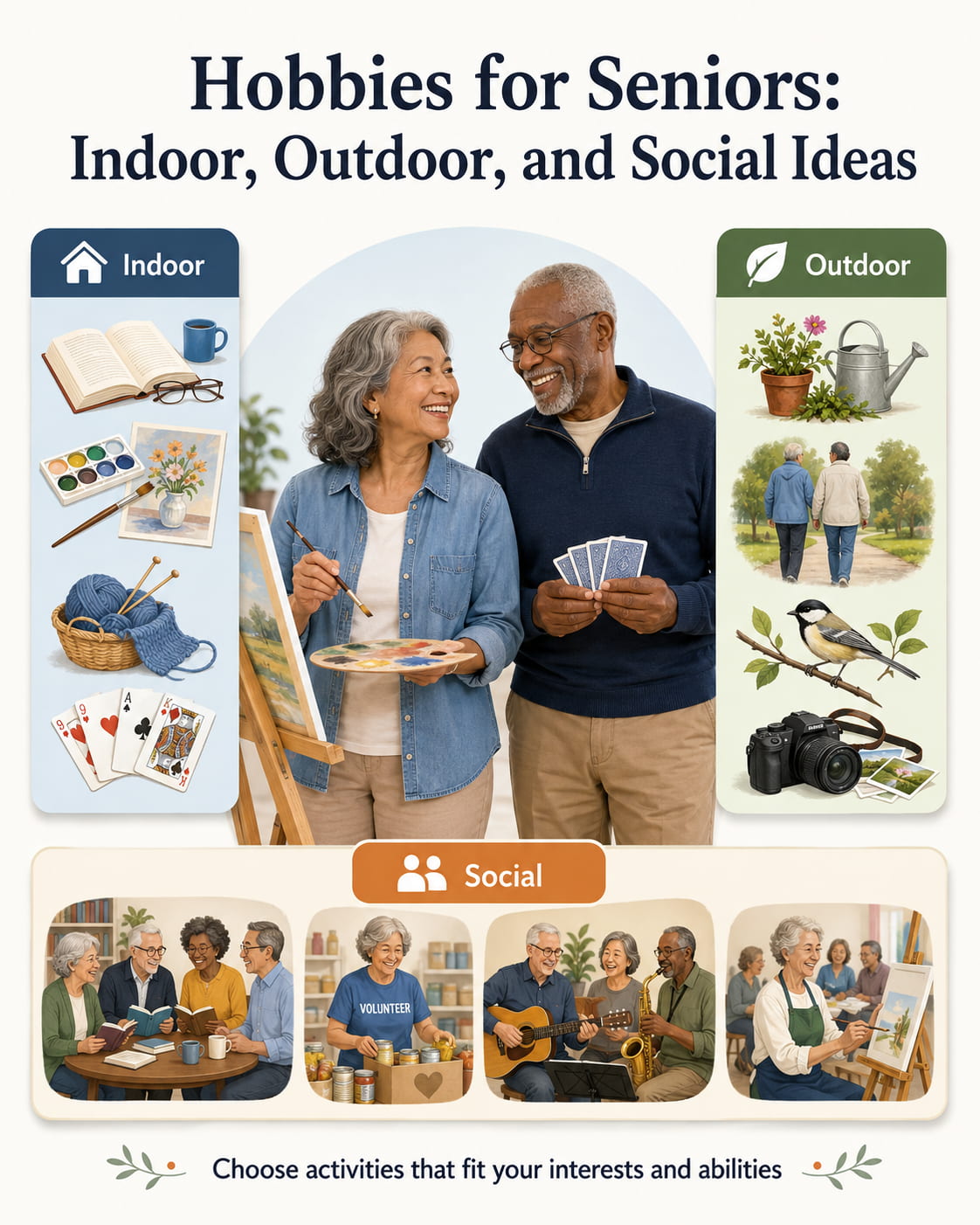
The best hobbies for seniors are activities that feel enjoyable, match current abilities, and are easy to continue, such as reading, gardening, walking, painting, music, volunteering, games, and group classes. A worthwhile hobby does not need to be strenuous, expensive, or highly social.
The right activity can add enjoyment and structure to the week while creating opportunities to learn, move, relax, create, or spend time with other people. This guide covers practical indoor, outdoor, and social hobbies for seniors, including accessible and low-cost options.
Best Hobbies for Seniors at a Glance
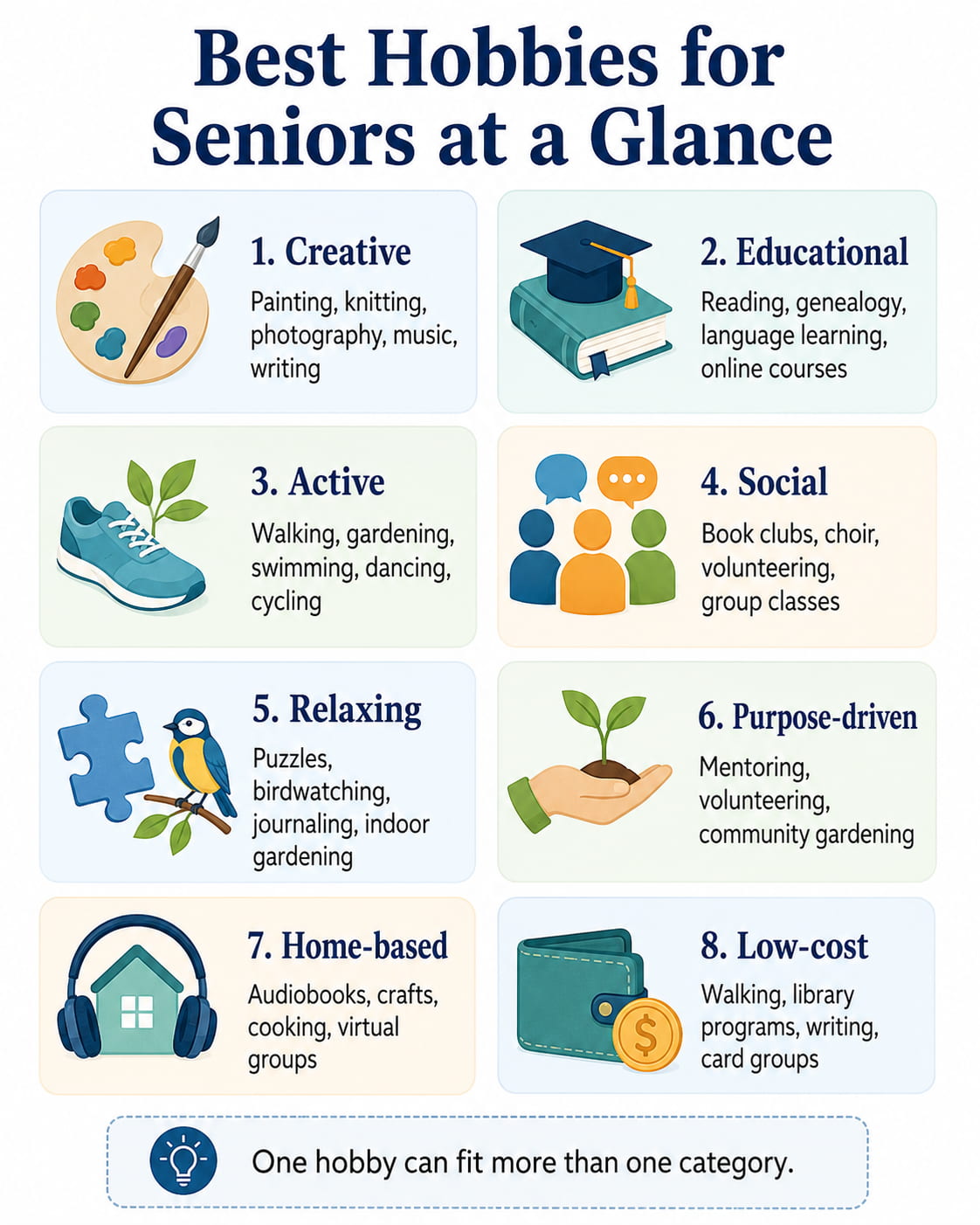
There is no single best hobby for every older adult. The most suitable option depends on your interests, energy level, physical abilities, budget, transportation, and preferred amount of social interaction.
| Hobby type | Examples | May suit people who want to |
|---|---|---|
| Creative | Painting, knitting, photography, music, writing | Make something and express ideas |
| Educational | Reading, genealogy, language learning, online courses | Learn and stay mentally engaged |
| Active | Walking, gardening, swimming, dancing, cycling | Add more movement to the week |
| Social | Book clubs, choir, volunteering, group classes | Meet people through a shared activity |
| Relaxing | Puzzles, birdwatching, journaling, indoor gardening | Enjoy calm, low-pressure time |
| Purpose-driven | Mentoring, volunteering, community gardening | Contribute skills or help others |
| Home-based | Audiobooks, crafts, cooking, virtual groups | Participate without regular travel |
| Low-cost | Walking, library programs, writing, card groups | Begin with little or no equipment |
A hobby can fit more than one category. Gardening, for example, can be a quiet individual activity, a form of physical movement, or a social activity in a community garden.
Why Hobbies Matter as You Get Older
Hobbies can provide more than a way to pass the time. A regular activity may create something to anticipate, offer a sense of progress, and make weekly routines feel more meaningful.
A 2023 study published in Nature Medicine analyzed 93,263 adults aged 65 and older across 16 countries. Hobby participation was associated with fewer depressive symptoms and better self-reported health, happiness, and life satisfaction. However, the study used observational data, so it could not prove that hobbies directly caused these outcomes.
More recent research published in July 2026 in the Journal of Global Health examined 43,346 adults aged 65 and older across 15 countries. Hobby engagement was associated with a lower subsequent Frailty Index. The researchers cautioned that the study could not establish cause and effect and that the clinical importance of the observed difference remained uncertain.
Hobbies can create opportunities for learning
Reading, music, crafts, games, photography, and classes require attention and practice. They may help older adults remain curious and engaged with new information.
The National Institute on Aging notes that activities such as music, dance, theater, creative writing, and photography have shown promise for supporting well-being and social interaction. It also emphasizes that evidence for lasting cognitive benefits is not definitive. No puzzle, craft, or game has been proven to prevent dementia.
Active hobbies can add movement to the day
Walking, gardening, dancing, swimming, cycling, and active games can make physical activity feel less like a formal workout.
An activity does not have to be intense to be worthwhile. Short walks, light gardening, and gentle movement can still break up long periods of sitting, even when they do not reach a moderate exercise intensity.
Social hobbies can make interaction easier
Conversation often feels more natural when people are working on a shared project, playing a game, attending a class, or helping with a community activity. This can be especially useful after retirement, relocation, bereavement, or other life changes that affect a person’s usual social routine.
Hobbies can provide purpose and progress
Completing a scarf, learning a song, growing vegetables, documenting family history, or helping at a food pantry can provide visible progress. The goal does not need to be competition or mastery. Enjoyment and consistent participation are enough.
How to Choose a Hobby That Fits Your Life
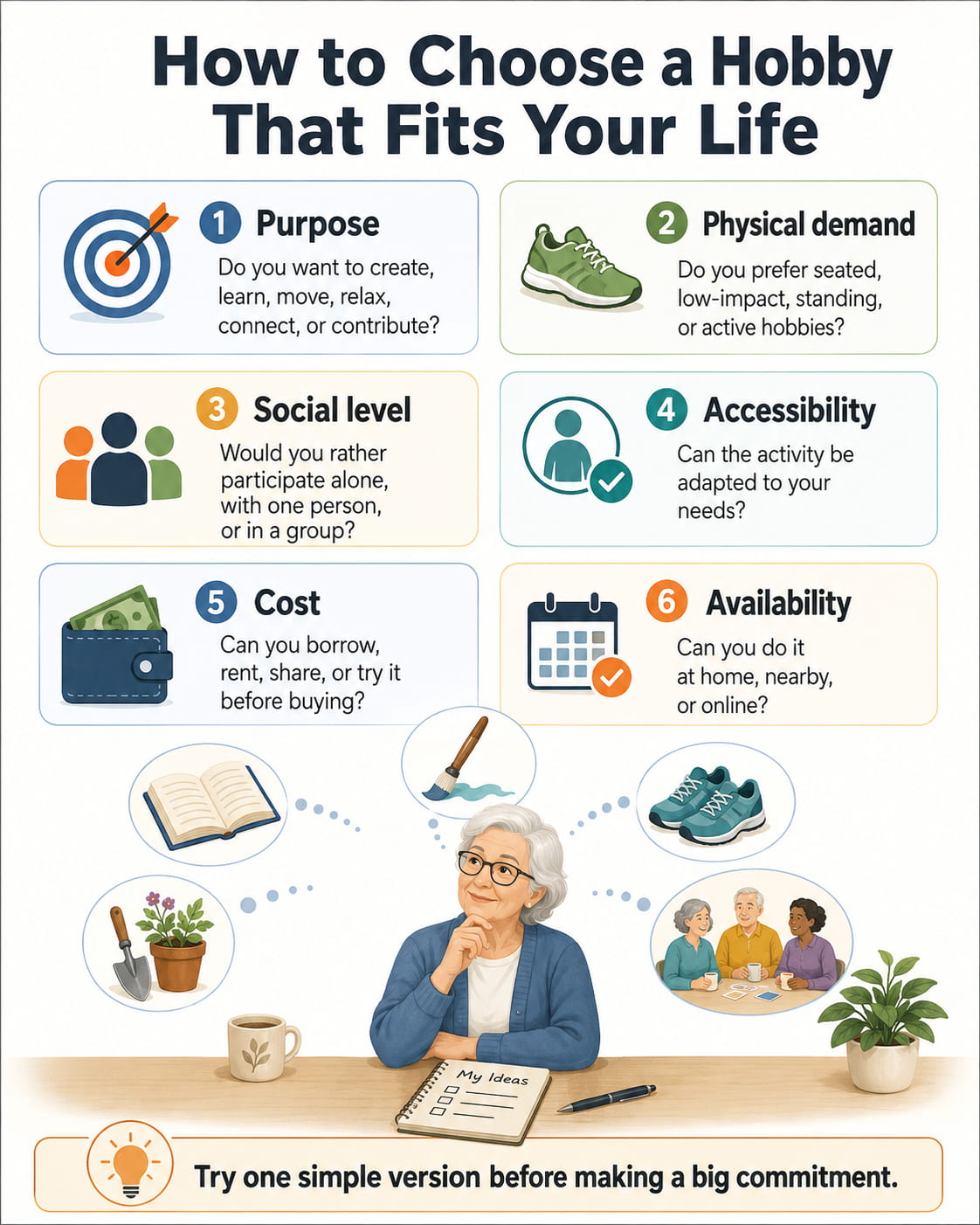
A hobby is more likely to last when it fits your real life rather than an ideal schedule. Before buying equipment or committing to a long course, consider the following factors.
Decide what you want from the activity
Ask yourself what you would most like the hobby to provide:
- Relaxation
- Creativity
- Physical movement
- Social contact
- Mental challenge
- Time outdoors
- A sense of contribution
- A reason to follow a regular schedule
Knowing your main goal can narrow a long list of options quickly.
Match the activity to your energy and mobility
Think about how long you can comfortably sit, stand, walk, reach, grip, or concentrate. An activity can often be adapted, but it should not regularly leave you exhausted or in pain.
Someone who enjoys gardening but cannot comfortably kneel might use raised beds or containers. A person who likes art but has limited hand strength might try larger brushes, grip supports, or digital drawing.
Choose the right level of social contact
Not every senior wants a large group activity. Social hobbies can range from quiet one-on-one interaction to a busy class or club.
Possible formats include:
- Independent participation at home
- Working beside others without much conversation
- Meeting one friend regularly
- Joining a small structured group
- Participating in a larger class or community event
- Attending an online group from home
A structured activity such as cards, crafts, or a book discussion can feel less pressured than attending an event based entirely on conversation.
Consider cost and transportation
Include the full cost when comparing options. A seemingly inexpensive activity may require recurring supplies, transportation, admission fees, or specialized equipment.
Before purchasing anything expensive, look for:
- Free introductory sessions
- Library or community-center programs
- Used equipment
- Rental options
- Supply-sharing groups
- Beginner kits
- Online alternatives
- Classes that provide equipment
Try the two-week test
Choose one simple version of the hobby and try it several times over two weeks. Afterward, ask:
- Did I look forward to it?
- Was it physically comfortable?
- Was the cost reasonable?
- Was it easy enough to repeat?
- Would I enjoy doing it alone, with others, or both?
You do not have to continue a hobby simply because you started it. Trying different activities is part of finding the right fit.
Indoor Hobbies for Seniors
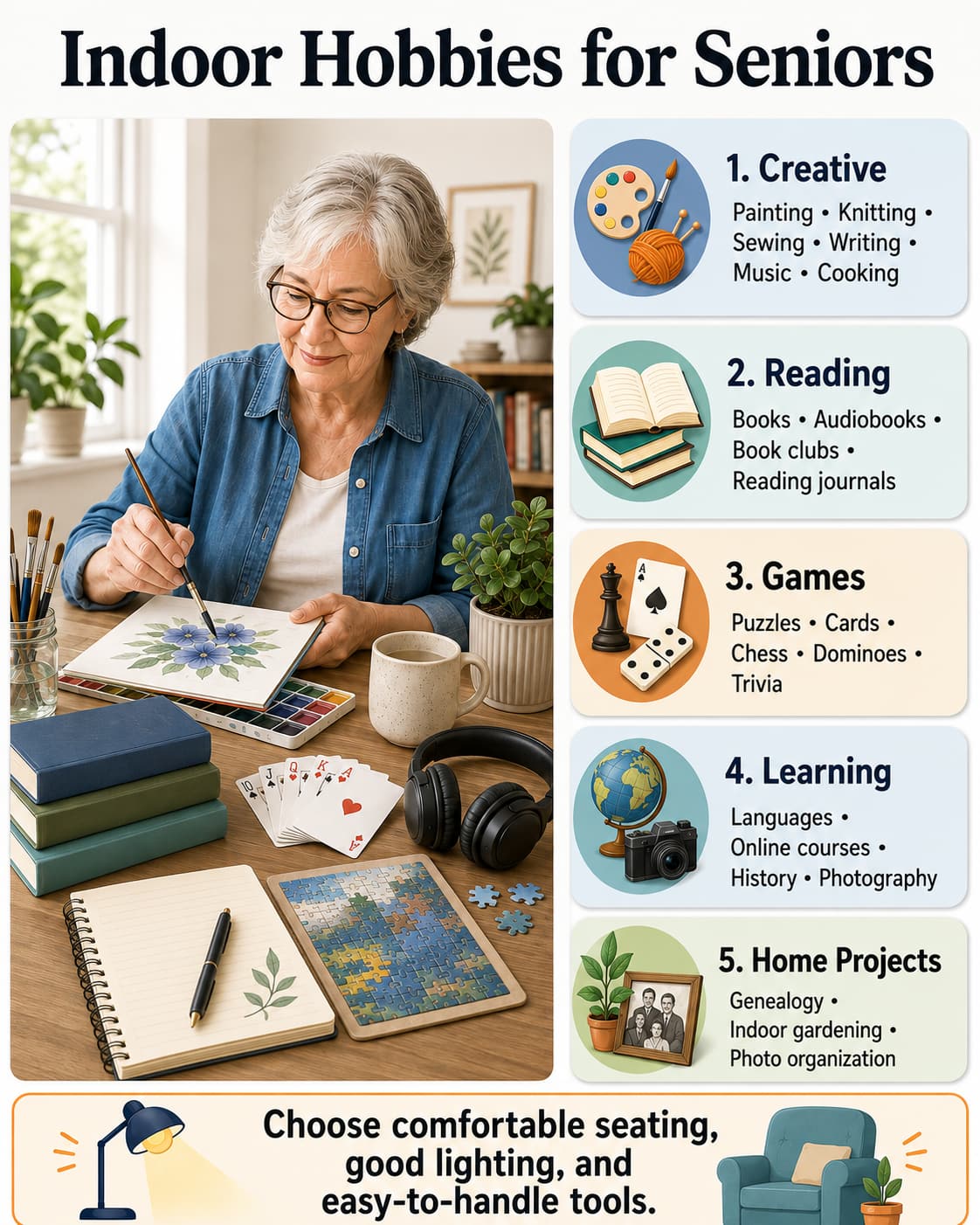
Indoor hobbies can be enjoyed throughout the year and are often easier to adapt for limited mobility, transportation difficulties, or extreme weather.
Creative indoor hobbies
Creative activities provide a clear project without requiring professional-level skill.
Good options include:
- Watercolor or acrylic painting
- Sketching
- Adult coloring
- Knitting or crocheting
- Sewing or quilting
- Scrapbooking
- Card making
- Pottery or clay work
- Model building
- Wood carving or simple woodworking
- Creative writing
- Poetry
- Playing a musical instrument
- Singing
- Cooking or baking
Choose a beginner project that can be completed without buying many supplies. A small painting, simple scarf, short family story, or familiar recipe may be more satisfying than an ambitious first project.
For woodworking, carving, resin crafts, or projects involving heat or chemicals, use appropriate ventilation, eye protection, stable work surfaces, and manufacturer-recommended safety equipment.
Reading and audiobook hobbies
Reading can become a more active hobby when paired with a theme or goal. You might read books about local history, biographies, travel, gardening, mysteries, or a subject you never had time to explore before.
Other ideas include:
- Joining a book club
- Keeping a reading journal
- Comparing a book with its film adaptation
- Reading aloud to grandchildren
- Listening to audiobooks while crafting
- Reviewing books for friends or an online group
Large-print books, e-readers with adjustable text, and audiobooks can make reading more accessible.
Puzzles, cards, and games
Games can be solitary, competitive, cooperative, or social.
Options include:
- Jigsaw puzzles
- Crosswords
- Sudoku
- Word searches
- Chess
- Checkers
- Dominoes
- Bridge
- Rummy
- Cooperative board games
- Trivia games
- Digital puzzle games
Choose games with readable print and manageable rules. Large-print cards, card holders, and oversized game pieces can help people with vision or dexterity limitations.
Lifelong learning
Retirement can provide time to study subjects based entirely on personal interest.
Possible learning hobbies include:
- Learning a language
- Taking an online course
- Studying local or world history
- Learning basic computer skills
- Exploring astronomy
- Studying art appreciation
- Attending museum lectures
- Learning photography
- Taking cooking classes
- Watching educational lectures and discussing them with a friend
Many public libraries, senior centers, museums, universities, and community colleges offer free or reduced-cost educational programs.
Genealogy and family history
Genealogy combines research, organization, storytelling, and communication with relatives.
A simple project could involve:
- Labeling old photographs
- Recording family stories
- Creating a family tree
- Interviewing relatives
- Scanning letters and documents
- Mapping places where family members lived
- Writing a short family history
- Creating a recipe collection
Protect living relatives’ personal information when posting family records online. Avoid publicly sharing full birth dates, addresses, financial details, or identity documents.
Indoor gardening
Indoor gardening can range from caring for one windowsill herb to maintaining a collection of houseplants.
Accessible options include:
- Countertop herb gardens
- Succulents
- African violets
- Indoor seed starting
- Terrariums
- Small hydroponic systems
- Arranging cut flowers
Select plants that are safe around pets and children when relevant. Place pots where spilled water will not create a slipping hazard.
Outdoor Hobbies for Seniors
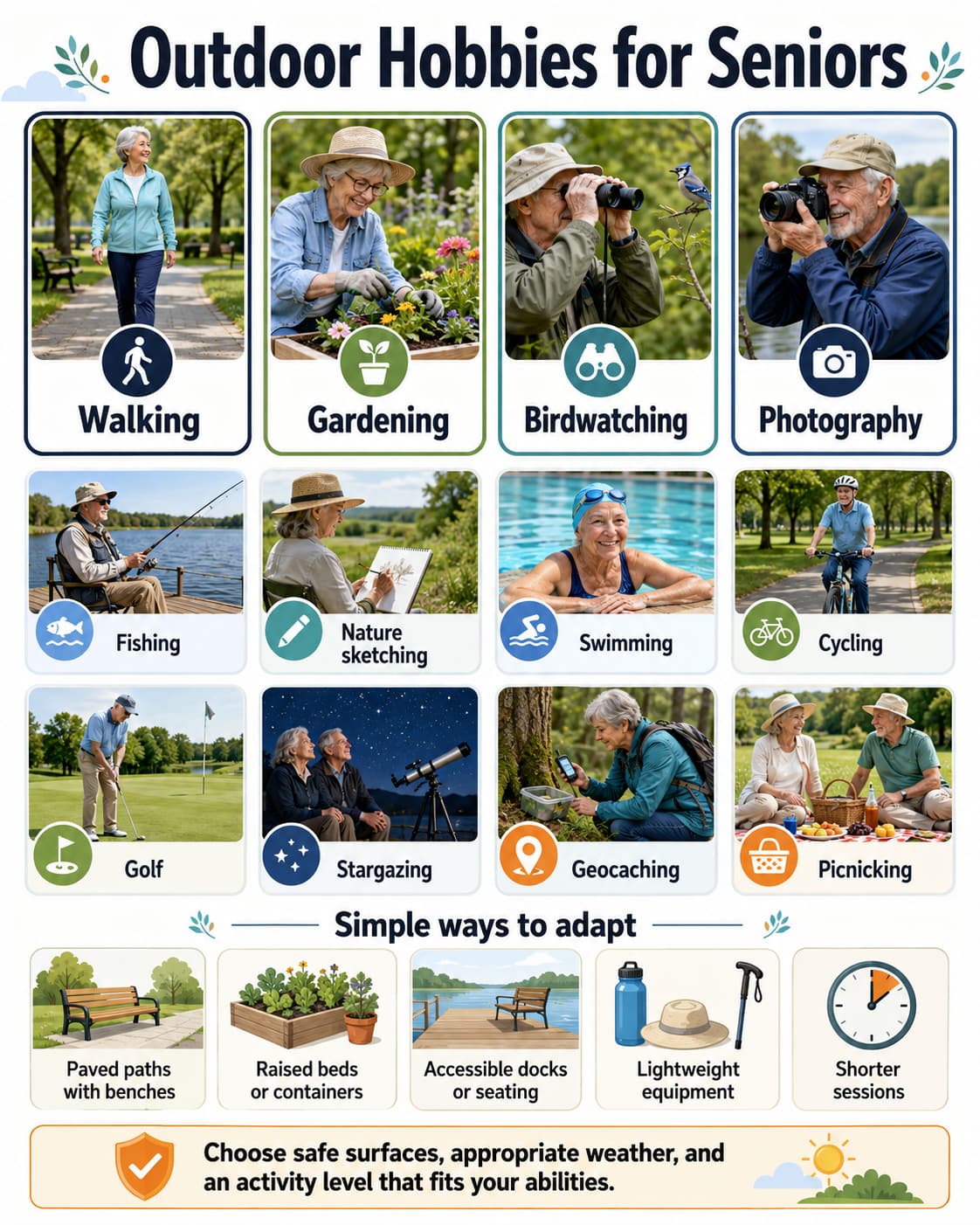
Outdoor hobbies can offer fresh air, changing scenery, nature observation, and physical movement. They can also be adapted to different energy and mobility levels.
| Outdoor hobby | Simple way to begin | Possible adaptation |
|---|---|---|
| Walking | Take a short walk on a familiar route | Use a paved path with benches |
| Gardening | Grow herbs or flowers | Use containers or raised beds |
| Birdwatching | Watch birds at a feeder | Observe from a window, porch, or vehicle |
| Photography | Photograph plants or architecture | Use a lightweight phone or camera |
| Fishing | Visit an accessible dock | Use a rod holder or seated setup |
| Nature sketching | Draw one leaf or landscape | Work from a bench or picnic table |
| Swimming | Join a beginner or open-swim session | Choose a supervised accessible pool |
| Cycling | Ride on a flat, quiet route | Consider a stationary or adult tricycle |
| Golf | Practice putting | Use a cart or shorter course |
| Stargazing | Learn several visible constellations | Observe from a yard or accessible park |
| Geocaching | Search for an easy nearby location | Filter for accessible terrain |
| Picnicking | Visit a nearby park | Choose tables close to parking |
Walking
Walking requires little equipment beyond suitable shoes and a safe place to move. It can be done alone, with a friend, in a mall, around a neighborhood, or through a walking group.
Begin with a distance that feels comfortable. Choose routes with even surfaces, good lighting, safe crossings, and places to rest.
Gardening
Gardening can involve movement, creativity, planning, and seasonal change. A large yard is not necessary.
Space-saving and accessible options include:
- Raised garden beds
- Window boxes
- Hanging baskets
- Patio containers
- Vertical planters
- Table-height potting stations
- Community-garden plots
Use lightweight tools with comfortable grips, avoid lifting loads that feel too heavy, and store hoses where they will not create a tripping hazard.
Birdwatching and nature observation
Birdwatching is flexible because it can be done while walking, sitting in a park, watching a feeder, or looking through a window.
A notebook can turn casual observation into an ongoing project. Record the date, location, weather, bird behavior, or seasonal changes rather than focusing only on identifying every species.
Swimming and water activities
Swimming and water exercise may appeal to people who prefer low-impact movement. Look for a supervised pool with handrails, safe entry steps, suitable water depth, and accessible changing facilities.
Anyone who feels unsteady in water should avoid swimming alone.
Can outdoor hobbies count as exercise?
Some can. The current Centers for Disease Control and Prevention recommendations for adults 65 and older call for at least 150 minutes of moderate-intensity aerobic activity each week, or 75 minutes of vigorous activity, plus muscle-strengthening activity on at least two days and activities that improve balance. People who cannot meet these amounts should be as active as their abilities and health conditions allow.
Brisk walking, active gardening, cycling, hiking, dancing, and water aerobics may contribute toward aerobic activity when they noticeably increase breathing and heart rate. A relaxed stroll or light garden task may not reach moderate intensity, but it can still be an enjoyable way to move.
Social Hobbies for Seniors
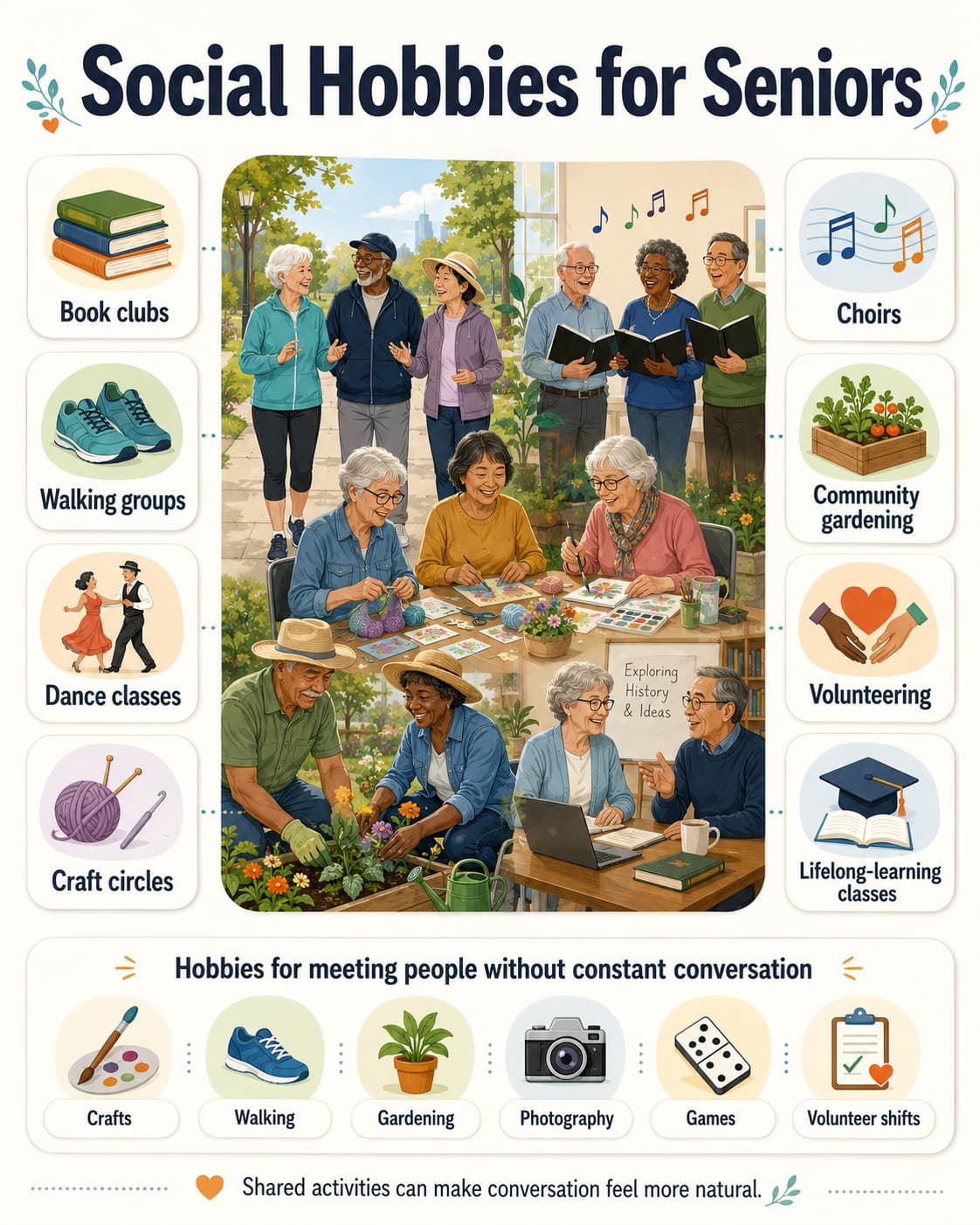
Social hobbies create repeated opportunities to see the same people. This often makes it easier to develop familiarity and connection than attending a single large event.
Good social hobbies include:
- Book clubs
- Walking groups
- Choirs
- Dance classes
- Group exercise
- Card or board-game groups
- Community gardening
- Cooking clubs
- Craft circles
- Amateur theater
- Museum or history groups
- Faith-community activities
- Community-service projects
- Mentoring
- Tutoring
- Pet-walking groups
- Local travel clubs
- Lifelong-learning classes
Volunteering
Volunteering can turn professional experience, practical skills, or personal interests into community support.
Possible roles include:
- Reading with children
- Mentoring students
- Helping at a library
- Supporting a food pantry
- Visiting or calling homebound adults
- Assisting at a museum
- Helping with community events
- Caring for shelter animals
- Maintaining a community garden
- Providing administrative support from home
Ask about time requirements before committing. A monthly or short-term role may be more manageable than a weekly position.
Hobbies for meeting people without constant conversation
Some people enjoy company but do not want an activity centered on talking. Consider:
- A choir
- A walking group
- A craft table
- A volunteer shift
- A gardening group
- A photography outing
- A cooking class
- A board-game session
The shared task provides a natural focus, so conversation does not have to carry the entire experience.
Social connection does not require constant group activity
Enjoying solitary hobbies is not the same as being lonely. Loneliness is the distressing feeling of being separated or disconnected, while social isolation refers to having few social contacts.
The National Institute on Aging recommends finding enjoyable activities, restarting an old hobby, taking a class, volunteering, and using technology to maintain contact. It also notes that a person may live alone without feeling lonely or feel lonely while surrounded by others.
Hobbies for Seniors With Limited Mobility
Limited mobility does not rule out creative, educational, social, or nature-based hobbies. The goal is to adapt the activity rather than assume it is unavailable.
| Need or limitation | Hobby options | Helpful adaptation |
|---|---|---|
| Difficulty standing | Painting, cards, music, writing, puzzles | Use a supportive chair and reachable workspace |
| Limited walking | Container gardening, birdwatching, fishing | Choose accessible paths, docks, or patios |
| Reduced hand strength | Coloring, digital photography, simple crafts | Use large-grip tools or card holders |
| Vision difficulty | Audiobooks, music, tactile crafts | Use large print, magnification, and strong lighting |
| Hearing difficulty | Crafts, gardening, photography, captioned classes | Request written instructions or captioning |
| Limited transportation | Online classes, virtual clubs, genealogy | Join by video, phone, or email |
| Low stamina | Journaling, indoor plants, short projects | Work in brief sessions with rest periods |
| Memory changes | Familiar music, sorting photos, simple crafts | Use clear steps, labels, and supportive supervision |
Accessible craft ideas
Consider projects that use large materials and simple steps:
- Large-piece mosaics
- Chunky-yarn knitting
- Collage
- Stamping
- Air-dry clay
- Large-print coloring
- Flower arranging
- Decorating picture frames
- Sorting and labeling photographs
Home-based social activities
People who have difficulty leaving home may still participate through:
- Virtual book clubs
- Telephone friendship programs
- Online religious services and discussion groups
- Video-call craft sessions
- Remote tutoring or mentoring
- Letter-writing projects
- Online classes
- Family game sessions by video
Use password-protected meetings when possible, and avoid sharing financial or identifying information with unfamiliar online contacts.
Adapting an activity for disability
Ask organizers direct questions before attending:
- Is the entrance step-free?
- Is accessible parking available?
- Are restrooms accessible?
- Can a companion or caregiver attend?
- Is seating available throughout the activity?
- Are instructions available in large print?
- Is captioning or hearing assistance available?
- Can equipment be modified?
- Is transportation provided?
An organizer may be able to make a simple accommodation, but they may not know what is needed unless you ask.
Free and Low-Cost Hobbies for Seniors
A rewarding hobby does not have to require an ongoing membership or expensive supplies.
Free hobby ideas
- Walking
- Birdwatching
- Journaling
- Creative writing
- Sketching with basic supplies
- Listening to library audiobooks
- Learning through free online lectures
- Volunteering
- Photographing local scenery with a phone
- Starting a neighborhood book exchange
- Playing cards with friends
- Collecting and documenting family recipes
- Attending free library events
- Joining a community cleanup
- Visiting free museum days
Ways to lower hobby costs
Borrow, rent, or share equipment before buying it. Libraries may lend more than books, including craft kits, puzzles, games, tools, seeds, or museum passes, although programs differ by location.
Other cost-saving approaches include:
- Buying used musical or sports equipment
- Sharing craft supplies
- Using household materials for projects
- Joining a free community group
- Taking a trial class
- Choosing seasonal memberships only when needed
- Asking whether a senior discount is available
- Using public parks rather than private facilities
Reduced-cost access to federal recreation sites
As of January, 2026, the National Park Service states that eligible U.S. citizens and residents aged 62 or older can purchase an America the Beautiful Senior Annual Pass for $20 or a Senior Lifetime Pass for $80. The passes provide entrance benefits at participating federal recreation sites, although reservations, some amenities, and other charges may still cost extra.
Accessible reading at no cost
The Library of Congress National Library Service provides eligible people with temporary or permanent low vision, blindness, or another qualifying print disability with free audiobook and braille library services. Materials can be downloaded or delivered by mail.
How to Start a New Hobby Safely
Most hobbies are low risk when they match the participant’s abilities and environment. Active, outdoor, and tool-based activities require additional planning.
Begin with a manageable version
Start with a short session, an easy route, a small project, or an introductory class. Increase the time or difficulty only when the current level feels comfortable.
A ten-minute walk, one container plant, or one beginner music lesson is a valid start.
Check the environment
Before beginning, look for:
- Loose rugs or cords
- Poor lighting
- Unstable chairs
- Cluttered walking areas
- Wet surfaces
- Uneven outdoor paths
- Tools that are difficult to grip
- Supplies stored too high or too low
- Hoses or equipment that could cause a fall
Keep frequently used materials within comfortable reach.
Prepare for outdoor conditions
For walking, gardening, photography, or other outdoor hobbies:
- Check the weather and air quality
- Avoid extreme heat, cold, or slippery conditions
- Wear supportive footwear
- Choose well-lit routes with even surfaces
- Carry identification and a phone
- Bring water when appropriate
- Use sun protection
- Tell someone where you are going
- Choose locations with rest areas
The National Institute on Aging recommends using sidewalks or paths when possible, watching for uneven surfaces, walking during daylight, and selecting routes with places to sit and rest.
Ask about health limitations
Speak with a healthcare professional before beginning vigorous activity when you have a condition, recent procedure, symptom, or mobility problem that could affect safe participation. Do not independently change prescribed oxygen, heart, blood-pressure, or diabetes management based on a general hobby or exercise guide.
During aerobic activity, stop if you develop dizziness, chest pain or pressure, or nausea. Seek appropriate medical assistance rather than trying to push through concerning symptoms.
Use safe tools and equipment
Follow manufacturer instructions for power tools, kilns, carving equipment, adhesives, paints, chemicals, and gardening products. Use suitable ventilation and protective equipment.
Do not use a chair as a ladder or work from an unstable stool. Ask for help with heavy bags, large plant containers, or equipment that is difficult to move.
Where to Find Classes, Clubs, and Volunteer Opportunities
Start locally. Nearby programs are usually easier to attend consistently and may offer accessible facilities or transportation.
Useful places to check include:
- Public libraries
- Senior centers
- Parks and recreation departments
- Community colleges
- Adult-education programs
- Museums
- Botanical gardens
- Art centers
- Faith communities
- Community gardens
- Volunteer centers
- Local historical societies
- YMCAs and similar community organizations
- Area Agencies on Aging
The Administration for Community Living notes that local senior centers may offer exercise and health-promotion programs, community education, meals, transportation, and social activities. Available services differ by location.
When contacting a program, ask whether it offers a beginner session, what equipment is required, whether there is a fee, and what accessibility accommodations are available.
When Losing Interest May Need More Than a New Hobby
It is normal for interests to change. However, a persistent loss of interest in activities that were previously enjoyable can be a symptom of depression, particularly when it occurs with ongoing low mood, fatigue, sleep changes, withdrawal, or difficulty concentrating.
The National Institute on Aging advises that depression in older adults deserves appropriate evaluation and care. A hobby can provide enjoyment and connection, but it is not a replacement for mental health care. Speak with a healthcare professional when these changes continue or interfere with daily life.
Frequently Asked Questions
What are the best hobbies for seniors?
The best hobbies are those that match the person’s interests, abilities, budget, and preferred level of social interaction. Popular choices include walking, gardening, reading, painting, photography, music, games, cooking, volunteering, and group classes.
A hobby is more likely to last when it is enjoyable and convenient rather than chosen only because it is considered beneficial.
What are good indoor hobbies for seniors?
Good indoor options include reading, audiobooks, puzzles, cards, knitting, painting, indoor gardening, cooking, genealogy, music, online classes, photography, and creative writing.
Choose activities with appropriate lighting, comfortable seating, readable materials, and tools that are easy to handle.
What hobbies can seniors do with limited mobility?
Seated painting, audiobooks, large-piece puzzles, music, genealogy, journaling, card games, flower arranging, indoor gardening, photography, virtual classes, and remote volunteering can all be adapted for limited mobility.
Raised planters, large-grip tools, card holders, captions, magnification, and shorter activity sessions may improve accessibility.
Which hobbies help seniors meet new people?
Book clubs, walking groups, choirs, dance classes, craft circles, community gardens, volunteering, group exercise, card groups, theater, and educational classes provide repeated opportunities to see people with similar interests.
A structured hobby can make meeting people easier because the activity gives everyone a natural topic of conversation.
What are inexpensive hobbies for retired people?
Walking, journaling, birdwatching, volunteering, reading library books, listening to free audiobooks, family-history projects, phone photography, free community events, and card games are inexpensive options.
Borrowing equipment and attending a trial class can prevent unnecessary purchases.
Can hobbies keep the mind active?
Reading, games, music, crafts, classes, writing, and learning new skills can provide mental stimulation and opportunities to practice attention and memory. Research suggests that engaging activities may support well-being, but no individual hobby has been proven to prevent dementia.
How much time should a senior spend on a hobby?
There is no required amount. Start with a manageable schedule, such as 15 to 30 minutes several times per week or one regular group session.
The best schedule is one that remains enjoyable and does not interfere with sleep, medical care, relationships, exercise, or essential daily tasks.
Conclusion
Hobbies for seniors can be creative, active, educational, social, or simply relaxing. The best choice is not necessarily the most ambitious one. It is the activity you enjoy enough to repeat and can participate in safely.
Choose three appealing ideas from this guide, try the simplest one first, and give yourself permission to adjust or replace it. A small project, short walk, beginner class, or monthly volunteer shift can be a meaningful place to begin.
This content is for informational purposes only and not medical advice.
References
- Nature Medicine — Hobby Engagement and Mental Well-Being Among People Aged 65 Years and Older in 16 Countries.
- Journal of Global Health — Association Between Hobby Engagement and Frailty Among Adults Aged 65 Years and Older in 15 Countries.
- National Institute on Aging — Cognitive Health and Older Adults.
- Centers for Disease Control and Prevention — Older Adults: Adding Activity Recommendations.
- National Institute on Aging — Loneliness and Social Isolation: Tips for Staying Connected.
- National Institute on Aging — Exercising Outdoors: Safety Tips for Older Adults.
- Administration for Community Living — Senior Centers and Supportive Services for Older Adults.
- National Park Service — Senior Annual and Lifetime Passes.
- Library of Congress — National Library Service for the Blind and Print Disabled.
- National Institute on Aging — Depression and Older Adults.