
Brain exercises for seniors can help practice memory, concentration, language, reasoning, and processing speed when they are varied, appropriately challenging, and performed consistently. These activities do not require an expensive subscription or special equipment. Most can be done with paper, household objects, books, cards, or conversation.
Brain exercises cannot guarantee that someone will avoid dementia, and they should not replace a medical evaluation for new or worsening memory problems. However, they can provide an enjoyable and practical way to keep learning, solve problems, recall information, and stay mentally engaged.
What Are Brain Exercises for Seniors?
Brain exercises are activities that actively engage one or more thinking skills. Unlike passive activities, such as watching television, they require the person to remember, organize, compare, calculate, plan, or make decisions.
Different activities exercise different cognitive skills:
| Cognitive skill | What it involves | Example activity |
|---|---|---|
| Memory | Storing and recalling information | Remembering a word list |
| Attention | Focusing while ignoring distractions | Finding a target symbol |
| Processing speed | Recognizing and responding to information | Timed visual-search exercises |
| Language | Understanding and producing words | Category-naming games |
| Reasoning | Identifying patterns and solving problems | Logic puzzles |
| Executive function | Planning, switching tasks, and making decisions | Strategy games |
| Visual-spatial ability | Understanding positions, shapes, and distances | Recreating an object layout |
A useful routine includes several of these skills instead of relying on only one puzzle or game.
Do Brain Exercises Really Improve Memory and Focus?
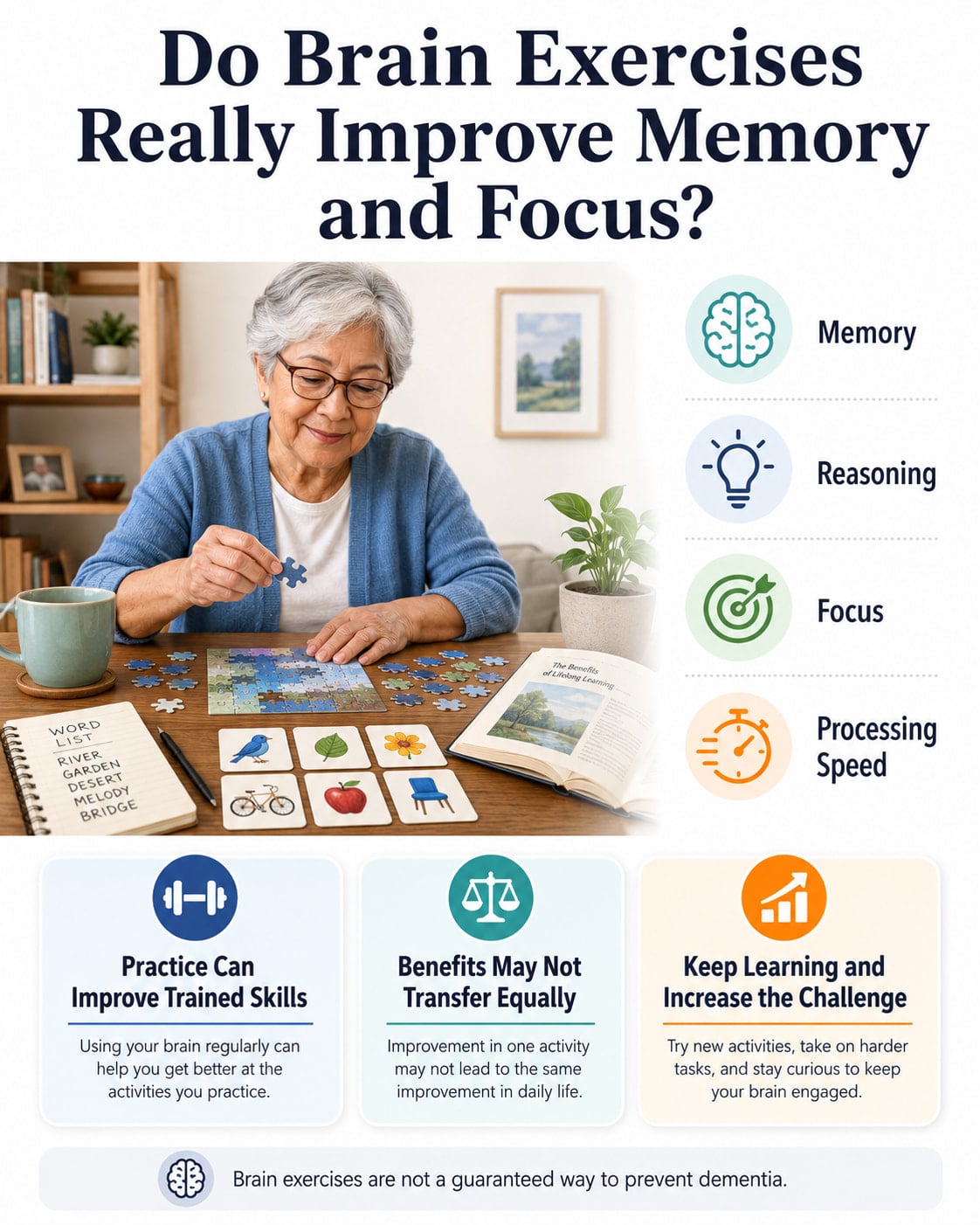
Cognitive training can improve the specific abilities being practiced, but the benefits do not always transfer equally to unrelated skills or everyday activities. The National Institute on Aging notes that researchers have studied training in memory, reasoning, processing speed, executive function, general knowledge, and everyday functioning. It also cautions that commercial brain-training products should not automatically be assumed to produce the same results as structured research programs.
A notable research update came from a February 2026 analysis of the NIH-funded ACTIVE trial. The original study enrolled 2,802 adults age 65 and older. In the long-term analysis, researchers used Medicare records for 2,021 participants and found that those assigned to adaptive visual processing-speed training with booster sessions had a lower incidence of recorded dementia diagnoses over as many as 20 years. Dementia was recorded in 40% of the boosted speed-training group and 49% of the control group, corresponding to a 25% lower adjusted incidence. Memory and reasoning training did not produce statistically significant differences at 20 years. The National Institutes of Health reported these findings in February 2026.
These findings do not mean that an ordinary puzzle, video game, or phone app will reduce dementia risk by 25%. The successful intervention was structured, adaptive, and reinforced with booster sessions. The long-term outcome was also based on diagnoses recorded in Medicare claims, so additional research is needed.
A separate 2026 observational study followed 1,939 older adults without dementia at the beginning of the study. Greater lifetime cognitive enrichment was associated with better initial cognitive function, slower decline, and later onset of Alzheimer’s dementia. Cognitive enrichment included educational experiences and mentally stimulating activities across a person’s life. The study indexed by PubMed was observational, so it shows an association rather than proving that starting one particular activity will prevent Alzheimer’s disease.
The practical message is straightforward: use a variety of activities, keep learning, and gradually increase the challenge—but do not treat brain exercises as a cure or a guaranteed dementia-prevention method.
12 Brain Exercises for Seniors at a Glance
| # | Brain exercise | Main skills practiced | Suggested starting time |
|---|---|---|---|
| 1 | Delayed word recall | Short-term memory and retrieval | 5–10 minutes |
| 2 | Read and retell | Memory, language, and comprehension | 10–15 minutes |
| 3 | Category naming | Verbal fluency and attention | 3–5 minutes |
| 4 | Mental math | Working memory and concentration | 5–10 minutes |
| 5 | Crosswords and logic puzzles | Vocabulary, reasoning, and problem-solving | 10–20 minutes |
| 6 | Strategy and card games | Planning and decision-making | 15–30 minutes |
| 7 | Visual search | Processing speed and divided attention | 5–10 minutes |
| 8 | Learn a new skill | Memory and cognitive flexibility | 10–20 minutes |
| 9 | Music and rhythm | Auditory memory and sequencing | 10–15 minutes |
| 10 | Map and object recall | Visual-spatial memory | 5–10 minutes |
| 11 | Mental tasks with safe movement | Attention and coordination | 5–10 minutes |
| 12 | Social teach-back | Recall, language, and reasoning | 10–30 minutes |
These times are practical starting points, not medical requirements. Seniors can shorten, lengthen, or simplify each activity according to their energy, vision, hearing, mobility, and current cognitive abilities.
1. Practice Delayed Word Recall
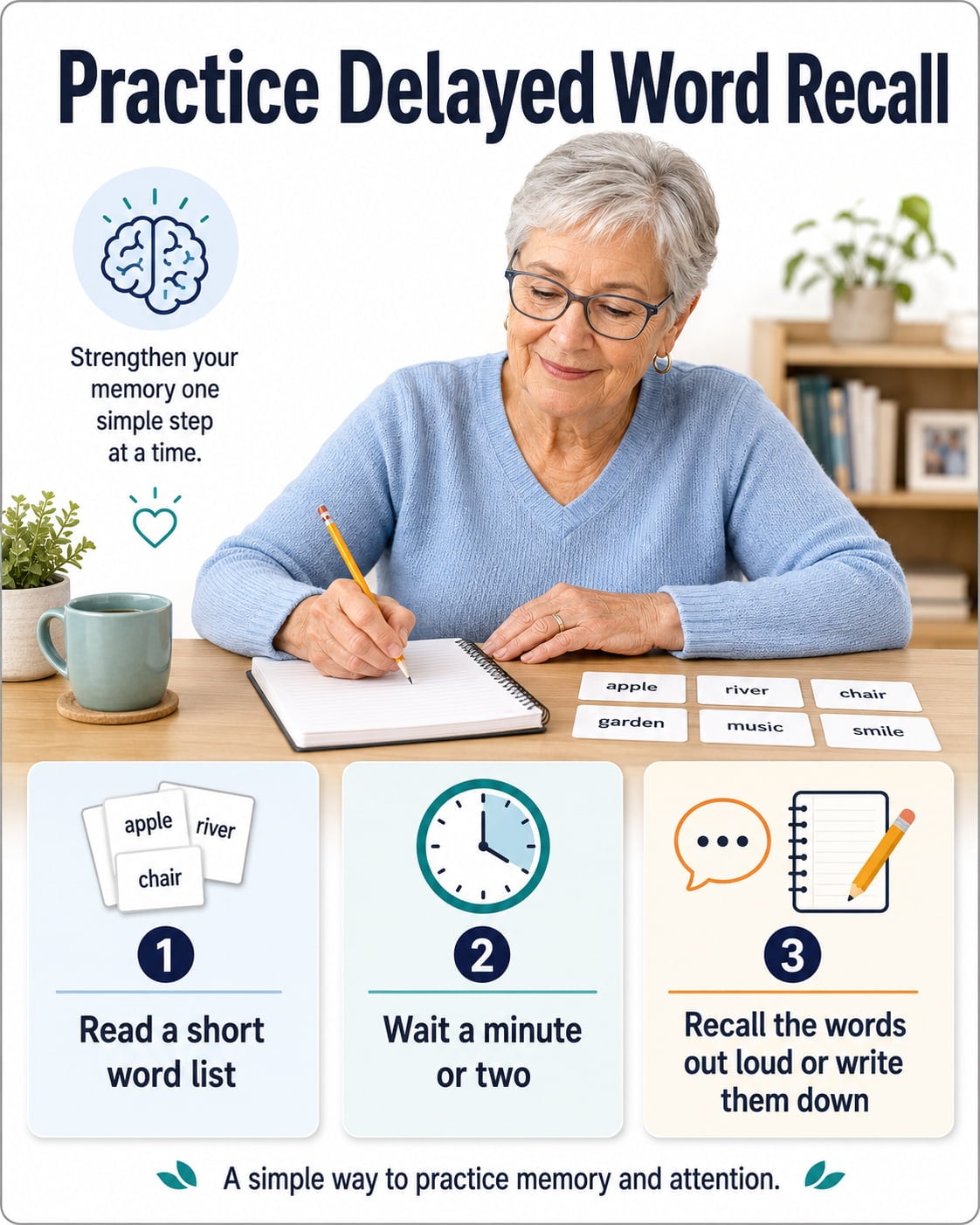
Delayed recall exercises require a person to remember information after a short period instead of repeating it immediately. This makes the activity more challenging than simply reading a list several times.
How to do it
- Write down five unrelated words, such as apple, train, jacket, river, and candle.
- Read the words aloud twice.
- Cover the list and do another activity for five minutes.
- Write or say as many words as you can remember.
- Check the original list without criticizing missed answers.
Begin with three or four words when five feels too difficult. As recall improves, add more words, increase the waiting period, or remember the words in their original order.
For another variation, create a short sentence or mental picture that connects the words. For example, imagine an apple on a train beside a jacket and candle overlooking a river.
A score on this home activity cannot diagnose a memory disorder. Day-to-day performance can be affected by stress, sleep, distractions, hearing, vision, and familiarity with the exercise.
2. Read and Retell a Short Story
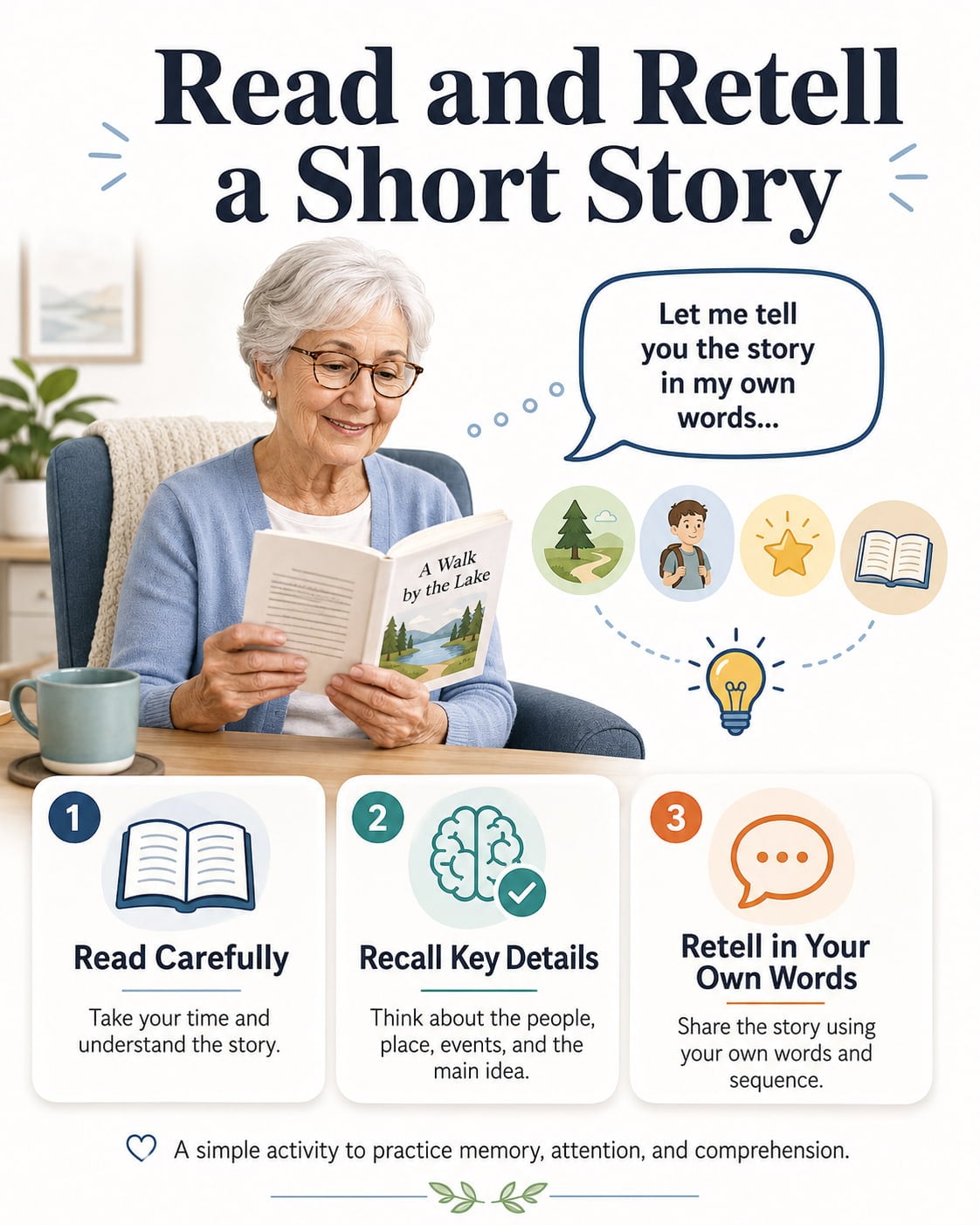
Reading becomes a stronger brain exercise when the reader actively retrieves the information afterward.
How to do it
Read two to four paragraphs from a newspaper article, short story, or book. Close the material and answer these questions:
- What was the main idea?
- Who or what was involved?
- What were three important details?
- What happened first and last?
- What conclusion did you reach?
Retell the information aloud, write a short summary, or explain it to someone else. Then look back at the text and check what was remembered accurately.
To make the activity harder, wait 15 or 30 minutes before giving the summary. Seniors who find reading difficult can listen to a short audiobook passage and retell it afterward.
3. Try a Category Naming Challenge
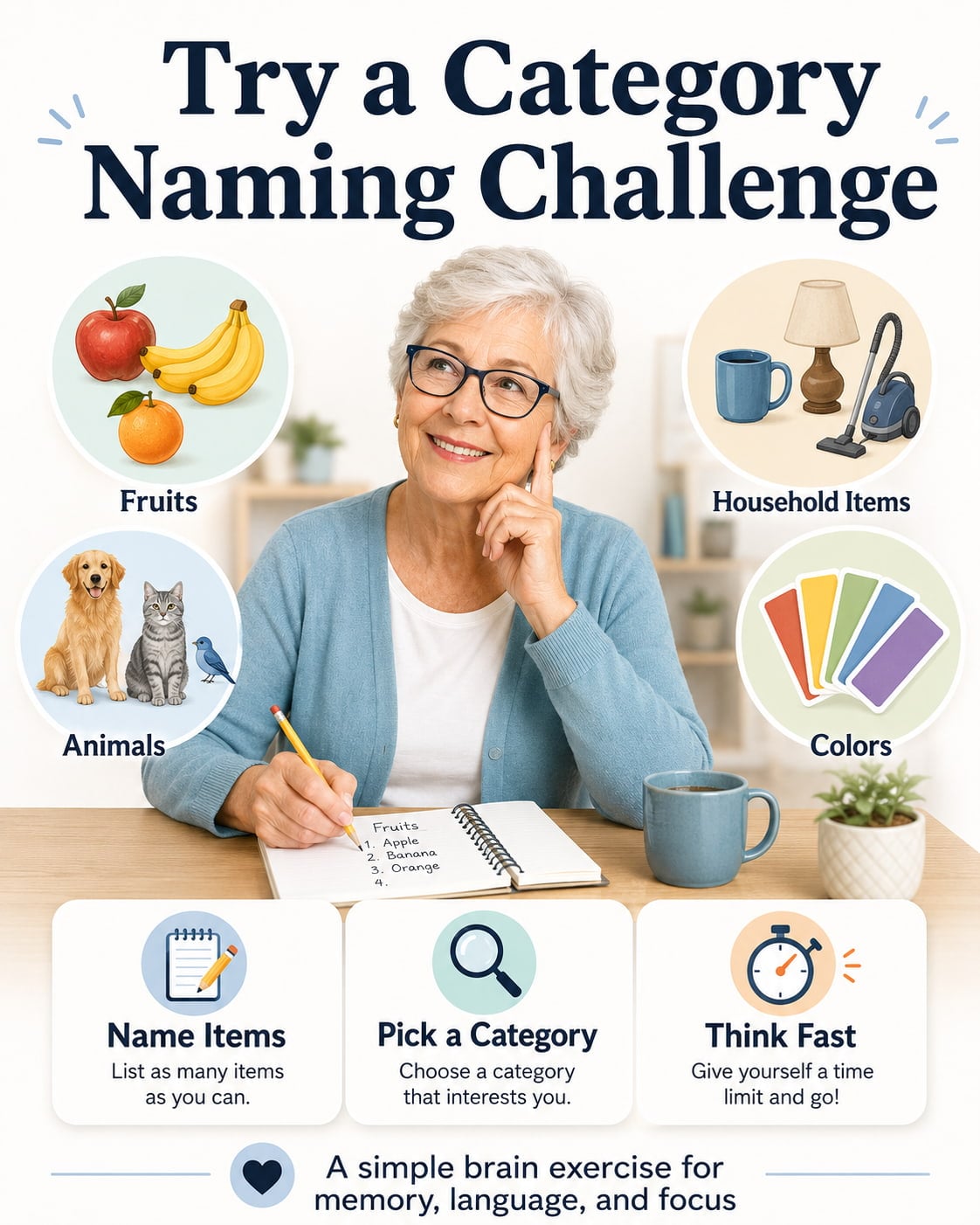
Category naming practices attention, language, and rapid retrieval from memory. It requires the brain to search for related words while avoiding repetition.
How to do it
Set a timer for 60 seconds and name as many items as possible from one category, such as:
- Animals
- Fruits and vegetables
- Cities
- Household items
- Musical instruments
- Words beginning with a chosen letter
Record the answers so repeated words are easy to notice.
Once a single category becomes easy, switch between two categories. For example, alternate between an animal and a food:
Dog, apple, horse, carrot, cat, rice.
Alternating categories adds task switching and concentration. Avoid choosing a level that causes significant frustration. The goal is active practice, not perfect performance.
4. Work on Mental Math and Number Sequences
Simple number activities exercise working memory because the person must hold information in mind while using it.
Useful activities include:
- Counting backward from 50 by threes
- Counting forward by sevens
- Calculating the change from a small purchase
- Adding the prices of several grocery items
- Doubling numbers, such as 3, 6, 12, and 24
- Continuing a pattern, such as 2, 5, 8, 11, and 14
- Estimating a restaurant bill before using a calculator
Start with calculations that can be completed successfully. Work out the answer mentally first, then use paper or a calculator to verify it.
Everyday math can be especially useful because it connects the exercise with familiar tasks. However, people experiencing difficulty managing real bills or finances should use appropriate assistance rather than treating important financial decisions as a brain game.
5. Complete Crosswords, Sudoku, and Logic Puzzles
Crosswords, Sudoku, word searches, jigsaw puzzles, and logic problems can practice vocabulary, pattern recognition, visual scanning, and problem-solving.
The challenge should be manageable but not automatic. Completing the same type of easy puzzle every day may become familiar and require less mental effort.
Try rotating between:
- A crossword one day
- A number puzzle the next day
- A jigsaw puzzle later in the week
- A word or symbol search
- A written logic problem
- A matching or sequencing game
When stuck, take a short break rather than forcing the answer. Returning later requires the brain to review the problem from a fresh perspective.
Crosswords and Sudoku may be enjoyable forms of cognitive stimulation, but research has not established that either one prevents dementia. They are best treated as one part of a varied routine.
6. Play Strategy and Card Games
Games that require planning, remembering rules, and responding to another player can exercise several cognitive abilities at once.
Options include:
- Chess
- Checkers
- Bridge
- Rummy
- Dominoes
- Backgammon
- Sequence-based card games
- Cooperative board games
To increase the mental challenge, pause before each move and explain the plan. For example: “I am placing this card because it gives me two options on the next turn.”
A game does not need complicated rules to be valuable. Seniors who are new to strategy games can learn one rule at a time and use written reminders until the rules become familiar.
Playing with another person can add conversation and social engagement. Solo card sorting, matching, or sequencing activities are alternatives for people who prefer independent practice.
7. Practice Visual Search and Processing Speed
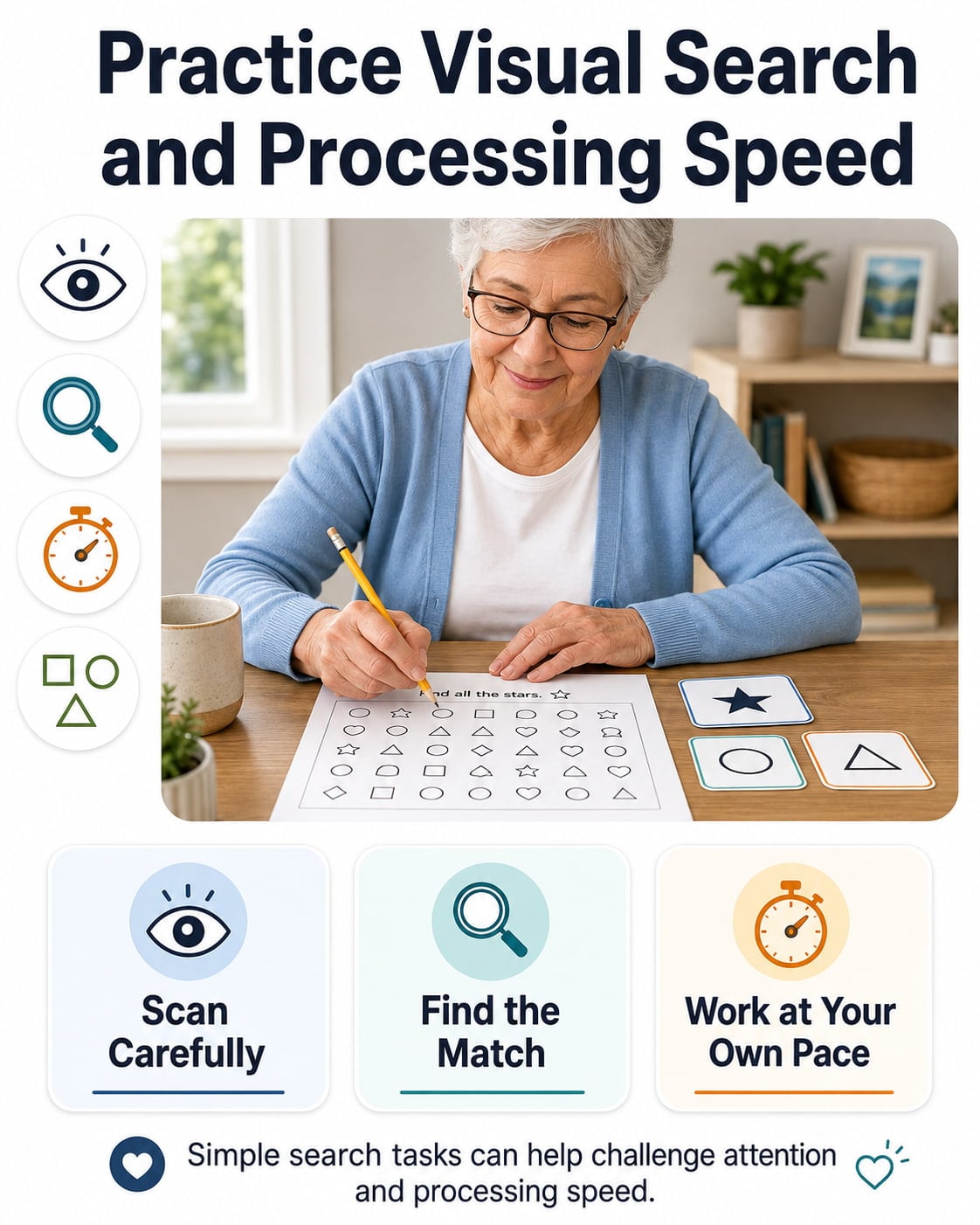
Visual-search exercises require the person to identify important information among distracting items. Some variations also ask the brain to process central and peripheral information quickly.
Simple visual-search exercise
Create or print a page containing several letters or symbols. Choose one target, such as the letter B, and circle every occurrence as accurately as possible.
For example:
B D P R B P D B R P
Start without a timer. When the exercise becomes easy:
- Add more symbols
- Make the symbols more similar
- Use several lines
- Reduce the available time slightly
- Search for two targets instead of one
Another exercise is to look at a central image while also identifying an object shown briefly to one side. This practices divided visual attention.
Accuracy should come before speed. Increase the pace gradually, and make sure glasses or other visual aids are used when needed. Ordinary visual searches are not identical to the structured, adaptive processing-speed intervention used in the ACTIVE study, so the study’s dementia findings should not be applied directly to every visual-search game.
8. Learn a New Skill or Language
Learning something unfamiliar requires attention, memory, error correction, and flexible thinking. The activity does not need to be academically difficult.
Suitable options include:
- Learning five words in another language
- Using a new smartphone feature
- Learning digital photography
- Trying a new craft technique
- Following a new recipe
- Learning basic drawing
- Practicing gardening methods
- Beginning a musical instrument
- Taking a community or online class
Break the skill into small steps. Practice one step, attempt it without instructions, and then check the result.
For language learning, review a few useful words at a time. Try recalling the meaning before looking at the answer rather than repeatedly rereading the list. Use each word in a sentence or short conversation.
Repeated retrieval over several days is generally more engaging than attempting to memorize a large amount in one session.
9. Exercise the Brain With Music and Rhythm
Music activities can combine listening, attention, sequencing, memory, and coordinated movement.
Try these exercises:
- Tap a short rhythm and repeat it from memory
- Listen to several notes and copy their order
- Learn part of a new song
- Practice a few measures on an instrument
- Identify instruments in a piece of music
- Recall what comes next in a familiar melody
- Create a simple rhythm and teach it to someone else
Begin with a two- or three-part rhythm. Add another beat when the pattern can be repeated accurately.
People with hearing loss can use a comfortable volume, visual rhythm cues, gentle tapping, or vibration-based activities. Music should not be played at an uncomfortable volume.
10. Recreate Maps and Object Layouts From Memory
This exercise practices visual-spatial memory—remembering what objects look like and where they are located.
Object-tray exercise
- Place five to eight familiar objects on a tray or table.
- Study them for 60 seconds.
- Cover the objects.
- Name or write down everything you remember.
- Draw where each object was positioned.
- Uncover the arrangement and compare.
Possible objects include a key, spoon, coin, button, pen, cup, and comb.
To make the exercise harder, add more objects, shorten the viewing time, or move one item and identify what changed.
A map variation involves studying a simple route between two locations and then drawing it from memory. Use imaginary routes for practice. A person who is becoming lost in familiar places should not rely on map exercises as a solution and should discuss the change with a healthcare professional.
11. Combine Mental Tasks With Safe Movement
Combining a simple thinking task with movement can practice attention switching and coordination. Safety must come first, particularly for seniors with balance problems.
A seated version is appropriate for many people:
- Sit upright in a sturdy, non-rolling chair.
- March the feet slowly.
- Name animals, count backward, or alternate between two categories.
- Continue for 30–60 seconds.
- Rest before repeating.
Other seated combinations include:
- Heel taps while naming months backward
- Arm reaches while counting by twos
- Gentle clapping while recalling words
- Passing a soft ball while answering questions
Standing or walking versions should only be attempted when the person can do so safely. Use a stable counter or appropriate supervision when necessary. Avoid dual-task walking when there is dizziness, significant unsteadiness, a recent fall, or difficulty using a mobility aid. Stop if the activity causes pain, lightheadedness, shortness of breath, or loss of balance.
12. Use Social Discussion and Teach-Back
Explaining information to someone else requires the brain to retrieve, organize, and communicate what was learned. It also reveals which parts were understood and which need review.
After reading, watching an educational program, or learning a new skill, explain:
- The main idea
- Three important facts
- What was surprising
- How the information could be used
- One question that remains
Other social brain exercises include:
- Book discussions
- Trivia groups
- Storytelling
- Volunteer activities
- Group classes
- Card or board games
- Discussing family photographs
- Teaching someone a recipe or hobby skill
The conversation does not need to be formal. A brief phone discussion can provide the same opportunity to recall and organize ideas.
How Often Should Seniors Do Brain Exercises?
There is no official daily “dose” of brain exercises that applies to every senior. A practical starting routine is 10–20 minutes on most days, with the activities rotated throughout the week.
Someone who becomes tired easily can use several five-minute sessions instead of one longer session.
Sample weekly brain-exercise plan
| Day | Activity |
|---|---|
| Monday | Delayed word recall and story retelling |
| Tuesday | Mental math and category naming |
| Wednesday | Visual search and a logic puzzle |
| Thursday | Language or new-skill practice |
| Friday | Music, rhythm, or object-layout recall |
| Saturday | Strategy game or social discussion |
| Sunday | Rest or choose a favorite activity |
This schedule is only an example. Enjoyment matters because an activity is more useful when someone is willing to continue doing it.
How to Make Brain Exercises More Effective
Choose a manageable challenge
An exercise should require concentration without making success feel impossible. Simplify the activity when it consistently causes frustration.
Increase difficulty gradually
Add one word, one object, one rule, or a small time challenge. Avoid making several changes at once.
Rotate different cognitive skills
Do not depend on one type of puzzle. Alternate between memory, language, reasoning, processing speed, music, and visual-spatial activities.
Use active recall
Try to produce an answer before checking it. Retelling a story from memory is more active than simply reading the same paragraph repeatedly.
Connect exercises to everyday life
Practice remembering a short shopping list, estimating a purchase, learning a phone feature, or explaining a recent appointment. Important information should still be written down and verified.
Address vision and hearing needs
Use large print, good lighting, hearing aids when prescribed, and comfortable sound levels. An activity may appear cognitively difficult when the real barrier is not seeing or hearing the instructions clearly.
Focus on participation, not perfect scores
Scores can help track whether a particular task is becoming easier, but they should not be used to diagnose cognitive impairment. Performance naturally varies with fatigue, illness, stress, distraction, and sleep.
Brain Exercises Versus Everyday Memory Tools
Brain exercises and memory tools serve different purposes.
Brain exercises practice a cognitive skill. Examples include recalling words, solving a puzzle, or learning a language.
Memory tools help a person complete daily tasks safely and reliably. Examples include:
- Calendars
- Written schedules
- Phone reminders
- Labeled storage spaces
- Shopping lists
- Appointment cards
- Medication reminders
- Keeping keys, glasses, and phones in consistent places
Using reminders is not cheating. It reduces unnecessary mental load and can support independence. Important tasks—especially medications, appointments, finances, and transportation—should not be left to memory practice alone.
Other Habits That Support Cognitive Health
Brain exercises are most useful as part of a broader healthy-aging routine.
Stay physically active
The Centers for Disease Control and Prevention states that physical activity can support thinking, learning, problem-solving, and memory. Current guidance recommends at least 150 minutes of moderate-intensity activity or 75 minutes of vigorous activity per week for most adults, plus muscle-strengthening activity on at least two days. Adults age 65 and older should also include balance activities. People unable to meet the full recommendations should be as active as their abilities and health conditions allow.
Protect sleep
Maintain a regular sleep schedule and discuss ongoing insomnia, heavy snoring, or daytime sleepiness with a healthcare professional.
Stay socially connected
Conversation, volunteering, classes, hobbies, and group activities can combine social connection with memory, language, and problem-solving.
Manage health conditions
Blood pressure, diabetes, depression, medication side effects, hearing loss, vision problems, and other conditions can affect cognitive function. Regular healthcare visits help identify and manage these concerns.
Avoid unproven products
Be cautious about supplements, apps, or programs that promise to prevent dementia, reverse memory loss, or produce rapid cognitive improvement. Discuss supplements with a healthcare professional because they may have side effects or interact with medications.
When Memory Changes Should Be Evaluated
Occasional forgetfulness can occur with normal aging. A person might temporarily forget a name, misplace an item, or miss a payment and remember it later.
More serious memory problems interfere with familiar daily activities. According to the National Institute on Aging, warning signs include repeatedly asking the same questions, getting lost in familiar places, having trouble following directions, becoming confused about people or time, and neglecting personal safety or self-care.
| Possible age-related forgetfulness | Reason to seek an evaluation |
|---|---|
| Occasionally forgetting a name but recalling it later | Repeatedly forgetting recently learned information |
| Misplacing an item occasionally | Frequently losing items and being unable to retrace steps |
| Missing one payment and remembering later | Increasing difficulty managing bills |
| Temporarily forgetting the day and recalling it later | Losing track of dates, seasons, or location |
| Occasionally needing more time to learn something | Being unable to complete familiar tasks |
| Sometimes searching for the right word | Increasing difficulty following or joining a conversation |
Other reasons to contact a healthcare professional include:
- Trouble managing medications
- New problems cooking familiar meals
- Declining judgment or unsafe behavior
- Noticeable personality or behavior changes
- Increasing difficulty using a phone or household appliance
- Memory changes noticed by family or friends
- Symptoms that are becoming more frequent or severe
Memory problems can have several causes, including medication effects, depression, sleep difficulties, vitamin deficiencies, thyroid disorders, infections, and neurological conditions. Some causes may be treatable or manageable, which is one reason early assessment matters. Sudden or rapidly worsening confusion requires prompt medical attention.
Frequently Asked Questions
What are the best brain exercises for seniors?
The best routine combines several types of activities rather than relying on one game. Delayed recall, story retelling, category naming, mental math, visual searches, strategy games, new-skill learning, music, and social discussion exercise different cognitive abilities.
The activity should be enjoyable, safe, and slightly challenging.
How often should seniors do brain exercises?
There is no universal medical requirement. A reasonable starting plan is 10–20 minutes on most days, with shorter sessions for someone who becomes tired or frustrated. Rotate activities during the week and allow rest when needed.
Do crossword puzzles prevent dementia?
No evidence shows that crossword puzzles alone prevent dementia. They can practice vocabulary, recall, and problem-solving, but they should be combined with other mentally, physically, and socially engaging activities.
Can brain-training apps improve memory?
An app may improve performance on the tasks practiced within the app. However, improvement does not always transfer to unrelated abilities or daily life, and commercial apps should not be assumed to prevent dementia.
Free activities using books, cards, paper, household objects, and conversation can provide meaningful cognitive challenges without a paid subscription.
What brain exercises can help seniors practice concentration?
Useful concentration exercises include visual searches, category naming, mental math, reading followed by retelling, rhythm copying, and alternating between two simple tasks. Reduce background noise and begin with short sessions.
Is learning a new language good for older adults?
Learning a language can practice attention, memory retrieval, listening, and cognitive flexibility. Start with a few practical words or phrases, review them over several days, and try to recall each meaning before checking the answer.
It is not necessary to become fluent to benefit from the mental challenge.
Can brain exercises reverse memory loss?
Brain exercises are not proven to reverse dementia or other medical causes of memory loss. They may help someone practice particular skills and remain mentally engaged, but noticeable or worsening memory problems should be evaluated by a healthcare professional.
Conclusion
Brain exercises for seniors work best when they are practical, varied, enjoyable, and challenging without becoming overwhelming. A person might begin with five-word recall, a short story summary, or a one-minute category game and then add other activities during the week.
Choose two exercises from this list, schedule a short session, and increase the difficulty gradually. Combine mental activity with regular movement, social connection, adequate sleep, and appropriate medical care for a more complete approach to healthy aging.
This content is for informational purposes only and not medical advice.
References
- National Institute on Aging — Preventing Alzheimer’s Disease: What Do We Know?
- National Institutes of Health — Cognitive Speed Training Over Weeks May Delay Diagnosis of Dementia Over Decades
- PubMed — Associations of Lifetime Cognitive Enrichment With Alzheimer Disease Dementia and Cognitive Aging
- Centers for Disease Control and Prevention — Physical Activity Boosts Brain Health
- National Institute on Aging — Memory Problems, Forgetfulness, and Aging