
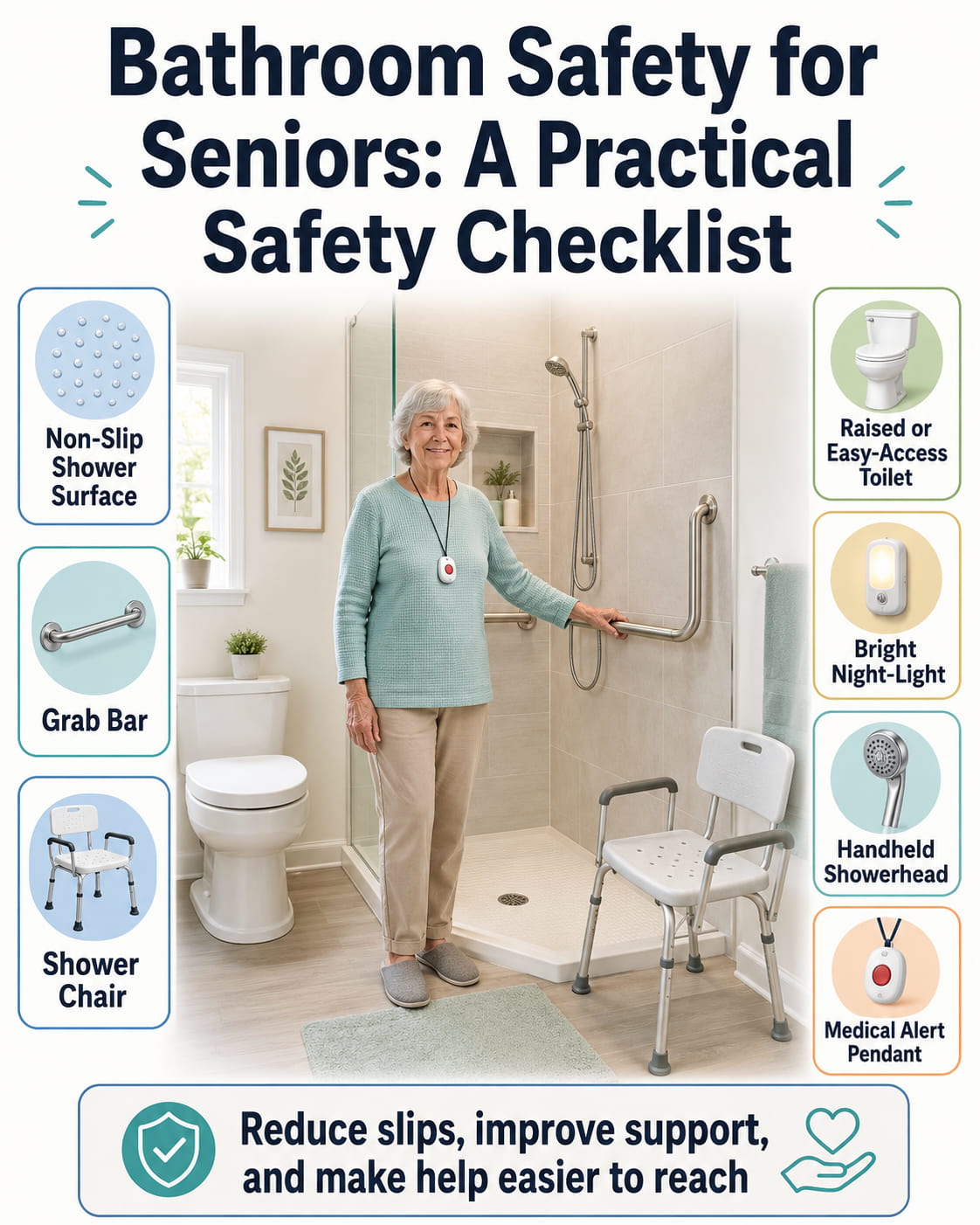
Bathroom safety for seniors starts with reducing slippery surfaces, adding secure support near the shower and toilet, improving lighting, and making help easy to reach. Most bathrooms can be made safer with a few targeted changes: remove tripping hazards, install properly anchored grab bars, choose suitable bathing and toilet equipment, control hot-water temperature, and prepare for nighttime trips and emergencies.
Bathroom safety matters even when an older adult has never fallen. In data updated February, 2026, the Centers for Disease Control and Prevention reports that more than 14 million adults age 65 and older—about one in four—fall each year. About 37% of those who fall report an injury that requires medical care or restricts activity for at least one day.
Not every senior needs every bathroom product. The safest setup depends on balance, strength, vision, joint movement, cognition, previous falls, and whether the person uses a cane, walker, or wheelchair.
Why Bathroom Safety Matters for Older Adults
Bathrooms combine several common fall hazards in one small space:
- Water and slippery surfaces
- Hard floors and fixtures
- Limited space for turning
- High bathtub walls or shower thresholds
- Repeated sitting and standing at the toilet
- Poor nighttime visibility
- A tendency to rush because of urinary urgency
A January 2025 U.S. Consumer Product Safety Commission staff report estimated an annual average of 97,600 emergency department-treated fall injuries associated with toilets or commodes among adults age 65 and older, based on 2022–2023 data. Most involved getting on or off the toilet or commode.
Bathroom modifications can make a meaningful difference, particularly for seniors who already have fall risk factors. A 2023 Cochrane review found that home fall-hazard reduction programs probably lowered the overall fall rate by 26%. Among older adults selected because they were at higher risk, the reduction was 38%. The review also found that assessment-based programs were more useful than education alone.
Quick Bathroom Safety for Seniors Checklist
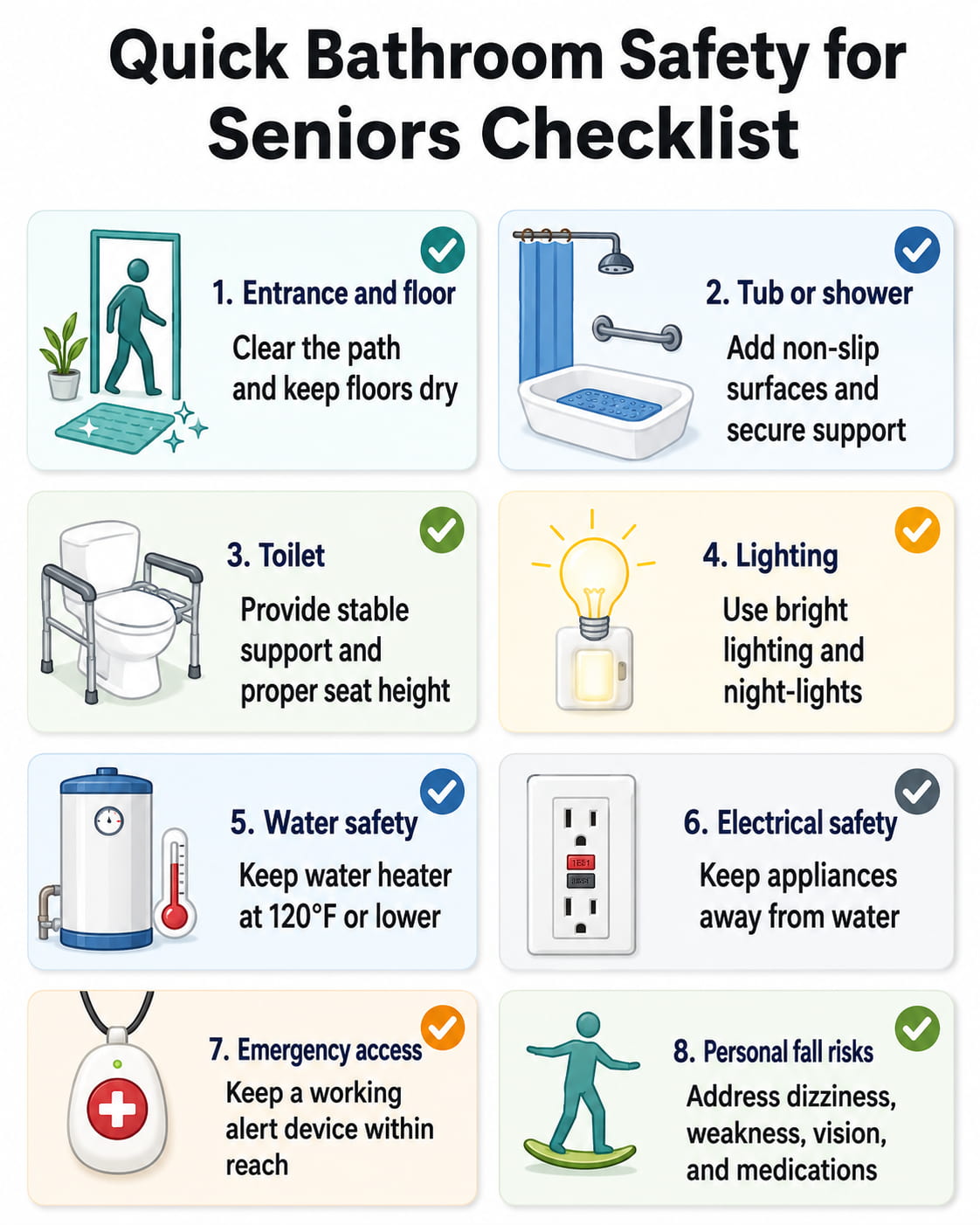
Use this checklist to identify the most urgent changes first.
| Bathroom area | Safety check |
|---|---|
| Entrance and floor | Keep the path clear, remove loose rugs, repair raised flooring, and clean up water promptly |
| Tub or shower | Add a slip-resistant surface, secure grab bars, a suitable seat or transfer bench, and a handheld showerhead |
| Toilet | Provide stable support, check the seat height, and leave enough space for a walker or caregiver |
| Lighting | Use bright, even lighting and night-lights between the bedroom and bathroom |
| Water safety | Set the water heater no higher than 120°F or 49°C and consider anti-scald controls |
| Electrical safety | Keep appliances away from water and confirm that bathroom outlets have working GFCI protection |
| Emergency access | Keep an alert device within reach and make sure the door can be opened from outside |
| Personal fall risks | Address dizziness, weakness, vision problems, medication effects, and unsafe footwear |
The National Library of Medicine’s MedlinePlus recommends non-slip bathing surfaces, a non-skid mat outside the tub, dry floors, shower seating, secure grab bars, and a maximum water-heater setting of 120°F. Its bathroom-safety guidance was medically reviewed in April 2026.
Make the Bathroom Floor and Entrance Safer
Begin with the walking surface. This is usually the easiest and least expensive part of bathroom safety for seniors.
Remove loose throw rugs, bath rugs that slide, cords, scales, laundry baskets, and other items from the route. A rug with curled edges can remain dangerous even when it has a rubber backing.
A non-skid bath mat may provide secure footing immediately outside the tub or shower, but it should:
- Lie completely flat
- Have an intact slip-resistant backing
- Be large enough to step onto comfortably
- Be replaced when the backing cracks, curls, or loses grip
Do not place a folded towel on the floor as a substitute. Towels can slide or bunch under the feet.
Inside the shower or bathtub, use a slip-resistant surface designed for wet areas. Check suction mats regularly because they may move when suction cups wear out or debris collects underneath them.
Keep the floor dry. Repair leaking faucets, shower doors, toilet seals, and plumbing promptly. Good ventilation can also reduce lingering moisture and condensation.
The route into the bathroom should be wide enough for the person’s usual mobility aid. Do not store a walker outside the door if the senior needs it to reach the toilet safely.
Install Grab Bars Correctly
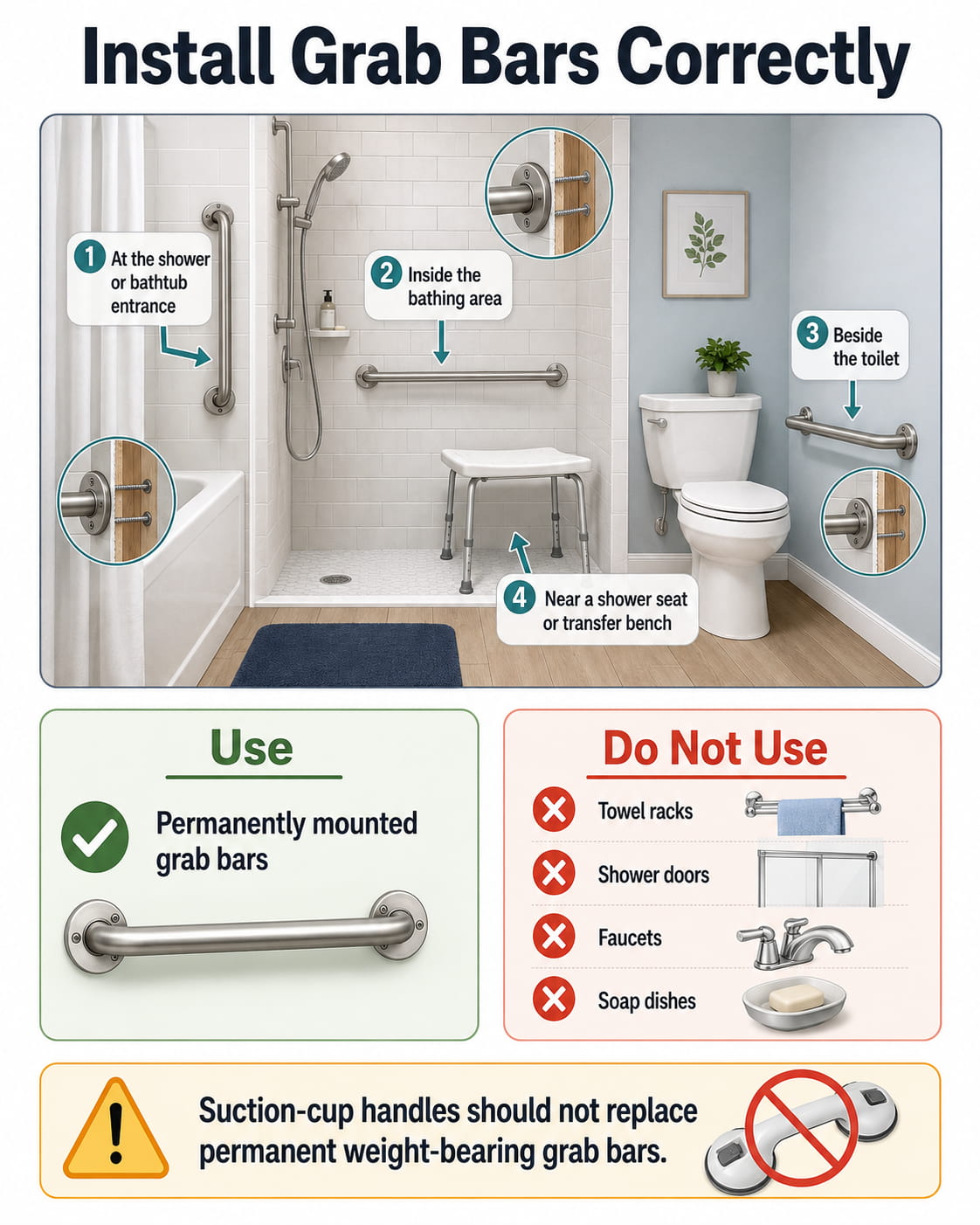
Grab bars provide reliable hand support during bathing and toilet transfers—but only when they are installed securely.
Common locations include:
- At the shower or bathtub entrance
- Inside the bathing area
- On the wall beside the toilet
- Near a shower seat or transfer bench
The exact location should match the person’s reach and the way they move. Someone who pushes up with both hands may need a different arrangement from someone with weakness on one side.
Do Not Use Towel Racks as Grab Bars
Towel racks, shower doors, faucets, shelves, and soap dishes are not designed to hold a person’s weight. They may pull away from the wall during a fall.
Choose grab bars with a textured, comfortable gripping surface. A qualified installer should attach them to studs, structural backing, or another mounting system suitable for the wall material and the bar’s rated load.
Be Careful With Suction-Cup Handles
A suction-mounted handle may loosen because of textured tile, grout lines, soap residue, moisture, or a damaged suction seal. It should not replace a permanently mounted, load-bearing grab bar during toilet, tub, or shower transfers.
Check portable handles before every use, even when they are only used as a light balance aid.
Personalize the Placement
Do not assume that a grab-bar height copied from a public restroom will work in a private home. Public accessibility standards offer useful design principles, but an individual senior may need a different position based on height, arm strength, joint movement, mobility equipment, and transfer technique.
An occupational therapist can observe the person using the bathroom and recommend specific locations before installation.
Create a Safer Tub or Shower Setup
Stepping over a tub wall or shower threshold can be difficult for someone with poor balance, weak legs, painful joints, or limited hip movement.
The safest equipment depends on what the person can do without losing balance.
Shower Chair
A shower chair may be appropriate when the person can enter the shower safely but cannot stand comfortably for the full bathing period.
Choose a chair that:
- Fits fully inside the shower
- Has non-slip rubber feet
- Does not rock or slide
- Has an appropriate weight capacity
- Can be adjusted so the user’s feet rest securely
- Allows water to drain without pooling
A chair with a back may provide more support. Armrests may help some people sit and stand, but they must not interfere with transfers.
Tub Transfer Bench
A transfer bench is often more practical when stepping over a bathtub wall is unsafe. Part of the bench sits outside the tub and part sits inside. The user sits down before moving the legs over the tub wall.
The bench must be assembled and positioned correctly. Its feet should remain level and stable on both sides of the tub, which may require height adjustment.
Handheld Showerhead
A handheld showerhead makes seated bathing easier and reduces reaching, turning, and standing. The hose and controls should be within comfortable reach from the shower chair or bench.
Keep soap, shampoo, towels, and other supplies at seated height. A person should not need to reach toward the floor, stretch overhead, or twist behind the body while wet.
Consider a Low-Threshold or Curbless Shower
During a larger renovation, a curbless or low-threshold shower can reduce the need to step over an obstacle. However, the design must also control water, provide drainage, allow adequate maneuvering space, and support correctly placed grab bars and seating.
A poorly planned curbless shower can allow water to spread across the bathroom floor, creating another hazard. Use a contractor experienced in accessible bathroom design.
Improve Toilet Safety and Transfers
Getting on and off the toilet requires leg strength, balance, coordination, and controlled movement. Toilet safety deserves as much attention as shower safety.
Useful options include:
- A securely mounted wall grab bar
- A stable toilet safety frame
- A properly fitted raised toilet seat
- A bedside commode when medically appropriate
- Clear floor space for a walker or caregiver
A toilet safety frame should not shift when the person pushes down on it. Check all bolts, clamps, and rubber feet regularly.
A raised toilet seat may reduce the amount of knee and hip bending required. However, a seat that is too high can leave the feet unsupported or make positioning difficult. The senior should be able to sit with stable foot contact and rise without pulling on unstable fixtures.
Avoid placing a wastebasket, storage cart, or towel stand where it restricts foot placement. The person should have room to turn, position a mobility aid, and approach the toilet without stepping sideways around obstacles.
Someone who feels dizzy after sitting should rise slowly and pause while holding a secure support. New or frequent dizziness should be discussed with a healthcare professional.
Improve Lighting and Visual Contrast
Bathroom lighting should be bright enough to reveal water, edges, obstacles, and changes in floor level without producing glare.
Use:
- Bright, even overhead lighting
- A light near the vanity or mirror
- A night-light inside the bathroom
- Low-level lighting along the bedroom-to-bathroom route
- Easy-to-reach switches at the entrance
- Motion-activated lights that remain on long enough to complete the trip
Replace burned-out bulbs promptly. Avoid relying on a phone flashlight while walking because holding it can prevent the person from using a cane, walker, railing, or grab bar correctly.
Visual contrast may help seniors distinguish important features. For example, a toilet seat that contrasts with the toilet, a grab bar that contrasts with the wall, or a clearly visible shower edge may be easier to identify than fixtures that blend into the background.
Use matte or low-glare finishes where possible. Highly polished tile can produce reflections that make depth and wet areas harder to judge.
Prevent Burns and Electrical Injuries
Older adults may have slower reaction times, reduced temperature sensation, memory changes, or difficulty adjusting faucet controls.
MedlinePlus advises setting the household water heater no higher than 120°F, or 49°C, to reduce burn risk. Test the water before entering the tub or shower. A thermostatic mixing valve or anti-scald device may provide additional protection when water temperature fluctuates.
A single-lever faucet may be easier to operate than separate hot and cold controls. Marking the comfortable temperature position may help someone with low vision or cognitive impairment.
Electrical appliances should remain away from the sink, bathtub, shower, and wet floor. Unplug hair dryers, electric shavers, curling tools, and chargers when they are not being used.
The U.S. Consumer Product Safety Commission advises using GFCI protection around portable electrical appliances in bathrooms. A GFCI can interrupt power rapidly when it detects a ground fault, but it does not make it safe to use an electrical appliance around water. Never reach into water for a plugged-in appliance.
Have a qualified electrician inspect outlets, switches, extension cords, damaged wiring, or a GFCI that does not test and reset correctly.
Prepare for Nighttime Bathroom Trips
Nighttime bathroom trips may involve poor visibility, sleepiness, urgency, dizziness, and a change in blood pressure after standing.
A safer routine includes:
- Sit on the edge of the bed before standing.
- Stand slowly and pause until steady.
- Use prescribed glasses and mobility aids.
- Follow a clear, well-lit route.
- Wear secure, non-slip footwear.
- Avoid rushing, even when the need to urinate feels urgent.
Keep the cane or walker beside the bed in the same position each night. Do not walk in loose backless slippers, socks alone, or clothing that drags near the feet.
Frequent nighttime urination, faintness, new weakness, or excessive sleepiness may be related to a health condition or medication. A healthcare professional can review possible causes rather than relying only on environmental changes.
Bathroom modifications work best as part of a complete fall-prevention plan. The U.S. Preventive Services Task Force recommends exercise interventions for community-dwelling adults age 65 and older who have increased fall risk. These programs commonly include balance, gait, functional, and strength training.
Create an Emergency Communication Plan
A safer bathroom should provide a realistic way to call for help after a fall.
Options include:
- A waterproof medical alert pendant or wrist device
- A wall-mounted emergency button or pull cord
- A voice-activated smart speaker
- A waterproof phone kept within reach
- Regular caregiver check-ins
An alert device only works when it is charged, connected, within range, and actually worn. Test it regularly and make sure the senior knows how to activate it.
Avoid a bathroom lock that could prevent a caregiver or emergency responder from entering. Consider a lock that can be released from outside or a door arrangement that will not become blocked if someone falls behind it.
A person who may be injured should not be pulled up quickly. Use the emergency plan and seek help when the person cannot rise safely, has severe pain, struck their head, lost consciousness, or developed sudden weakness, breathing difficulty, or chest symptoms.
Bathroom Safety for Seniors With Dementia or Limited Mobility
Some seniors need additional safeguards because of memory changes, poor judgment, visual-spatial problems, paralysis, advanced weakness, or wheelchair use.
Helpful adaptations may include:
- High-contrast grab bars and toilet seats
- Simple, clearly marked faucet controls
- Locked storage for medications, razors, and cleaning chemicals
- Automatic temperature limits
- Consistent placement of toiletries
- Removal or modification of locks
- Supervised bathing
- Enough space for a wheelchair, transfer equipment, or caregiver
- A roll-in shower when appropriate
Do not make unnecessary changes that reduce independence. The goal is to support the person’s remaining abilities while reducing hazards that the person cannot recognize or manage safely.
The National Institute on Aging recommends bathroom grab bars, non-skid surfaces, shower seating, handheld showerheads, temperature safeguards, and secure storage as appropriate parts of home safety planning.
When to Request a Professional Home Safety Assessment
A bathroom safety checklist is helpful, but it cannot show exactly how an individual moves.
Ask a healthcare professional about an occupational therapy, physical therapy, or home-safety referral when the senior:
- Has fallen or nearly fallen in the bathroom
- Struggles to rise from the toilet
- Cannot step over the tub safely
- Uses a cane, walker, or wheelchair
- Has weakness on one side
- Experiences dizziness or faintness
- Has poor vision or depth perception
- Needs hands-on caregiver assistance
- Has dementia or difficulty following steps
- Recently returned home after surgery or hospitalization
An occupational therapist can evaluate bathing, dressing, toilet use, equipment, grab-bar placement, and caregiver needs. A physical therapist can assess balance, walking, transfers, leg strength, and safe use of mobility aids.
A qualified assessment is especially important before purchasing expensive equipment or renovating the bathroom. The wrong seat, bar position, or layout may create a new obstacle instead of solving the original problem. MedlinePlus specifically recommends requesting an occupational or physical therapy referral when the necessary bathroom changes are uncertain.
Does Medicare Cover Bathroom Safety Equipment?
Original Medicare generally does not cover many common bathroom safety products.
According to the current Centers for Medicare & Medicaid Services durable medical equipment reference list, the following general rules apply:
| Bathroom item | General Original Medicare status |
|---|---|
| Grab bars | Not covered as durable medical equipment |
| Bathtub seats | Not covered |
| Bathtub lifts | Not covered |
| Raised toilet seats | Not covered |
| Standard toilet or bidet seats | Not covered |
| Commode chair | May be covered when specific medical confinement requirements are met |
A commode may qualify when the person is medically confined to a bed or room, or to a floor of the home that does not have a bathroom. A prescription alone does not guarantee coverage. The CMS version referenced here became effective June, 2025.
Medicare Advantage, Medicaid, long-term care insurance, and community programs may have different benefits. Confirm coverage directly with the plan before buying equipment or arranging installation.
Eligible veterans may receive help with medically necessary home modifications through the Department of Veterans Affairs Home Improvements and Structural Alterations program. As of April, 2026, the listed lifetime benefit amounts were $6,800 for specified qualifying situations and $2,000 for other qualifying disabilities. Medical justification and eligibility requirements apply.
Local aging agencies, nonprofit organizations, housing programs, and state assistance programs may also help with assessments, equipment, or installation costs.
Frequently Asked Questions
What is the most important bathroom safety item for seniors?
There is no single item that protects everyone. Secure grab bars and slip-resistant surfaces are often the highest priorities because they address support and footing. However, a senior who struggles to rise from the toilet may need toilet support first, while someone who cannot step over a tub may need a transfer bench or shower renovation.
Where should grab bars be installed in a senior bathroom?
Common locations include the shower or tub entrance, inside the bathing area, beside the toilet, and near a shower seat. The best positions depend on the person’s height, stronger side, transfer method, and mobility equipment. A professional assessment is preferable when the person has already fallen or needs physical assistance.
Are suction-cup grab bars safe for older adults?
They should not be the main weight-bearing support for transfers. Their grip can weaken because of moisture, textured tile, grout, soap residue, or seal failure. A permanently mounted grab bar installed into suitable structural support is the safer default.
Is a shower chair or transfer bench better?
A shower chair is generally useful when the person can enter the shower safely but needs to sit while bathing. A transfer bench is often more appropriate when the main problem is stepping over a bathtub wall. The equipment must fit the space and the person’s transfer ability.
What is a safe water-heater temperature for seniors?
MedlinePlus advises setting the water heater no higher than 120°F, or 49°C, to reduce burn risk. Test the water before bathing and consider an anti-scald valve when the senior has reduced sensation, slow reactions, or cognitive impairment.
Does Medicare pay for grab bars or raised toilet seats?
Original Medicare generally does not cover grab bars, bathtub seats, bathtub lifts, or raised toilet seats as durable medical equipment. A commode chair may qualify under limited medical-confinement conditions. Other plans and assistance programs may use different rules.
When should an occupational therapist assess the bathroom?
Request an assessment after a fall or near fall, when the senior has trouble using the toilet or shower, needs caregiver help, uses mobility equipment, or has significant weakness, low vision, or cognitive changes. An assessment is also useful before major renovations or permanent grab-bar installation.
Conclusion
Bathroom safety for seniors does not always require an expensive remodel. Start by removing loose rugs and clutter, keeping the floor dry, improving nighttime lighting, and replacing unstable supports with properly installed grab bars. Then evaluate the shower, toilet, water temperature, electrical safety, and emergency plan.
Walk through the checklist with the older adult rather than making changes without their input. Fix the highest-risk hazards first, and request an occupational or physical therapy assessment when transfers, balance, vision, cognition, or mobility needs make the safest solution unclear.
This content is for informational purposes only and not medical advice.
References
- Centers for Disease Control and Prevention (CDC) — Older Adult Falls Data
- U.S. Consumer Product Safety Commission (CPSC) — Senior Injuries and Deaths Associated With Consumer Products: 2024 Report
- Cochrane — Reducing Fall Hazards Within the Environment
- MedlinePlus — Bathroom Safety for Adults
- National Institute on Aging — Preventing Falls at Home: Room by Room
- National Institute on Aging — Alzheimer’s Caregiving: Home Safety Tips
- U.S. Preventive Services Task Force — Falls Prevention in Community-Dwelling Older Adults
- Centers for Medicare & Medicaid Services — Durable Medical Equipment Reference List
- Centers for Medicare & Medicaid Services — Toileting Aids Coverage Guidance
- U.S. Department of Veterans Affairs — Home Improvements and Structural Alterations (HISA)