

AMRAP stands for “as many rounds as possible” or “as many reps as possible.” It is a workout format in which you complete as much technically sound work as you can within a set amount of time or during a single exercise set.
For example, a 10-minute AMRAP might ask you to repeat 10 squats, 8 incline push-ups, and 10 reverse lunges until the timer ends. Your result would be the number of full rounds you completed, plus any additional repetitions from an unfinished round.
Although AMRAP workouts are often challenging, the goal is not to move recklessly or avoid resting. A well-designed AMRAP helps you accumulate quality work at a pace you can control.
What Does AMRAP Mean?
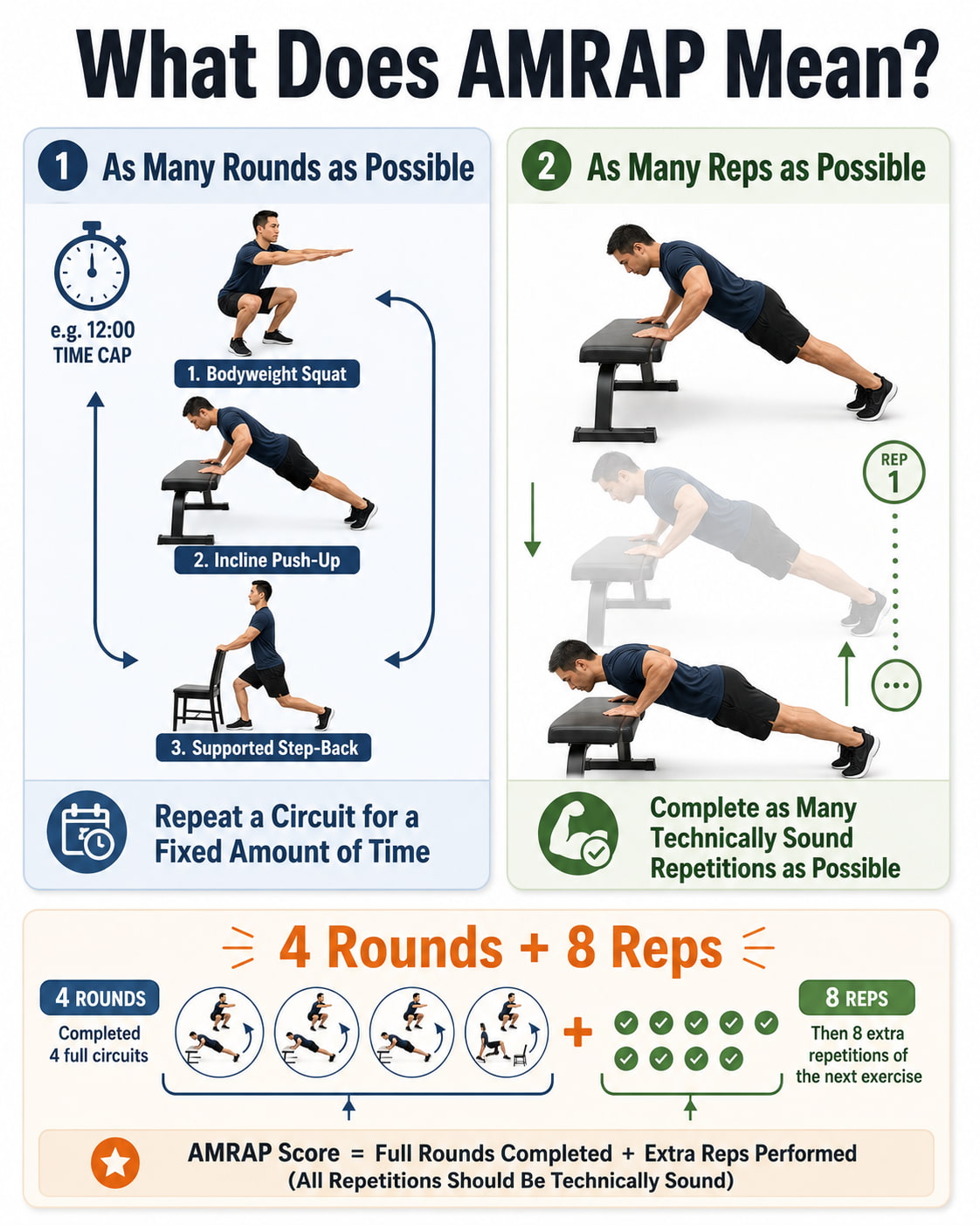
AMRAP has two closely related meanings. The workout instructions should make it clear which version you are doing.
As Many Rounds as Possible
In a rounds-based AMRAP, you repeat a circuit of two or more exercises for a fixed amount of time.
A workout might read:
Complete as many rounds as possible in 8 minutes:
- 8 bodyweight squats
- 6 incline push-ups
- 10 alternating step-backs
You complete each exercise in order and continue repeating the circuit until the timer ends.
Your score includes:
- The number of complete rounds
- Any additional repetitions completed in the final unfinished round
If you finish four full rounds and then complete eight squats in round five, your score is:
4 rounds + 8 reps
Official CrossFit workouts use this fixed-time scoring method. For example, the Cindy workout records the rounds and extra repetitions completed within 20 minutes while emphasizing consistent mechanics and range of motion.
As Many Reps as Possible
In a reps-based AMRAP, you perform as many good repetitions as possible of one exercise.
Examples include:
- As many controlled push-ups as possible in 60 seconds
- As many chair stands as possible in 30 seconds
- As many dumbbell rows as possible before technique begins to deteriorate
The instructions may set a time limit, or the set may continue until you can no longer perform another safe repetition.
For general fitness, “as many reps as possible” should usually mean as many technically sound reps as possible. Stop the set when you can no longer maintain the intended range of motion, posture, speed, or control.
| AMRAP type | What you repeat | How it is scored |
|---|---|---|
| As many rounds as possible | A circuit of multiple exercises | Complete rounds plus extra reps |
| As many reps as possible | One exercise or movement | Total quality repetitions |
How Does an AMRAP Workout Work?
An AMRAP usually follows a simple structure:
- Choose one exercise or a short circuit.
- Assign a specific number of repetitions to each movement.
- Set a timer.
- Complete the exercises in the listed order.
- Rest whenever necessary.
- Continue until the timer ends.
- Record your result.
The timer is fixed, but your pace is not. You can slow down, pause between movements, or divide a set into smaller groups of repetitions.
For example, you do not have to perform 10 push-ups without stopping. You could complete five, pause briefly, and then perform the remaining five before moving to the next exercise.
Are You Allowed to Rest During an AMRAP?
Yes, you can rest during an AMRAP.
AMRAP does not mean nonstop exercise at any cost. Short, planned breaks may help you maintain better movement quality and complete more total work over the full interval.
Rest when:
- Your technique begins to change
- You can no longer control your breathing
- You feel too fatigued to perform the next repetition safely
- Your muscles are approaching failure
- You need to prepare or reposition equipment
Taking a 10- or 20-second break is often more productive than rushing through several poor repetitions and then needing a much longer recovery.
What Are the Benefits of AMRAP Workouts?
An AMRAP is a workout structure, not a guarantee of a particular result. Its benefits depend on the exercises, resistance, duration, pace, rest periods, and how consistently you train.
Provides a Time-Efficient Workout
Because an AMRAP has a fixed endpoint, it can make workouts easier to schedule. Once the timer starts, you know exactly how long the main training block will last.
A short AMRAP may work well when you:
- Have limited workout time
- Exercise at home
- Want a brief conditioning session
- Need a structured workout finisher
- Prefer not to count multiple traditional sets
A complete session should still include time for a warm-up and, when appropriate, a short cool-down.
Challenges Cardiovascular Fitness
An AMRAP that combines large-muscle movements with limited rest can raise your heart rate and challenge your cardiovascular system.
Exercises such as squats, step-ups, marching, rowing, cycling, or low-impact jumping movements can make the workout feel similar to circuit training or high-intensity interval training.
However, not every AMRAP is a cardio workout. A slow mobility circuit or a heavy strength-focused AMRAP produces a different response than a fast bodyweight circuit.
Builds Muscular Endurance
Repeatedly performing squats, push-ups, rows, lunges, or similar exercises can improve your ability to sustain muscular work over time.
This may help with activities that require repeated effort, such as:
- Climbing stairs
- Carrying groceries
- Walking uphill
- Performing physical work
- Participating in recreational sports
The exact muscles challenged depend on the exercises included.
Can Support Strength and Muscle Development
AMRAP sets can contribute to a strength or muscle-building program when you use an appropriate resistance and gradually increase the challenge.
However, completing the maximum possible number of repetitions is not necessary in every set. The American College of Sports Medicine’s 2026 resistance-training guidance emphasizes consistent, individualized training and reports that routinely training to momentary muscle failure is not required for the average healthy adult.
For strength or muscle development, stop the set when you can no longer maintain:
- A controlled lifting speed
- Stable joint positioning
- The intended range of motion
- Normal breathing without excessive straining
Can Be Scaled for Different Fitness Levels
Almost every part of an AMRAP can be adjusted.
You can change:
- The exercises
- The number of repetitions
- The resistance
- The timer length
- The movement speed
- The range of motion
- The impact level
- The amount of support used
For example, standard push-ups can become incline or wall push-ups. Jump squats can become regular squats. Box jumps can become low step-ups.
Scaling the workout does not make it ineffective. It helps match the workout to your current ability.
Makes Progress Easier to Measure
An AMRAP gives you a score that can be recorded and compared later.
Progress might mean:
- Completing more quality repetitions
- Completing an additional round
- Using a slightly heavier resistance
- Using a more challenging exercise variation
- Taking fewer or shorter breaks
- Maintaining better technique
- Feeling more controlled at the same score
For a useful comparison, repeat the same workout under similar conditions. Keep the exercises, repetitions, timer, equipment, and resistance consistent.
Requires Minimal Equipment
Many AMRAP workouts use only bodyweight exercises. Others can be completed with one dumbbell, a resistance band, a step, or a stable chair.
This makes the format practical for home workouts, travel, small spaces, and busy schedules.
Is AMRAP the Same as HIIT?
AMRAP and HIIT can overlap, but they are not identical.
- AMRAP describes the workout goal: complete as many quality rounds or repetitions as possible.
- HIIT describes the intensity and interval structure: alternate higher-intensity work periods with recovery periods.
An AMRAP may function as HIIT when it includes demanding exercises performed at a high effort with planned recovery. It may also function as moderate circuit training, muscular-endurance training, or a strength set.
For example:
- A 10-minute fast-paced squat, push-up, and mountain-climber AMRAP may resemble HIIT.
- A controlled dumbbell circuit with longer rest breaks may be strength endurance.
- A low-impact chair-based AMRAP may remain at a moderate intensity.
The acronym alone does not determine how hard the workout is.
How Long Should an AMRAP Workout Be?
There is no single required AMRAP duration. Choose a timer that fits your experience, exercises, and workout goal.
| AMRAP use | Practical starting duration |
|---|---|
| Beginner workout | 5–10 minutes |
| General full-body circuit | 8–15 minutes |
| Workout finisher | 3–8 minutes |
| Longer conditioning workout | 15–20 minutes or more |
| Single-exercise interval | 20–60 seconds |
These are programming examples rather than strict rules.
A five-minute AMRAP can be very demanding when it includes advanced or explosive movements. A 15-minute low-impact circuit may feel more manageable. Duration should always be considered alongside movement difficulty, resistance, and pace.
Beginners will generally benefit more from a short, well-controlled AMRAP than from starting with a long workout that causes early exhaustion.
How Hard Should an AMRAP Feel?
Most of the workout should feel challenging but repeatable. You should be working hard enough to feel the exercises, but not so hard that your technique falls apart after the first round.
A useful standard is to ask:
Can I perform the next round with roughly the same technique as the first?
When the answer is no, reduce your pace, take a short break, lower the resistance, or modify the exercise.
An AMRAP is not automatically an all-out test. You can use a controlled effort for a regular workout and reserve maximal testing for occasional, appropriately selected sessions.
How to Pace an AMRAP
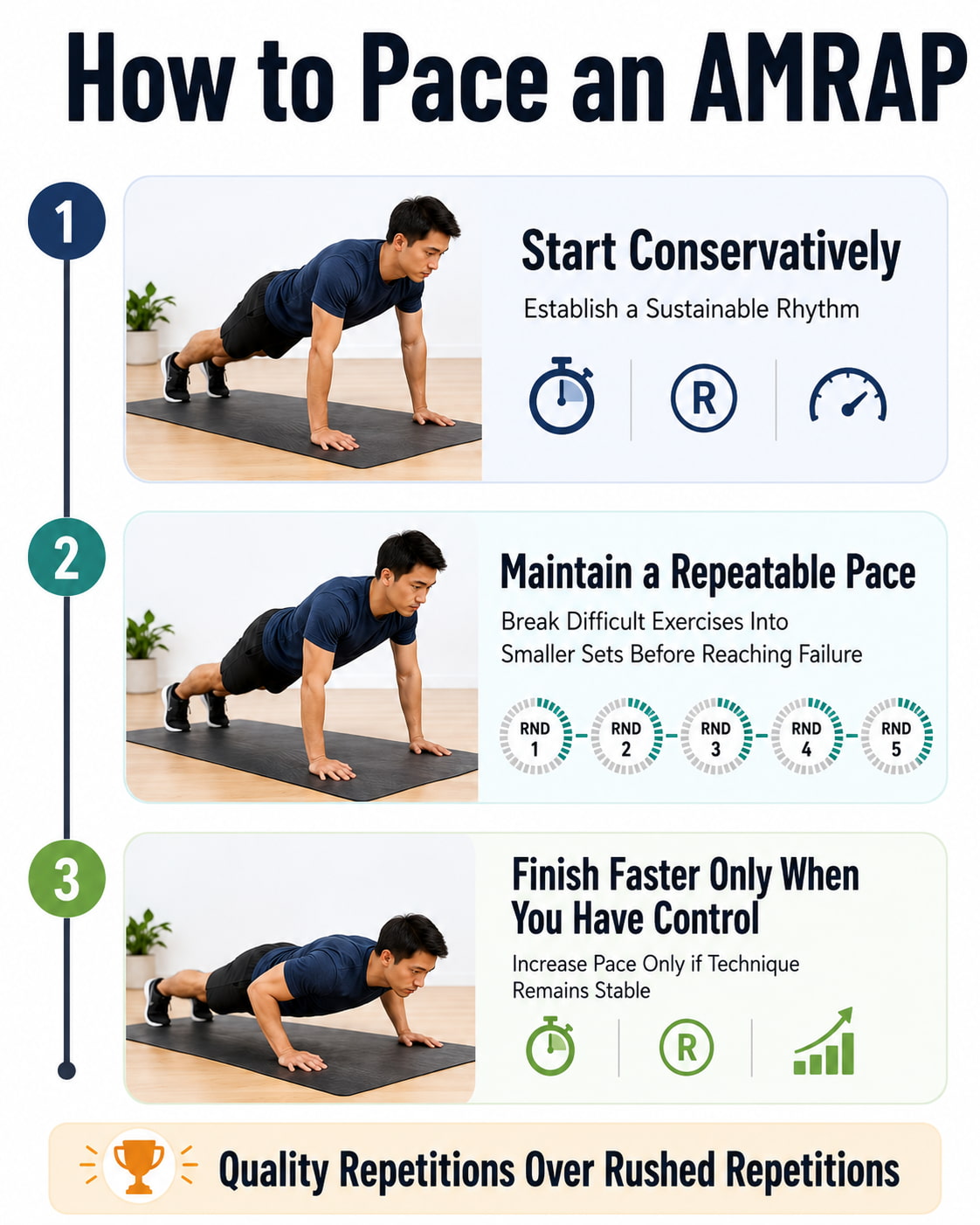
One of the most common mistakes is starting too quickly. A fast opening round may feel impressive, but it often leads to long breaks and poor technique later.
Start Conservatively
Treat the first round as an opportunity to establish a sustainable rhythm. Move deliberately and avoid racing the timer.
Maintain a Repeatable Pace
During the middle of the workout, aim for rounds that take approximately the same amount of time.
Break difficult exercises into smaller sets before reaching failure. For example, perform 10 push-ups as two sets of five rather than struggling through all 10 at once.
Finish Faster Only When You Have Control
During the final minute or two, you can increase your pace when:
- Your technique remains consistent
- You are not experiencing pain or dizziness
- You can control the movement
- The equipment and exercise allow you to speed up safely
Do not rush advanced lifts or technical exercises simply because the timer is almost finished.
How to Do an AMRAP Safely
Warm Up First
Spend a few minutes increasing your body temperature and practicing the movements included in the workout.
A simple warm-up might include:
- Easy walking or marching
- Arm circles
- Hip hinges
- Controlled squats
- Practice repetitions using a lighter resistance
The warm-up should prepare you without creating significant fatigue.
Choose Familiar Exercises
AMRAPs are not the best time to learn a complicated new movement. Fatigue makes it harder to maintain technique and follow detailed instructions.
Use exercises you can already perform with reasonable control.
Use a Manageable Resistance
Choose a load that you can lift repeatedly without grinding, holding your breath excessively, or changing your posture.
The correct weight may feel relatively easy during the first round. That is often appropriate because fatigue accumulates as the workout continues.
Keep the Workout Area Clear
Place equipment where you can reach it without rushing, tripping, or stepping over objects. Make sure chairs, benches, bands, and steps are stable before starting.
Count Only Good Repetitions
A repetition should meet the same basic standard at the end of the workout as it did at the beginning.
Do not count reps that require you to:
- Shorten the movement substantially
- Bounce or use uncontrolled momentum
- Lose balance
- Round or overextend your back
- Drop the weight without control
- Ignore sharp or worsening pain
Change One Variable at a Time
To make an AMRAP harder, you could add time, resistance, repetitions, or a more challenging exercise. Changing all of these at once makes the increase difficult to control.
A simple progression might be:
- Repeat the workout until your pace feels consistent.
- Add one or two repetitions to one exercise.
- Add one minute to the timer.
- Increase resistance slightly when all rounds remain controlled.
AMRAP Workout Examples
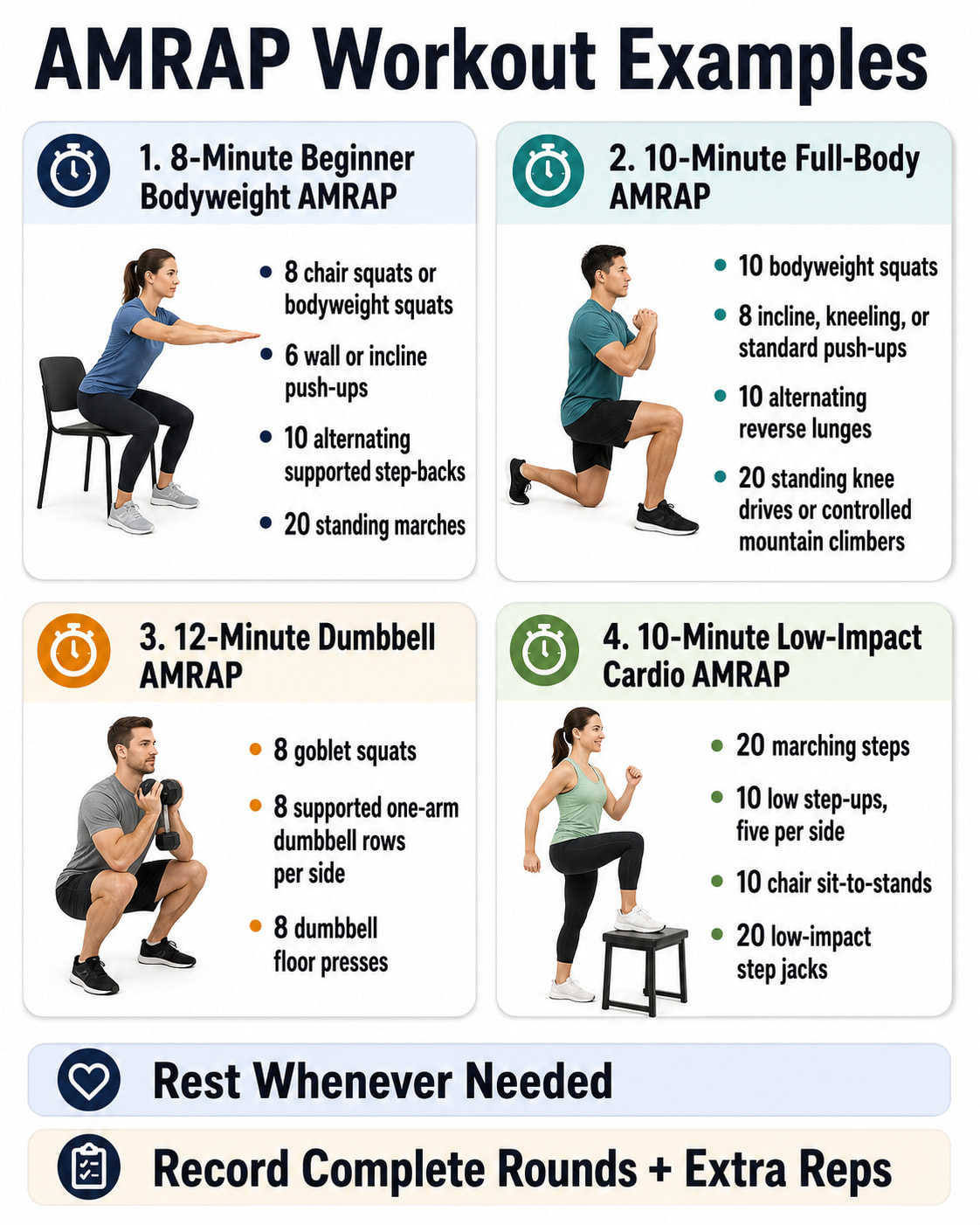
Warm up before each workout. Rest whenever needed, and stop counting repetitions when you can no longer maintain safe technique.
1. 8-Minute Beginner Bodyweight AMRAP
Complete as many controlled rounds as possible in 8 minutes:
- 8 chair squats or bodyweight squats
- 6 wall or incline push-ups
- 10 alternating supported step-backs
- 20 standing marches
How to scale it: Use a higher chair for squats, perform push-ups against a wall, and hold a stable surface during the step-backs.
How to score it: Record complete rounds plus any repetitions completed in the final round.
2. 10-Minute Full-Body AMRAP
Complete as many quality rounds as possible in 10 minutes:
- 10 bodyweight squats
- 8 incline, kneeling, or standard push-ups
- 10 alternating reverse lunges
- 20 standing knee drives or controlled mountain climbers
Pacing tip: Complete the first round at a moderate pace. Divide the push-ups into two smaller sets when necessary.
Lower-impact option: Use supported step-backs instead of lunges and standing knee drives instead of mountain climbers.
3. 12-Minute Dumbbell AMRAP
Complete as many controlled rounds as possible in 12 minutes:
- 8 goblet squats
- 8 supported one-arm dumbbell rows per side
- 8 dumbbell floor presses
Use one or two dumbbells depending on the exercise and your experience.
Weight selection: Choose a resistance that allows you to complete every repetition without twisting, bouncing, or losing control.
How to scale it: Reduce the dumbbell weight, squat to a chair, or perform the floor press with one arm at a time.
4. 10-Minute Low-Impact Cardio AMRAP
Complete as many steady rounds as possible in 10 minutes:
- 20 marching steps
- 10 low step-ups, five per side
- 10 chair sit-to-stands
- 20 low-impact step jacks
How to scale it: Replace the step-ups with toe taps on a low step. Hold a wall, railing, or stable chair when balance support is needed.
Pacing tip: Maintain a speed that allows you to breathe harder while still staying in control.
5. Single-Exercise AMRAP Set
Choose an exercise you can perform safely, such as incline push-ups.
Complete as many technically sound repetitions as possible, stopping when you cannot perform another repetition without changing your body position or range of motion.
Record:
- The exercise variation
- The total repetitions
- The surface height
- Whether the set was timed
- How your technique felt
Do not compare scores when the exercise setup changes. Ten wall push-ups and 10 floor push-ups represent different levels of difficulty.
AMRAP vs. EMOM vs. For Time
AMRAP is only one way to organize a workout.
| Format | What is fixed? | What you do |
|---|---|---|
| AMRAP | Workout duration | Complete as many quality rounds or reps as possible |
| EMOM | Start of each minute | Complete assigned work, then rest for the remaining time |
| For time | Total amount of work | Complete the prescribed workout as efficiently as possible |
| Traditional sets | Reps, sets, and rest | Complete planned sets with defined recovery periods |
AMRAP
Best suited to fixed-time circuits, conditioning, muscular endurance, and repeatable performance tests.
EMOM
EMOM means “every minute on the minute.” You begin the prescribed exercise at the start of each minute. After finishing the repetitions, you rest until the next minute begins.
For Time
In a “for time” workout, the amount of work is fixed instead of the duration. You complete all prescribed rounds and record how long the workout takes.
None of these formats is automatically better. The most appropriate option depends on your goal, exercise experience, and ability to maintain good technique.
How to Track AMRAP Progress
Write down more than the final score. Record the details needed to repeat the workout accurately:
- Date
- Timer length
- Exercises
- Repetitions per exercise
- Resistance used
- Exercise modifications
- Complete rounds
- Additional repetitions
- Rest breaks
- Perceived difficulty
- Notes about technique
Suppose you complete six rounds one week and six rounds plus 12 repetitions several weeks later. That may indicate improved work capacity when the workout conditions remained the same.
Completing the same score with better technique, less discomfort, or more controlled breathing can also represent progress.
How Often Should You Do AMRAP Workouts?
The appropriate frequency depends on the workout’s intensity and how it fits into the rest of your program.
A beginner might start with one or two AMRAP sessions per week. A short, moderate circuit may be performed more often than a demanding full-body workout using heavy resistance or explosive movements.
Avoid training the same fatigued muscles hard on consecutive days. Your weekly program should also include appropriate aerobic activity, strength training, mobility, and recovery.
The federal Physical Activity Guidelines for Americans from the U.S. Department of Health and Human Services recommend that adults work toward 150–300 minutes of moderate aerobic activity each week and perform muscle-strengthening activity on at least two days. An AMRAP may contribute to these goals, but one workout format does not need to provide every part of a balanced program.
Who Should Modify an AMRAP?
You may need a shorter, lower-impact, or professionally supervised workout when you are:
- New to exercise
- Returning after a long period of inactivity
- Recovering from an injury or operation
- Pregnant or recently postpartum
- Managing joint pain or balance limitations
- Living with a cardiovascular, respiratory, neurological, or metabolic condition
- Taking medication that affects heart rate, blood pressure, balance, or exercise tolerance
People with chronic conditions or disabilities can often be physically active, but the Centers for Disease Control and Prevention recommends discussing appropriate exercise types and amounts with a healthcare professional or physical activity specialist when needed.
When Should You Stop an AMRAP?
Stop the workout when you experience:
- Sharp, sudden, or worsening pain
- Loss of balance
- Faintness or marked dizziness
- Unusual weakness
- Severe or unexpected shortness of breath
- Chest pressure, squeezing, fullness, or pain
- Confusion or loss of coordination
Chest discomfort, shortness of breath, cold sweating, nausea, and lightheadedness can be warning signs of a heart attack. The American Heart Association advises calling emergency services when heart attack warning signs are present.
Normal muscle fatigue and faster breathing may occur during exercise, but they should not be confused with severe, unusual, or rapidly worsening symptoms.
Common AMRAP Mistakes
Starting Too Fast
Racing through the first round often causes excessive fatigue and longer breaks later. Begin at a pace you believe you could maintain for the entire interval.
Choosing Too Many Exercises
A long list can make the workout confusing and difficult to track. Most AMRAPs work well with approximately three to five movements.
Using Exercises That Are Too Technical
Complicated lifts become harder to control under fatigue. Choose simpler variations unless you are experienced and appropriately supervised.
Using Too Much Weight
A load that is manageable for one set may become inappropriate after several rounds. Select resistance based on the full workout, not just the first round.
Refusing to Rest
Resting briefly is not failing the workout. It can help you maintain better technique and accumulate more useful work.
Counting Poor Repetitions
More repetitions do not represent progress when they are achieved by shortening the range of motion or losing control.
Comparing Unmatched Workouts
Scores are only comparable when the exercises, timer, resistance, repetition targets, and movement standards are the same.
Frequently Asked Questions
What does AMRAP stand for in fitness?
AMRAP stands for as many rounds as possible or as many reps as possible. The workout instructions determine which meaning applies.
Is AMRAP only used in CrossFit?
No. AMRAP is strongly associated with CrossFit, but trainers and exercisers also use it in bodyweight workouts, strength training, boot camps, home workouts, and general circuit training.
Do you rest during an AMRAP?
Yes. Rest whenever it is necessary to control your breathing, maintain technique, or prepare for the next exercise. AMRAP does not require nonstop movement.
Does AMRAP mean training to failure?
Not always. A single-exercise AMRAP set may approach muscular failure, but a timed circuit usually requires pacing and brief rest periods. For general training, stop or modify an exercise when your technique becomes unreliable.
Is AMRAP good for beginners?
AMRAP can be suitable for beginners when the workout uses familiar, low-impact exercises, manageable repetition targets, and a short timer. Beginners should focus on learning the structure rather than earning the highest possible score.
Can AMRAP build muscle?
It can contribute to muscle growth when the workout provides sufficient resistance, effort, weekly training volume, and progressive overload. However, the AMRAP format alone does not guarantee muscle growth.
Is AMRAP cardio or strength training?
It can be either or both. A fast bodyweight circuit may primarily challenge cardiovascular and muscular endurance. A dumbbell AMRAP using controlled repetitions may place greater emphasis on strength endurance.
How long should a beginner AMRAP be?
Approximately five to 10 minutes is a practical starting range. The timer should be shorter when the movements are demanding and may be longer when the exercises are low impact and performed at a controlled pace.
What is a good AMRAP score?
There is no universal good score. Your result depends on the exercises, resistance, timer, repetition targets, and movement standards. Compare your score only with your own previous result from the same workout.
The Bottom Line
AMRAP means completing as many rounds or repetitions as possible, but the most important word is not “many.” It is quality.
A productive AMRAP uses familiar exercises, appropriate resistance, a realistic timer, and a sustainable pace. Rest is allowed, modifications are encouraged, and repetitions should stop when safe technique can no longer be maintained.
Used thoughtfully, AMRAP can provide a simple, measurable, and flexible way to train cardiovascular fitness, muscular endurance, and full-body work capacity without requiring a complicated workout plan.
References
- CrossFit — AMRAP workout structure and scoring
- American College of Sports Medicine — Resistance training and training-to-failure guidance
- U.S. Department of Health and Human Services — Physical Activity Guidelines for Americans
- Centers for Disease Control and Prevention — Physical activity guidance for people with chronic health conditions
- American Heart Association — Heart attack warning signs and emergency guidance