
Boot camp workouts combine resistance exercises and cardio intervals in one efficient, full-body training session. The best routines use simple movements such as squats, lunges, pushes, pulls, carries, and low- or high-impact conditioning drills.
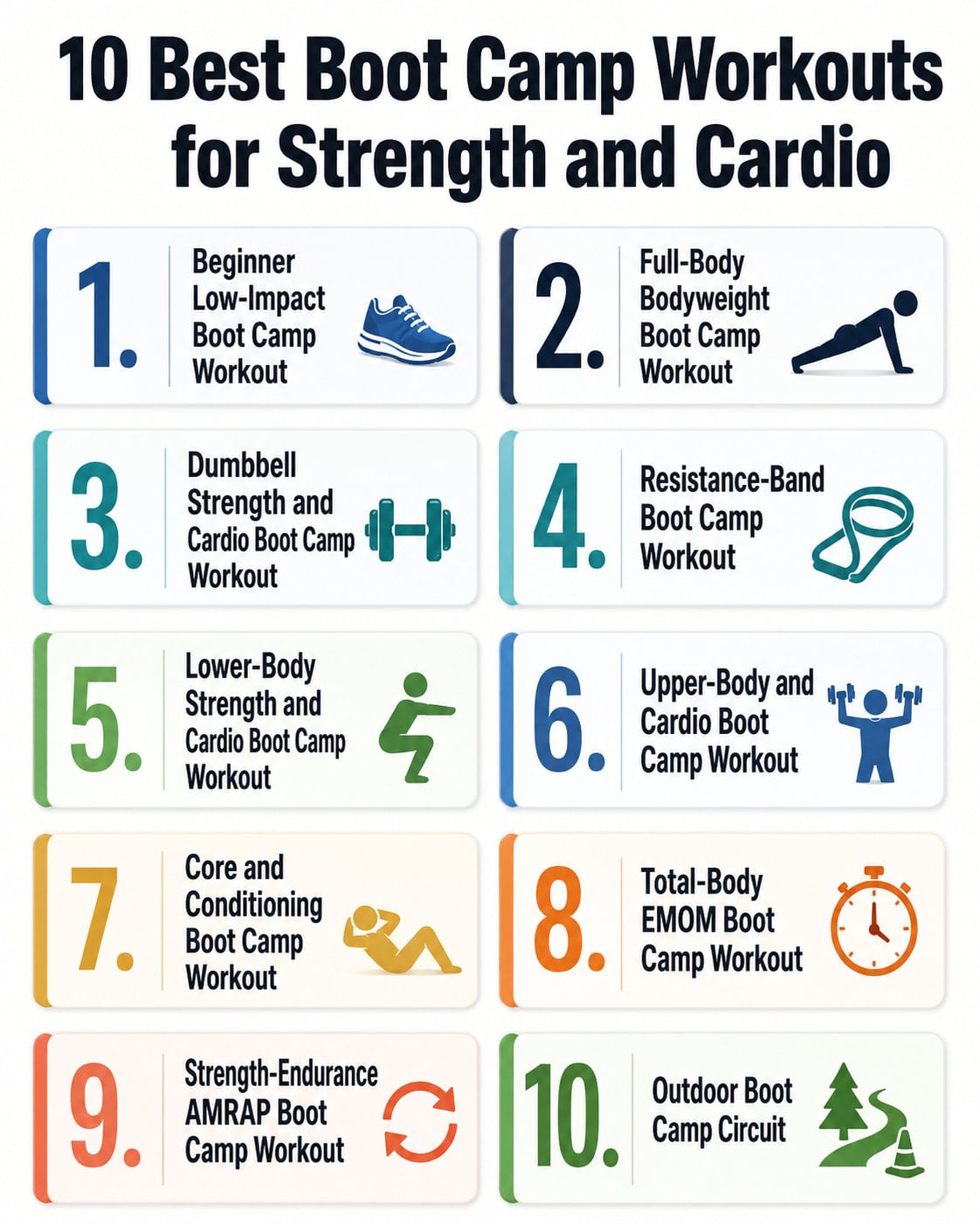
The 10 boot camp workouts below include beginner, bodyweight, dumbbell, resistance-band, core, lower-body, upper-body, EMOM, AMRAP, and outdoor options. Most take 20–30 minutes after a short warm-up, and every routine can be adjusted to match your current fitness level.
Adults should generally work toward at least 150 minutes of moderate-intensity aerobic activity or 75 minutes of vigorous activity each week, plus muscle-strengthening activity on at least two days. A well-designed boot camp session may contribute to both goals when it keeps you moving and challenges your major muscle groups, according to the Centers for Disease Control and Prevention.
Boot Camp Workouts at a Glance
The listed times cover the main circuit. Add approximately five minutes for warming up and three to five minutes for cooling down.
| Workout | Best for | Equipment | Main circuit |
|---|---|---|---|
| Beginner Low-Impact Boot Camp | New exercisers | Chair and wall | 10–17 minutes |
| Full-Body Bodyweight Boot Camp | No-equipment training | Optional mat | 18–20 minutes |
| Dumbbell Strength and Cardio Boot Camp | Building strength | One or two dumbbells | 18–22 minutes |
| Resistance-Band Boot Camp | Home or travel | Long band; mini loop optional | 18–22 minutes |
| Lower-Body Boot Camp | Legs and conditioning | Low step optional | 18–22 minutes |
| Upper-Body and Cardio Boot Camp | Pushing and pulling strength | Dumbbells or band | 18–22 minutes |
| Core and Conditioning Boot Camp | Trunk control and stamina | Mat or bench | 14–18 minutes |
| Total-Body EMOM Boot Camp | Structured pacing | Band or step optional | 20 minutes |
| Strength-Endurance AMRAP | Efficient full-body work | Dumbbell optional | 12–15 minutes |
| Outdoor Boot Camp Circuit | Training outside | Bench; weights optional | 20–25 minutes |
What Is a Boot Camp Workout?
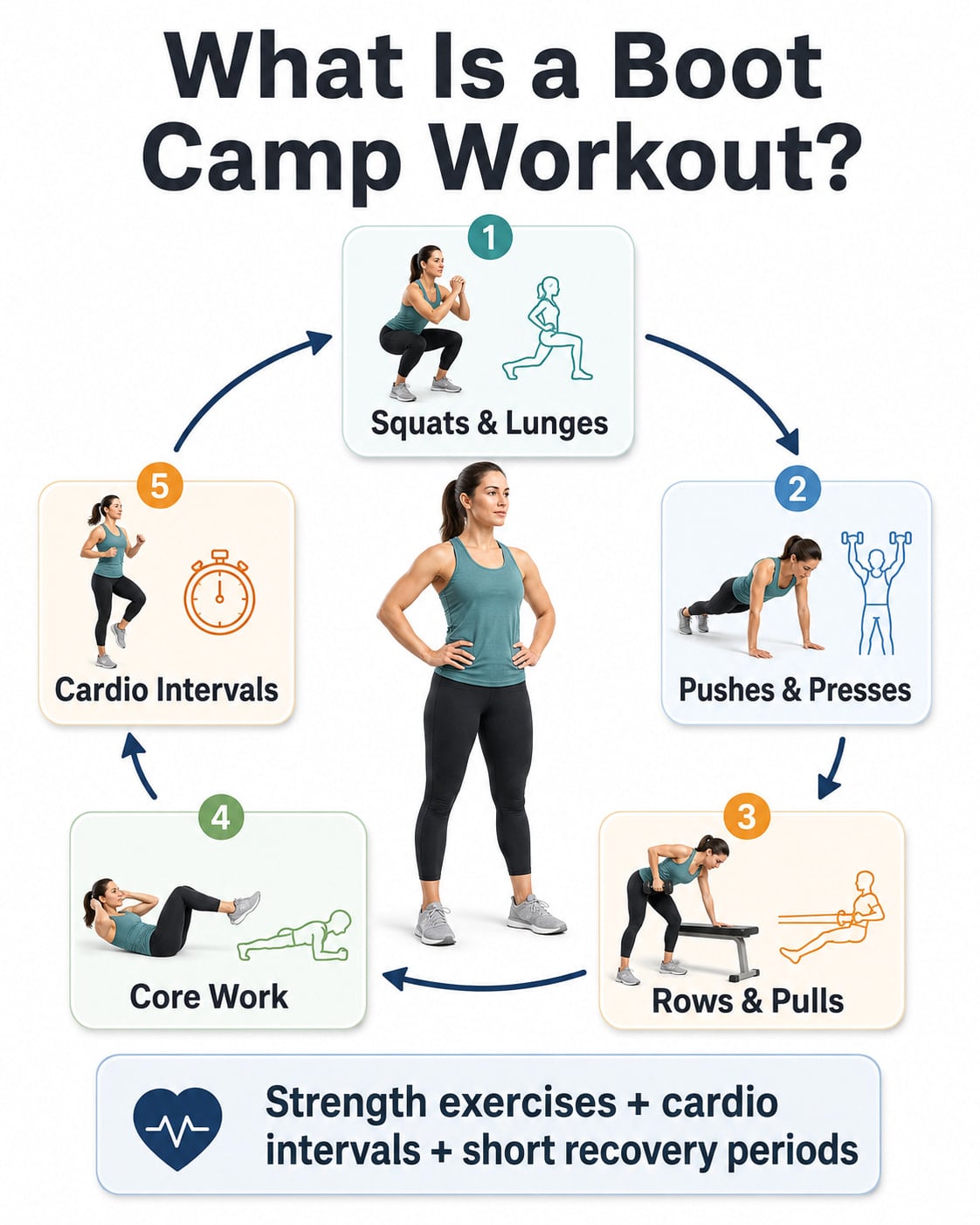
A boot camp workout is a circuit-based session that alternates strength exercises with cardiovascular movements and short recovery periods.
A typical workout may include:
- Squats, lunges, or step-ups for the lower body
- Push-ups or presses for the chest, shoulders, and arms
- Rows or band pulls for the back
- Planks, carries, or dead bugs for the core
- Marching, jumping jacks, mountain climbers, or short walking intervals for cardio
Boot camp training does not have to include yelling, maximum-effort sprints, heavy weights, or difficult jumping exercises. It can be low impact, moderate intensity, and beginner-friendly.
Some challenging boot camp circuits resemble high-intensity functional training, or HIFT. A systematic review published in Scientific Reports examined 17 studies and found small-to-moderate improvements in strength and endurance compared with no exercise. However, the available evidence did not establish that HIFT was better than traditional resistance training.
The American College of Sports Medicine emphasized in its March 2026 resistance-training update that consistency is more important than following a needlessly complex program. It also noted that bodyweight exercises, resistance bands, free weights, and home-based routines can all support meaningful results.
How Hard Should a Boot Camp Workout Feel?
Use a 0–10 effort scale, where 0 represents sitting at rest and 10 represents your maximum possible effort.
The CDC exercise-intensity guide classifies moderate activity as approximately 5–6 out of 10 and vigorous activity as approximately 7–8 out of 10. During moderate cardio, you can usually talk but not sing. During vigorous cardio, you may only be able to say a few words before pausing for breath.
For most of these workouts:
- Beginners can aim for an effort of 4–6.
- More experienced exercisers can work around 6–8.
- Strength repetitions should remain controlled, even when your heart rate is elevated.
- You should not need to work at 9 or 10 out of 10 to complete an effective session.
Slow down, reduce the resistance, or extend the recovery period when your technique starts to deteriorate.
Complete This 5-Minute Warm-Up First
Warm up before beginning any of the boot camp workouts. Move smoothly and use a comfortable range of motion.
- March in place: 60 seconds
- Bodyweight squat or chair sit-to-stand: 8–10 repetitions
- Bodyweight hip hinge: 10 repetitions
- Alternating step-back: 6 repetitions per side
- Arm circles and overhead reaches: 20 seconds each
- Wall or incline push-ups: 5–8 controlled repetitions
The warm-up should make you feel warmer and more mobile without causing significant fatigue.
10 Best Boot Camp Workouts for Strength and Cardio
1. Beginner Low-Impact Boot Camp Workout
This routine introduces basic boot camp exercises without running, jumping, or getting down on the floor.
Equipment: A sturdy chair and a clear wall
Format: Work for 30 seconds and rest for 30 seconds. Complete two or three rounds.
- Chair sit-to-stand
- Wall push-up
- Supported alternating step-back
- March in place with arm swings
- Standing alternating knee drives
Rest for 60–90 seconds between rounds.
During the sit-to-stand, place the chair against a wall so it cannot slide. Stand by pressing through your feet rather than pushing on your thighs. For the step-back, hold the chair lightly and take a comfortable step behind you without forcing a deep lunge.
Make it easier: Work for 20 seconds and rest for 40 seconds.
Make it more challenging: Use an incline push-up instead of a wall push-up, work for 40 seconds, or complete one additional round.
2. Full-Body Bodyweight Boot Camp Workout
This no-equipment circuit trains the legs, chest, shoulders, core, and cardiovascular system.
Equipment: Optional exercise mat
Format: Work for 35 seconds and rest for 25 seconds. Complete three rounds.
- Bodyweight squats
- Wall, incline, or floor push-ups
- Alternating reverse lunges
- Step jacks or regular jumping jacks
- Elevated or floor plank shoulder taps
- Slow or regular mountain climbers
Rest for 60 seconds after each round.
Lower yourself under control during the squat, push-up, and lunge. Save your faster pace for the step jacks and mountain climbers. When performing shoulder taps, widen your feet and limit side-to-side movement through your hips.
Low-impact option: Use step jacks and elevated mountain climbers with your hands on a sturdy bench or countertop.
More challenging option: Use floor push-ups, regular mountain climbers, or 40-second work periods.
3. Dumbbell Strength and Cardio Boot Camp Workout
This workout adds external resistance while keeping the exercises simple enough to perform in a circuit.
Equipment: One or two dumbbells
Format: Work for 40 seconds and rest for 20 seconds. Complete three rounds.
- Goblet squat
- Dumbbell Romanian deadlift
- One-arm dumbbell row, switching sides halfway
- Standing dumbbell overhead press
- Fast march or alternating step-ups
- Farmer carry or dumbbell march
Rest for 60–90 seconds between rounds.
Choose a weight that lets you control the final few seconds of every station. During Romanian deadlifts and rows, push your hips back and keep your spine long. Avoid turning the overhead press into a backbend.
If you have only one dumbbell, hold it at your chest for squats, use one side at a time for rows and presses, and switch hands halfway through the carry.
Make it easier: Use one light dumbbell and complete two rounds.
Make it more challenging: Gradually increase the resistance without shortening your range of motion or rushing the repetitions.
4. Resistance-Band Boot Camp Workout
Resistance bands provide a portable way to train major muscle groups without gym machines.
Equipment: One long resistance band and an optional mini loop
Format: Work for 40 seconds and rest for 20 seconds. Complete three rounds.
- Banded squat
- Bent-over band row
- Standing band overhead press
- Banded good morning
- Lateral band walk
- Step jacks or quick marching
Rest for 60 seconds between rounds.
For bent-over rows and good mornings, stand securely on the middle of the long band. Use a mini loop above your knees or ankles for lateral walks, depending on your experience and the band’s resistance.
Inspect the band before every workout. Do not use a band with cracks, tears, weak spots, or damaged handles. Make sure it cannot slip from under your feet.
No mini loop: Perform unresisted lateral steps.
No comfortable overhead range: Replace the overhead press with an incline push-up or a band chest press using a properly secured anchor.
5. Lower-Body Strength and Cardio Boot Camp Workout
This circuit focuses on the quadriceps, hamstrings, glutes, calves, and lower-body conditioning.
Equipment: A low, stable step is optional
Format: Work for 40 seconds and rest for 20 seconds. Complete three rounds.
- Squat to calf raise
- Alternating reverse lunges
- Alternating step-ups
- Glute bridges
- Lateral skater steps
- High-knee march
Rest for 60–90 seconds after each round.
Place your entire foot on the step and press through it to stand. Step down under control rather than dropping quickly. During skater steps, move laterally without forcing a large jump.
No step available: Replace step-ups with alternating knee drives or supported split squats.
Knee-friendly adjustment: Use a chair sit-to-stand, shorten your lunge depth, and perform side steps instead of skater hops.
More challenging option: Hold a light dumbbell for squats, lunges, and step-ups.
6. Upper-Body and Cardio Boot Camp Workout
This workout alternates upper-body pushing and pulling exercises with simple cardio stations.
Equipment: Dumbbells or a resistance band
Format: Work for 40 seconds and rest for 20 seconds. Complete three rounds.
- Wall, incline, or floor push-ups
- One-arm dumbbell row or band row
- Standing dumbbell or band overhead press
- Elevated plank shoulder taps
- Controlled shadow boxing
- Step jacks or jumping jacks
Rest for 60 seconds after every round.
Keep your shoulders down and away from your ears during rows and presses. When shadow boxing, rotate through your upper body without snapping your elbows or using maximum force.
This workout includes both pushing and pulling. That balance is important because boot camp circuits sometimes include many push-ups but little work for the muscles of the upper back.
Beginner option: Use wall push-ups, light rows, and step jacks.
More challenging option: Lower the push-up surface, increase the rowing resistance, or use floor shoulder taps.
7. Core and Conditioning Boot Camp Workout
Core training is not limited to fast sit-ups. This routine emphasizes controlling your trunk while your arms and legs move.
Equipment: Exercise mat and optional bench
Format: Work for 30 seconds and rest for 15 seconds. Complete three rounds.
- Dead bugs
- Bird dogs
- Forearm, high, or elevated plank
- Standing cross-body knee drives
- Elevated or floor mountain climbers
- Side plank from the knees, switching sides halfway
Rest for 60 seconds between rounds.
Keep the dead bugs and bird dogs slow. Extend only as far as you can while keeping your lower back and pelvis controlled. During mountain climbers, bring each knee forward without bouncing through your hips.
Wrist-sensitive option: Use a forearm plank or place your hands on an elevated surface.
Beginner option: Perform standing knee drives in place of mountain climbers and use a wall plank instead of a floor plank.
8. Total-Body EMOM Boot Camp Workout
EMOM means “every minute on the minute.” Start the assigned exercise at the beginning of each minute. The time left after completing the repetitions becomes your recovery.
Equipment: Resistance band and low step optional
Format: Complete the following five-minute sequence four times for a 20-minute workout.
- Minute 1: 10–15 bodyweight squats
- Minute 2: 6–12 incline or floor push-ups
- Minute 3: 8–12 alternating reverse lunges in total
- Minute 4: 10–15 band rows
- Minute 5: 30–40 seconds of fast marching or step-ups
Select repetition targets you can finish in approximately 30–45 seconds. You should normally have at least 15 seconds to breathe, adjust your position, and prepare for the next minute.
If an exercise takes nearly the entire minute, reduce the repetitions during the next round. An EMOM should provide structured recovery, not force you to rush through poor-quality repetitions.
9. Strength-Endurance AMRAP Boot Camp Workout
AMRAP means completing as many rounds as possible within a specific time. In this workout, “as many as possible” means as many well-controlled rounds as you can complete without sacrificing form.
Equipment: One dumbbell is optional
Format: Set a timer for 12–15 minutes.
Complete:
- 8 goblet or bodyweight squats
- 6–10 wall, incline, or floor push-ups
- 8 alternating reverse lunges in total
- 10 dumbbell Romanian deadlifts or bodyweight hip hinges
- 20 marching knee drives or low-impact jumping jacks in total
Rest whenever necessary, then continue from where you stopped.
Avoid racing through the squats, push-ups, lunges, or hinges. Move more quickly only during the final conditioning exercise.
Record your completed rounds if you want to monitor progress. A better result may mean completing the same number of rounds with improved control, a slightly heavier weight, or less fatigue—not simply moving faster.
10. Outdoor Boot Camp Circuit
An outdoor boot camp can add walking, hills, benches, and loaded carries to a full-body circuit.
Equipment: A stable park bench and optional dumbbells or evenly loaded carry bags
Format: Complete three rounds.
- Bench step-ups: 8 repetitions per side
- Bench incline push-ups: 8–12 repetitions
- Walking or stationary reverse lunges: 10 total repetitions
- Brisk uphill walk or short shuttle walk: 45 seconds
- Farmer carry: 30–45 seconds
Rest for 60–90 seconds between rounds.
Check that the bench is secure, dry, and free of damage before using it. Choose a walking route with a predictable surface and enough space to avoid other people, traffic, or obstacles.
On hot or humid days, reduce the intensity, choose a cooler time of day, bring water, and consider moving the workout indoors. Avoid slippery grass, loose gravel, poorly lit areas, and outdoor equipment that feels unstable.
Low-Impact Boot Camp Exercise Substitutions
You do not need jumping exercises to make a boot camp workout effective. Use these substitutions when you want to reduce impact, simplify the movement, or maintain better control.
| Higher-impact or advanced exercise | Lower-impact alternative |
|---|---|
| Jumping jacks | Alternating step jacks |
| Burpees | Elevated walkouts or squat-to-reach |
| Running in place | Fast marching |
| Jump lunges | Supported reverse lunges |
| Skater hops | Lateral skater steps |
| Floor mountain climbers | Elevated climbers or standing knee drives |
| Floor push-ups | Wall or incline push-ups |
| Deep lunges | Chair sit-to-stand |
| Box jumps | Controlled step-ups |
The modified exercise should still match the purpose of the station. For example, fast marching can replace running because both provide a cardio challenge, while a chair sit-to-stand can replace a lunge because both train lower-body strength.
How Often Should You Do Boot Camp Workouts?
Start with two boot camp workouts per week on nonconsecutive days. This schedule gives you time to practice the exercises and evaluate how well you recover.
A simple two-day schedule might look like this:
| Day | Activity |
|---|---|
| Monday | Full-Body Bodyweight or Beginner Boot Camp |
| Tuesday | Easy walking or mobility |
| Wednesday | Rest or light activity |
| Thursday | Dumbbell or Resistance-Band Boot Camp |
| Friday | Easy walking |
| Weekend | Rest or enjoyable recreational activity |
More experienced exercisers may complete three weekly sessions, provided the workouts do not repeatedly challenge the same muscles at a high intensity.
For example:
- Monday: Dumbbell Strength and Cardio Boot Camp
- Wednesday: Core and Conditioning Boot Camp
- Saturday: Outdoor or Lower-Body Boot Camp
You do not need to complete all 10 routines in one week. Choose two or three that fit your equipment, abilities, and goals.
How to Progress Your Boot Camp Workouts
Progress gradually instead of changing everything at once.
Begin with:
- Two rounds
- 30 seconds of work
- 30 seconds of recovery
- Bodyweight or light resistance
- Moderate effort
Once the routine feels manageable, change one variable:
- Add five seconds to each work period.
- Add one round.
- Increase the resistance slightly.
- Use a more challenging exercise variation.
- Reduce recovery by five seconds.
- Improve your range of motion or movement control.
Do not increase the weight, work time, number of rounds, and exercise difficulty simultaneously. Changing one variable makes it easier to determine whether your body is adapting well.
More work is not always better. Reduce the volume when fatigue is affecting your technique, sleep, motivation, or performance across several sessions.
Common Boot Camp Workout Mistakes
Rushing Strength Exercises
Squats, lunges, rows, hinges, and push-ups should remain controlled. Moving faster does not compensate for poor positioning or a shortened range of motion.
Making Every Station Maximum Effort
A workout does not need to feel like an all-out test. Use harder efforts selectively and recover enough to maintain good technique.
Using Too Much Impact Too Soon
Jumping can increase exercise intensity, but it is optional. Build strength, balance, and landing control before adding repetitive hops or jumps.
Skipping Pulling Exercises
Many boot camp routines include several pushing movements but no rows. Include a dumbbell or resistance-band row to train the upper back.
Choosing Resistance That Is Too Heavy
Use a weight you can control for the entire station. Stop the set or reduce the load when you begin swinging, twisting, or shortening the movement.
Ignoring Recovery
Hard boot camp sessions place demands on both your muscles and cardiovascular system. Space demanding sessions apart and use lighter activities between them.
Boot Camp Workout Safety Tips
Moderate activity is generally safe for most adults. However, the CDC recommends discussing appropriate exercise with a healthcare professional if you have a chronic condition. It also advises seeking guidance before starting vigorous activity if you have been inactive or have certain health or mobility concerns.
Before and during your workout:
- Use a clear exercise area with enough room to move.
- Wear shoes appropriate for the floor or outdoor surface.
- Secure chairs, steps, bands, and other equipment.
- Learn the strength exercises before performing them in a fast circuit.
- Breathe continuously instead of deliberately holding your breath.
- Stop an exercise that causes sharp, sudden, or worsening pain.
- Reduce your pace if you cannot maintain control.
- Drink according to your needs and the training environment.
Stop exercising and seek urgent help for chest pressure or discomfort, unusual severe shortness of breath, fainting, or symptoms such as pain spreading to the arm, back, neck, or jaw. The American Heart Association advises calling 911 when heart attack warning signs are present. Use your local emergency number when outside the United States.
Frequently Asked Questions
What is a boot camp workout?
A boot camp workout is a circuit that combines resistance exercises, functional movements, and cardio intervals. It may use bodyweight, dumbbells, resistance bands, steps, benches, or other simple equipment.
Are boot camp workouts good for strength and cardio?
They can support both when the routine includes sufficiently challenging resistance exercises and continuous or interval-based aerobic movement. However, a boot camp circuit is not automatically superior to separate strength and cardio sessions. The best format depends on your goals and preferences.
Can beginners do boot camp workouts?
Yes. Beginners should choose low-impact movements, use longer recovery periods, and start with one or two rounds. Chair squats, wall push-ups, supported step-backs, and marching are practical starting exercises.
How long should a boot camp workout last?
A practical session can last 20–40 minutes, including the warm-up and cool-down. Beginners may benefit from a 10–15-minute main circuit, while experienced exercisers may use a 20–30-minute circuit.
How many times a week should I do boot camp workouts?
Two nonconsecutive sessions per week is a reasonable starting point. A third session can be added when you are recovering well and can maintain good form. Vary the workout focus instead of repeating the same difficult full-body circuit on consecutive days.
Do I need equipment for a boot camp workout?
No. Squats, lunges, incline push-ups, step jacks, planks, and mountain climbers can create a complete bodyweight circuit. Dumbbells and resistance bands provide additional ways to increase resistance.
Are all boot camp workouts considered HIIT?
No. HIIT uses repeated vigorous or near-vigorous work intervals separated by recovery periods. A boot camp workout may instead use moderate-intensity exercise, low-impact movements, longer rest periods, or strength-focused stations. Boot camp describes the circuit style, not one required intensity.
Conclusion
Boot camp workouts offer a flexible way to combine strength and cardio without relying on complicated equipment or all-out exercise. The most effective routine is one that matches your current ability, challenges the major muscle groups, and allows you to maintain safe, controlled technique.
Choose one workout from this guide, complete two manageable rounds, and record the exercises, resistance, and work periods you used. Progress one variable at a time as your strength and conditioning improve.
References
- Centers for Disease Control and Prevention — Adding Physical Activity as an Adult.
- Centers for Disease Control and Prevention — How to Measure Physical Activity Intensity.
- American College of Sports Medicine — Updated Resistance Training Guidelines.
- Scientific Reports — Chronic Effects of High-Intensity Functional Training on Motor Function.
- American Heart Association — Heart Attack, Stroke and Cardiac Arrest Symptoms.