
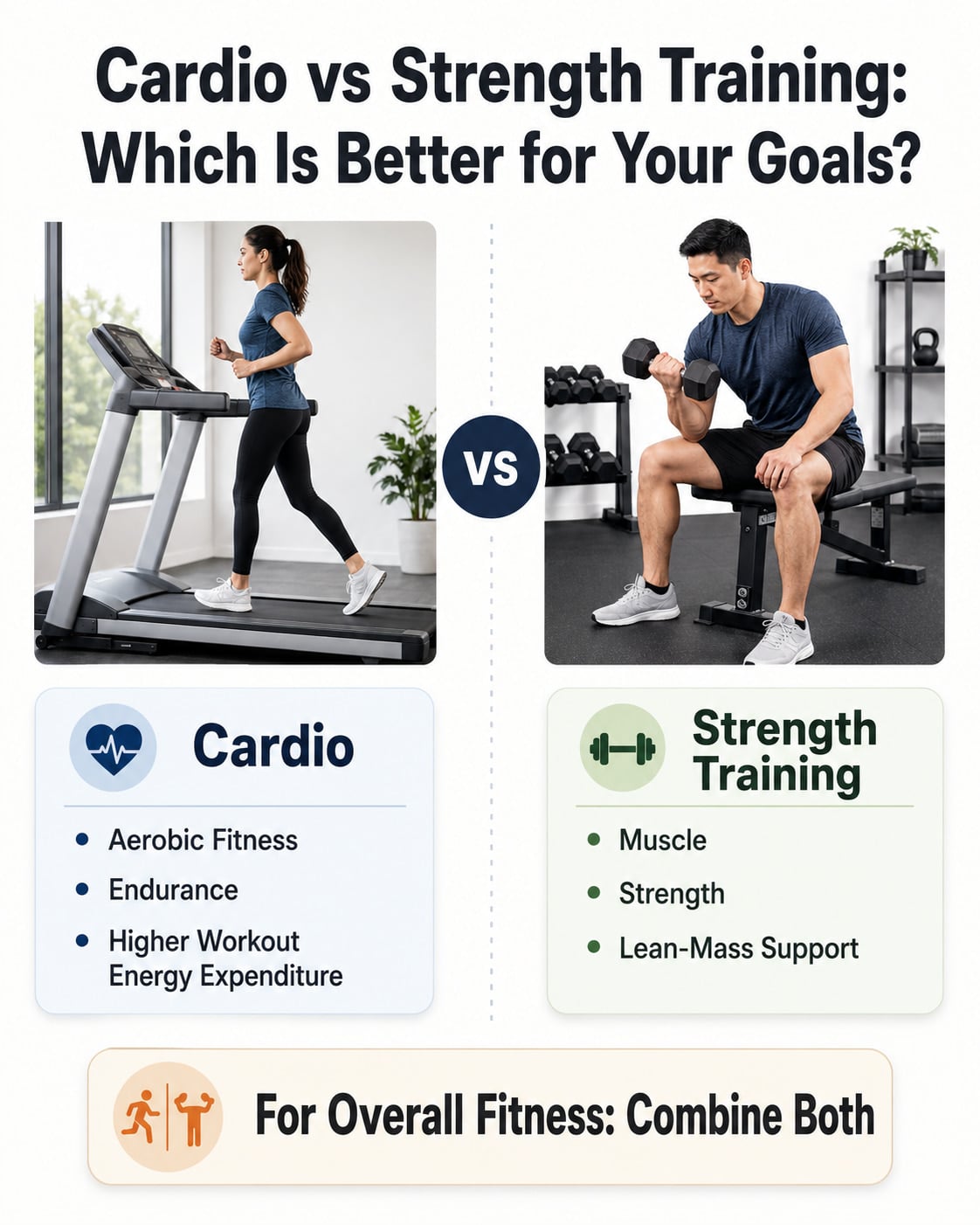
Cardio is better for improving aerobic endurance and usually burns more calories during the workout, while strength training is better for building muscle, increasing strength, and preserving lean mass. For overall health, fitness, and body composition, combining both is usually the best approach.
Your ideal balance depends on whether you want to lose fat, gain muscle, improve heart health, train for an endurance event, or stay active as you age. You do not need to choose one forever.
Current U.S. physical activity guidelines recommend that adults complete 150–300 minutes of moderate-intensity aerobic activity or 75–150 minutes of vigorous activity each week. Adults should also perform muscle-strengthening activities on at least two days per week.
Cardio vs Strength Training at a Glance
| Category | Cardio | Strength training |
|---|---|---|
| Main purpose | Improve cardiovascular and aerobic fitness | Build muscle, strength, and power |
| Common examples | Walking, running, cycling, swimming, rowing, dancing | Weightlifting, machines, resistance bands, bodyweight exercises |
| Best for | Endurance, aerobic capacity, and greater energy expenditure during exercise | Muscle gain, strength, lean-mass preservation, and physical function |
| Primary progression | More time, distance, speed, resistance, or intensity | More weight, repetitions, sets, range of motion, or control |
| Typical frequency | Three or more days per week | At least two days per week |
| Equipment needed | Often none or minimal | Bodyweight, bands, machines, or free weights |
| Main limitation | Does not provide enough resistance for maximum muscle growth | May not provide enough sustained aerobic work by itself |
Both types of exercise can support health. The most useful question is not “Which one is best?” but “Which one should receive more attention for my main goal?”
What Is the Difference Between Cardio and Strength Training?
What Counts as Cardio?
Cardio, also called aerobic exercise, involves continuous or repeated movement that raises your heart rate and breathing for an extended period.
Common forms of cardio include:
- Brisk walking
- Jogging or running
- Cycling
- Swimming
- Rowing
- Hiking
- Dancing
- Stair climbing
- Elliptical training
- Group fitness classes
During moderate-intensity cardio, you should usually be able to talk but not sing comfortably. During vigorous activity, you may only be able to speak a few words before pausing for breath.
Cardio primarily trains your heart, lungs, blood vessels, and working muscles to deliver and use oxygen more efficiently.
What Counts as Strength Training?
Strength training makes your muscles work against resistance. That resistance can come from weights, machines, bands, cables, or your own body weight.
Examples include:
- Squats
- Lunges
- Push-ups
- Rows
- Deadlifts
- Chest presses
- Overhead presses
- Pull-ups
- Resistance-band exercises
- Weight-machine exercises
Strength training works best when the resistance gradually becomes more challenging. This is called progressive overload. You can create it by adding weight, completing more repetitions, improving your range of motion, or using better control.
Which Is Better for Your Goal?
| Your primary goal | Better emphasis | Recommended approach |
|---|---|---|
| Improve aerobic endurance | Cardio | Make cardio the main focus and strength train twice weekly |
| Build muscle | Strength training | Prioritize progressive resistance training and add moderate cardio |
| Increase maximum strength | Strength training | Focus on heavier, well-controlled resistance exercise |
| Lose body weight | Cardio or combined training | Use cardio to increase energy expenditure and strength training to preserve muscle |
| Reduce body fat | Combined training | Pair cardio and strength training with calorie-appropriate eating |
| Improve heart health | Cardio or combined training | Accumulate regular moderate or vigorous aerobic activity |
| Support bone health | Strength and weight-bearing cardio | Include resistance exercise, walking, stairs, or other appropriate loading activities |
| Improve healthy aging | Combined training | Train endurance, strength, balance, and mobility |
| Prepare for a race | Cardio | Follow a sport-specific endurance plan while keeping two strength sessions |
| Improve sports power | Strength training | Prioritize strength and explosive work and manage demanding cardio carefully |
Cardio vs Strength Training for Weight Loss and Fat Loss
For weight loss, cardio often has an immediate advantage because it usually uses more energy during a comparable amount of exercise time. However, strength training plays an important role that the scale may not show.
Why Cardio Helps With Weight Loss
Walking, running, cycling, swimming, and other aerobic activities increase your total daily energy expenditure. This can make it easier to create the sustained calorie deficit needed for weight loss.
A 2024 JAMA Network Open systematic review analyzed 116 randomized trials involving 6,880 adults with overweight or obesity. Body weight, waist circumference, and body-fat measures generally decreased as weekly moderate-to-vigorous aerobic exercise increased toward 300 minutes. At least 150 minutes per week was associated with meaningful reductions in waist circumference and body fat.
These results are group averages, not guaranteed outcomes. Your results will also depend on food intake, exercise intensity, starting fitness, sleep, medication, health conditions, and consistency.
Why Strength Training Still Matters
Weight loss does not always come entirely from body fat. Some people also lose muscle, especially during a large calorie deficit.
A 2025 BMJ Open Sport & Exercise Medicine review found that adding resistance exercise to dietary weight loss helped reduce the loss of fat-free mass, supported greater fat loss, and improved strength in adults with overweight or obesity. The scale did not necessarily fall much faster, but the composition of the weight lost was more favorable.
Strength training can also change how your body looks even when scale weight changes slowly. You may lose fat while maintaining or gaining muscle.
Which Is Better for Belly Fat?
Neither cardio nor strength training can selectively remove fat from your stomach, thighs, arms, or another specific area. Fat loss occurs throughout the body according to factors such as genetics, hormones, age, and overall energy balance.
Abdominal exercises can strengthen your core, but they do not directly burn the fat covering those muscles.
The Verdict for Fat Loss
A balanced fat-loss program should generally include:
- Two or three full-body strength workouts each week
- At least 150 minutes of moderate-intensity cardio per week
- Additional everyday movement, such as walking
- A sustainable, calorie-appropriate eating pattern
- Enough protein, sleep, and recovery to support muscle retention
Cardio helps increase energy expenditure. Strength training helps protect or build muscle. Nutrition largely determines whether you maintain a calorie deficit.
Cardio vs Strength Training for Heart Health
Cardio is the more direct choice for improving aerobic fitness because it trains your body to sustain activity using oxygen. Regular aerobic exercise can support cardiorespiratory fitness and several cardiovascular risk factors.
In the 2024 CardioRACE randomized trial, 406 adults with overweight or obesity and elevated blood pressure were assigned to aerobic, resistance, combined, or no structured exercise for one year. Aerobic and combined training improved the study’s overall cardiovascular risk score, while resistance training improved muscular strength and lean mass.
The study involved a specific population, so its exact results may not apply to everyone. However, it supports a practical conclusion: cardio should be included when cardiovascular and aerobic fitness are important goals, while combined training provides a broader mix of adaptations.
Strength training is still valuable for health. It should complement cardio rather than automatically replace it.
Cardio vs Strength Training for Muscle Gain and Strength
Strength training is the clear priority when your main goal is to build muscle or become stronger.
Muscle growth requires repeated mechanical tension and gradually increasing demands. Although activities such as running, rowing, and cycling train the working muscles, they do not usually provide the progressive resistance needed for maximum strength or muscle growth.
The American College of Sports Medicine’s 2026 resistance-training guidance reviewed 137 systematic reviews representing more than 30,000 participants. It emphasizes that training all major muscle groups at least twice weekly and following a program consistently matter more than using complicated techniques. Heavier resistance is generally more useful for maximum strength, while greater weekly training volume supports muscle growth.
A practical strength workout should train the major movement patterns:
- Squat or lunge
- Hip hinge
- Horizontal push
- Horizontal pull
- Vertical push
- Vertical pull
- Core stabilization
- Carrying or loaded movement when appropriate
Choose resistance that makes the final repetitions challenging without causing your form to break down. Once you can comfortably exceed your target repetitions, gradually increase the resistance or difficulty.
Does Cardio Reduce Muscle Growth?
Cardio does not automatically “kill gains.”
A systematic review of 43 studies found that combining aerobic and strength training did not significantly compromise muscle growth or maximum-strength development compared with strength training alone. However, improvements in explosive strength could be smaller when hard cardio and strength work were performed within the same session.
For most recreational exercisers, this interference effect is not a reason to avoid cardio. It becomes more relevant when maximum power, sprint performance, or elite-level strength is the main objective.
To reduce unnecessary fatigue:
- Avoid difficult intervals immediately before heavy lower-body training.
- Keep some cardio sessions easy or moderate.
- Separate demanding cardio and strength workouts by several hours or different days when possible.
- Eat enough and allow time for recovery.
Which Is Better for Bone Health and Healthy Aging?
Strength training and weight-bearing cardio can both support bone health, but they do so differently.
Resistance exercises place controlled tension on muscles and bones. Weight-bearing activities place force through the skeleton while you support your body weight.
Examples of weight-bearing cardio include:
- Brisk walking
- Stair climbing
- Hiking
- Dancing
- Jogging, when appropriate
- Court sports
Swimming and cycling can provide excellent cardiovascular exercise, but they place less direct load on the skeleton than weight-bearing activities.
The National Institute of Arthritis and Musculoskeletal and Skin Diseases identifies resistance and weight-bearing exercise as useful components of bone-health activity. Exercise selection should be individualized for people with osteoporosis, previous fractures, significant balance problems, or joint limitations.
Strength training also supports tasks such as standing from a chair, carrying groceries, climbing stairs, and maintaining independence. Older adults should include balance exercises in addition to aerobic and muscle-strengthening activity.
Should You Do Cardio Before or After Strength Training?
The best order depends on which activity matters most that day.
Do Strength Training First When:
- Your main goal is building muscle
- You want to improve maximum strength
- You are performing heavy or technically demanding lifts
- Hard cardio would make it difficult to maintain safe lifting form
Complete your primary strength exercises while you are fresh. Cardio can follow, preferably at an intensity that does not compromise recovery.
Do Cardio First When:
- You are training for a running, cycling, rowing, or swimming event
- Aerobic performance is the main goal of the session
- The planned strength workout is short and supportive
- You need to practice a specific pace or endurance skill
A short, easy warm-up before lifting does not count as choosing cardio first. Five to ten minutes of walking, cycling, or rowing can prepare you for strength work without creating substantial fatigue.
For General Fitness
Either order can work. Start with the activity you most want to improve or the one that requires the most concentration.
Consistency matters more than finding a perfect sequence.
Can You Do Cardio and Strength Training on the Same Day?
Yes. Many people can safely combine cardio and strength training in one session.
A practical same-day workout might look like this:
- Five to ten minutes of easy movement
- Thirty to forty-five minutes of strength training
- Ten to twenty-five minutes of easy or moderate cardio
- A gradual cool-down
Avoid making every part of the workout highly demanding. Combining heavy leg training with exhausting running intervals may reduce performance and increase fatigue, especially if you are new to exercise.
When both sessions need to be intense, complete them at different times of day or on separate days.
How Much Cardio and Strength Training Do You Need?
For most adults, the general weekly target is:
| Exercise type | Weekly recommendation |
|---|---|
| Moderate-intensity cardio | 150–300 minutes |
| Vigorous-intensity cardio | 75–150 minutes |
| Combination of intensities | An equivalent mixture of moderate and vigorous activity |
| Strength training | At least two days covering all major muscle groups |
| Balance training | Especially important for older adults and people at increased fall risk |
You do not need to complete all your cardio in long sessions. Shorter periods can be added throughout the week.
For example, you could reach 150 minutes with:
- Five 30-minute sessions
- Three 50-minute sessions
- Daily sessions of about 22 minutes
- A combination of 10-, 15-, and 30-minute periods
Some activity is better than none. Beginners can start below the recommended amount and gradually increase time, frequency, or intensity.
Sample Cardio and Strength Training Plans
These are general examples rather than individualized prescriptions.
Beginner Plan for General Health
| Day | Activity |
|---|---|
| Monday | Full-body strength training plus a 15-minute easy walk |
| Tuesday | 30-minute brisk walk |
| Wednesday | 30-minute brisk walk or bike ride |
| Thursday | Full-body strength training plus a 15-minute easy walk |
| Friday | Rest or gentle mobility |
| Saturday | 30 minutes of moderate cardio |
| Sunday | 30 minutes of moderate cardio |
This schedule provides two strength days and approximately 150 minutes of cardio.
A beginner who cannot yet complete 30 minutes continuously could divide the activity into shorter periods.
Plan With a Fat-Loss Emphasis
Use two or three full-body strength sessions and three to five cardio sessions each week. Start near 150 weekly cardio minutes and add time gradually only when recovery remains good.
Most cardio can be moderate intensity. One shorter interval session may be added after you have developed a fitness base, but intense intervals are not required for fat loss.
Plan With a Muscle-Gain Emphasis
Use three or four strength sessions and two or three easy cardio sessions each week.
Cardio sessions might last 20–30 minutes and include walking, easy cycling, or another low-fatigue activity. Keep demanding endurance workouts away from your hardest lower-body strength sessions when possible.
Plan With an Endurance Emphasis
Use three to five sport-specific cardio sessions and two strength sessions each week.
Your cardio plan may include easy sessions, a longer session, and one higher-intensity workout. Strength sessions should support the muscles and movement patterns needed for your activity without creating excessive soreness.
How to Choose the Right Balance
Start by identifying one primary goal for the next several weeks.
Choose More Cardio When You Want To:
- Improve stamina
- Prepare for an endurance event
- Walk longer without tiring
- Increase weekly energy expenditure
- Improve aerobic fitness
Choose More Strength Training When You Want To:
- Build muscle
- Lift heavier weights
- Preserve lean mass during weight loss
- Improve everyday strength
- Support sports requiring strength or power
Use a Balanced Approach When You Want To:
- Improve general health
- Change body composition
- Stay active as you age
- Support both strength and endurance
- Avoid becoming highly specialized
You should also consider enjoyment, schedule, equipment, injury history, and current fitness. A theoretically ideal program has little value if it is too difficult or inconvenient to follow consistently.
Common Cardio vs Strength Training Mistakes
Choosing Only One Type of Exercise
Cardio and strength training create different adaptations. Relying exclusively on one can leave important areas of fitness underdeveloped.
Doing Too Much Too Soon
Rapidly increasing running distance, interval frequency, or lifting volume can create more fatigue than your body is prepared to manage. Increase one variable at a time.
Making Every Cardio Session Intense
Easy and moderate sessions build fitness with less fatigue. High-intensity interval training can be useful, but it does not need to dominate your program.
Lifting Without Progression
Repeating the same easy resistance indefinitely may maintain activity, but it provides little reason for your muscles to adapt. Increase the challenge gradually while preserving good form.
Measuring Progress Only by Body Weight
Scale weight does not show changes in muscle, strength, endurance, waist size, or fitness. Track several measures that match your goal.
Ignoring Recovery
Exercise adaptations occur between workouts. Persistent fatigue, declining performance, irritability, sleep problems, or unusually prolonged soreness may indicate that your workload needs adjustment.
Cardio and Strength Training Safety Tips
Start with exercise that matches your current ability. Gradually increase duration and intensity rather than beginning with demanding intervals or heavy resistance.
Use stable equipment and controlled movement during strength training. Stop a set when you cannot maintain safe technique.
Moderate-intensity activity is appropriate for many adults. However, the CDC advises people with chronic conditions to discuss suitable exercise types and amounts with a healthcare professional. People who have been inactive or have certain health concerns should seek guidance before beginning vigorous-intensity exercise.
Stop exercising and seek urgent medical assistance for symptoms such as chest pressure, fainting, severe breathing difficulty, or sudden weakness or numbness.
Frequently Asked Questions
Is Cardio or Strength Training Better for Losing Belly Fat?
Neither exercise can target belly fat specifically. Cardio can increase calorie expenditure, while strength training helps preserve or build muscle. Combining both with a sustainable calorie deficit is generally the most practical approach.
Can Strength Training Replace Cardio?
Strength training can provide some cardiovascular demand, especially when exercises are performed with limited rest. However, it usually does not provide the same sustained aerobic stimulus as brisk walking, running, swimming, or cycling. Most people benefit from including both.
Does Cardio Make You Lose Muscle?
Moderate amounts of cardio do not automatically cause muscle loss. The risk may increase when high training volumes are combined with inadequate calories, insufficient protein, poor recovery, or no resistance training.
Is 20 Minutes of Cardio After Weights Enough?
It can contribute meaningfully to your weekly total. Whether it is enough depends on intensity, frequency, your other activity, and your goal. Five 20-minute sessions provide 100 minutes, so additional moderate activity would normally be needed to reach the general 150-minute target.
How Many Days a Week Should I Do Cardio and Strength Training?
Aim for strength training on at least two days per week and distribute your aerobic activity across several days. Your exact schedule can vary as long as you accumulate the recommended weekly amount and recover adequately.
Should Beginners Start With Cardio or Strength Training?
Beginners should generally include both. Two simple full-body strength sessions and several short walks or other moderate cardio sessions provide a manageable starting point. Increase the workload gradually as your fitness improves.
Conclusion
In the cardio vs strength training debate, the right answer depends on what you want to achieve. Cardio deserves more attention when aerobic endurance and energy expenditure are your priorities. Strength training should lead when your goal is muscle, strength, or lean-mass preservation.
For overall health and balanced fitness, combine the two. Start with at least two strength sessions and gradually work toward 150 minutes of moderate cardio each week. Choose activities you enjoy, track progress that matches your goal, and adjust the balance as your needs change.
References
- Office of Disease Prevention and Health Promotion: Physical Activity Guidelines for Americans
- American College of Sports Medicine: 2026 Resistance Training Guidelines
- JAMA Network Open: Aerobic Exercise and Weight Loss in Adults
- European Heart Journal: CardioRACE Trial
- BMJ Open Sport & Exercise Medicine: Resistance Exercise During Dietary Weight Loss
- Sports Medicine: Concurrent Aerobic and Strength Training Meta-Analysis
- National Institute of Arthritis and Musculoskeletal and Skin Diseases: Exercise for Bone Health
- Centers for Disease Control and Prevention: Adding Physical Activity as an Adult