
A practical weight loss workout plan combines two full-body strength sessions with progressively more cardio, reaching about 150 minutes of moderate-intensity aerobic exercise by Week 4. This four-week program gives you a clear schedule, home and gym exercise options, recovery days, and simple progression rules.
The plan is designed for generally healthy adults who are beginning exercise or returning after a break. It can support weight loss, improve fitness, and build strength, but exercise does not guarantee a specific change on the scale. Nutrition, sleep, stress, medications, health conditions, and your starting activity level also influence results.
How This Weight Loss Workout Plan Works
The federal Physical Activity Guidelines for Americans recommend that adults work toward:
- 150 to 300 minutes of moderate-intensity aerobic activity each week
- Or 75 to 150 minutes of vigorous activity
- Or an equivalent combination
- Muscle-strengthening exercise on at least two days per week
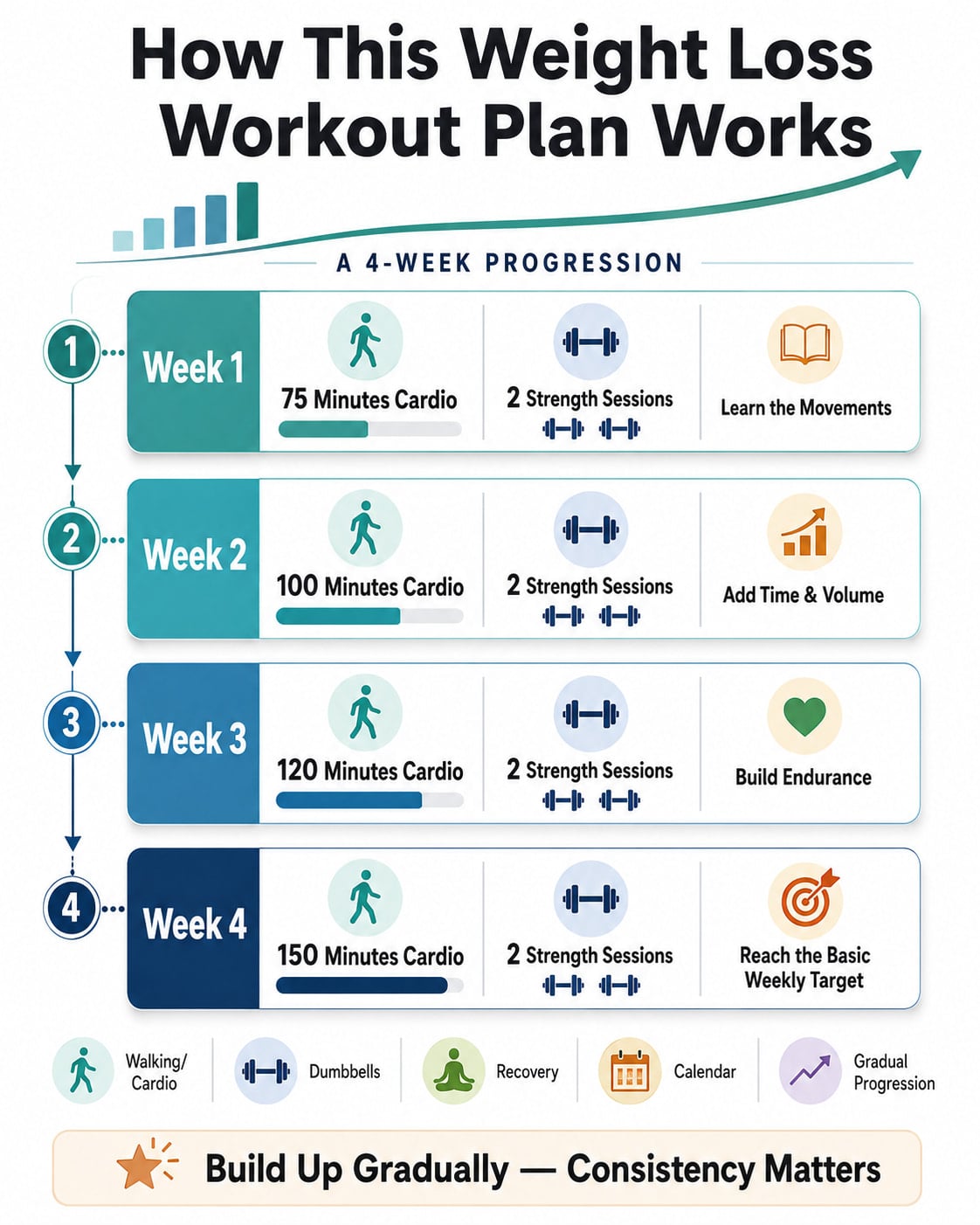
People who are currently inactive are encouraged to start with smaller amounts and build up gradually. This plan follows that approach by increasing planned cardio from 75 minutes in Week 1 to 150 minutes in Week 4 while maintaining two nonconsecutive strength days.
| Week | Planned Cardio | Strength Training | Primary Goal |
|---|---|---|---|
| Week 1 | 75 minutes | 2 sessions | Learn the movements and establish consistency |
| Week 2 | 100 minutes | 2 sessions | Add cardio time and strength volume |
| Week 3 | 120 minutes | 2 sessions | Improve endurance and introduce optional intervals |
| Week 4 | 150 minutes | 2 sessions | Reach the basic weekly aerobic target |
The listed cardio minutes refer to the main working portion of each session. Add a short warm-up and cool-down when needed.
Why Cardio Is Included
Cardio raises your heart rate, improves aerobic fitness, and increases the amount of energy you use during the week. Suitable activities include brisk walking, stationary cycling, elliptical training, swimming, rowing, dancing, and low-impact aerobics.
According to the CDC’s guidance on physical activity and weight, regular activity can support the calorie deficit needed for weight loss. However, many people also need to adjust their food intake because the amount of activity required to lose and maintain weight varies significantly between individuals.
A 2024 systematic review in JAMA Network Open examined 116 randomized trials involving 6,880 adults with overweight or obesity. Body weight, waist circumference, and body-fat measures generally improved as weekly aerobic exercise increased toward 300 minutes. At least 150 weekly minutes of moderate-to-vigorous aerobic exercise was associated with clinically important reductions in waist circumference and body-fat measures. The included programs lasted at least eight weeks, so this four-week plan should be viewed as a starting block rather than a complete weight-loss program.
Why Strength Training Is Included
Strength training works your major muscle groups and helps improve your ability to squat, lift, push, pull, carry, and perform everyday tasks.
A 2025 systematic review found that resistance exercise during diet-induced weight loss helped protect fat-free mass, increased fat-mass loss, and improved strength, even though it did not necessarily produce a larger change in total scale weight.
The American College of Sports Medicine released updated resistance training guidelines in March 2026. The guidance emphasizes that consistent training matters more than complicated routines. Bodyweight exercises, resistance bands, machines, and free weights can all be effective, and training to complete muscular failure is not required for most healthy adults.
Before Starting the 4-Week Weight Loss Workout Plan
Who This Plan Is For
This plan is most appropriate for generally healthy adults who:
- Are new to structured exercise
- Are returning after a period of inactivity
- Can walk or perform another form of cardio without serious symptoms
- Want a simple home or gym workout schedule
- Can complete basic movement patterns with safe, controlled form
It is not an individualized rehabilitation program. People recovering from surgery, managing an injury, pregnant or recently postpartum, or living with a condition that affects exercise tolerance may need a plan from a qualified healthcare or fitness professional.
Equipment You May Need
You can complete the plan with little or no specialized equipment.
Useful options include:
- A sturdy chair or bench
- Comfortable walking or training shoes
- An exercise mat
- Resistance bands
- One or two dumbbells
- A backpack that can be loaded gradually
- A stationary bike, treadmill, elliptical, or rowing machine
No single machine or type of weight is required. Choose equipment that allows you to maintain control throughout every repetition.
How Hard Should Cardio Feel?
Most cardio in this plan should be performed at a moderate intensity.
Use either of these methods:
The Talk Test
At moderate intensity, you should be able to speak in sentences but not sing comfortably. At vigorous intensity, you will usually need to pause for breath after a few words.
The 1-to-10 Effort Scale
Use this simple rating:
| Effort | Description | How It Feels |
|---|---|---|
| 2–3 | Easy | Comfortable warm-up or recovery pace |
| 4–6 | Moderate | Breathing faster but still able to talk |
| 7–8 | Vigorous | Difficult, with only short phrases possible |
| 9–10 | Near maximum | Not needed in this beginner plan |
Aim for approximately 4 to 6 out of 10 during steady cardio. The optional intervals in Weeks 3 and 4 may briefly reach 7 out of 10, but they should never become an all-out sprint.
Warm Up Before Each Workout
Before cardio, spend three to five minutes moving at an easy pace. Gradually increase your speed until you reach the planned effort.
Before strength training, complete one round of:
- 30 to 60 seconds of easy marching
- 8 controlled chair squats
- 8 bodyweight hip hinges
- 8 alternating step-backs
- 10 arm circles in each direction
- Several easy practice repetitions of the first exercise
The warm-up should prepare you to move, not tire you out.
4-Week Weight Loss Workout Plan
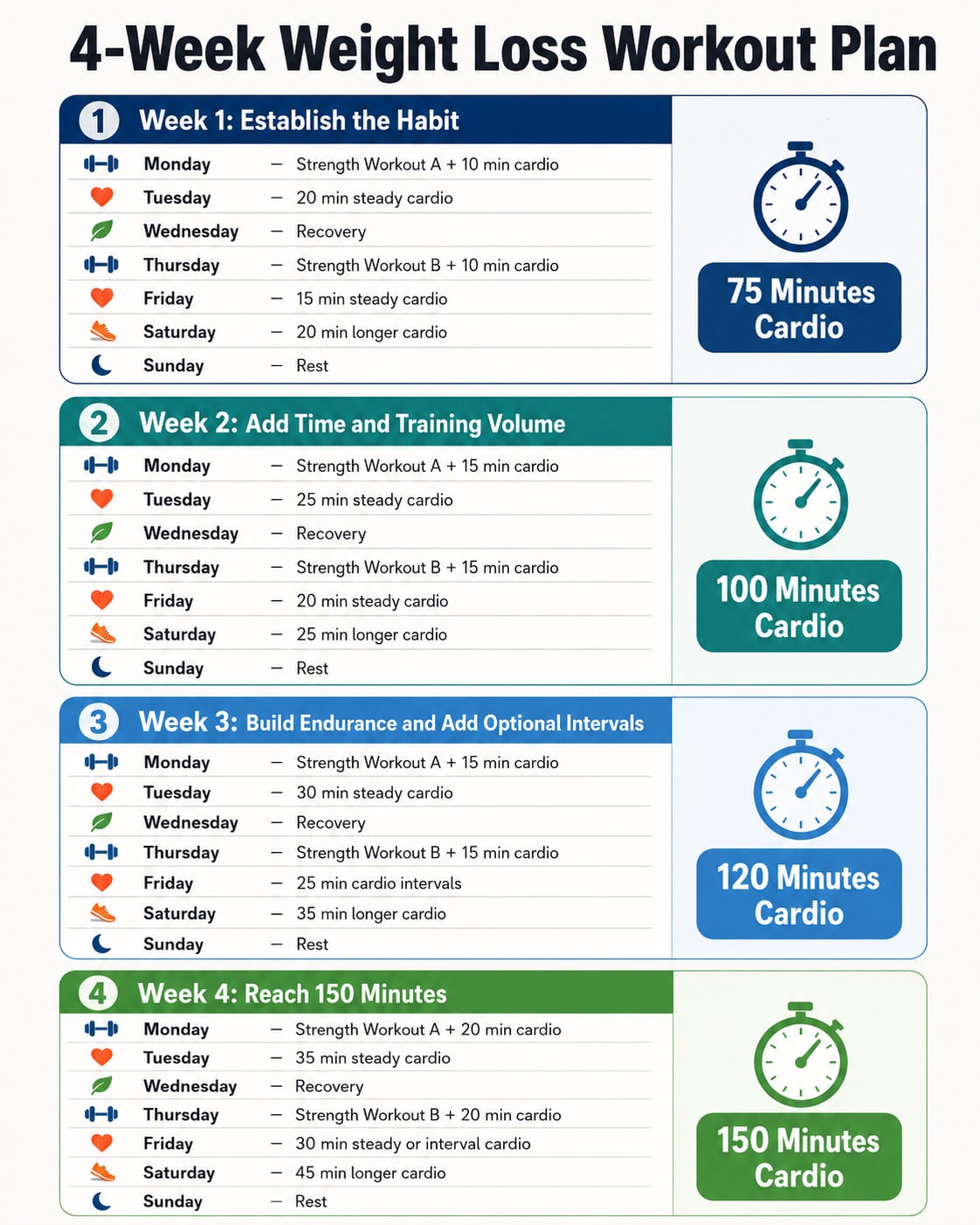
You can change the days to fit your schedule. Keep at least one day between the two full-body strength sessions whenever possible.
Week 1: Establish the Habit
Week 1 introduces the schedule without trying to maximize calorie burn. Use comfortable cardio choices and prioritize controlled strength-training form.
Cardio target: 75 minutes
| Day | Workout | Details |
|---|---|---|
| Monday | Strength Workout A plus cardio | Complete 1 set of each strength exercise, followed by 10 minutes of moderate cardio |
| Tuesday | Steady cardio | 20 minutes at an effort of 4–5 out of 10 |
| Wednesday | Recovery | Rest or perform 10–15 minutes of easy walking and mobility |
| Thursday | Strength Workout B plus cardio | Complete 1 set of each strength exercise, followed by 10 minutes of moderate cardio |
| Friday | Steady cardio | 15 minutes at an effort of 4–5 out of 10 |
| Saturday | Longer cardio | 20 minutes at an effort of 4–5 out of 10 |
| Sunday | Rest | Full rest or gentle daily movement |
Week 1 Goal
Finish each workout feeling that you could have done a little more. Avoid adding extra workouts simply because the first week feels manageable. Consistency is more important than starting aggressively.
Week 2: Add Time and Training Volume
Week 2 adds 25 minutes of cardio across the week. You may also add a second set to selected strength exercises.
Cardio target: 100 minutes
| Day | Workout | Details |
|---|---|---|
| Monday | Strength Workout A plus cardio | Complete 1–2 sets per exercise, followed by 15 minutes of moderate cardio |
| Tuesday | Steady cardio | 25 minutes at an effort of 4–6 out of 10 |
| Wednesday | Recovery | Rest or complete easy walking and mobility |
| Thursday | Strength Workout B plus cardio | Complete 1–2 sets per exercise, followed by 15 minutes of moderate cardio |
| Friday | Steady cardio | 20 minutes at an effort of 4–6 out of 10 |
| Saturday | Longer cardio | 25 minutes at an effort of 4–6 out of 10 |
| Sunday | Rest | Full rest |
Week 2 Goal
Add a second strength set only when the first set feels controlled and your form remains consistent. You do not need to increase the weights and sets during the same week.
Week 3: Build Endurance and Add Optional Intervals
Week 3 increases your longest cardio session and introduces a controlled interval option. Intervals are not required for weight loss. Continue with steady cardio if faster work causes pain, excessive fatigue, or discomfort.
Cardio target: 120 minutes
| Day | Workout | Details |
|---|---|---|
| Monday | Strength Workout A plus cardio | Complete 2 sets per exercise, followed by 15 minutes of moderate cardio |
| Tuesday | Steady cardio | 30 minutes at an effort of 4–6 out of 10 |
| Wednesday | Recovery | Rest or complete gentle walking and mobility |
| Thursday | Strength Workout B plus cardio | Complete 2 sets per exercise, followed by 15 minutes of moderate cardio |
| Friday | Cardio intervals | 25 minutes using the beginner interval format below |
| Saturday | Longer cardio | 35 minutes at an effort of 4–6 out of 10 |
| Sunday | Rest | Full rest |
Beginner Cardio Interval Format
After warming up, repeat the following five times:
- 1 minute at an effort of about 7 out of 10
- 4 minutes at an effort of about 4–5 out of 10
The harder minute should feel brisk and challenging, not maximal. Walking uphill, increasing bike resistance, or slightly increasing elliptical speed can create the interval without running.
Week 4: Reach 150 Minutes
Week 4 reaches the basic federal aerobic target while maintaining two full-body strength sessions.
Cardio target: 150 minutes
| Day | Workout | Details |
|---|---|---|
| Monday | Strength Workout A plus cardio | Complete 2 sets per exercise, followed by 20 minutes of moderate cardio |
| Tuesday | Steady cardio | 35 minutes at an effort of 4–6 out of 10 |
| Wednesday | Recovery | Rest or complete gentle mobility |
| Thursday | Strength Workout B plus cardio | Complete 2 sets per exercise, followed by 20 minutes of moderate cardio |
| Friday | Steady or interval cardio | 30 minutes of steady cardio or controlled intervals |
| Saturday | Longer cardio | 45 minutes at an effort of 4–6 out of 10 |
| Sunday | Rest | Full rest |
Week 4 Goal
Complete the weekly schedule without sacrificing form or recovery. Reaching 150 minutes is useful, but you do not need to force the target through pain, illness, or excessive fatigue.
If Week 4 feels like too large a jump, repeat Week 3 before progressing.
Full-Body Strength Workout A
Complete the exercises in order. Rest approximately 60 to 90 seconds between sets, or longer when needed to restore controlled breathing and good technique.
| Exercise | Repetitions | Beginner Option | Progression Option |
|---|---|---|---|
| Chair squat | 8–12 | Sit down and stand from a higher chair | Goblet squat with a dumbbell |
| Incline push-up | 8–12 | Push against a wall | Use a lower bench or perform a floor press |
| Supported one-arm row | 8–12 per side | Light band row | Heavier dumbbell or band |
| Glute bridge | 10–15 | Shorter range of motion | Add a dumbbell or pause at the top |
| Standing calf raise | 12–15 | Hold a chair for support | Single-leg or weighted calf raise |
| Dead bug | 6–10 per side | Move one limb at a time | Extend the opposite arm and leg together |
Chair Squat
Stand in front of a stable chair with your feet around hip- to shoulder-width apart.
Push your hips back, bend your knees, and lower under control until you lightly touch the chair. Keep your feet planted and stand by pressing through the floor.
Use a higher chair or reduce the depth if needed.
Incline Push-Up
Place your hands on a wall, countertop, or secure bench. Keep your body in a straight line from your head to your heels.
Bend your elbows and lower your chest toward the surface. Press away without allowing your hips to sag.
A higher surface makes the movement easier.
Supported One-Arm Row
Place one hand on a sturdy chair or bench. Hold a dumbbell, band, or loaded bag in the other hand.
Pull the resistance toward your ribs while keeping your torso steady. Lower it slowly instead of letting it drop.
Glute Bridge
Lie on your back with your knees bent and feet flat.
Gently brace your midsection, press through your feet, and raise your hips. Stop before your lower back begins to overarch.
Standing Calf Raise
Stand tall and hold a stable object if you need balance support.
Raise your heels, pause briefly, and lower them under control. Avoid bouncing.
Dead Bug
Lie on your back with your knees bent and arms pointing upward.
Keep your trunk controlled as you slowly lower one heel or extend one leg. Only use a range that allows you to avoid excessive arching through the lower back.
Full-Body Strength Workout B
| Exercise | Repetitions | Beginner Option | Progression Option |
|---|---|---|---|
| Low step-up | 6–10 per side | Supported reverse lunge or repeated chair stand | Higher step or light dumbbells |
| Hip hinge | 8–12 | Bodyweight hip hinge | Dumbbell Romanian deadlift |
| Shoulder press | 8–12 | Seated press with light weights | Standing press or heavier resistance |
| Band pulldown | 8–12 | Seated band row | Stronger band or machine pulldown |
| Suitcase carry | 20–40 seconds per side | Standing weighted march | Longer walk or heavier load |
| Bird dog | 6–10 per side | Move one arm or leg at a time | Extend the opposite arm and leg |
Low Step-Up
Place one foot fully on a low, stable step. Press through that foot to stand taller, then step down with control.
Hold a railing, wall, or sturdy support if needed. Keep the step low enough that you can move without pushing excessively from the trailing leg.
Hip Hinge or Romanian Deadlift
Stand with soft knees and push your hips backward while keeping your spine in a comfortable neutral position.
You should feel tension through the back of your thighs. Stand by driving your hips forward, not by leaning backward.
Shoulder Press
Hold light dumbbells, resistance bands, or suitable household objects at shoulder level.
Press upward without excessively arching your lower back. Use a seated position if standing makes balance or trunk control difficult.
Band Pulldown
Anchor a resistance band safely above you.
Pull your elbows down toward your sides, pause briefly, and allow the arms to return under control. A seated row can replace the pulldown when an appropriate anchor is unavailable.
Suitcase Carry
Hold one dumbbell or loaded bag at your side. Stand tall and walk slowly without leaning toward or away from the weight.
Switch hands after the planned time. You can march in place when space is limited.
Bird Dog
Begin on your hands and knees.
Extend one arm, one leg, or the opposite arm and leg while keeping your trunk steady. Use a smaller movement if your hips or lower back rotate.
How to Progress the Strength Workouts
The National Institute of Diabetes and Digestive and Kidney Diseases recommends training the major muscle groups at least twice weekly and provides a general starting range of 8 to 12 repetitions for many strength exercises. It also advises avoiding training the same muscles on consecutive days.
Use these progression rules:
- Week 1: Perform one set of each exercise.
- Week 2: Add a second set to exercises that feel comfortable.
- Weeks 3 and 4: Aim for two controlled sets.
- Increase repetitions first: Work toward the top of the recommended range.
- Increase resistance gradually: Add a small amount of weight or band tension once you can complete the top number with consistent form.
- Avoid complete failure: Finish most sets feeling that you could perform another two or three controlled repetitions.
- Change one variable at a time: Do not increase resistance, repetitions, sets, and cardio duration simultaneously.
A more difficult workout is not automatically a better workout. Progress only when you can control the movement and recover before the next scheduled session.
How to Adapt the Plan to Your Needs
For Home Workouts
Use bodyweight, bands, dumbbells, or loaded household objects.
Practical substitutions include:
- Backpack squats instead of goblet squats
- Wall push-ups instead of bench push-ups
- Band rows instead of cable rows
- Water containers instead of dumbbells
- Marching indoors instead of treadmill walking
- Stair walking instead of a step machine
Make sure chairs, steps, band anchors, and household equipment are stable before using them.
For Gym Workouts
You can replace the strength exercises with comparable machines:
| Plan Exercise | Gym Alternative |
|---|---|
| Chair or goblet squat | Leg press or supported squat |
| Incline push-up | Chest press machine |
| One-arm row | Seated cable row |
| Glute bridge | Hip thrust machine |
| Step-up | Supported split squat |
| Hip hinge | Dumbbell or machine Romanian deadlift |
| Shoulder press | Seated shoulder press machine |
| Band pulldown | Lat pulldown machine |
Machines can be useful when you are learning because they reduce some balance and coordination demands. They are not required for effective training.
For Low-Impact Exercise
Choose movements that reduce pounding and abrupt changes of direction:
- Flat or gently inclined walking
- Stationary cycling
- Recumbent cycling
- Elliptical training
- Water walking
- Swimming
- Low-impact aerobics
Low impact does not mean zero stress. Reduce the duration, range of motion, speed, or resistance if an activity aggravates a joint or changes the way you move.
For Busy Schedules
You may divide cardio into shorter sessions.
For example, a planned 30-minute day could become:
- 10 minutes before work
- 10 minutes at lunch
- 10 minutes after dinner
Current guidance allows moderate-to-vigorous activity to accumulate in shorter bouts rather than requiring a single continuous session.
You can also separate cardio and strength completed on the same day. Perform strength in the morning and cardio later, or reverse the order according to your schedule.
For People Who Are Already Active
Start with the week that is closest to your current sustainable activity level.
You can also progress by:
- Increasing cardio toward 180 minutes after Week 4
- Adding a third strength set to selected exercises
- Using slightly heavier resistance
- Adding another interval round
- Choosing more challenging exercise variations
Do not progress every category at once.
How to Make the Plan Support Weight Loss
Pair Exercise With a Sustainable Eating Pattern
Exercise can support a calorie deficit, but workouts are only one part of weight management. The CDC describes healthy weight loss as a combination of nutritious eating, regular activity, adequate sleep, and stress management.
You do not need an extreme diet. Start with practical changes such as:
- Building meals around minimally processed foods
- Including a protein-rich food at meals
- Eating vegetables and fruit regularly
- Choosing fiber-rich carbohydrates when appropriate
- Limiting frequent high-calorie drinks
- Planning portions instead of eating directly from large packages
- Eating slowly enough to notice fullness
- Preparing convenient meals before busy days
The eating pattern must be realistic enough to continue after the four-week program ends.
Avoid “Earning” Food With Exercise
A workout should not be used as punishment for eating or as permission to overeat.
Cardio machines and fitness trackers provide calorie estimates, not exact measurements. Instead of trying to match every calorie eaten with calories supposedly burned, focus on a repeatable eating routine and consistent weekly activity.
Prioritize Recovery
Recovery supports exercise performance and makes the plan easier to maintain.
Helpful habits include:
- Keeping two lower-demand days each week
- Getting a consistent amount of sleep
- Drinking fluids throughout the day
- Eating regular, balanced meals
- Using light movement when you feel mildly stiff
- Reducing training volume when illness, pain, or unusual fatigue develops
Normal muscle fatigue is different from sharp, worsening, or joint-related pain.
How to Track Progress Over Four Weeks
Scale weight is only one measure of progress.
Consider tracking:
- Weekly cardio minutes
- Strength workouts completed
- Repetitions or resistance used
- Walking pace or distance
- Waist measurement
- How your clothes fit
- Energy during everyday activities
- Sleep quality
- Exercise confidence
For body weight, measure under similar conditions each time. Day-to-day changes do not always reflect changes in body fat, so look for a trend rather than reacting to one reading.
You can also perform a simple fitness check at the beginning and end of the program:
- How far can you walk comfortably in 20 minutes?
- How many controlled chair squats can you perform?
- What incline allows you to complete 8 good push-ups?
- How long can you maintain a moderate cardio pace?
- What resistance can you row for 8–12 controlled repetitions?
Improving these measures is meaningful progress even when scale weight changes slowly.
What Results Can You Expect in Four Weeks?
Possible four-week results include:
- Better workout consistency
- Improved cardio endurance
- More strength repetitions
- Better exercise technique
- Greater confidence with physical activity
- Possible changes in body weight or waist measurement
- Improved ability to perform daily activities
A gradual pace of approximately 1 to 2 pounds per week is commonly described by the CDC as more sustainable than rapid weight loss. However, this does not mean everyone following the plan will lose 4 to 8 pounds in four weeks. Food intake, water balance, starting weight, medications, hormones, medical conditions, sleep, age, and prior training all affect the result.
You may improve your fitness before seeing a clear scale change. That does not make the plan unsuccessful.
Common Weight Loss Workout Mistakes
Doing Too Much Too Soon
Starting with daily intense exercise may cause excessive soreness, fatigue, or an overuse problem that interrupts consistency.
Follow the progression unless you already tolerate a higher workload.
Relying Only on Cardio
Cardio is useful, but skipping strength training removes an important opportunity to improve strength and protect fat-free mass during weight loss.
Making Every Workout High Intensity
Most weekly cardio should feel moderate. Hard intervals are optional and should represent only a small part of a beginner’s plan.
Ignoring Pain
Sharp pain, worsening joint pain, or pain that changes your movement is not a signal to “push through.” Stop the aggravating exercise and choose a suitable modification.
Constantly Changing the Program
Repeating the same fundamental movements allows you to improve technique and measure progress. You do not need a completely new workout every day.
Treating Exercise as the Entire Weight Loss Strategy
Workouts cannot reliably compensate for an eating pattern that consistently exceeds your energy needs. Combine activity with realistic nutrition, sleep, and stress-management habits.
Weight Loss Workout Plan Safety
Most people can participate in appropriate physical activity safely. However, review the NIDDK’s exercise safety guidance and speak with a healthcare professional before starting if you:
- Become short of breath very easily
- Have difficulty moving or maintaining balance
- Are unsure whether exercise is safe for you
- Have diabetes, high blood pressure, heart disease, or another chronic condition
- Have a back, hip, knee, bone, or joint problem that activity may aggravate
- Have recently had surgery, a major illness, or a significant injury
Stop exercising and seek prompt medical help for:
- Pain, pressure, or tightness in the chest, neck, shoulder, or arm
- Extreme shortness of breath
- Dizziness
- Feeling seriously unwell
Persistent pain in your joints, feet, ankles, or legs also deserves professional assessment.
Frequently Asked Questions
Can You Lose Weight in Four Weeks With This Workout Plan?
You may lose weight, but no workout plan can guarantee a specific result. Weight loss depends on your total calorie intake, activity, starting weight, sleep, stress, health, medications, and consistency.
Four weeks is long enough to build a routine and improve fitness. Larger, reliable changes in body composition usually require continued habits beyond the first month.
How Many Days a Week Should You Work Out to Lose Weight?
This plan includes five active days, but two days combine strength training with short cardio sessions. It also includes two recovery days.
The more important targets are your total weekly activity, two weekly strength sessions, and your ability to recover. You do not need seven hard workout days.
Is Cardio or Strength Training Better for Weight Loss?
Cardio generally makes it easier to accumulate aerobic exercise and increase weekly energy expenditure. Strength training improves muscular strength and may help protect fat-free mass during diet-induced weight loss.
A combined plan provides benefits that either method alone may not fully provide.
Do Beginners Need HIIT to Lose Weight?
No. High-intensity interval training is not required.
Moderate walking, cycling, elliptical training, swimming, and similar activities can support weight management when performed consistently. Beginners should first develop a comfortable aerobic base. Intervals can be added later when appropriate.
Can This Weight Loss Workout Plan Be Done at Home?
Yes. Chair squats, incline push-ups, glute bridges, hip hinges, step-ups, rows, carries, dead bugs, and bird dogs can all be adapted for home training.
Resistance bands, dumbbells, or a loaded backpack can provide additional resistance, but bodyweight options are available.
What Should You Do When You Miss a Workout?
Do not double your next workout to make up for it.
Continue with the next planned session. When practical, move the missed workout to a recovery day while preserving space between strength sessions. One missed day has little effect compared with abandoning the plan entirely.
What Should You Do After Week 4?
Repeat Week 4 until it feels sustainable, or progress gradually.
Suitable next steps include:
- Maintaining 150 weekly cardio minutes
- Increasing toward 180–200 minutes
- Adding small amounts of resistance
- Adding a third set to a few strength exercises
- Trying a different cardio activity
- Beginning another structured four- to eight-week program
Choose one or two progressions rather than changing everything at once.
Conclusion
This weight loss workout plan gives you four weeks of structured cardio, full-body strength training, and recovery. Begin with manageable sessions, use moderate intensity for most cardio, and prioritize movement quality over exhaustion.
By Week 4, you will have built toward 150 minutes of cardio and completed eight full-body strength workouts. Continue the routine, pair it with sustainable eating and recovery habits, and judge progress by your consistency, fitness, strength, measurements, and overall health—not only the scale.
This content is for informational purposes only and not medical advice.
References
- Physical Activity Guidelines for Americans: Questions and Answers
- CDC: Physical Activity and Your Weight and Health
- CDC: Steps for Losing Weight
- CDC: How to Measure Physical Activity Intensity
- ACSM: Updated Resistance Training Guidelines
- JAMA Network Open: Aerobic Exercise and Weight Loss in Adults
- PubMed: Resistance Exercise During Diet-Induced Weight Loss
- NIDDK: Staying Active at Any Size