
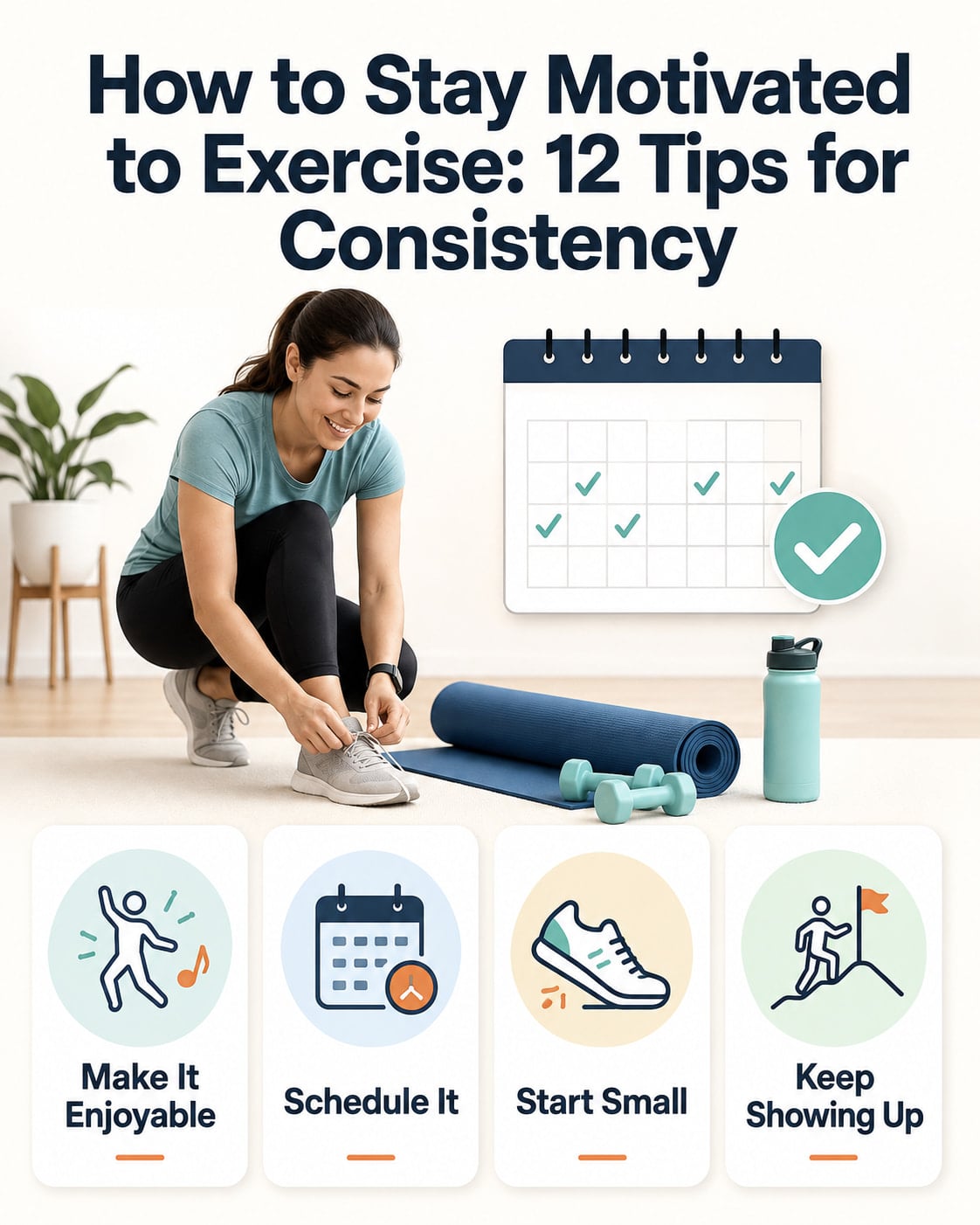
The most reliable way to stay motivated to exercise is to create a routine that is enjoyable, specific, easy to start, and flexible enough to survive busy days. Motivation will come and go, so long-term consistency depends more on your habits, environment, and expectations than on feeling excited before every workout.
Start with an activity you like, choose a realistic weekly goal, schedule it, remove common barriers, and prepare a shorter backup workout. You do not need a perfect plan or a sudden burst of willpower. You need a routine you can repeat—and restart when life interrupts it.
Current CDC physical activity guidance for adults recommends working toward at least 150 minutes of moderate-intensity aerobic activity per week, or 75 minutes of vigorous activity, plus muscle-strengthening exercise on at least two days. However, some activity is better than none, and the weekly total can be divided into smaller sessions. Beginners can build toward these targets gradually.
Why Is It So Hard to Stay Motivated to Exercise?
Exercise motivation often feels strong when you begin a new program. You may have a clear goal, new equipment, or an upcoming event that gives you extra energy. That initial excitement usually becomes less intense over time.
Motivation can also drop because of:
- Stress, fatigue, or poor sleep
- An unpredictable schedule
- Work or family responsibilities
- Workouts that are too difficult
- Boredom with the same routine
- Slow or less visible progress
- Soreness or inadequate recovery
- All-or-nothing expectations
- Choosing activities you do not enjoy
None of these challenges means you are lazy or incapable of being consistent. They usually mean that your exercise plan needs to fit your real life more closely.
Motivation, Discipline, Habit, and Consistency
These terms are related, but they are not interchangeable.
| Term | What It Means |
|---|---|
| Motivation | The temporary desire or enthusiasm to exercise |
| Discipline | Following a reasonable plan even when enthusiasm is low |
| Habit | A repeated behavior that becomes easier to begin in a familiar situation |
| Consistency | Maintaining or repeatedly returning to your routine over time |
You do not need to feel motivated before every workout. The goal is to make starting simple enough that you can act even when your motivation is average.
How to Stay Motivated to Exercise: 12 Practical Tips
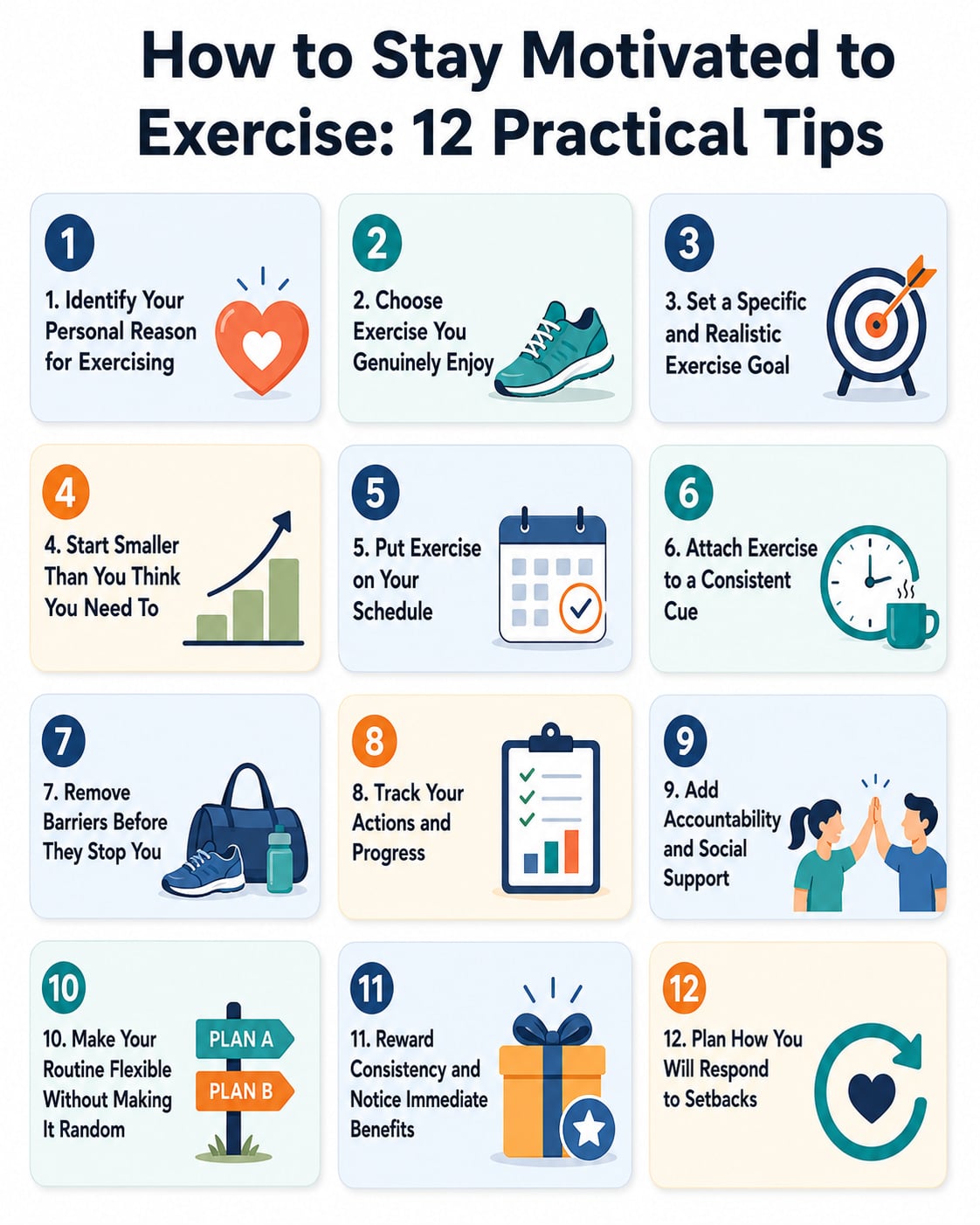
1. Identify Your Personal Reason for Exercising
A goal is easier to pursue when it matters to you personally. Instead of exercising only because you think you “should,” connect movement to an outcome you genuinely value.
Your reason might be to:
- Have more energy during the day
- Improve your strength or endurance
- Keep up with your children or grandchildren
- Feel more confident using your body
- Support your mobility and independence
- Prepare for a race, hike, sport, or vacation
- Manage everyday stress
- Make daily tasks feel easier
A 2025 review of systematic reviews found that feelings of competence, enjoyment-related motivation, and personally meaningful reasons were important determinants of physical activity across age groups. This supports choosing goals that feel personally relevant rather than relying on guilt or pressure. (PubMed)
Write your main reason in one sentence:
“I want to exercise because I want enough strength and energy to stay active with my family.”
Keep that reason somewhere visible, such as your calendar, phone notes, or workout log.
2. Choose Exercise You Genuinely Enjoy
There is no rule that says exercise must happen in a gym. Walking, dancing, swimming, cycling, gardening, sports, home strength training, fitness classes, and recreational activities can all contribute to an active lifestyle.
Ask yourself:
- Do I prefer exercising indoors or outdoors?
- Do I enjoy exercising alone or with other people?
- Do I like structured workouts or recreational activities?
- Do I prefer music, silence, classes, sports, or nature?
- Do I enjoy shorter, more intense sessions or longer, easier sessions?
Not every workout will feel fun from beginning to end. However, your main activity should feel tolerable, satisfying, or rewarding enough to repeat.
Try a two-week experiment. Choose two or three activities and note how you feel before, during, and after each session. Keep the activities you are most willing to do again.
The National Institute of Diabetes and Digestive and Kidney Diseases recommends choosing activities that match your interests and abilities, starting slowly, and adding variety as needed.
3. Set a Specific and Realistic Exercise Goal
“Exercise more” is a good intention, but it does not tell you what to do.
A useful goal identifies:
- The activity
- The duration
- The day
- The time
- The location
For example:
“I will walk for 20 minutes at 7:00 a.m. on Monday, Wednesday, and Friday.”
This is more actionable than saying, “I will try to walk more this week.”
Begin with a goal that fits your current ability and schedule. You can expand it later. An ambitious plan that lasts one week is less useful than a moderate plan you can maintain.
Focus first on behavior goals you can control, such as completing three walks this week. Body weight, appearance, pace, and other outcomes can be affected by many factors and may change more slowly.
4. Start Smaller Than You Think You Need To
Many people lose motivation because they start with a routine designed for their future fitness level rather than their current one.
A beginner does not need to start with a one-hour workout six days per week. A more sustainable starting point might be:
- A 5- to 10-minute walk
- One set of several strength exercises
- A short mobility routine
- Ten minutes on a stationary bike
- One beginner fitness class per week
Your first goal is not to prove how hard you can work. It is to create a successful experience you are willing to repeat.
Increase one part of the routine at a time. You could add a few minutes, another exercise, an additional set, or one more weekly session. Avoid increasing everything at once.
5. Put Exercise on Your Schedule
Do not leave exercise for whenever you happen to have free time. For many people, that free time never appears.
Choose your exercise time in advance and treat it like an appointment. Consider when you usually have the most energy and the fewest interruptions.
Your plan could look like this:
“After I finish work on Tuesday and Thursday, I will change clothes immediately and complete a 25-minute home workout before dinner.”
Also create a backup plan:
“If I have to work late, I will complete a 10-minute routine after I get home.”
The backup prevents one schedule change from turning into an abandoned week.
Review your calendar at the beginning of each week. Move workouts before conflicts happen instead of waiting until you miss them.
6. Attach Exercise to a Consistent Cue
A cue is something that reminds you to begin a behavior. Using the same cue repeatedly can reduce the amount of decision-making required to start.
Possible exercise cues include:
- Finishing your morning coffee
- Returning home from work
- Dropping your children off at school
- Ending your lunch break
- Turning off your work computer
- Seeing your walking shoes near the door
- Starting a particular playlist
For example:
“After I brush my teeth in the morning, I will put on my walking shoes.”
This approach is sometimes called habit stacking because you connect a new action to something you already do.
The American Heart Association’s movement-habit guidance recommends choosing an enjoyable activity, starting small, using a visible cue, and reinforcing the routine with a positive experience.
7. Remove Barriers Before They Stop You
Make the desired behavior easier before motivation becomes low.
You might:
- Set out your workout clothes the night before
- Keep resistance bands in a visible location
- Save a short home workout on your phone
- Pack your gym bag before work
- Choose a gym close to home or work
- Create an indoor option for bad weather
- Place your phone in another room during workouts
- Prepare water and necessary equipment in advance
Think about why you missed your most recent workouts. Then address that specific barrier.
If travel time is the problem, use a home routine. If mornings are consistently rushed, exercise later. If a 45-minute session feels overwhelming, plan 15 minutes.
Good routines do not depend on perfect conditions. They include practical ways to work around predictable problems.
8. Track Your Actions and Progress
Tracking provides evidence that you are making progress, even when changes are not obvious in the mirror or on the scale.
You could record:
- Workouts completed
- Weekly active minutes
- Walking distance or steps
- Exercises, sets, and repetitions
- Weight used
- Energy before and after exercise
- Mood after the session
- Sleep or recovery
- Skills you are learning
Keep tracking simple. A calendar check mark may be enough.
Review your record once per week and ask:
- What went well?
- What made exercise difficult?
- What should I adjust next week?
NIDDK notes that recording the type and duration of activity, along with how you felt, may help you see progress, identify setbacks, and set new goals. You can use paper, an app, or a wearable device, but no special technology is required.
Tracking should inform you, not punish you. If numbers make exercise stressful or obsessive, use a simpler measure such as whether you completed your planned sessions.
9. Add Accountability and Social Support
Other people can make exercise more enjoyable and harder to postpone.
Options include:
- Walking with a friend
- Joining a recreational sports team
- Attending a fitness class
- Hiring a qualified trainer
- Sharing weekly goals with a family member
- Joining an online exercise group
- Scheduling a regular active family outing
Be specific about the support you need. Instead of saying, “Help me exercise more,” ask a friend to meet you for a walk every Saturday morning.
However, do not make your entire routine dependent on another person. Keep an individual backup option for days when your partner cancels.
10. Make Your Routine Flexible Without Making It Random
Consistency does not require completing the exact same workout every time. A flexible routine can help you stay active through changes in time, energy, weather, or location.
Create three versions of your workout:
| Plan | When to Use It | Example |
|---|---|---|
| Plan A | Normal day | 30-minute complete workout |
| Plan B | Busy or lower-energy day | 15-minute shortened workout |
| Plan C | Very limited time | 5-minute walk, mobility session, or one exercise |
All three plans count.
You can also keep a consistent weekly structure while changing the activity. For example, Monday may always be a cardio day, but you can choose walking, cycling, swimming, or dancing.
Flexibility prevents a small disruption from becoming a reason to do nothing.
11. Reward Consistency and Notice Immediate Benefits
Long-term outcomes can take time. Immediate rewards help make the process feel worthwhile now.
After a workout, notice whether you feel:
- More alert
- Calmer
- More confident
- Proud that you followed through
- Less stiff after sitting
- Better prepared for the next session
You can also use reasonable nonfood rewards for milestones, such as:
- New workout clothing
- A book or movie
- A relaxing bath
- New music or headphones
- An outdoor activity
- A class you have wanted to try
Reward the behavior you completed, not only a body-weight or appearance result.
For example, celebrate completing your planned workouts for four weeks rather than waiting until you reach a distant outcome.
12. Plan How You Will Respond to Setbacks
Illness, travel, deadlines, family responsibilities, and low-energy periods can interrupt any exercise routine.
Prepare a restart rule before this happens:
“If I miss a workout, I will return at the next realistic opportunity with a manageable session.”
Do not try to punish yourself with an extra-long or overly intense workout. Simply restart.
After a difficult week, ask:
- Was the plan too demanding?
- Did the workout time conflict with my schedule?
- Did I need a shorter backup?
- Was I recovering adequately?
- Did I stop enjoying the activity?
- Was there a health issue that needs attention?
NIDDK emphasizes that setbacks do not mean failure. Its behavior-change guidance recommends reviewing your plan, identifying roadblocks, preparing alternatives, and returning to your goal as soon as reasonably possible.
What to Do When You Have No Motivation to Work Out
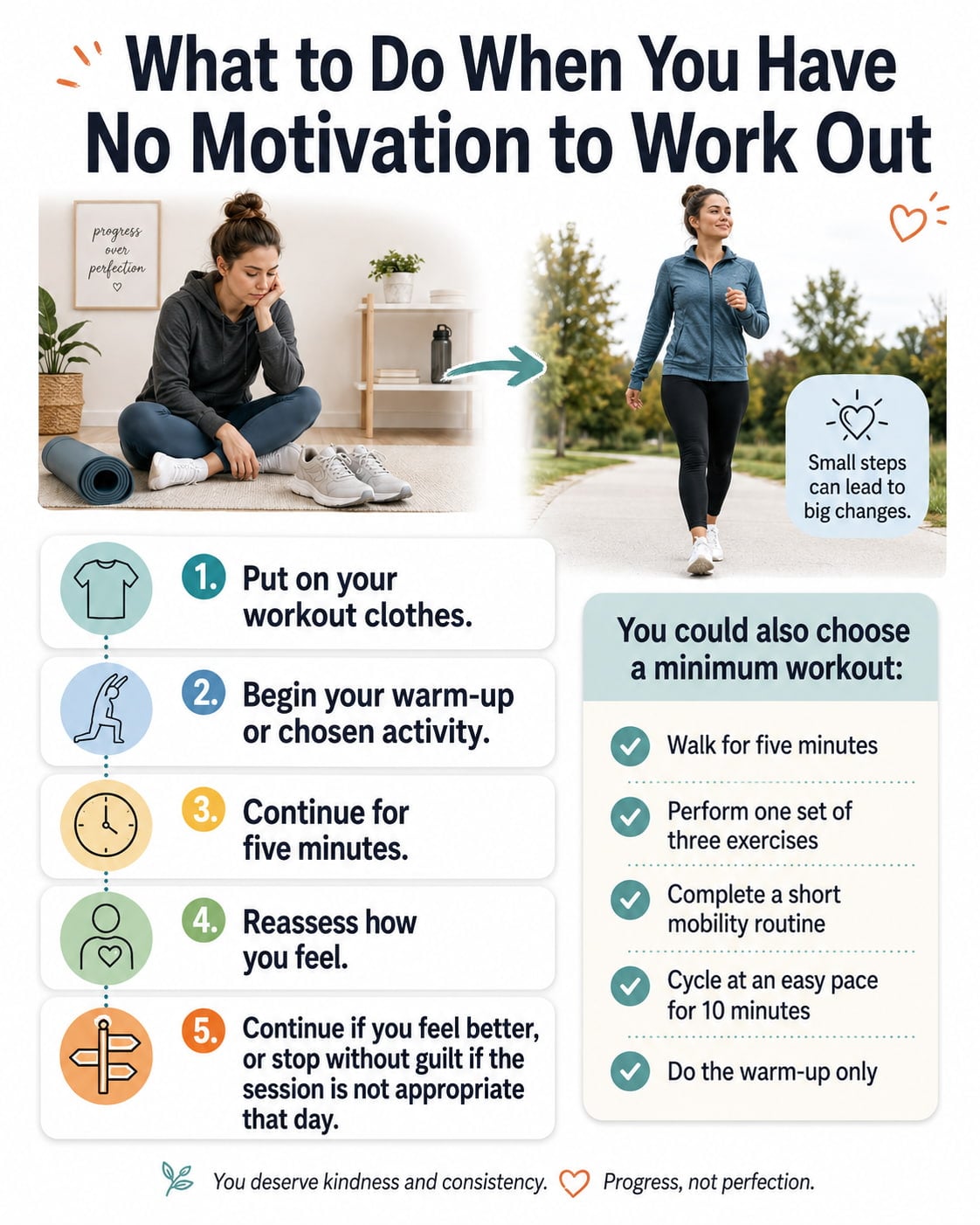
First, determine whether you are simply unmotivated or whether your body needs rest.
If you are healthy but do not feel enthusiastic, try the five-minute approach:
- Put on your workout clothes.
- Begin your warm-up or chosen activity.
- Continue for five minutes.
- Reassess how you feel.
- Continue if you feel better, or stop without guilt if the session is not appropriate that day.
You could also choose a minimum workout:
- Walk for five minutes
- Perform one set of three exercises
- Complete a short mobility routine
- Cycle at an easy pace for 10 minutes
- Do the warm-up only
Starting is often the hardest part. Even when five minutes does not become a longer workout, it can preserve the pattern of showing up.
When Not to Push Through
Low motivation is different from a possible illness, injury, or warning symptom.
Stop exercising if you experience chest pain, dizziness, faintness, nausea, unusual breathing difficulty, or significant pain. Speak with a healthcare professional about safely starting or modifying exercise if you have an injury, a chronic condition, or unresolved symptoms. Seek urgent care for severe or rapidly worsening symptoms.
How Long Does It Take to Make Exercise a Habit?
There is no universal number of days required to make exercise automatic.
A 2024 systematic review of health-related habits reported median habit-formation times of approximately 59–66 days in the studies that measured time to habit formation. Mean estimates were longer, ranging from 106–154 days. The review included different health behaviors, so these numbers are not a precise deadline for exercise. Individual results varied considerably. (PubMed)
The practical lesson is that building a routine may take several weeks or months—not necessarily 21 days.
Habit formation may be easier when you:
- Keep the activity manageable
- Repeat it in a consistent situation
- Use a clear cue
- Reduce preparation time
- Choose an activity you value
- Recover from missed sessions quickly
Do not assume you have failed because exercise still requires conscious effort after a few weeks. Continue improving the routine until it fits your life more naturally.
A Simple Weekly Exercise Consistency Plan
The following plan is an example for a generally healthy beginner. Adjust the exercises, intensity, and duration to match your abilities.
| Day | Activity |
|---|---|
| Monday | 20-minute comfortable walk |
| Tuesday | Rest or gentle daily movement |
| Wednesday | 15- to 20-minute beginner strength workout |
| Thursday | Rest or short mobility session |
| Friday | 20-minute walk, bike ride, or other enjoyable cardio |
| Saturday | Optional recreational activity |
| Sunday | Review the week and schedule the next one |
Backup workout: Complete five minutes of walking or one set of several basic exercises when the planned session is not possible.
After two or three manageable weeks, consider adding a few minutes or another session. Progress gradually rather than turning the entire plan into a harder program at once.
When Should You Change Your Exercise Plan?
A routine should challenge you, but it should also be realistic enough to maintain.
Consider adjusting your plan if:
- You dread almost every workout
- You repeatedly miss sessions for the same reason
- The program leaves you excessively fatigued
- Soreness prevents normal activity
- Your schedule has permanently changed
- The routine no longer matches your goals
- You experience recurring pain
- You have stopped making progress despite consistent effort
Change one factor at a time. You might switch the activity, shorten the workout, reduce the intensity, choose another time of day, or add more recovery.
Changing an unsustainable plan is not quitting. It is problem-solving.
Frequently Asked Questions
How can I motivate myself to exercise when I am tired?
Identify whether the tiredness is mental, physical, or related to poor sleep or illness. If you are generally well but mentally drained, choose a shorter and easier session. A 10-minute walk or brief mobility routine may feel more manageable than a demanding workout.
Rest may be more appropriate if you are sick, unusually exhausted, injured, or experiencing concerning symptoms.
How do beginners stay consistent with exercise?
Beginners should start with a small number of repeatable sessions. Choose two or three days, use simple activities, schedule exact times, and keep a short backup workout ready. Increase the routine only after the current version feels manageable.
Is exercising three days per week enough?
Three days per week can be a practical and effective schedule, depending on the type, duration, and intensity of the sessions. It can also help you work toward the current adult target of at least 150 minutes of moderate aerobic activity plus two weekly muscle-strengthening days.
You may also accumulate activity through shorter walks and other movement on the remaining days.
How long does it take for exercise to become a habit?
The timeline varies. Research on health behaviors suggests that habit formation commonly takes weeks or months, with considerable differences between people and behaviors. Focus on repetition and a workable routine rather than expecting exercise to feel automatic after a fixed number of days.
Should I work out when I do not feel motivated?
You can often begin with a short, lower-intensity session when the issue is simply low enthusiasm. Give yourself permission to reassess after five minutes.
Do not use this rule to push through illness, injury, chest pain, dizziness, faintness, or significant pain.
How do I start exercising again after a long break?
Start below the level you previously reached. Choose two or three short weekly sessions, use comfortable intensity, and increase gradually. Your previous experience may help, but your current fitness and recovery should guide the plan.
Do fitness trackers help with motivation?
A tracker can make steps, active minutes, or completed workouts easier to see. Some people find that feedback motivating, while others feel pressured by the numbers.
A wearable is optional. A paper calendar, notebook, or simple phone note can provide the same basic record of consistency.
Conclusion
Learning how to stay motivated to exercise is not about finding a permanent source of excitement. It is about building a routine that still works when your enthusiasm, schedule, and energy change.
Choose movement you enjoy, begin with a realistic target, schedule it, reduce barriers, and prepare a shorter backup. Track completed actions, not perfection, and expect occasional setbacks. The ability to restart is part of consistency—not evidence that you failed.
Choose one tip from this guide and use it today. Schedule your next manageable workout before motivation has a chance to make the decision for you.
This content is for informational purposes only and not medical advice.
References
- Centers for Disease Control and Prevention: Adding Physical Activity as an Adult
- National Institute of Diabetes and Digestive and Kidney Diseases: Tips to Keep Moving
- American Heart Association: Make Movement a Habit
- PubMed: Self-Determination Theory and Physical Activity Review
- PubMed: Time to Form a Habit Systematic Review and Meta-Analysis