
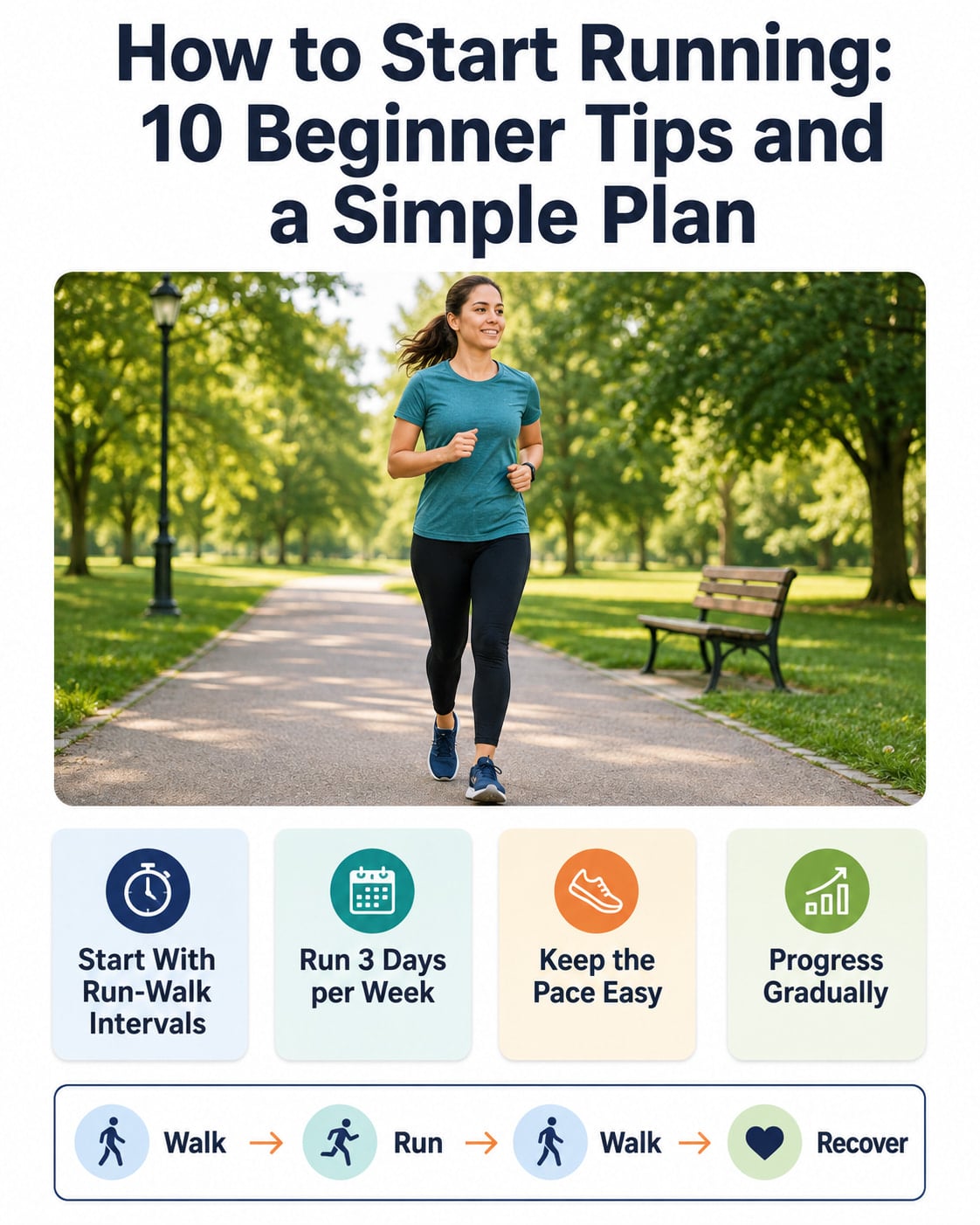
The best way to start running is to complete short run-walk intervals three days per week, maintain a comfortable pace, and leave at least one recovery day between sessions. You do not need to run continuously, cover a certain distance, or reach a specific speed during your first workouts.
Learning how to start running gradually matters because your cardiovascular fitness may improve faster than your muscles, joints, bones, and connective tissues adapt to running’s repeated impact. A simple plan built around easy effort, walking breaks, comfortable shoes, and adequate recovery can make running feel more manageable.
The four-week beginner running plan below starts with one minute of running followed by four minutes of walking. You can repeat any week until it feels comfortable before moving forward.
How to Start Running as a Complete Beginner
Before you begin jogging, make sure you can walk comfortably for approximately 20–30 minutes. You do not need to walk quickly, but you should be able to complete the walk without pain, unusual breathlessness, dizziness, or excessive fatigue.
If 20 minutes of walking is currently difficult, start there instead of forcing yourself to run. Walk for as long as you can comfortably manage, rest when needed, and gradually add a few minutes.
The goal is not to pass a formal fitness test. It is simply to establish enough walking tolerance that adding short running intervals does not feel like an extreme jump in activity.
The Hospital for Special Surgery’s beginner running guidance recommends easing into running regardless of how motivated or generally fit you feel. It suggests starting with three sessions per week, using walking breaks, and waiting until the current routine feels easy before progressing.
What You Need for Your First Run
You can begin with a small amount of basic equipment:
- Comfortable running shoes that fit securely without squeezing your toes
- Lightweight clothing appropriate for the weather
- A phone, watch, or timer for tracking intervals
- Reflective clothing or a light when running in low visibility
- Water when conditions are hot or the session will be longer
A fitness tracker, running belt, specialized socks, heart-rate monitor, and expensive shoes are optional. They are not requirements for becoming a runner.
Choose a familiar, relatively flat route for your first few workouts. A park loop, quiet neighborhood street, track, or treadmill can make it easier to focus on effort instead of hills, traffic, or navigation.
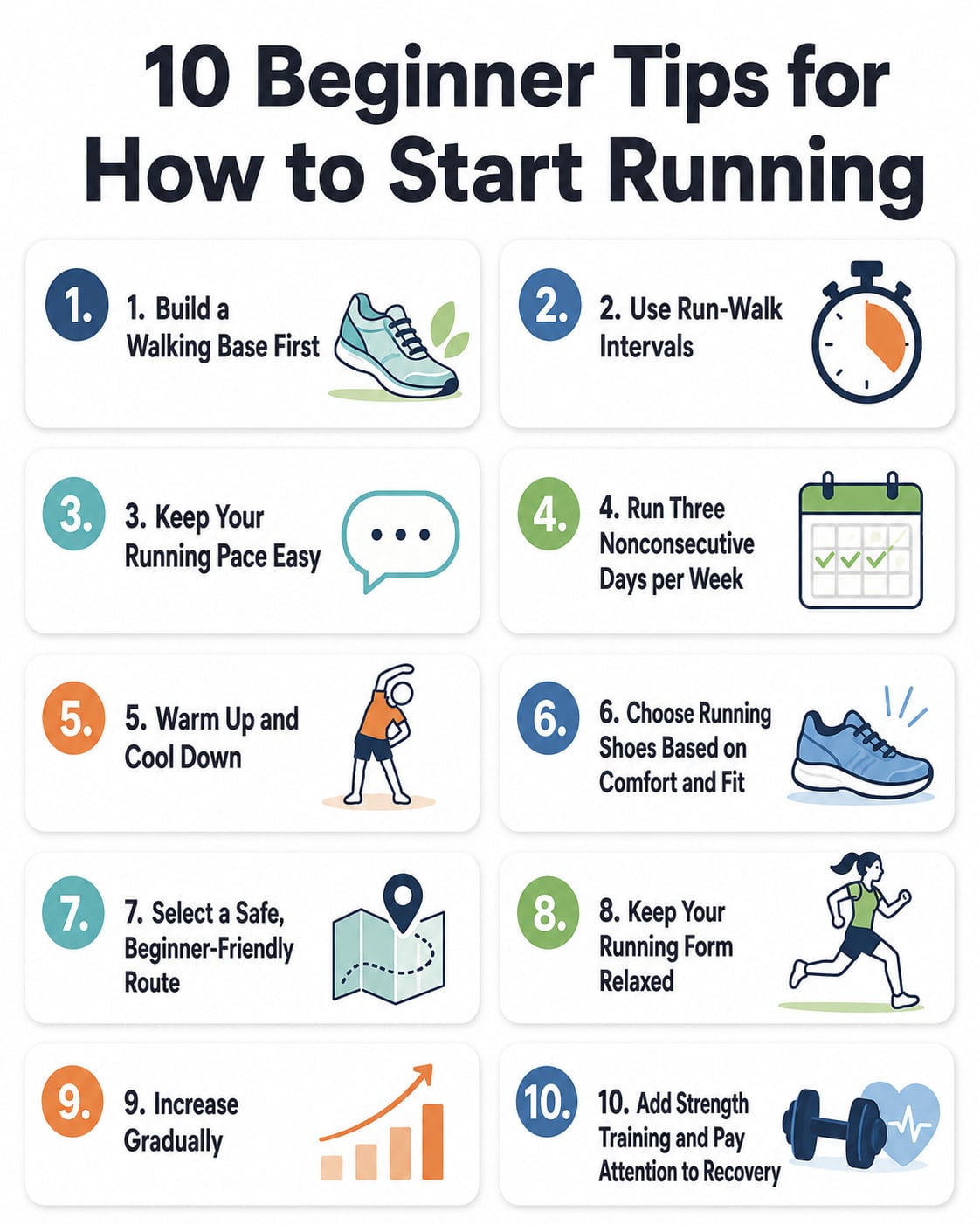
10 Beginner Tips for How to Start Running
1. Build a Walking Base First
Walking prepares you for regular time on your feet and helps you establish an exercise habit before adding more impact.
Try to reach a point where you can walk for 20–30 minutes without significant discomfort. This does not need to happen immediately. Someone beginning after a long inactive period may need several weeks of shorter walks first.
A basic walking progression could look like this:
- Week 1: Walk for 10–15 minutes
- Week 2: Walk for 15–20 minutes
- Week 3: Walk for 20–25 minutes
- Week 4: Walk for 25–30 minutes
Progress only when the current duration feels manageable. If walking causes joint pain or symptoms that concern you, speak with a healthcare professional before adding running.
2. Use Run-Walk Intervals
Walking during a running workout is not cheating or failure. It is a practical method for controlling fatigue while your body becomes accustomed to running.
For example, your first workout could include:
- Walk for five minutes.
- Run slowly for one minute.
- Walk for four minutes.
- Repeat the run-walk block four times.
- Finish with another five-minute walk.
That produces a 30-minute session, but only four minutes are spent running.
The official NHS Couch to 5K running plan also begins with alternating short running and walking periods rather than expecting beginners to run continuously. Its first week includes one-minute running intervals, a five-minute walking warm-up, and a five-minute walking cool-down.
3. Keep Your Running Pace Easy
One of the most common beginner mistakes is running each interval too fast. Your running portions should feel like controlled jogging, not sprinting.
Use your breathing as a guide. You should be able to say a short sentence without gasping. If you can say only one or two words before needing a breath, slow down. When slowing down is not enough, return to walking.
Do not worry if your running pace is only slightly faster than your walking pace. Pace is not the goal during your first weeks. Your priorities are:
- Finishing the session in control
- Maintaining relaxed movement
- Recovering normally afterward
- Becoming consistent
Running more slowly now can help you complete more productive workouts later.
4. Run Three Nonconsecutive Days per Week
Three weekly sessions are enough for a new runner. A schedule such as Monday, Wednesday, and Saturday provides a recovery day after each run.
Rest days are especially important because running places repeated impact through the feet, ankles, knees, hips, and surrounding tissues. Your breathing may recover within minutes, but the rest of your body may need longer.
Avoid running every day during your first few weeks. On non-running days, choose from:
- Complete rest
- Comfortable walking
- Gentle mobility work
- Light strength training
- Easy cycling or swimming
The current CDC adult physical activity guidance recommends that adults eventually work toward 150 minutes of moderate-intensity activity or 75 minutes of vigorous-intensity activity per week, along with muscle-strengthening activity on two days. Beginners do not need to reach those totals immediately; some activity is better than none.
5. Warm Up and Cool Down
Begin every session with at least five minutes of walking. Start comfortably and gradually increase your walking pace before the first running interval.
A simple warm-up might include:
- Two minutes of comfortable walking
- Three minutes of gradually faster walking
- Optional ankle circles, leg swings, or marching
After the last running interval, walk slowly for another five minutes. Do not finish a hard interval and immediately sit or lie down.
The American Heart Association’s warm-up and cool-down guidance recommends warming up for 5–10 minutes and gradually reducing activity for another 5–10 minutes afterward.
Static stretching before running is not mandatory. When you enjoy stretching, perform it gently after your cool-down, when your muscles are warm. Stretching should create mild tension, not pain.
6. Choose Running Shoes Based on Comfort and Fit
You do not need the most expensive running shoes. You need shoes that fit comfortably, stay secure around the heel, and leave enough room for your toes.
When trying on shoes:
- Wear the socks you expect to run in.
- Check that your toes are not pressed against the front.
- Walk or jog briefly in the shoes.
- Make sure the heel does not slide excessively.
- Avoid any immediate pinching, rubbing, or pressure.
- Try another model if the shoes cause pain.
Do not choose a shoe only because a friend or popular runner uses it. Feet, comfort preferences, and running mechanics differ.
A specialty running store may help when you have trouble finding a comfortable fit, but gait analysis, custom insoles, and premium footwear are not essential for every beginner. HSS emphasizes proper fit and comfort rather than attachment to a particular brand.
7. Select a Safe, Beginner-Friendly Route
For your first few weeks, choose a flat route with an even surface. Steep hills and technical trails can make it difficult to maintain an easy effort.
A suitable beginner route should ideally be:
- Familiar and easy to navigate
- Free from heavy traffic
- Well lit when visibility is low
- Close enough to home that you can stop early
- Relatively flat
- Free from major cracks, loose stones, or other hazards
Tell someone where you are going when running alone. Keep your phone available, remain aware of vehicles and cyclists, and avoid turning your music volume so high that you cannot hear your surroundings.
Weather also affects effort. In hot conditions, run earlier or later in the day, reduce your pace, wear lightweight clothing, and drink water. The CDC advises stopping activity and moving to a cool place if you feel faint or weak in the heat.
8. Keep Your Running Form Relaxed
Beginners often become overly focused on foot strike, cadence, arm angles, or copying another runner’s form. You generally do not need to force a dramatic technique change when you are just starting.
Use a few simple cues:
- Look ahead rather than directly at your feet.
- Keep your shoulders relaxed.
- Bend your elbows naturally.
- Let your arms move forward and backward.
- Keep your hands loose.
- Take comfortable, controlled steps.
- Avoid deliberately reaching far forward with each stride.
Your running should feel natural rather than rigid. If you notice loud, heavy steps, try slowing down and taking slightly shorter steps instead of forcing a particular type of foot landing.
HSS advises new runners not to copy another runner’s gait simply because it appears to be the “correct” style.
9. Increase Gradually
Do not add speed, distance, longer intervals, hills, and extra running days at the same time. Change one part of your program, then give your body time to adapt.
A reasonable progression may involve:
- Adding 30–60 seconds to each running interval
- Slightly shortening the walking breaks
- Adding one interval to the workout
- Extending the total session by a few minutes
You do not have to progress every week. Repeat the current week when:
- You struggle to complete the intervals
- Your form becomes noticeably less controlled
- Soreness affects normal walking
- You remain unusually tired on the next scheduled running day
- The workout does not yet feel easier
For example, if Week 2 still feels demanding after three sessions, complete Week 2 again. Repetition is part of training, not a setback.
Avoid using the popular “10% rule” as a guarantee that a particular increase is safe. Instead, avoid abrupt increases and progress according to comfort, recovery, and consistency.
10. Add Strength Training and Pay Attention to Recovery
Strength training can support the general physical demands of running. Aim for approximately two short full-body sessions each week, but begin with one if two sessions would be difficult to recover from.
Useful beginner exercises include:
- Chair squats or bodyweight squats
- Glute bridges
- Calf raises
- Low step-ups
- Wall or incline push-ups
- Resistance-band or dumbbell rows
- Bird dogs
- Short planks
Start with one or two sets of each exercise. Use controlled movements and stop before your technique breaks down.
Strength training does not guarantee that you will avoid injury. It can, however, help build the strength and stability required for general activity. Both CDC guidance and the 2026 HSS running guide recommend muscle-strengthening work on approximately two days per week.
Recovery also includes sleep, adequate food, hydration, and rest. A new runner who is constantly exhausted, unusually sore, or losing motivation may need less training—not more discipline.
A Simple Four-Week Beginner Running Plan
Complete the following workout three times per week on nonconsecutive days. Run at a slow, controlled pace. None of the running intervals should be sprints.
This is a conservative beginner plan adapted from run-walk principles used by HSS and the NHS. It is not the official NHS Couch to 5K schedule and is not an individualized rehabilitation program.
| Week | Warm-Up | Main Run-Walk Workout | Cool-Down |
|---|---|---|---|
| Week 1 | Walk 5 minutes | Run 1 minute, walk 4 minutes × 4 | Walk 5 minutes |
| Week 2 | Walk 5 minutes | Run 1½ minutes, walk 3½ minutes × 4 | Walk 5 minutes |
| Week 3 | Walk 5 minutes | Run 2 minutes, walk 3 minutes × 4 | Walk 5 minutes |
| Week 4 | Walk 5 minutes | Run 3 minutes, walk 2 minutes × 4 | Walk 5 minutes |
Sample Weekly Schedule
| Day | Activity |
|---|---|
| Monday | Run-walk workout |
| Tuesday | Rest or short strength session |
| Wednesday | Run-walk workout |
| Thursday | Rest or easy walking |
| Friday | Short strength session or rest |
| Saturday | Run-walk workout |
| Sunday | Rest or easy walking |
How to Use the Plan
Before progressing, ask yourself:
- Could I complete every interval without sprinting?
- Did my breathing remain under control?
- Was I able to walk normally after the session?
- Did any soreness improve within a reasonable period?
- Do I feel ready for another session after a recovery day?
When the answer is no, repeat the week or reduce the running interval. For example, someone struggling with Week 1 could run for 30 seconds and walk for 4½ minutes instead.
Do not complete extra intervals to make up for a missed workout. Simply continue with the next scheduled session.
What to Do After Week 4
After Week 4, you have several options:
- Repeat Week 4 until it feels comfortable.
- Add 30–60 seconds to each running interval.
- Reduce each walking break slightly.
- Follow a structured beginner program such as Couch to 5K.
- Continue using run-walk intervals indefinitely.
You do not have to eliminate walking breaks to be considered a runner. Run-walk training can remain a useful approach for fitness, recreational running, and longer distances.
How Fast and How Far Should a Beginner Run?
Begin with time rather than distance. Trying to complete a mile or 5K can encourage you to run too quickly or continue after your form has deteriorated.
During the first four weeks, focus on completing the scheduled intervals. Your distance will vary based on your walking pace, running pace, route, and fitness level.
Your effort is probably too high when:
- You are sprinting to finish an interval.
- You cannot say a short sentence.
- Your shoulders and hands become tense.
- Your steps become heavy or uncontrolled.
- You need several minutes to recover from every interval.
- You feel nauseated, dizzy, or unusually breathless.
Slow down or walk when these signs appear. Beginner running should require effort, but it should not feel like a maximum-intensity test.
Common Beginner Running Mistakes
Trying to Run Continuously on Day One
Running for 20–30 minutes without preparation can create more fatigue and soreness than necessary. Start with short intervals and build from there.
Running Every Workout Too Fast
Fast running is not required to improve. An easy pace allows you to practice consistency while managing fatigue.
Progressing Because the Calendar Says So
Completing one week does not automatically mean you are ready for the next. Progress when the current workout feels controlled.
Adding Too Much at Once
Increasing speed, duration, hills, and frequency together makes it difficult to determine what caused excessive fatigue or pain.
Ignoring Pain That Changes Your Movement
Do not continue running when pain causes limping, favoring one side, or changing your stride. Stop the session and allow the problem to settle. Seek professional advice when the pain is severe, sudden, persistent, or worsening.
Comparing Yourself With Other Runners
Another runner’s easy pace may be your hard pace. Training history, age, health, sleep, terrain, and weather all affect performance. Use your own effort and recovery as your guide.
When to Stop Running or Speak With a Healthcare Professional
Some muscle fatigue and mild soreness can occur after unfamiliar exercise. However, stop running when you experience:
- Sudden or severe pain
- Pain mainly on one side
- Pain that causes limping
- Dizziness or faintness
- Chest pain, pressure, or tightness
- An irregular or pounding heartbeat with other symptoms
- Unusual or severe shortness of breath
- Confusion, weakness, or signs of heat illness
- Symptoms that worsen with each workout
Seek urgent medical care for chest pressure or pain, fainting, severe breathing difficulty, confusion, or other potentially serious symptoms.
Speak with a healthcare professional before beginning vigorous exercise when you have a chronic condition such as heart disease, arthritis, or diabetes, are returning after a significant injury or surgery, or have been inactive and are uncertain whether running is appropriate. The CDC specifically advises people with chronic conditions to discuss suitable activity types and amounts with a healthcare professional.
Frequently Asked Questions
How long should a beginner run for the first time?
A beginner can start with four one-minute running intervals separated by four-minute walks. Including a five-minute warm-up and cool-down, the total session takes approximately 30 minutes, but only four minutes involve running.
People who find that too difficult can begin with 20–30 seconds of running at a time. There is no minimum running duration you must achieve during your first session.
How many days per week should a beginner run?
Three nonconsecutive days per week is a practical starting point. This schedule provides regular practice while leaving recovery days between running sessions.
Two days per week may be more suitable when you are returning after a long break, managing other demanding workouts, or experiencing significant soreness.
Is it okay to walk during a run?
Yes. Walking breaks help control effort and allow beginners to accumulate running time gradually. You can continue using run-walk intervals even after your fitness improves.
What pace should a beginner run?
Run slowly enough that you can say a short sentence without gasping. Your pace may be only slightly faster than your walking pace, especially during the first few weeks.
Do not use another person’s speed or a target mile time to judge your first workouts.
Should beginners run every day?
Generally, beginners should not run every day. Start with two or three nonconsecutive running days and use the remaining days for rest, walking, or light strength training.
More frequent running may become appropriate later, but it is not necessary for building an effective beginner routine.
Do I need special running shoes?
You need comfortable athletic shoes suitable for running, but they do not need to be expensive. The shoes should fit securely, leave room for your toes, and feel comfortable while walking and jogging.
Replace or return shoes that create persistent rubbing, pressure, numbness, or pain.
When should I increase my running intervals?
Increase when you can complete the current intervals with controlled breathing, relaxed form, and normal recovery. Add approximately 30–60 seconds to the running periods or slightly shorten the walking breaks.
Repeat the same week when the current level still feels difficult.
Conclusion
Learning how to start running does not require completing a nonstop mile or pushing through an exhausting first workout. Begin with short run-walk intervals, run three nonconsecutive days per week, keep your pace easy, and allow your body time to adapt.
Choose three realistic workout days, prepare comfortable shoes and a safe route, and complete Week 1 without worrying about speed or distance. Consistent, manageable sessions are more useful than one overly difficult run.
References
- Centers for Disease Control and Prevention: Adding Physical Activity as an Adult.
- Hospital for Special Surgery: How to Get Into or Back Into Running.
- NHS Better Health: Couch to 5K Running Plan.
- American Heart Association: Warm Up, Cool Down.
- Centers for Disease Control and Prevention: Heat and Athletes.