
The Copenhagen side plank is a bodyweight exercise that challenges your inner-thigh muscles and core by supporting your upper leg on a bench while you hold a side-plank position. Start with a bent-knee variation, keep your hips aligned, and increase the challenge gradually.
This exercise can add focused adductor work to your strength routine. However, the full version is demanding, and good control matters more than a long hold. Choosing the right modification helps you practice without taking on more load than you can manage.
What Is a Copenhagen Side Plank?
A Copenhagen side plank uses your forearm and supported upper leg to hold your body above the floor. In an unassisted version, your lower leg also lifts off the ground.
The upper leg’s inner-thigh muscles work to support your pelvis. Your trunk muscles help keep your body steady.
You may also see the name Copenhagen adduction exercise. The terms overlap, but there is a useful distinction:
- Static Copenhagen side plank: You hold the position without moving your pelvis.
- Dynamic Copenhagen adduction: You raise and lower your pelvis under control. During the lowering phase, the supporting adductors work while lengthening, known as eccentric loading.
Much of the research involves progressive Copenhagen adduction programs. Their results should not be assumed to apply to every static hold or beginner routine.
What Muscles Does the Copenhagen Side Plank Work?
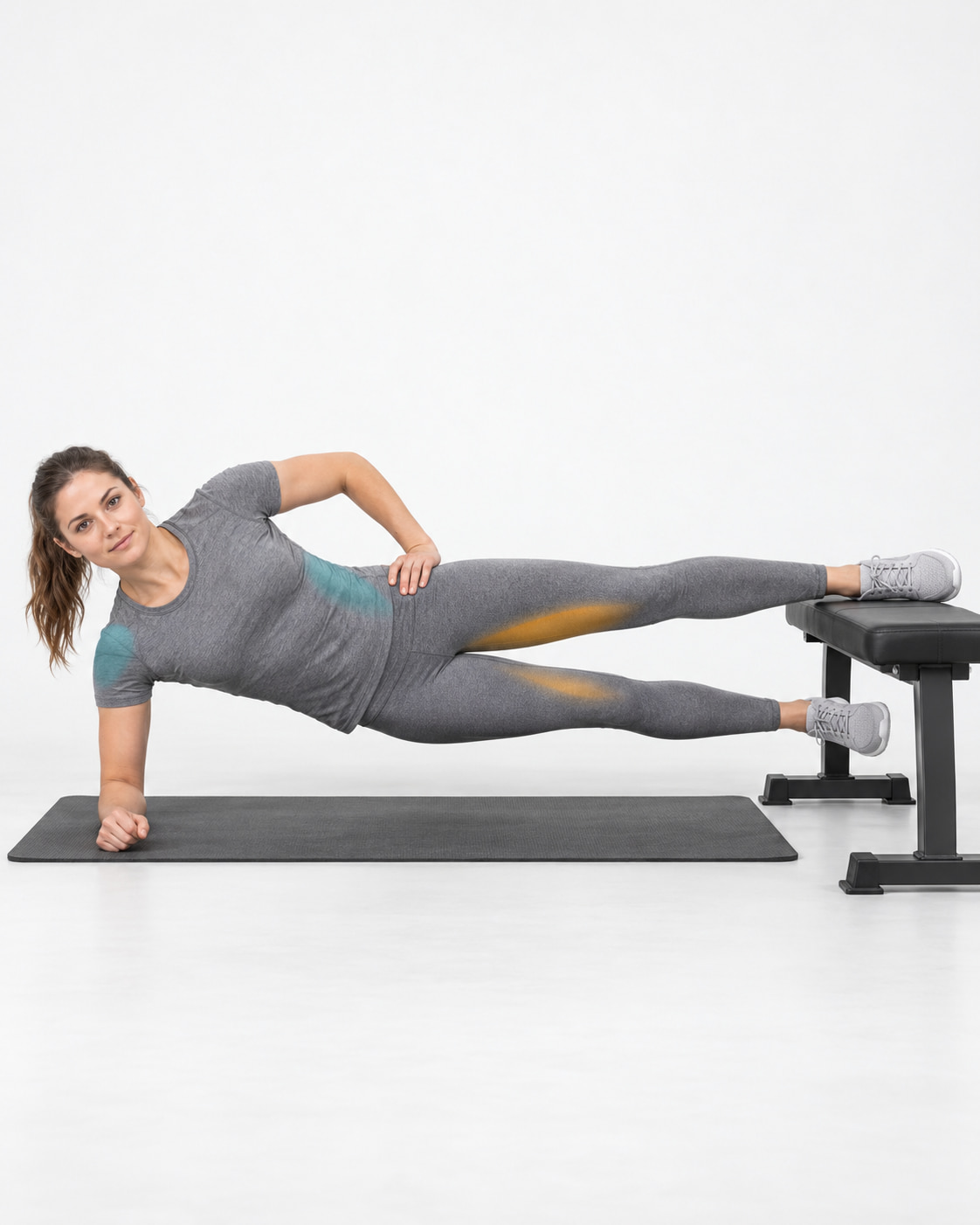
The main target is the hip adductor group, located along the inner thigh. These muscles help bring your leg toward your body’s midline.
Other muscles contribute to the position:
- Obliques and other trunk stabilizers: Help resist sideways bending and rotation.
- Supporting shoulder muscles: Help hold your upper body above the floor.
- Lower-leg adductors: Work when you lift the lower leg toward the supported leg.
You will often feel substantial effort in the upper leg’s inner thigh and the side of your trunk. Sharp groin pain or pressure inside a joint is a reason to stop and adjust.
How to Do a Copenhagen Side Plank
Begin with the knee-supported version. Use a stable, padded bench or box that will not slide or tip, plus a mat for your forearm. Choose a height that lets you set up comfortably.
The University of Calgary’s Copenhagen exercise guide emphasizes placing the elbow beneath the shoulder and keeping the hips elevated without rotating inward.
Step-by-Step Knee-Supported Copenhagen Side Plank
- Lie on your side beside the bench. Prop yourself on your lower forearm, with your elbow beneath your shoulder.
- Position your upper leg. Bend the upper knee and support the inner thigh near the knee on the padded surface. Avoid concentrating pressure on the knee joint.
- Keep your lower knee on the floor initially. Bend it for assistance as you learn the movement.
- Lift your pelvis. Press through your forearm and supported upper leg. Bring your shoulder, hip, and supported knee into a line.
- Keep your hips stacked. Face your chest forward and maintain a neutral neck.
- Lift the lower leg if you can stay steady. Bring the lower knee toward the upper knee without twisting. Otherwise, retain floor assistance.
- Breathe normally and finish with control. Lower your pelvis gently, then repeat on the other side.
Keep the movement small and deliberate. If you cannot lift your pelvis without discomfort or losing alignment, use an easier exercise first.
Copenhagen Side Plank Benefits
Builds Inner-Thigh Strength
Copenhagen adduction training provides a substantial strengthening stimulus for the hip adductors.
In a small 2016 trial involving 24 male under-19 soccer players, researchers found improved eccentric hip-adduction strength after eight weeks of supervised progressive training. The intervention group improved by 35.7% from baseline.
That finding supports the exercise’s strengthening potential. It does not mean every person will gain that amount of strength, particularly when using a different variation or training schedule.
Challenges Trunk Stability
Holding your pelvis above the floor requires your trunk to resist sagging and rotation. This makes the exercise a way to combine adductor loading with a side-plank challenge.
Think of trunk stability as a demand of the movement. It does not establish that Copenhagen planks will improve posture or resolve back pain.
May Help Reduce Groin Problems in Some Athletes
A 2019 trial studied 652 male semiprofessional soccer players across 35 teams. A progressive adductor program was associated with lower odds of reporting groin problems than usual training.
Average weekly prevalence was 13.5% in the exercise group versus 21.3% in the control group. The reported odds ratio corresponded to 41% lower odds.
Players trained three times weekly during preseason, then once weekly during the competitive season. This was a structured program with progression levels, not simply a short daily plank.
The findings are encouraging for that population. They do not guarantee injury prevention for recreational exercisers or establish the same benefit from static holds alone.
Copenhagen Side Plank Modifications and Progressions
Adjust the support and leverage before adding more time or resistance. There is no requirement to reach the hardest variation.
Assisted Short-Lever Hold
Support your bent upper leg near the knee and keep your lower knee on the floor. The lower leg shares the work while you practice lifting and aligning your pelvis.
Use this version when lifting the lower leg causes your hips to drop or rotate.
Unassisted Short-Lever Hold
Keep the upper knee supported, then lift your lower leg away from the floor. Maintain the same shoulder-to-hip-to-knee alignment.
Removing floor assistance can be a meaningful increase in difficulty. Shorten the hold when you first make this change.
Long-Lever Copenhagen Side Plank
Straighten your upper leg and place the inner ankle or lower leg on a padded support. Supporting the leg farther from the hip increases the leverage your adductors must manage.
You can initially keep the lower foot on the floor for assistance. Progress to lifting it only when you can maintain a straight line through your shoulder, hip, and upper ankle.
If this setup creates knee or ankle discomfort, return to knee support rather than forcing the position.
Dynamic Copenhagen Adduction
Once a hold is controlled, you can introduce small, slow pelvis raises and lowers. Keep your trunk aligned as your supporting hip moves.
Start with a manageable range. Moving only the lower leg while your pelvis stays still is a different variation; it does not reproduce the supporting leg’s eccentric action during a controlled pelvis lower.
How Long Should You Hold a Copenhagen Side Plank?
Use a duration you can complete while breathing normally and maintaining alignment. Stop the set before your hips sag or your shoulder collapses.
The following is a conservative practice example for a healthy beginner, not a research-established injury-prevention program:
| Training detail | Starting example |
|---|---|
| Variation | Assisted knee-supported hold |
| Hold duration | 5–10 seconds per side |
| Sets | 1–2 per side |
| Rest | About 45–60 seconds, or longer if needed |
| Frequency | Twice weekly on nonconsecutive days |
If even five seconds feels uncontrolled, add assistance or choose another exercise. Start after a brief general warm-up, while you still have enough energy to maintain form.
After several comfortable sessions, add a few seconds or reduce assistance. Change one element at a time. When moving to a harder variation, reduce the hold duration again.
The University of Calgary suggests working toward 20–30 seconds per side for its knee-supported hold. You do not need to reach that duration before the exercise becomes useful, and longer holds are not automatically better.
Common Copenhagen Side Plank Mistakes
| Mistake | Practical correction |
|---|---|
| Hips dropping toward the floor | End the set earlier or restore lower-leg support. |
| Chest or pelvis rolling forward | Stack your shoulders and hips; shorten the hold if needed. |
| Elbow reaching far away from the body | Reset it beneath the shoulder. |
| Jumping straight to ankle support | Practice the knee-supported version first. |
| Holding your breath | Use a difficulty that allows normal breathing. |
| Continuing through joint or sharp groin pain | Stop and reassess the setup and exercise choice. |
Alternatives if Copenhagen Planks Are Too Difficult
You can train the adductors without supporting your body in a side plank. Options include:
- Adductor squeeze: With your knees bent, gently squeeze a cushion or soft ball between them.
- Side-lying hip adduction: Lie on your side, place the upper foot on the floor in front of you, and lift the straight lower leg a small distance.
- Hip-adduction machine: Use a comfortable range and resistance you can control.
A 2025 trial involving 57 male soccer players compared Copenhagen training with an adductor squeeze program. It found no statistically significant difference in strength outcomes between groups, while Copenhagen training produced more soreness during several sessions.
That does not prove the exercises are equivalent, but it supports choosing a manageable option instead of assuming Copenhagen planks are always superior.
When to Stop or Seek Guidance
Some muscle fatigue and mild soreness can occur when you introduce unfamiliar strength work. Reduce the next session if soreness interferes with normal movement, and avoid increasing difficulty while you are still unusually sore.
Stop the exercise if you experience sharp groin pain, increasing pain, or discomfort in the knee, ankle, shoulder, or back. Persistent or recurring symptoms deserve assessment by a qualified healthcare professional.
Seek prompt medical care after an injury if pain is severe or worsening, swelling or bruising is substantial, or you cannot bear weight or walk more than a few steps. These are among the warning signs in NHS guidance on sprains and strains.
If you have an existing groin injury or are returning after surgery, get individualized guidance before using demanding Copenhagen variations.
Frequently Asked Questions
Can Beginners Do Copenhagen Side Planks?
Yes, if an assisted knee-supported version feels comfortable and controlled. Beginners do not need to lift the lower leg immediately. An adductor squeeze may be a more manageable starting option.
Is a Copenhagen Side Plank Better Than a Regular Side Plank?
They emphasize different demands. Copenhagen planks add substantial loading through the upper leg’s adductors. A regular side plank can be a simpler choice when your main goal is practicing trunk control.
Which Leg Should You Feel Working?
The supported upper leg’s inner thigh does much of the work of holding your pelvis up. The lower leg’s adductors also work when you lift it. Your trunk and supporting shoulder contribute throughout.
Can You Do Copenhagen Side Planks Every Day?
Daily practice is unnecessary for a beginner. Start with sessions separated by recovery days and assess your response. More frequent training is not automatically more effective.
Can You Do Copenhagen Side Planks Without a Bench?
Yes. A stable padded box or an appropriately positioned partner can provide support. If you have no secure setup, use an adductor squeeze or side-lying hip adduction instead of improvising with unstable furniture.
Why Does the Copenhagen Side Plank Hurt My Knee?
Possible reasons include pressure from the support, positioning, or more load than you currently tolerate. Pain alone cannot identify the cause. Stop, reassess the setup, and seek guidance if discomfort persists or returns.
Getting Started
The Copenhagen side plank can be a useful addition to an adductor-strengthening routine. Begin with knee support and floor assistance, practice short controlled holds on both sides, and increase difficulty only when your form and recovery allow it.
At your next strength session, try the easiest comfortable version and use control—not the timer—as your main checkpoint.
References
- University of Calgary. Copenhagen hip adduction: knee-supported exercise guide.
- Ishøi L, et al. (2016). Large eccentric strength increase using the Copenhagen Adduction exercise in football: A randomized controlled trial.
- Harøy J, et al. (2019). The Adductor Strengthening Programme prevents groin problems among male football players: A cluster-randomised controlled trial.
- Polglass G, et al. (2019). Impact of a modified progressive Copenhagen adduction exercise programme on hip adduction strength and postexercise muscle soreness in professional footballers.
- Pippas C, et al. (2025; published online in 2024). Strength effects of the Copenhagen adduction exercise vs an adductor squeeze exercise in male football players.
- NHS. Sprains and strains: symptoms and when to seek help.