
Bodyweight exercises for women can build strength at home without dumbbells or gym machines. Squats, lunges, glute bridges, push-ups, and controlled core exercises are practical choices that can be adjusted to your current ability.
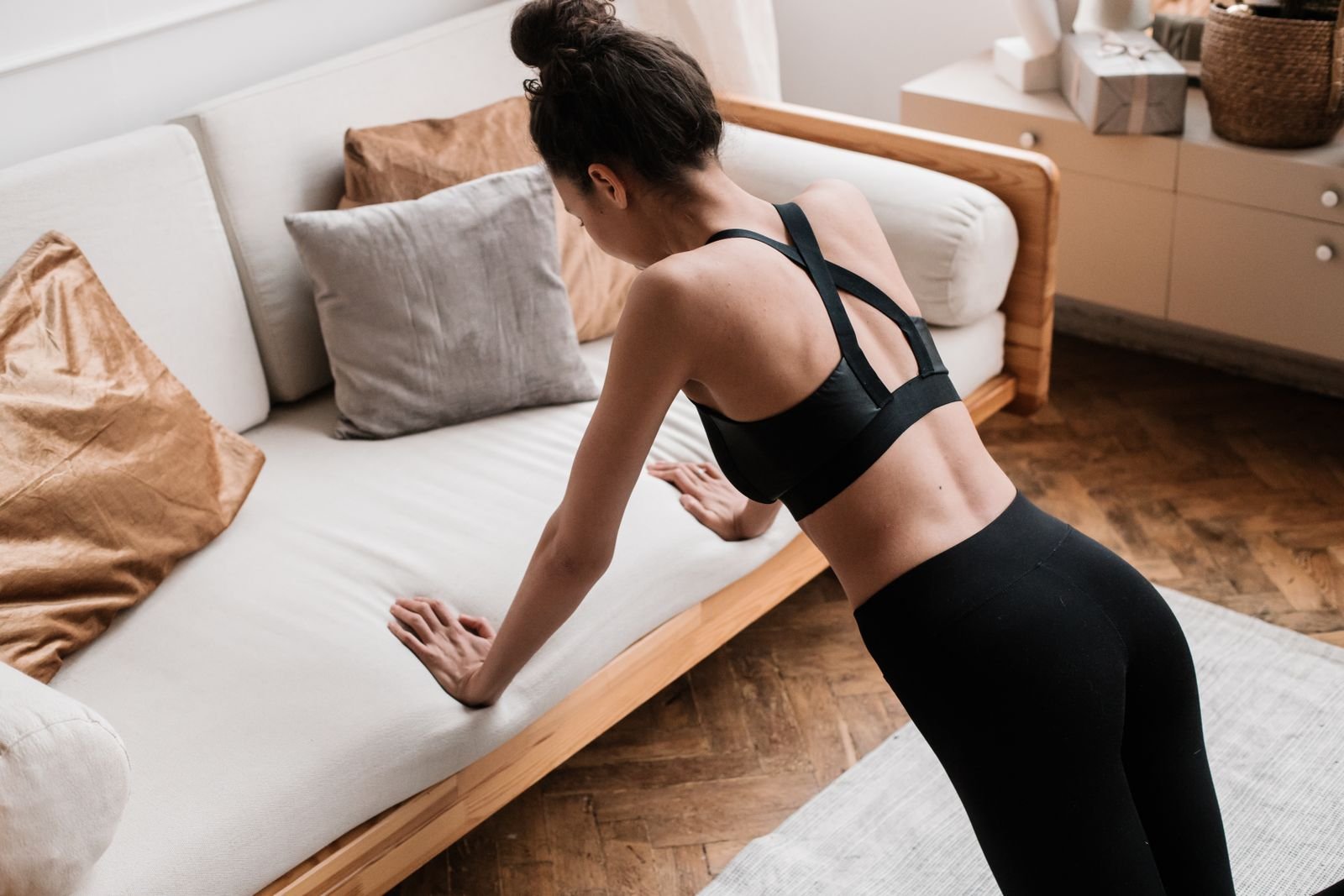
The key is choosing manageable variations and making them more challenging gradually. In its March 2026 resistance-training guidance, the American College of Sports Medicine recognizes bodyweight exercises and home-based routines as effective options for improving strength and physical function.
The following exercises are selected for home practicality, movement variety, and adaptable difficulty—not because research has established a universal “best” ranking. Each includes form instructions, an easier option, and a progression.
How to Get Started With Bodyweight Exercises at Home
Clear enough space to move freely. Use a nonslip surface and, for supported exercises, a fixed countertop or sturdy chair that cannot slide or tip. A mat or folded towel can make floor exercises more comfortable.
Warm up with 5–10 minutes of walking or marching, followed by a few easy practice repetitions. This follows the approach in Mayo Clinic’s strength-training advice.
Choose a variation that feels challenging toward the end of a set without forcing you to lose control. You do not need to continue until you cannot complete another repetition.
The repetition ranges below are suggested starting points, not requirements for every reader. Begin with one set and use fewer repetitions or shorter holds when needed. A repetition is one complete movement; a set is a group of repetitions.
10 Best Bodyweight Exercises for Women
1. Bodyweight Squat
Main focus: Thighs, glutes, and lower-body strength.
How to do it:
- Stand with your feet about shoulder-width apart and your toes turned slightly outward. Reach your arms forward for balance.
- Bend your hips and knees, lowering your body while keeping your feet grounded. Let your knees follow the direction of your toes.
- Stop at a depth you can control, then push through your feet to stand.
Suggested starting amount: 6–12 repetitions.
Make it easier: Sit down on a stable chair and stand back up, using your hands for assistance when necessary.
Make it harder: Lower for about three seconds or gradually increase your comfortable depth.
Common mistake: Forcing a deeper squat after your heels lift or your torso loses control. A shallower, controlled squat is a better starting choice.
2. Reverse Lunge
Main focus: Glutes, quadriceps—the muscles at the front of your thighs—and balance.
How to do it:
- Stand with your feet hip-width apart. Step your right foot backward, keeping your feet on separate tracks rather than crossing one behind the other.
- Bend both knees to lower your hips. Keep your left foot flat, your rear heel lifted, and your torso steady.
- Press through your left foot to return to standing. Complete your repetitions, then switch sides.
Suggested starting amount: 5–8 repetitions per side.
Make it easier: Hold a fixed support and use a shallower bend. When stepping is difficult, practice bending and straightening from a stationary split stance.
Make it harder: Gradually increase your comfortable depth before adding repetitions.
Common mistake: Rushing the backward step and losing balance. Your rear knee does not have to touch the floor.
3. Lateral Lunge
Main focus: Thighs and glutes while moving sideways.
How to do it:
- Stand with your feet hip-width apart and your toes generally facing forward.
- Step to the right. Bend your right knee and move your hips backward while keeping your left leg relatively straight and both heels grounded.
- Push through your right foot to return to the starting position. Repeat on the other side.
Suggested starting amount: 5–8 repetitions per side.
Make it easier: Take a smaller step and bend only slightly.
Make it harder: Gradually sit farther into the working hip while maintaining foot and knee alignment.
Common mistake: Stepping so wide that the bending knee collapses inward. Shorten the step when you cannot control your alignment.
4. Glute Bridge
Main focus: Glutes, with your abdominal muscles helping stabilize your trunk.
How to do it:
- Lie on your back with your knees bent and feet flat, about hip-width apart. Rest your arms beside you.
- Gently tighten your abdomen, exhale, and lift your hips by pressing your feet into the floor and contracting your glutes.
- Stop before your lower back arches excessively. Pause briefly, then lower slowly.
Suggested starting amount: 6–12 repetitions.
Make it easier: Lift your hips through a smaller range.
Make it harder: Add a brief pause at the top. Later, try a single-leg variation only when you can keep your pelvis steady.
Common mistake: Trying to lift as high as possible by arching your lower back. Focus on hip movement rather than maximum height.
5. Push-Up
Main focus: Chest, triceps, and shoulders, with your trunk muscles maintaining body position.
How to do it:
- For a floor push-up, place your hands approximately shoulder-width apart and extend your legs behind you. Keep your head, torso, and hips aligned.
- Bend your elbows and lower your chest through a range you can control. Avoid letting your hips sag or rise separately.
- Push the floor away to return to the starting position, moving your body as one unit.
Suggested starting amount: 6–12 repetitions of an appropriate variation.
Make it easier: Start against a wall, with your hands at chest height. Bend your elbows to bring your chest toward the wall, then press back.
Make it harder: Progress from the wall to a fixed, weight-supporting elevated surface, then toward floor push-ups.
Common mistake: Choosing a version that is too difficult to maintain a steady torso.
6. Prone W Raise
Main focus: Upper-back and shoulder-blade control.
How to do it:
- Lie face down, resting your forehead on a folded towel if comfortable. Bend your elbows and angle them away from your sides so your arms form a W.
- Gently draw your shoulder blades back and down. Lift your elbows and hands slightly from the floor without throwing your chest upward.
- Keep your neck aligned with your upper back. Hold while breathing, then lower and relax.
Suggested starting amount: 2–4 holds of about five seconds.
Make it easier: Use a very small arm lift.
Make it harder: Gradually extend each controlled hold toward 8–10 seconds.
Common mistake: Shrugging your shoulders or generating most of the lift by arching your lower back. This is a small, controlled movement.
7. Dead Bug
Main focus: Abdominal control while your arms and legs move.
How to do it:
- Lie on your back with your arms pointing toward the ceiling. Lift your legs so your hips and knees are bent approximately 90 degrees.
- Gently brace your abdomen. Slowly reach your right arm overhead and extend your left leg away from you without increasing your lower-back arch.
- Return to the starting position, then switch sides.
Suggested starting amount: 4–6 repetitions per side.
Make it easier: Keep your arms still and move one bent leg at a time through a small range.
Make it harder: Extend the opposite arm and leg farther while keeping your trunk steady.
Common mistake: Lowering your limbs farther than you can control. They do not need to reach the floor.
8. Bird Dog
Main focus: Trunk stability, with your back and glutes helping control the movement.
How to do it:
- Start on your hands and knees, with your hands beneath your shoulders and knees beneath your hips.
- Reach your right arm forward and your left leg backward. Keep your pelvis relatively level and look down rather than lifting your chin.
- Pause briefly, return both limbs to the floor, and switch sides.
Suggested starting amount: 4–6 repetitions per side.
Make it easier: Move only one arm or one leg at a time.
Make it harder: Add a controlled three- to five-second hold without rotating or arching.
Common mistake: Lifting your leg too high. Think about reaching long, not reaching upward; stop where you can maintain your lower-back position.
9. Side Plank
Main focus: The obliques—the muscles along the sides of your abdomen—and trunk stability.
How to do it:
- Lie on your side and place your elbow beneath your shoulder. Extend your legs, with your feet stacked or slightly staggered.
- Press through your forearm and lift your hips, forming a relatively straight line from your head to your feet.
- Breathe steadily during the hold, lower with control, and repeat on the other side.
Suggested starting amount: 10–20 seconds per side, or less when needed.
Make it easier: Bend your knees and support yourself through your forearm and knees.
Make it harder: Progress from bent knees to straight legs before chasing longer holds.
Common mistake: Sagging hips or rotating your torso. End the hold before you lose position.
10. Standing Calf Raise
Main focus: The calf muscles at the back of your lower legs.
How to do it:
- Stand with your feet about hip-width apart. Hold a fixed support or stable chair lightly.
- Slowly lift both heels, rising onto the balls of your feet as high as feels comfortable.
- Lower your heels with control rather than dropping them.
Suggested starting amount: 6–12 repetitions.
Make it easier: Use a smaller heel lift and additional hand support.
Make it harder: Add repetitions gradually or pause briefly at the top while keeping the movement controlled.
Common mistake: Bouncing through repetitions. Keep the upward and downward movements deliberate, and retain support when balance is a concern.
Beginner Bodyweight Workout for Women
You do not need to perform all 10 exercises in every session. Start with this six-movement routine twice a week on nonconsecutive days, such as Monday and Thursday. Leaving recovery time between sessions follows Mayo Clinic’s general strength-training guidance.
This is an illustrative beginner routine, not a program tested as a complete package.
| Exercise | Suggested starting amount |
|---|---|
| Bodyweight squat or chair sit-to-stand | 1 set of 6–12 repetitions |
| Push-up variation | 1 set of 6–12 repetitions |
| Glute bridge | 1 set of 6–12 repetitions |
| Prone W raise | 2–4 holds of about 5 seconds |
| Dead bug | 1 set of 4–6 repetitions per side |
| Standing calf raise | 1 set of 6–12 repetitions |
Rest approximately 60–90 seconds between exercises, taking longer when necessary to regain comfortable breathing and movement control. After the session becomes manageable, consider adding a second set rather than immediately adding every remaining exercise.
For variety, use reverse or lateral lunges instead of squats in another session. Bird dogs or side planks can replace dead bugs. “Six repetitions per side” means six on the left and six on the right—12 total.
What This Routine Does Not Cover
The routine does not include a substantial resisted pulling exercise. A prone W raise lifts your arms and practices shoulder-blade control; it is not equivalent to a row or pull-up. For more balanced strength work, consider adding an appropriately set-up rowing movement when equipment becomes available.
Keep aerobic activity in your week, too. The CDC’s adult activity guidelines recommend at least 150 minutes of moderate-intensity aerobic activity or 75 minutes of vigorous activity weekly, plus muscle-strengthening work covering all major muscle groups on at least two days. This short routine does not automatically fulfill every part of those recommendations.
How to Make Bodyweight Exercises More Challenging
Progress gradually instead of changing several things at once. Increasing repetitions and moving to more demanding variations are practical ways to build on your starting routine.
For example, you might begin with six controlled squats. When that amount becomes manageable, try eight. Later, work toward the top of your chosen range before adding another set or selecting a harder variation.
Keep a simple record of the exercise version, repetitions, and how controlled the movement felt. For holds, record the time you maintained a steady position—not the time you stayed up while sagging.
A harder variation should still look controlled. Reduce the difficulty when added repetitions or longer holds consistently change your technique.
Common Mistakes to Avoid
Turning every session into a race. Rushing can replace deliberate muscle effort with momentum. Allow enough rest to perform the next exercise well.
Holding your breath. Continue breathing during holds, and generally exhale during the more demanding part of a repetition.
Using repetition totals as a reason to continue through pain. The suggested numbers are adjustable. Stop a painful exercise rather than forcing yourself to finish the set.
Safety Tips and When to Get Help
For persistent pain, an injury affecting movement, or uncertainty about technique, ask a qualified fitness professional or physical therapist for individualized guidance. People with chronic health conditions may also need advice about suitable activity types and amounts.
Pregnancy and Postpartum Considerations
This is a general fitness guide, not a prenatal or postpartum recovery program. Discuss exercise choices with your maternity care team when pregnant or returning after childbirth.
Some positions need modification during pregnancy. For example, NHS pregnancy exercise guidance advises avoiding prolonged flat-on-the-back exercise, particularly after 16 weeks. Do not assume every floor exercise in this list is appropriate throughout pregnancy.
Pelvic-Floor Symptoms
Arrange an assessment for urinary leakage during exercise, vaginal heaviness or pressure, or a vaginal bulge. The NHS guidance on pelvic organ prolapse symptoms identifies these as symptoms worth discussing with a healthcare professional. They do not establish a diagnosis by themselves, and simply doing more abdominal exercises is not a substitute for assessment.
Stop exercising and seek urgent medical help for chest pain, fainting, or severe, unusual breathlessness. Call emergency services for possible heart-attack symptoms.
Frequently Asked Questions
Can Women Build Muscle With Bodyweight Exercises?
Yes. Bodyweight resistance training can support muscle growth when the exercises provide an appropriate challenge. Progress depends on factors such as training difficulty, volume, and consistency—not simply completing the same easy repetitions indefinitely.
How Often Should Women Do Bodyweight Workouts?
Two nonconsecutive sessions per week are a reasonable starting schedule for this routine. Public-health guidance recommends strengthening all major muscle groups on at least two days weekly, with recovery between demanding sessions for the same muscles.
Are Bodyweight Exercises Enough for a Complete Fitness Routine?
They can provide strength training, but your week should also include aerobic activity. Exercise selection matters: this particular equipment-free routine has limited pulling resistance, so it does not challenge every muscle group equally.
Which Bodyweight Exercises for Women Are Best for Beginners?
Chair sit-to-stands, wall push-ups, supported calf raises, and comfortable-range glute bridges are practical starting options. Choose movements you can perform steadily rather than assuming every beginner should start with the same version.
Can I Do This Workout Without Getting on the Floor?
You can start with the standing movements and wall push-ups. However, that changes the routine’s coverage; it does not directly replace every floor-based exercise. Ask for tailored alternatives when getting down or back up is difficult.
How Do I Know When to Make an Exercise Harder?
Consider a small progression when you can complete your chosen repetitions with steady technique and the movement no longer feels challenging. Add repetitions, increase a hold slightly, or choose a harder variation—without sacrificing control.
Conclusion
The most useful bodyweight exercises for women are the ones that fit your ability and give you a manageable way to progress. Start with appropriate variations, practice controlled movement, and leave room for recovery.
Choose your versions of the six exercises in the sample routine, complete one manageable set of each, and record your starting point. Then schedule your next session rather than trying to accomplish everything in one workout.
References
- American College of Sports Medicine: 2026 resistance-training guidelines update.
- Centers for Disease Control and Prevention: Adult physical activity recommendations and activity guidance for chronic conditions and disabilities.
- Mayo Clinic: Weight training: Do’s and don’ts of proper technique.
- American Council on Exercise: Bodyweight squat, side lunge, glute bridge, push-up, prone shoulder stabilization, and bird dog.
- Hinge Health: Reverse lunge instructions and modifications.
- National Academy of Sports Medicine: Dead bug exercise instructions.
- Cleveland Clinic: Plank and side-plank exercise guidance.
- NHS: Home strength exercises, exercise in pregnancy, and pelvic organ prolapse.
- American Heart Association: Warning signs of a heart attack.