
Chair Pilates exercises for seniors are gentle, controlled movements performed while seated or using a stable chair for support. They may help older adults practice balance, posture, mobility, breathing control, and functional strength without needing to get down on the floor.
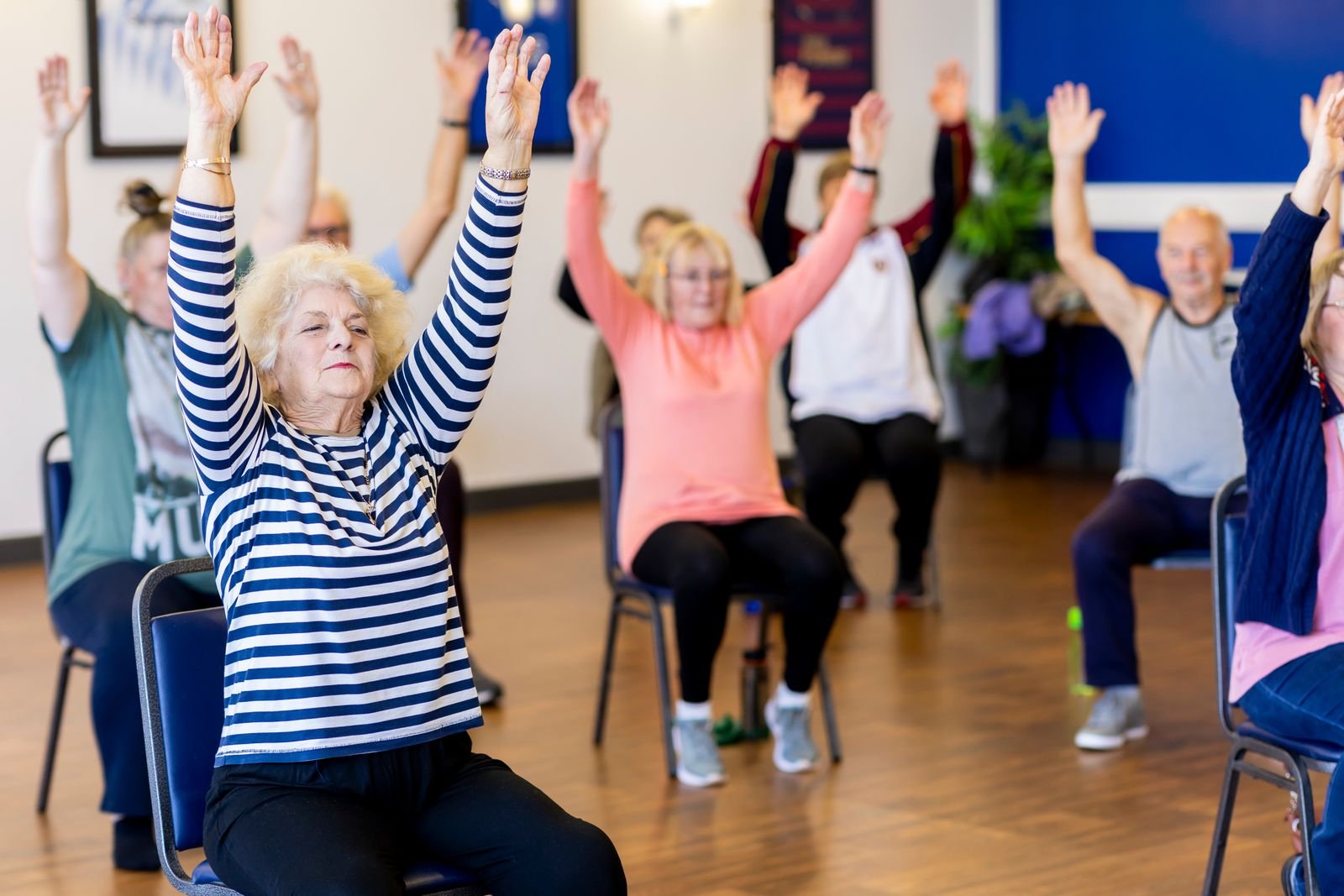
Chair Pilates can be particularly useful for beginners, people with limited mobility, and anyone who feels uncomfortable exercising on the floor. Most movements can also be adjusted by reducing the range of motion, slowing the pace, or remaining seated.
However, chair Pilates is not a complete exercise program by itself. It works best alongside appropriate aerobic activity, progressive strength training, and additional balance practice.
Chair Pilates for Seniors at a Glance
| Category | Recommendation |
|---|---|
| Equipment | One solid, stable chair without wheels |
| Routine length | Approximately 10–20 minutes |
| Starting volume | 1 set of 5–8 controlled repetitions |
| Progression | Gradually build toward 8–12 repetitions |
| Frequency | 2–3 times per week |
| Rest | 20–60 seconds or as needed |
| Movement speed | Slow and controlled |
| Best for | Beginners, limited mobility, balance practice, and difficulty getting onto the floor |
| Important rule | Stop if a movement causes pain, dizziness, or unusual symptoms |
Is Chair Pilates Good for Seniors?
Chair Pilates can provide an accessible way to move more regularly. It may be especially helpful when traditional floor exercises are uncomfortable, intimidating, or impractical.
Potential Benefits of Chair Pilates Exercises for Seniors
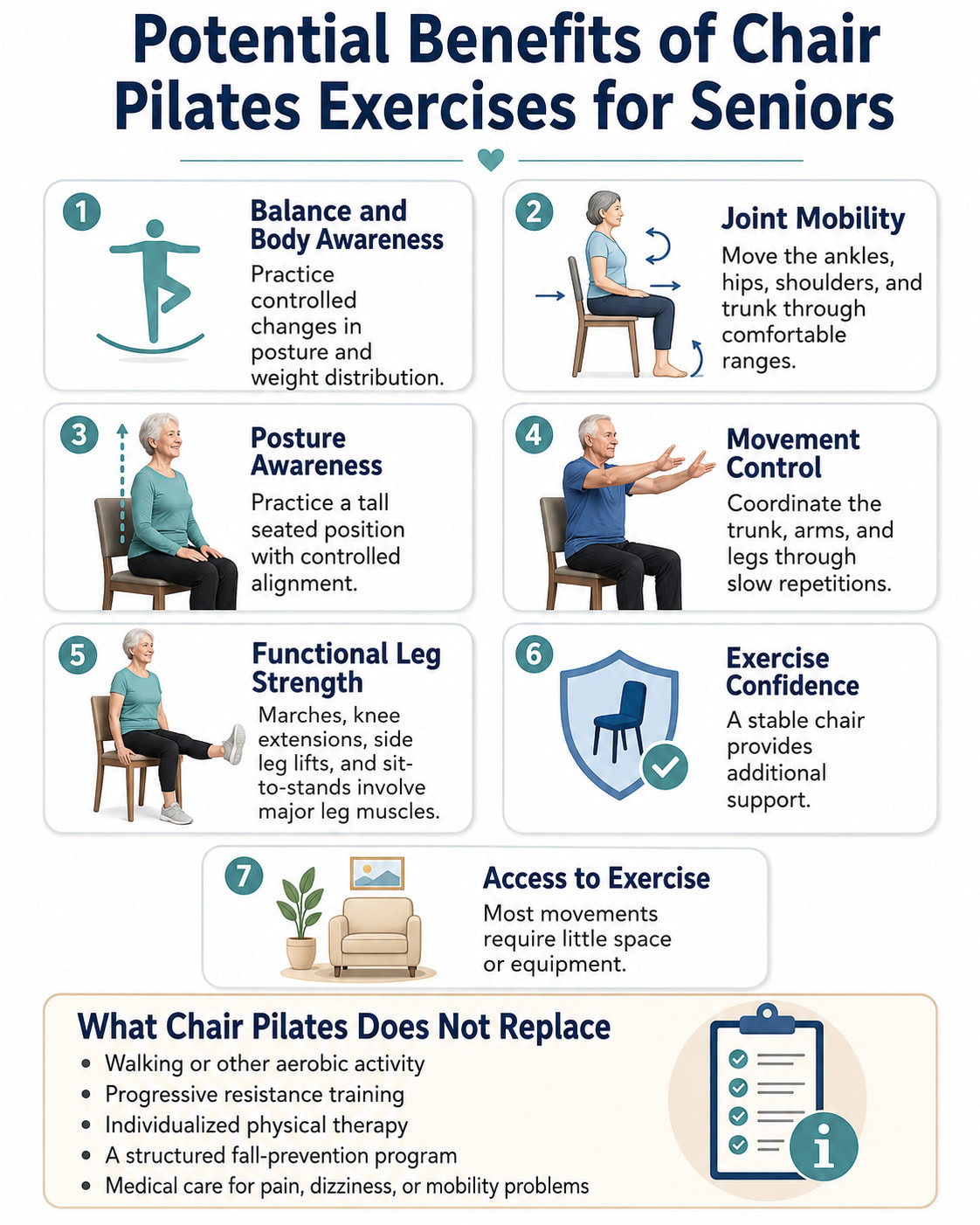
Regular practice may support:
- Balance and body awareness: Slow movements require you to notice how your weight and posture change.
- Joint mobility: Seated ankle, hip, shoulder, and trunk movements gently take the joints through comfortable ranges.
- Posture awareness: Many exercises encourage a tall seated position with the head, ribs, and pelvis aligned.
- Movement control: Controlled repetitions can help improve coordination between the trunk, arms, and legs.
- Functional leg strength: Marching, knee extensions, side leg lifts, and sit-to-stands train muscles used during daily activities.
- Exercise confidence: The chair provides a predictable base of support for people who feel uncertain about balance.
- Access to exercise: Most movements require very little space or equipment.
A 2024 systematic review and meta-analysis indexed by the National Library of Medicine included 39 studies and 1,770 participants. Pilates improved several measures of static and dynamic balance compared with inactive control groups. However, it was not shown to reduce the actual number of falls or fear of falling, and the certainty of the evidence ranged from very low to moderate.
A separate systematic review of chair-based exercise programs, also available through the National Library of Medicine, found improvements in several measures of upper- and lower-body physical function. Those programs included different forms of seated exercise, so the findings support chair exercise generally rather than proving that every chair Pilates movement produces the same result.
What Chair Pilates Does Not Replace
Gentle chair Pilates should not be presented as a replacement for:
- Walking or other aerobic activity
- Progressive resistance training
- Individualized physical therapy
- A structured fall-prevention program
- Medical care for pain, dizziness, or mobility problems
A 2024 review available through the National Library of Medicine concluded that the available evidence was not sufficient to recommend Pilates specifically for improving muscular strength, endurance, or power in older adults. Some of the exercises below can strengthen muscles, but significant strength development normally requires gradually increasing resistance or difficulty.
The current U.S. Office of Disease Prevention and Health Promotion guidance for older adults, updated November, 2025, recommends at least 150 minutes of moderate aerobic activity each week, muscle-strengthening activity on at least two days, and activities that improve balance. People who cannot currently meet those amounts should start slowly and remain as active as their abilities allow.
10 Best Chair Pilates Exercises for Seniors
1. Seated Pilates Breathing
Why it works:
Seated Pilates breathing helps you coordinate breathing with posture and gentle trunk engagement. It can also help reduce unnecessary tension in the neck and shoulders before other exercises.
Muscles worked:
Diaphragm, deep abdominal muscles, intercostals, and other trunk stabilizers.
How to do it:
- Sit toward the front or middle of a stable chair.
- Place both feet flat on the floor about hip-width apart.
- Sit tall without forcing your chest upward.
- Place your hands around the sides of your lower ribs.
- Inhale slowly through your nose and allow your ribs to expand.
- Exhale slowly through lightly pursed lips.
- Gently tighten your lower abdomen at the end of the exhale.
- Repeat for about 5 slow breathing cycles.
Trainer Tip:
Keep your shoulders relaxed and avoid sucking your stomach in forcefully. The goal is smooth breathing and gentle trunk control.
2. Seated Pelvic Tilts
Why it works:
Seated pelvic tilts teach you to control the position of your pelvis and lower back. The small movement may also help maintain comfortable lower-trunk mobility.
Muscles worked:
Abdominals, lower-back muscles, and other muscles that control the pelvis.
How to do it:
- Sit tall with your feet flat on the floor.
- Rest your hands on your thighs.
- Gently tilt your pelvis backward so your lower back flattens slightly.
- Return to a comfortable neutral position.
- Tilt your pelvis slightly forward without excessively arching your back.
- Continue slowly between the positions.
- Perform about 5–8 controlled repetitions.
Trainer Tip:
Keep the movement small and comfortable. If you have osteoporosis or have been advised to avoid spinal flexion, keep your spine more neutral or skip this exercise.
3. Seated Chest Expansion
Why it works:
Seated chest expansion combines controlled breathing with shoulder movement and upright posture. It may help improve awareness of the shoulders, chest, and upper-back position.
Muscles worked:
Shoulders, upper-back muscles, chest, and trunk stabilizers.
How to do it:
- Sit upright with your feet flat on the floor.
- Let your arms hang beside your body with your palms facing backward.
- Inhale and lengthen through the top of your head.
- Exhale as you gently move both straight arms slightly behind you.
- Open across your collarbones without pushing your ribs forward.
- Inhale as you slowly return your arms to the starting position.
- Perform about 6–10 repetitions.
Trainer Tip:
Do not force your arms far behind your body. A small, controlled movement is more useful than trying to create a large stretch.
4. Seated Spine Twist
Why it works:
The seated spine twist practices controlled rotation of the trunk while the hips and legs remain stable. It may support upper-back mobility and trunk coordination.
Muscles worked:
Obliques, upper-back muscles, and deep trunk stabilizers.
How to do it:
- Sit tall with both feet flat on the floor.
- Keep your knees pointing forward.
- Cross your arms over your chest or place your hands on opposite shoulders.
- Inhale while facing forward.
- Exhale as you slowly rotate your upper body to the right.
- Keep your hips, knees, and feet facing forward.
- Return to the center.
- Repeat to the left.
- Perform about 4–6 repetitions per side.
Trainer Tip:
Think about rotating your rib cage rather than pulling yourself around with your arms. Avoid forceful or end-range twisting, especially if you have osteoporosis or spinal-fracture risk.
5. Seated Side Bend
Why it works:
Seated side bends train controlled movement through the side of the trunk while both hips remain supported by the chair.
Muscles worked:
Obliques, side trunk muscles, shoulders, and trunk stabilizers.
How to do it:
- Sit tall with both feet flat on the floor.
- Place your right hand lightly on the side of the chair.
- Lift your left arm overhead.
- Exhale as you gently lean your torso to the right.
- Keep both sitting bones in contact with the chair.
- Inhale as you return to the center.
- Complete the repetitions and switch sides.
- Perform about 4–6 repetitions per side.
Trainer Tip:
Keep the movement small enough that you can stay upright rather than collapsing forward. If reaching overhead is uncomfortable, keep your hand on your hip.
6. Seated March
Why it works:
Seated marching trains the hips and thighs while requiring the trunk to stay relatively steady. It also provides an accessible way to practice alternating leg movement.
Muscles worked:
Hip flexors, quadriceps, and trunk stabilizers.
How to do it:
- Sit tall with both feet flat on the floor.
- Hold the sides of the chair lightly if needed.
- Gently brace your abdomen while continuing to breathe.
- Lift your right knee without leaning backward.
- Lower your foot slowly to the floor.
- Repeat with your left leg.
- Continue alternating sides.
- Perform about 5–10 repetitions per leg.
Trainer Tip:
Lift the knee only as high as you can without rocking your torso backward. A smaller controlled lift is better than a higher uncontrolled one.
7. Seated Knee Extension
Why it works:
Seated knee extensions directly train the quadriceps, which help straighten the knee and contribute to everyday movements such as standing, walking, and climbing stairs.
Muscles worked:
Quadriceps.
How to do it:
- Sit upright with both feet flat on the floor.
- Hold the chair lightly for support.
- Slowly straighten your right knee.
- Stop before aggressively locking the joint.
- Pause briefly with your leg extended.
- Lower your foot under control.
- Complete the repetitions and switch legs.
- Perform about 6–10 repetitions per leg.
Trainer Tip:
Avoid kicking the leg upward quickly. Try taking about two or three seconds to lower the foot back to the floor.
8. Seated Ankle Point and Flex
Why it works:
Pointing and flexing the ankle moves the joint through a comfortable range and activates muscles in the calf and front of the lower leg that contribute to walking and foot control.
Muscles worked:
Calves, tibialis anterior, and other ankle and lower-leg muscles.
How to do it:
- Sit tall and hold the chair lightly if needed.
- Extend your right leg slightly forward.
- Keep the heel hovering or resting lightly on the floor.
- Point your toes gently away from you.
- Pull your toes back toward your shin.
- Continue slowly through a comfortable range.
- Complete the repetitions and switch feet.
- Perform about 8–12 repetitions per foot.
Trainer Tip:
Keep the thigh relatively still so the movement comes mainly from the ankle. Never force the toes into a painful position.
9. Chair-Supported Side Leg Lift
Why it works:
Chair-supported side leg lifts strengthen muscles on the outside of the hips while allowing you to practice standing balance with hand support.
Muscles worked:
Gluteus medius, gluteus minimus, other hip abductors, and trunk stabilizers.
How to do it:
- Stand behind a stable chair.
- Hold the backrest with both hands.
- Stand tall with your feet about hip-width apart.
- Shift your weight onto your left leg.
- Slowly lift your right leg a short distance to the side.
- Keep your toes and kneecap generally facing forward.
- Lower your foot slowly.
- Complete the repetitions and switch sides.
- Perform about 5–10 repetitions per leg.
Trainer Tip:
Do not lean your torso away from the moving leg. Use a smaller leg lift if needed so you can keep your body upright and stable.
10. Chair-Assisted Sit-to-Stand
Why it works:
Sit-to-stands practice one of the most important everyday movements: rising from a seated position. They train several major lower-body muscles while also requiring balance and trunk control.
Muscles worked:
Quadriceps, glutes, hamstrings, calves, and trunk stabilizers.
How to do it:
- Sit near the front of a stable chair.
- Place your feet about hip-width apart and underneath or slightly behind your knees.
- Place your hands on the armrests, chair, or thighs if you need assistance.
- Lean forward slightly from your hips while keeping your back long.
- Press your feet into the floor and stand up.
- Pause until you feel stable.
- Push your hips backward and slowly lower yourself to the chair.
- Perform about 5–8 controlled repetitions.
Trainer Tip:
Exhale as you stand and lower yourself slowly instead of dropping onto the seat. Use your hands as much as necessary until you can perform the movement confidently.
What You Need Before Starting
Choose the Right Chair
Use a chair that is:
- Solid and stable
- Free from wheels or casters
- Unable to swivel
- Placed on a nonslip surface
- High enough for your feet to rest flat
- Firm enough that you do not sink into the seat
An armless dining chair works well for most movements because armrests can restrict the arms and trunk. However, a chair with armrests may be helpful if you need to push with your hands during sit-to-stands.
The NHS recommends a stable, non-wheeled chair that allows the feet to remain flat and the knees to bend at approximately right angles for its sitting exercises.
Prepare the Exercise Area
Before beginning:
- Place the chair away from loose rugs and electrical cords.
- Keep enough space around the chair for your arms and legs.
- Place the chair against a wall for standing exercises if it might slide.
- Wear comfortable clothing.
- Use stable footwear or nonslip socks.
- Keep water nearby.
- Keep a phone or another person nearby if you have significant balance concerns.
Warm Up First
Spend approximately five minutes preparing your body. You can perform:
- Relaxed breathing
- Gentle shoulder rolls
- Ankle pumps
- Easy seated marching
- Slow opening and closing of the hands
The warm-up should feel comfortable and should not leave you tired before the main routine.
Chair Pilates Safety Tips for Older Adults
Chair support makes exercise more accessible, but it does not make every movement appropriate for every person.
Get individualized advice from a healthcare professional or physical therapist before beginning if you:
- Recently had an operation, heart event, or serious illness
- Have a current injury
- Experience frequent falls or unexplained dizziness
- Have significant heart, lung, joint, or neurological problems
- Have been advised to limit twisting, bending, or weight-bearing activity
- Are uncertain whether the exercises match your current abilities
Stop exercising if you develop:
- Chest pain or pressure
- Dizziness or faintness
- Unusual or extreme shortness of breath
- Nausea
- Sudden weakness
- Loss of balance
- New, sharp, or worsening pain
The NHS advises stopping immediately if exercise causes pain or makes you feel unwell. It also recommends obtaining professional advice when recovering from an injury, living with a health condition, or returning after a recent health event.
Keep Breathing
Do not hold your breath while exercising.
Inhale during the easier part of a movement and exhale during the more demanding part. For example, exhale as you stand from the chair and inhale as you sit down.
The National Institute on Aging advises breathing out during effort and breathing in while relaxing during strengthening exercises.
Important Advice for Osteoporosis
People with osteoporosis, a previous spinal fracture, significant height loss, or a pronounced forward curve of the upper back may need to modify several Pilates movements.
The Bone Health and Osteoporosis Foundation advises avoiding or modifying movements that involve forward bending from the waist or twisting the spine to the point of strain. It recommends maintaining an upright upper back and using controlled movement.
This is particularly relevant to:
- Seated pelvic tilts
- Seated spine twists
- Seated side bends
- Any movement that rounds the upper back
Use a small range, avoid forceful end-range positions, and follow guidance from a physical therapist when necessary.
Beginner Chair Pilates Routine for Seniors
Begin with one round of the following routine.
| Exercise | Starting Amount |
|---|---|
| Seated Pilates breathing | 5 breathing cycles |
| Seated pelvic tilts | 6 repetitions |
| Seated chest expansion | 6 repetitions |
| Seated spine twist | 4 per side |
| Seated side bend | 4 per side |
| Seated march | 6 per leg |
| Seated knee extension | 6 per leg |
| Seated ankle point and flex | 10 per foot |
| Chair-supported side leg lift | 6 per side |
| Chair-assisted sit-to-stand | 5 repetitions |
Rest whenever necessary. The routine should feel controlled and manageable, not exhausting.
Once one round feels comfortable, you can gradually:
- Increase exercises from 5–6 repetitions to 8–12.
- Add a second set to selected exercises.
- Slow the lowering portion of strength exercises.
- Add brief pauses while maintaining normal breathing.
- Reduce hand support during standing exercises when safe.
- Add light resistance only when appropriate.
Change one variable at a time. Adding repetitions, sets, resistance, and reduced support simultaneously can make the routine unnecessarily difficult.
How Often Should Seniors Do Chair Pilates?
A practical starting schedule is two or three chair Pilates sessions per week.
Allow at least one recovery day between more demanding sessions if the routine includes repeated sit-to-stands or challenging leg exercises. Gentle breathing, ankle movement, and comfortable mobility exercises may be performed more often when they do not cause pain or excessive fatigue.
The NHS suggests performing its seated exercises at least twice weekly, building repetitions gradually, and combining them with separate flexibility, balance, and strength routines.
A balanced weekly plan could include:
- Chair Pilates on two or three days
- Walking or another appropriate aerobic activity on several days
- Progressive strength exercises on at least two days
- Regular balance practice
- Rest or lighter activity when needed
How to Make Chair Pilates Easier
Use one or more of these modifications:
- Sit against the backrest.
- Reduce the range of motion.
- Perform fewer repetitions.
- Rest after every exercise.
- Move one arm or leg at a time.
- Keep both hands on the chair during standing movements.
- Replace standing exercises with seated alternatives.
- Use a higher chair for sit-to-stands.
- Skip any movement that does not feel safe or controlled.
Reducing the range is better than forcing a position or losing control.
How to Make Chair Pilates More Challenging
Progress only after you can complete the basic version with steady breathing and consistent posture.
Options include:
- Add two repetitions at a time.
- Add a second set.
- Slow each repetition.
- Pause at the most demanding point.
- Use less hand pressure for balance.
- Combine arm and leg movements.
- Use a light resistance band where appropriate.
Do not make a balance exercise harder by using an unstable chair, closing your eyes, standing on a cushion, or removing support before you are ready.
Common Chair Pilates Mistakes
Moving Too Quickly
Fast repetitions often use momentum and reduce movement control. Slow down enough to feel each position.
Holding the Breath
Breath holding can increase tension and make exercise feel more difficult. Exhale during effort and inhale during the easier return.
Forcing a Large Range
A larger movement is not automatically better. Use the range you can control without pain, strain, or loss of posture.
Slouching in the Chair
Sit tall but relaxed. Avoid collapsing the chest or pushing the head forward.
Gripping the Chair Too Hard
Use the chair for support, not to pull your body through the exercise.
Progressing Too Soon
First improve control and repetitions. Add resistance or reduce support only after the basic version feels stable.
Ignoring Pain or Dizziness
Muscular effort and mild stretching sensations can occur, but sharp pain, dizziness, chest discomfort, or unusual shortness of breath are reasons to stop.
Frequently Asked Questions
Is Chair Pilates Safe for Seniors?
Chair Pilates can be appropriate for many older adults when the exercises match the person’s health, balance, and mobility. The chair must be stable, and each movement should remain controlled and pain-free.
People with recent operations, current injuries, serious health conditions, frequent falls, or unexplained symptoms should obtain individualized guidance before beginning.
Can Chair Pilates Improve Balance?
Pilates may improve measurements of static and dynamic balance in older adults. However, current evidence does not show that Pilates alone reduces the actual number of falls or fear of falling.
For fall prevention, chair Pilates should be combined with appropriate balance, gait, and strength exercises.
Can Chair Pilates Be Done Entirely While Seated?
Yes. Breathing, pelvic tilts, chest expansion, twists, side bends, marching, knee extensions, and ankle movements can all be performed while seated.
The standing side leg lift can be replaced with a seated knee opening. A person unable to perform sit-to-stands can practice leaning forward from the hips and pressing the feet into the floor without leaving the chair.
How Long Should a Chair Pilates Workout Last?
Beginners may start with approximately 10 minutes. A complete one-round routine may take 10–20 minutes, depending on rest periods.
There is no need to complete every exercise in one session. Quality and safety are more important than workout length.
Does Chair Pilates Build Muscle?
Some chair Pilates exercises place useful demands on the legs, hips, and trunk. Sit-to-stands, knee extensions, marches, and side leg lifts may support muscular function.
However, gentle chair Pilates is not a dependable replacement for progressive resistance training when the main goal is increasing strength or muscle mass. Resistance must eventually become more challenging as the person adapts.
What Type of Chair Is Best for Chair Pilates?
Choose a firm, stable chair that does not roll or swivel. Your feet should reach the floor comfortably, and your knees should be near a right angle.
Avoid soft couches, rocking chairs, folding chairs that may collapse, and unstable stools.
Is Chair Pilates Suitable for Someone With Osteoporosis?
Some exercises may be appropriate, but movements involving pronounced forward rounding or forceful twisting may require modification. Maintain a tall spine, use small ranges, and avoid moving to the point of strain.
People with a history of vertebral fracture, significant spinal curvature, or high fracture risk should seek guidance from a physical therapist familiar with osteoporosis-safe exercise.
Conclusion
Chair Pilates exercises for seniors offer a practical way to practice controlled movement, posture, mobility, balance, and functional leg strength without getting down on the floor.
Start with a stable chair, one short round, and approximately five controlled repetitions per exercise. Keep the movements comfortable, breathe continuously, and progress gradually rather than trying to complete a difficult routine immediately.
Use chair Pilates as one part of a broader activity plan that includes appropriate walking or aerobic movement, progressive strength training, and balance practice. Begin with the exercises that feel most stable and record your repetitions so you can progress safely over time.
References
- Bone Health and Osteoporosis Foundation: Proper Body Alignment.
- NHS: Chair-Based Pilates Video Workout.
- NHS: Sitting Exercises.
- U.S. Office of Disease Prevention and Health Promotion: Physical Activity Guidelines Midcourse Report.
- PubMed: Effects of Pilates Exercises on Postural Balance and Reduced Risk of Falls in Older Adults.
- PubMed: Effect of Chair-Based Exercise on Physical Function in Older Adults.
- PubMed: Effects of Pilates Exercises on Strength, Endurance, and Muscle Power in Older Adults.