
Farro nutrition facts depend on the product and whether you measure it dry or cooked. A ¼-cup dry serving of Bob’s Red Mill Organic Farro (52 grams) provides 190 calories, 6 grams of protein, and 5 grams of fiber. These are product-specific values, not a universal profile for every farro variety.
Understanding the serving size makes it easier to compare foods and plan meals. Start with your package’s label, then consider whether you are buying whole, semi-pearled, or pearled farro.
Farro Nutrition Facts
The following values come from Bob’s Red Mill’s nutrition label, checked on September, 2026. The listed ingredient is organic pearled farro.
| Nutrient | Per ¼ cup dry farro, 52 grams |
|---|---|
| Calories | 190 |
| Total carbohydrate | 38 g |
| Protein | 6 g |
| Dietary fiber | 5 g |
| Total fat | 1 g |
| Total sugars | 0 g |
| Added sugars | 0 g |
| Sodium | 0 mg |
| Iron | 2 mg |
| Potassium | 204 mg |
| Calcium | 14 mg |
These figures describe the uncooked grain, without added oil, sauces, or salt. Check your own package because its serving weight and nutritional values may differ.
Also, a label serving is not a recommendation for how much everyone should eat. The FDA explains that serving sizes reflect amounts people typically consume, rather than individualized nutritional needs.
Cooked vs. Dry Farro Nutrition
A ¼ cup of dry farro is not the same portion as a ¼ cup of cooked farro. Cooking adds water and increases the grain’s volume.
The Whole Grains Council’s cooking guide gives a general yield of approximately 3 cups cooked farro from 1 cup dry. Actual yield varies with the grain and preparation method.
Applying that estimated yield to the product label above gives these approximate values:
| Nutrient | Estimated ½ cup cooked | Estimated 1 cup cooked |
|---|---|---|
| Calories | About 130 | About 250 |
| Carbohydrate | About 25 g | About 51 g |
| Protein | About 4 g | About 8 g |
| Fiber | About 3.3 g | About 6.7 g |
These are calculated estimates, not laboratory-tested cooked-food values. They assume a threefold increase in volume and plain-water cooking, without accounting for nutrients lost in discarded cooking water or added ingredients.
How to Estimate Your Own Cooked Portions
For a more consistent estimate, use the nutrition information for the dry amount you actually cook, then divide the batch into equal portions.
For example, cooking four label servings and dividing the finished batch into four equal portions gives approximately one label serving per portion—regardless of how many cups the cooked grain occupies.
Include oil, cheese, dressing, or other ingredients separately when calculating a recipe. This approach avoids assigning the same nutritional value to every loosely or tightly packed cup.
What Is Farro?
Farro is a wheat grain, commonly emmer, with a nutty flavor and firm, chewy texture. You can serve it as a side dish or add it to soups, salads, and grain bowls. It is not the same grain as barley, although they can have similar culinary uses.
The description “ancient grain” does not tell you how much processing a package has undergone. For that, look for terms such as whole, semi-pearled, or pearled.
Whole, Semi-Pearled, and Pearled Farro
The main difference is how much of the grain’s outer layers remain.
| Type | What it means | What to consider |
|---|---|---|
| Whole farro | Retains the bran, germ, and endosperm | The whole-grain option |
| Semi-pearled farro | Some bran has been removed | Retains part of the nutrient-rich bran |
| Pearled farro | The outer bran has been removed | Not equivalent to whole-grain farro |
Tufts’ nutrition guidance explains these distinctions and recommends checking the label when choosing whole-grain farro.
For a whole-grain option, look for clear wording such as “whole farro” or “whole-grain farro.” Pearled farro can still contribute fiber, as the nutrition table above shows. Compare the actual labels rather than assuming every product in a category has identical values.
Is Farro Healthy?
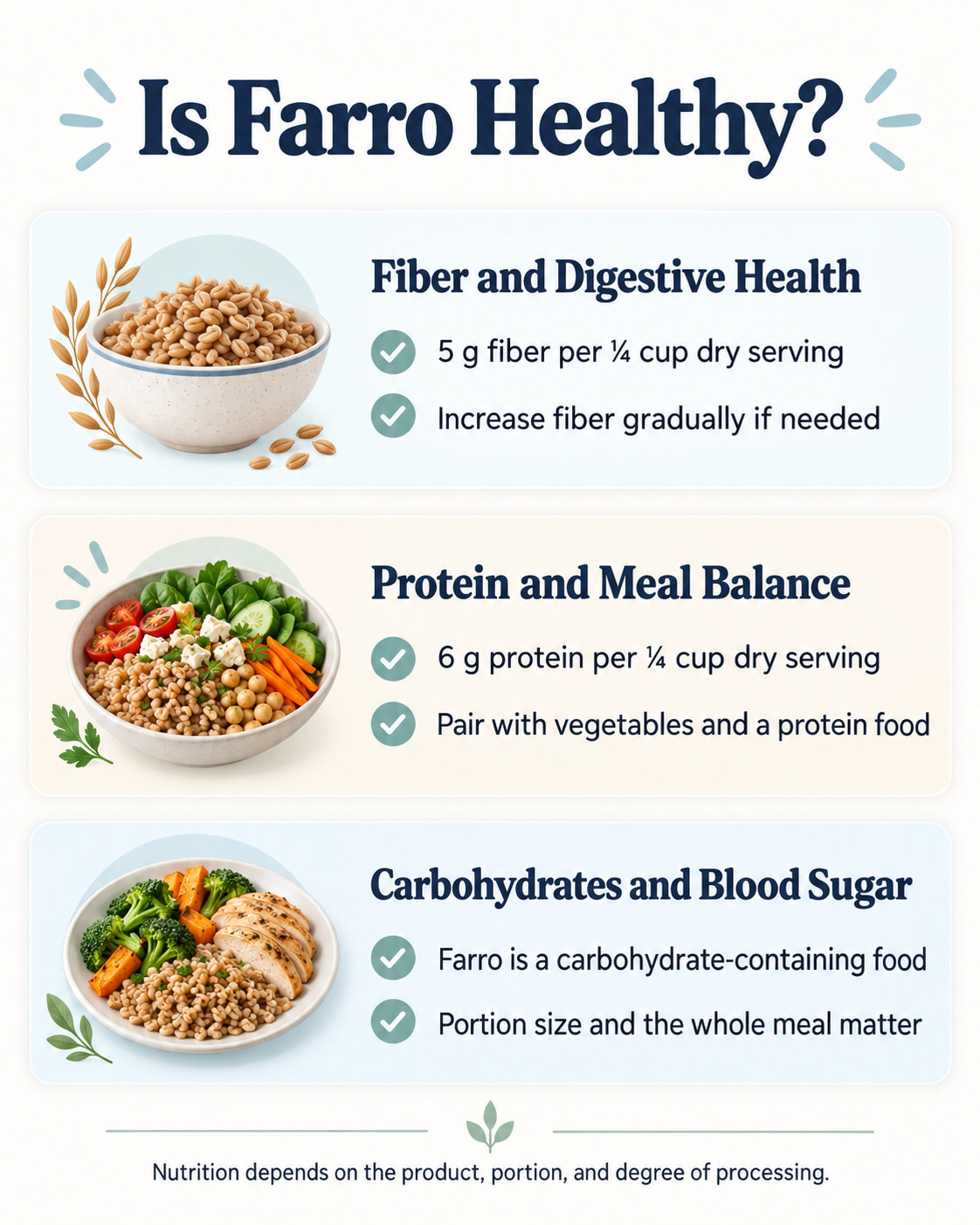
Farro can be a nutritious grain option for people who tolerate wheat. Its main contributions are carbohydrate, fiber, plant-based protein, and several micronutrients. Its nutritional value also depends on processing and what you serve alongside it.
Fiber and Digestive Health
The FDA’s Daily Value guidance lists 28 grams of fiber as the labeling reference. A serving containing 5 grams supplies approximately 18% of that Daily Value. This percentage helps you interpret a label; it is not a personalized daily target.
Fiber can support bowel regularity. However, increasing your intake suddenly may cause bloating or cramping. Harvard’s nutrition guidance recommends adding fiber gradually and drinking adequate fluids. Starting with a smaller portion may be more comfortable when you are introducing more fiber-rich foods.
Protein and Meal Balance
Farro contributes plant-based protein, but a grain serving does not need to carry the whole meal’s protein content.
For a practical grain bowl, combine farro with lentils, tofu, chicken, or fish, then add vegetables. This follows the general approach in CDC meal-planning guidance, which includes vegetables, a protein food, and a carbohydrate food rather than relying on one ingredient alone.
Carbohydrates and Blood Sugar
Farro is a carbohydrate-containing food, even when its label lists no sugar. “No added sugar” does not mean “no effect on blood sugar.”
The CDC’s diabetes meal-planning guidance, dated May, 2024, explains that carbohydrates raise blood glucose. The response depends partly on the food and what accompanies it; eating carbohydrates with protein, fat, or fiber can slow the rise.
For someone managing diabetes, the useful questions are how much farro is in the meal and how it fits the individual carbohydrate plan. A registered dietitian can help determine an appropriate portion. Being an ancient grain does not remove the need to consider carbohydrates.
Vitamins and Minerals
Farro can contribute iron, magnesium, and B vitamins. Exact amounts depend on the product, so use a matching label or food-composition record when tracking specific nutrients.
A nutrient missing from a short label is not necessarily absent from the food. The FDA requires certain vitamins and minerals on Nutrition Facts labels, while others may be listed voluntarily unless additional labeling requirements apply.
Farro vs. Brown Rice and Quinoa
There is no need to choose one grain as universally healthier than the others. Consider gluten requirements, processing, portion size, and the kind of meal you enjoy.
Brown rice retains its bran and germ and contributes fiber and minerals. Unlike farro, plain rice is naturally gluten-free. It can be an alternative when wheat is unsuitable.
Quinoa is a seed used like a grain. Harvard’s nutrition resource reports approximately 8 grams of protein and 5 grams of fiber per cooked cup. It is also naturally gluten-free. For celiac disease, check packaged products and preparation practices for gluten cross-contact.
Farro offers a particularly chewy texture that works well in hearty salads and soups. Choose it for its taste and how it fits your meal—not because the name guarantees a nutritional advantage.
When comparing calories or nutrients, use equivalent serving sizes and preparation states. Comparing dry farro with cooked rice or quinoa gives a misleading picture.
Is Farro Gluten-Free?
No. Farro is wheat and contains gluten. Whole, semi-pearled, and pearled forms are not suitable for a gluten-free diet.
The NIDDK’s celiac disease guidance specifically identifies emmer as a gluten-containing wheat. People with celiac disease need to avoid it.
Farro is also inappropriate for people who need to avoid wheat because of a wheat allergy. Wheat allergy and celiac disease are different conditions, but neither makes farro a suitable wheat substitute.
When to Seek Medical Advice
Discuss recurring symptoms after wheat-containing foods with a clinician rather than assuming the cause is gluten. When celiac disease is suspected, ask about testing before starting a gluten-free diet because avoiding gluten can affect the results.
Trouble breathing, throat tightness, or difficulty swallowing after eating requires emergency attention. Follow your prescribed allergy emergency plan when applicable.
How to Cook and Eat Farro
Follow the Package’s Cooking Directions
Cooking time varies, so package directions are the best starting point. As a general guide, the Whole Grains Council lists 2½ cups of liquid per cup of dry farro, simmered for approximately 25–40 minutes. Some products require a different method or cooking time.
Bring the grain and liquid to a boil, reduce the heat, and simmer until tender but pleasantly chewy. Add water if needed or drain excess liquid once the grain reaches your preferred texture.
Build a Meal Around It
Try one of these simple combinations:
- Lunch bowl: Farro, lentils, roasted carrots, spinach, and a lemon dressing.
- Dinner side: Farro with mushrooms and herbs, served alongside fish or tofu.
- Hearty salad: Farro, chickpeas, cucumber, tomatoes, and chopped parsley.
These are meal ideas rather than fixed serving prescriptions. Adjust the ingredients and portions to your appetite, preferences, and dietary needs.
Store Cooked Farro Safely
Refrigerate cooked farro promptly in shallow containers. FoodSafety.gov advises refrigerating perishable foods within 2 hours, or within 1 hour when temperatures exceed 90°F. Keep the refrigerator at 40°F or below.
The Whole Grains Council recommends using refrigerated cooked grains within 3–4 days. Freeze portions for longer storage.
Frequently Asked Questions
How Many Calories Are in 1 Cup of Cooked Farro?
The example calculation in this article gives approximately 250 calories per cooked cup. That estimate assumes the selected product triples in volume during cooking. Your package and actual cooked yield may produce a different result.
Is Farro a High-Protein Food?
Farro contributes protein, but think of it primarily as a grain component of a meal. Pairing it with beans, tofu, eggs, fish, or another protein food creates a more varied meal than eating farro alone.
Is Farro Suitable for a Low-Carbohydrate Diet?
It depends on the plan and portion. Farro supplies substantial carbohydrate, so it may not fit a very-low-carbohydrate eating pattern in typical grain portions. Use the package’s total carbohydrate amount rather than judging it by its sugar content.
Is Pearled Farro a Whole Grain?
No. Pearling removes the outer bran, so pearled farro is not equivalent to whole-grain farro. Look for a product specifically identified as whole farro when retaining all parts of the grain is your priority.
Can Farro Fit Into a Weight-Management Eating Plan?
Yes. Grains do not have to be eliminated for weight management. NIDDK guidance emphasizes overall calorie intake and notes that whole-grain foods may help with fullness. Farro is an option within an eating pattern, not a food that produces weight loss by itself.
Can Farro Cause Gas or Bloating?
It may contribute to discomfort when it sharply increases your fiber intake. Introduce fiber-rich foods gradually. Persistent or recurring symptoms deserve medical assessment, especially when they repeatedly follow wheat-containing meals.
The Bottom Line
Farro offers fiber, plant-based protein, and useful micronutrients, but the serving size and degree of processing matter. Whole farro retains the complete grain structure, while pearled products differ. All farro contains gluten.
Start by checking your package’s dry serving size. Then cook a batch and try it in a vegetable-rich bowl or salad with a protein food you enjoy.
This content is for informational purposes only and not medical advice.
References
- Bob’s Red Mill: Organic Farro product information and Nutrition Facts.
- Tufts Health & Nutrition Letter: Healthy Reasons to Put Farro on Your Plate.
- Centers for Disease Control and Prevention: Diabetes Meal Planning.
- National Institute of Diabetes and Digestive and Kidney Diseases: Eating, Diet, & Nutrition for Celiac Disease and Some Myths About Nutrition & Physical Activity.
- American College of Allergy, Asthma & Immunology: Wheat Allergy Information.