
Revenge bedtime procrastination means delaying sleep to reclaim personal time, even when you expect the lost sleep to leave you tired the next day. It can happen when late-night entertainment or quiet time feels like your only break from a demanding schedule.
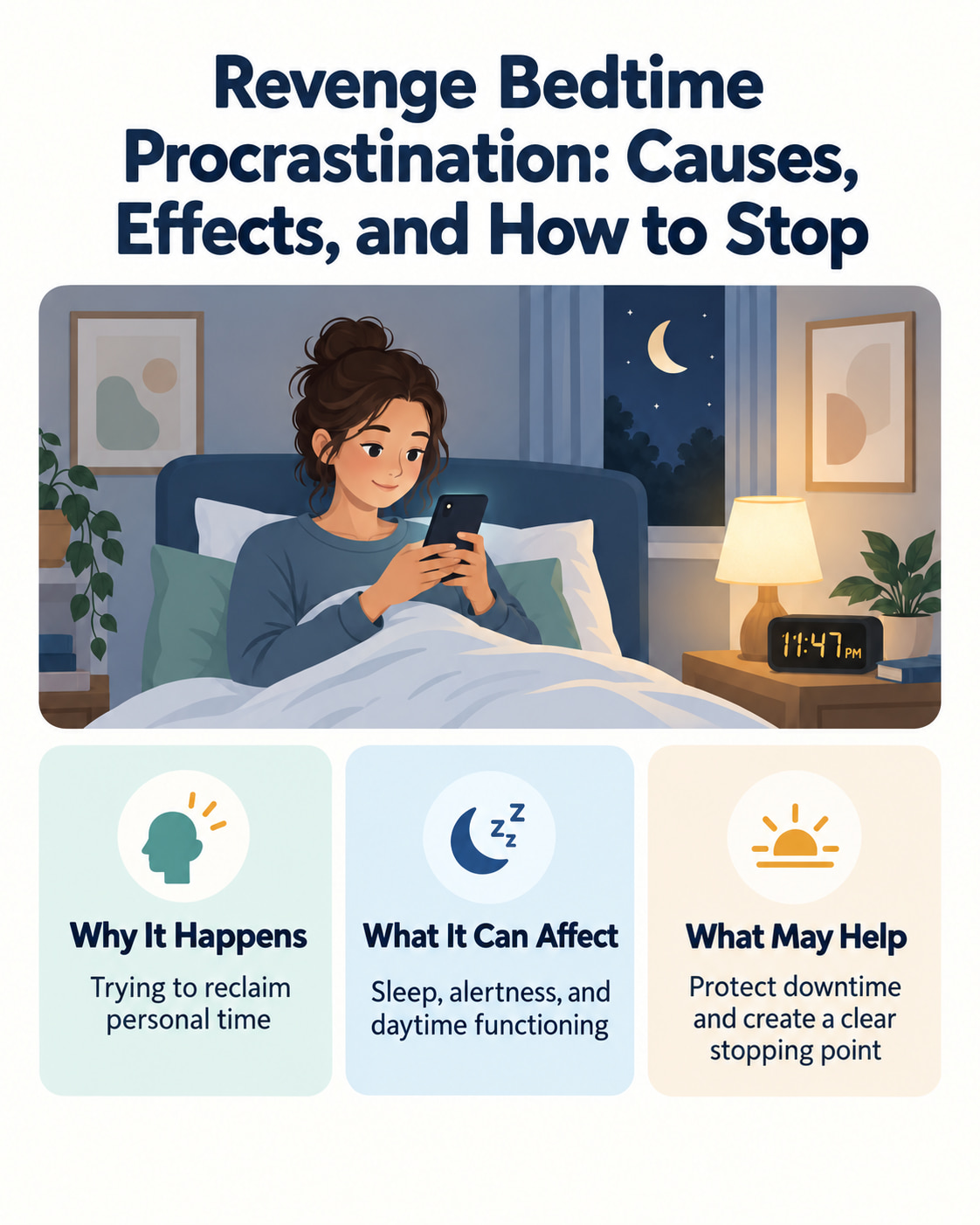
Start by identifying what those late-night hours give you. Then protect some personal time, create a clear stopping point for evening activities, and leave enough time for sleep.
The goal is not to give up your evenings. It is to make room for both enjoyment and rest.
What Is Revenge Bedtime Procrastination?
Researchers introduced the broader concept of bedtime procrastination in a 2014 study. It describes going to bed later than intended when no external circumstances prevent you from going to bed. The “revenge” label adds a particular motivation: trying to take back time that did not feel like yours during the day.
For example, you plan to stop watching a show at 10:30 p.m. but continue until midnight because you finally have uninterrupted time alone.
That differs from staying awake because you must finish a night shift or care for a child. Those responsibilities can reduce sleep, but they are not automatically procrastination.
Signs of Revenge Bedtime Procrastination
Consider whether these patterns sound familiar:
- You repeatedly miss your intended bedtime. You continue an optional activity after deciding you should stop.
- You expect a downside. You know the delay will probably leave less time for sleep.
- You feel protective of the late-night hours. Ending the activity feels like giving up your only personal time.
These are reflection questions, not a diagnostic checklist. The useful distinction is between time you cannot control and bedtime delays you may be able to change.
What Causes Revenge Bedtime Procrastination?
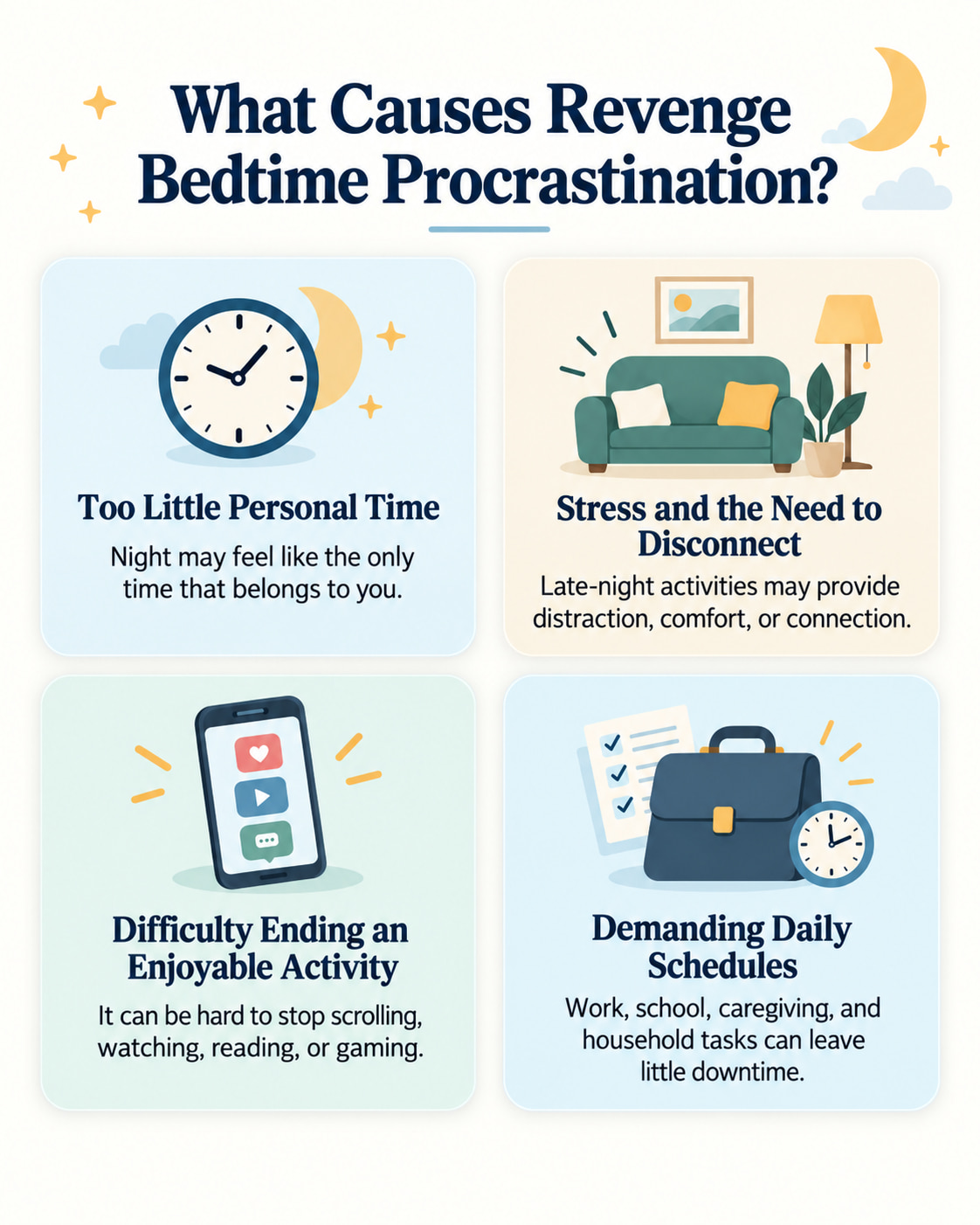
There is no single explanation that fits everyone. Different needs and habits can lead to the same late bedtime.
Too Little Personal Time
When work, caregiving, school, and household tasks fill the day, nighttime may become the first opportunity to do something purely for yourself.
Cleveland Clinic identifies limited free time, demanding schedules, stress, and feeling little control over the day as possible contributors.
Stress and the Need to Disconnect
Late-night activities may provide distraction, comfort, or connection.
In a 2023 study, researchers identified several functions of bedtime procrastination, including managing emotions, compensating for missed personal time, and social interaction. These findings help explain why simply knowing that sleep matters may not resolve the pattern. They do not establish a universal cause.
Difficulty Ending an Enjoyable Activity
Sometimes the problem is following through on a stopping point rather than deliberately deciding to sacrifice sleep.
The original bedtime-procrastination research found an association with difficulties in self-regulation—managing behavior in line with intentions. Because the study was observational, it could not establish which factor caused the other.
Instead of judging yourself, look for the moment when your plan stops working. Is it starting another episode, reopening an app, or postponing getting ready for bed?
How Revenge Bedtime Procrastination Affects Your Health
The main concern is repeatedly getting too little sleep, particularly when your morning alarm cannot move later.
According to the National Heart, Lung, and Blood Institute, sleep deficiency can affect:
- Thinking and performance: Problems with concentration, memory, decisions, and reaction time.
- Emotional functioning: Greater difficulty managing emotions and coping with change.
- Daytime alertness: Tiredness, mistakes, and difficulty functioning at work, school, or behind the wheel.
Ongoing insufficient sleep is also associated with health risks, including high blood pressure, heart disease, and problems with blood sugar regulation. These concerns relate to sleep deficiency; they do not prove that the “revenge” motivation independently causes those conditions.
Focus on the recurring pattern rather than treating every late night as a personal failure.
Revenge Bedtime Procrastination vs. Insomnia
Putting off the opportunity to sleep is different from trying to sleep and being unable to.
| Pattern | Main distinction |
|---|---|
| Bedtime procrastination | You delay going to bed despite intending to stop your activities earlier. |
| Insomnia | You have difficulty falling asleep, staying asleep, or getting satisfactory sleep despite having time and suitable conditions for sleep. |
| Delayed sleep-wake phase disorder | Your sleep timing is persistently later than desired, making it difficult to wake for work, school, or other responsibilities. |
This comparison cannot tell you which explanation applies. Regular difficulty sleeping deserves professional assessment rather than an assumption that you need more discipline.
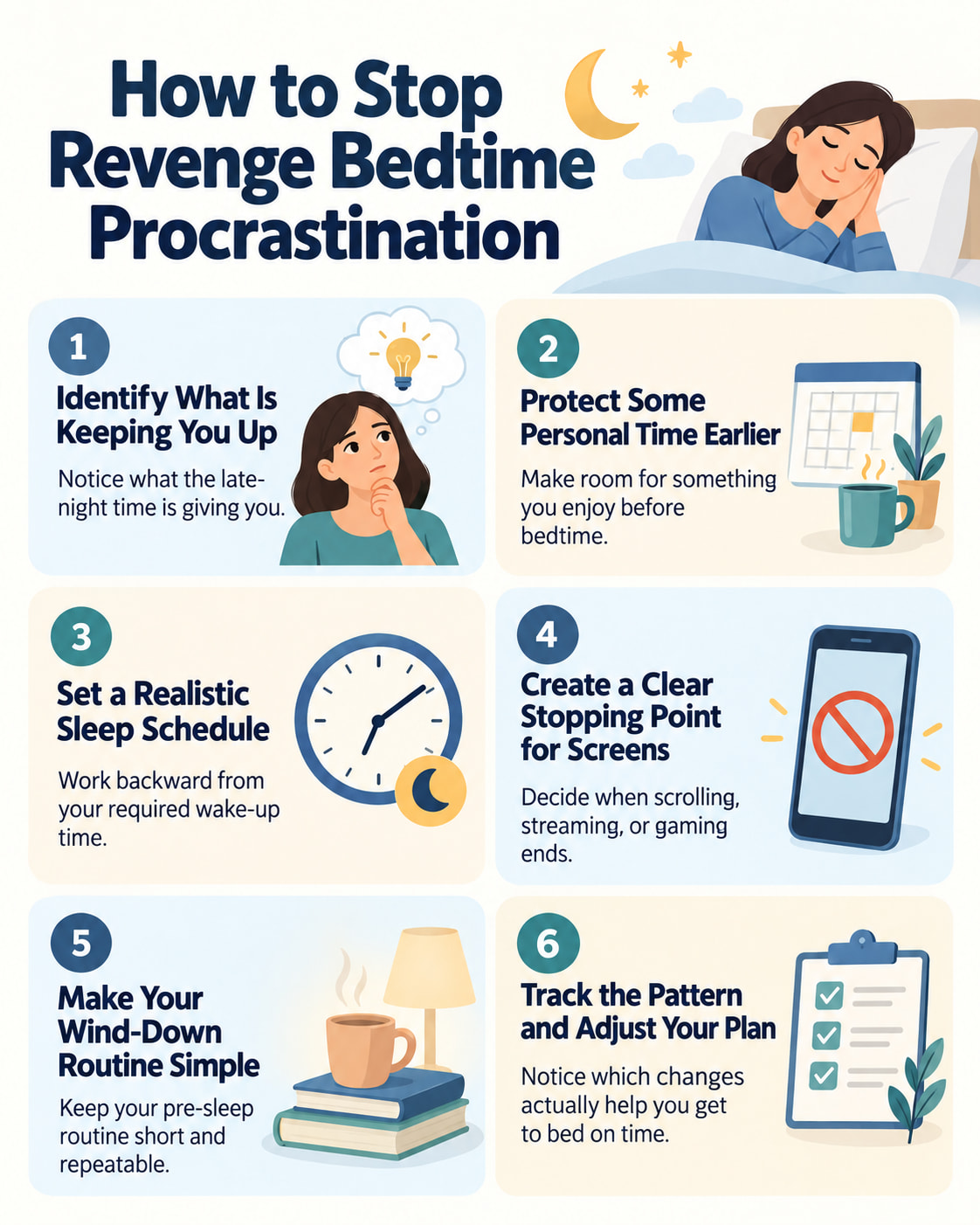
How to Stop Revenge Bedtime Procrastination
Behavior-focused approaches show promise. A 2023 randomized trial involving 60 young adults found improvements in bedtime procrastination after a structured intervention. A 2025 pilot randomized trial involving 32 university students also reported improvements following a cognitive behavioral program. Both studies were small, and neither proves that an individual self-help tip will work for everyone.
Use the following steps as practical starting points, not as a substitute for care when sleep problems persist.
1. Identify What Is Keeping You Up
Before changing your bedtime, ask:
“What am I getting from staying awake that I am not getting earlier?”
Your answer might be solitude, entertainment, connection, or relief from responsibilities. Identifying the purpose of the delay helps you choose a more relevant change than simply removing an activity. This approach reflects the different motivations identified in bedtime-procrastination research.
Here are examples to try:
| What you notice | A change to experiment with |
|---|---|
| You want uninterrupted time alone. | Agree on a protected break with your household before your wind-down period. |
| You keep starting another video or episode. | Choose the final item before you begin and turn off autoplay. |
| Getting ready for bed feels like another task. | Brush your teeth and complete basic preparation earlier. |
| Optional chores keep expanding. | Decide which tasks must happen tonight and which can wait. |
Start with the situation that most closely matches your evenings.
2. Protect Some Personal Time Earlier
Do not make your plan entirely about taking something away. Look for a small, realistic opportunity to keep an activity you enjoy.
For example, try reading during part of a break, arranging an earlier call with a friend, or setting aside time after dinner before returning to chores.
Cleveland Clinic emphasizes that changing this pattern may require reconsidering whether your daytime routine meets your needs—not just improving bedtime habits.
When your schedule is genuinely overloaded, consider what can be shared, postponed, or simplified. A bedtime alarm cannot create time that your responsibilities do not allow.
3. Set a Realistic Sleep Schedule
Start with your required wake-up time and work backward.
The CDC’s sleep recommendations advise at least seven hours for adults ages 18–60, seven to nine hours for ages 61–64, and seven to eight hours for adults 65 and older. These are general recommendations; individual needs vary.
Remember that time in bed is not necessarily time asleep. Leave room for winding down and falling asleep rather than planning every available minute as sleep.
Aim for reasonably consistent sleep and wake times. However, do not turn an earlier bedtime into hours of forcing yourself to sleep. Persistent difficulty sleeping at the time you need may require assessment.
4. Create a Clear Stopping Point for Screens
The CDC recommends turning off electronic devices at least 30 minutes before bedtime.
Translate that guidance into a specific action. For example:
“When my wind-down reminder sounds, I will save what I am watching and put my phone on its charger.”
You could also disable autoplay, set an app limit, or charge your phone beyond arm’s reach. Preserve access to necessary calls or alerts.
A stopping point can apply to books, games, and other activities too. Decide where you will stop before beginning, rather than repeatedly renegotiating when you are already enjoying yourself.
5. Make Your Wind-Down Routine Simple
Choose a short routine that does not feel like another project.
For example, lower the lights, complete basic bedtime preparation, and spend a little time reading something calming or listening to quiet music. NHLBI recommends quiet time before bed and a bedroom that is cool, dark, and quiet.
Also review anything that may make sleep harder after you stop procrastinating. Caffeine can interfere with sleep, and alcohol is not a reliable sleep aid. Avoid relying on either to manage a cycle of late nights and tired mornings.
Keep the routine manageable enough to repeat on busy evenings.
6. Track the Pattern and Adjust Your Plan
Try keeping a brief record for several nights. Note your intended bedtime, when you stopped your activities, your wake-up time, and how alert you felt the next day.
A sleep diary can help a healthcare professional understand your sleep patterns. The CDC also recommends recording factors such as naps, caffeine, alcohol, exercise, and medications when keeping one.
For your own review, ask which change helped you follow through. Did an earlier break matter more than an app limit? Did getting ready for bed sooner remove an obstacle?
Change one part of the plan at a time. After a difficult evening, return to the plan rather than abandoning it.
An Example Evening Plan
For someone who needs to wake at 6:30 a.m., an illustrative schedule might be:
| Time | Plan |
|---|---|
| 9:00–9:45 p.m. | Enjoy a chosen leisure activity. |
| 9:45–10:00 p.m. | Finish essential tasks and prepare for bed. |
| 10:00 p.m. | Put screens away and begin quiet wind-down time. |
| Around 10:30 p.m. | Go to bed when sleepy. |
This provides an eight-hour window before the alarm, not a guarantee of eight hours asleep. Adjust the example to your sleep needs and responsibilities. It is not a prescribed schedule for shift workers or people with persistent difficulty falling asleep.
When to Seek Professional Help
Talk with a healthcare professional when you regularly struggle to sleep despite giving yourself the opportunity, or you remain significantly sleepy despite apparently sufficient sleep.
Also seek assessment for frequent loud snoring, gasping during sleep, or witnessed breathing pauses. These can be signs of sleep apnea rather than a bedtime-habit problem.
For chronic insomnia, NHLBI guidance identifies cognitive behavioral therapy for insomnia, or CBT-I, as a usual first treatment option. It is a structured approach, not simply a list of sleep-hygiene tips.
Do not drive or operate dangerous equipment when you are sleepy. Insufficient sleep can impair reaction time and lead to brief, involuntary episodes of sleep.
Frequently Asked Questions
Why Do I Stay Up Late Even When I’m Tired?
Wanting sleep and wanting personal time can compete. Staying awake may provide emotional relief, entertainment, or connection that feels difficult to give up. Those motivations were identified in research on bedtime procrastination, but they are not the only possible explanation for late nights.
Does Scrolling in Bed Count as Bedtime Procrastination?
It can extend the same pattern when you keep using your phone instead of giving yourself the opportunity to sleep. Research has examined delays between getting into bed and turning out the lights, not just the time someone enters the bedroom.
Is Being a Night Owl the Same Thing?
No. A preference for later sleep does not automatically mean you are procrastinating. When your sleep timing persistently conflicts with necessary wake times, a clinician can assess whether a circadian rhythm problem is involved.
How Long Does It Take to Change the Habit?
The available intervention studies do not establish one timeline that applies to everyone. Focus on whether your bedtime delays are decreasing and whether you are getting adequate sleep. Persistent problems warrant support rather than an arbitrary deadline for success.
Should I Sleep In on Weekends to Compensate?
Try to provide enough time for sleep throughout the week rather than making weekend catch-up your main plan. NHLBI recommends keeping weekday and weekend schedules similar, ideally with no more than about an hour’s difference.
What Can I Do When Nighttime Is My Only Free Time?
Keep some leisure time in your plan rather than eliminating it. Choose the activity you most value, give it a defined endpoint, and look for one responsibility that can be shared or postponed. When there is no realistic room for both rest and downtime, the schedule itself needs attention.
The Bottom Line
Address revenge bedtime procrastination by looking at both your evening habits and the personal time missing from your day.
Tonight, choose one activity you genuinely enjoy, decide when it will end, and set aside a simple wind-down period. Build from a workable change rather than demanding a perfect routine.
This content is for informational purposes only and not medical advice.
References
- Cleveland Clinic: Choosing Me-Time Over Sleep? Here’s What To Do About Revenge Bedtime Procrastination
- Kroese and colleagues, Frontiers in Psychology: Bedtime Procrastination: Introducing a New Area of Procrastination
- Jeoung and colleagues, Sleep Medicine: Randomized Controlled Trial of a Behavioral Intervention for Decreasing Bedtime Procrastination
- Rasouli and colleagues, BMC Psychology: Transdiagnostic CBT for Bedtime Procrastination: A Pilot Randomized Controlled Trial
- CDC: About Sleep
- NHLBI: How Sleep Affects Your Health
- NHLBI: Healthy Sleep Habits
- NHLBI: Sleep Apnea Symptoms