
Yes, 9 hours of sleep is good for many people. For adults, it sits at the top of the normal recommended range, and for teens, it falls comfortably within the healthy target. What matters most is not just the number on the clock, but also your age, sleep quality, and how you feel during the day. According to the National Heart, Lung, and Blood Institute, adults generally need 7 to 9 hours a night, while the American Academy of Sleep Medicine says teens ages 13 to 18 should regularly get 8 to 10 hours.
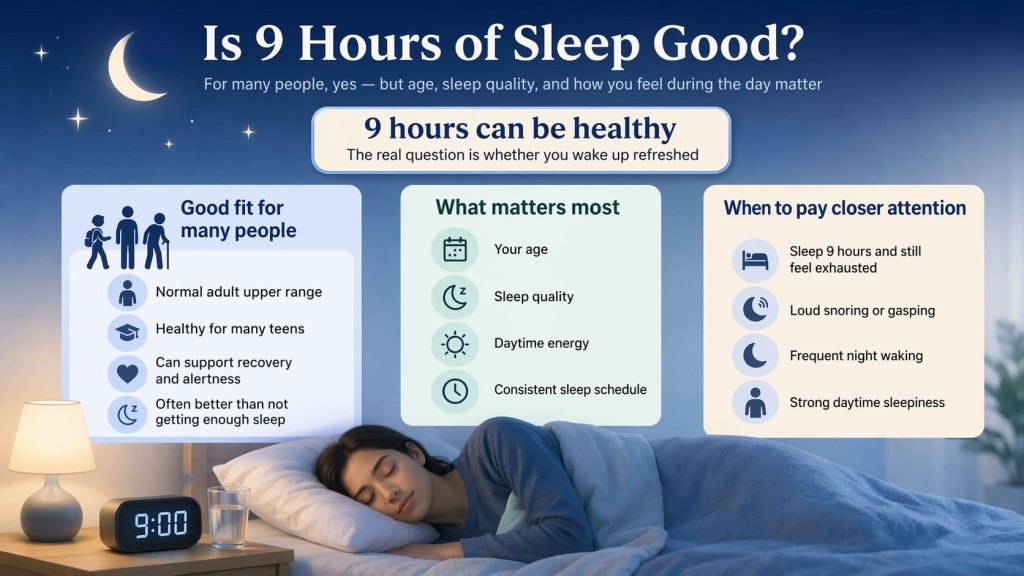
That means 9 hours of sleep is often a healthy amount, not a problem. In fact, many people are more likely to be under-sleeping than over-sleeping. The Centers for Disease Control and Prevention says about one-third of U.S. adults and children under 14, and about three-quarters of high school students, do not get enough sleep.
Is 9 Hours of Sleep Good for Adults?
For many adults, yes. The National Heart, Lung, and Blood Institute says adults should generally sleep 7 to 9 hours a night, so 9 hours is still within the normal adult range. If you sleep 9 hours, wake up feeling restored, and function well during the day, that amount may be a very good fit for you.
This is also why 9 hours should not automatically be treated as too much. The American Academy of Sleep Medicine notes that sleeping more than 9 hours may be appropriate for young adults, people recovering from sleep debt, and people who are sick. For others, the health meaning of regularly sleeping beyond 9 hours is less clear.
So for a healthy adult, 9 hours of sleep is usually not a red flag by itself. The more important question is whether you feel well, alert, and reasonably refreshed, or whether you still feel tired no matter how long you sleep.
Is 9 Hours of Sleep Good by Age?
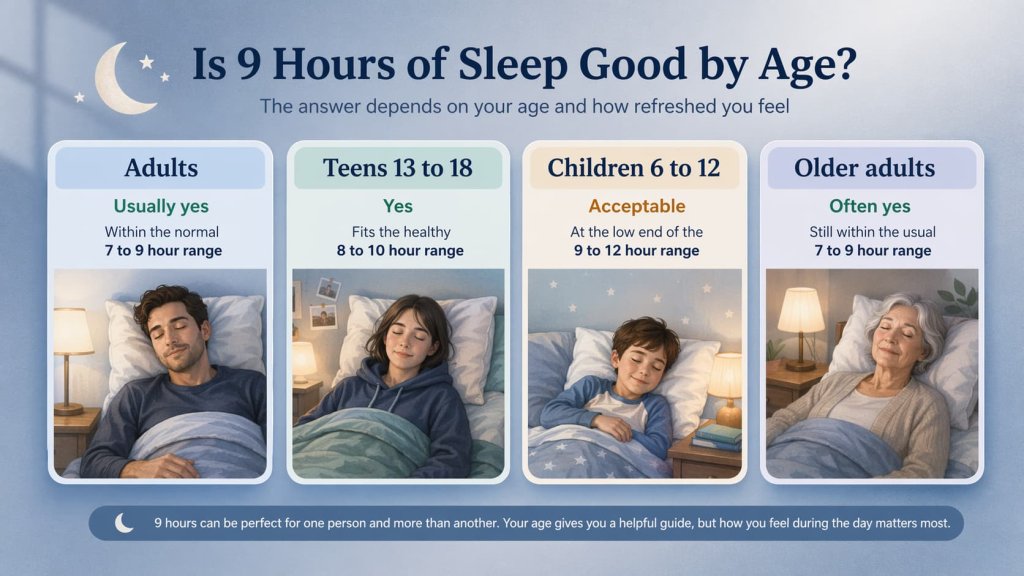
Sleep needs change with age, so the answer depends on who you are.
Adults
For adults, 9 hours is at the upper end of the usual healthy range. It can be perfectly normal, especially if you are physically active, under heavy mental demand, recovering from short-term sleep loss, or simply someone who feels best near the top end of the range.
Teens
For teens ages 13 to 18, 9 hours is solidly within the recommended range. The American Academy of Sleep Medicine says teens should regularly get 8 to 10 hours per 24 hours to support health and daytime alertness. That makes 9 hours a very normal target for many teenagers.
School-age children
For children ages 6 to 12, the National Heart, Lung, and Blood Institute says the recommended range is 9 to 12 hours per day. So 9 hours is acceptable, but it is the low end of the range rather than the middle.
Older adults
Older adults do not suddenly need far less sleep just because they are older. The National Institute on Aging says older adults generally need about the same amount of sleep as other adults, around 7 to 9 hours each night. What often changes with age is sleep pattern, not necessarily sleep need. Sleep may become lighter, shorter, and more fragmented, which can make 9 hours in bed feel less refreshing than it sounds.
When 9 Hours of Sleep Is a Good Sign
In many cases, 9 hours of sleep is simply a sign that you are getting enough rest. It is especially reassuring when:
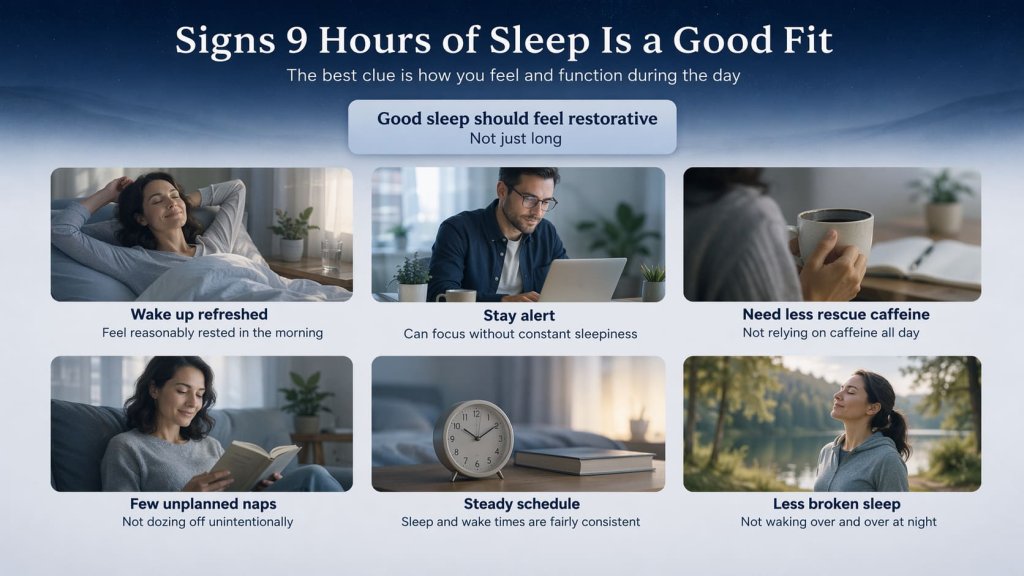
- You wake up feeling fairly refreshed
- You stay alert through the day
- You do not rely on constant caffeine to function
- You are not falling asleep unintentionally
- Your sleep schedule is fairly regular
- You are not waking up again and again during the night
The Centers for Disease Control and Prevention notes that healthy sleep is about both duration and quality. Good sleep should be refreshing and reasonably uninterrupted, not just long.
A practical way to think about it is this: 9 hours is good when it helps you feel and function better. Sleep need is not identical for every person, so being closer to 9 hours does not mean anything is wrong.
When 9 Hours of Sleep May Point to a Problem
Sleeping 9 hours is not automatically bad, but it deserves a closer look if it comes with symptoms that suggest poor sleep quality or an underlying sleep issue.
Pay more attention if you:
- Sleep 9 hours and still feel exhausted most days
- Wake up unrefreshed
- Snore loudly
- Gasp or choke during sleep
- Wake up often at night
- Struggle with strong daytime sleepiness
- Notice a sudden increase in how much sleep you need
- Find that long sleep is affecting school, work, or daily life
The Centers for Disease Control and Prevention says signs of poor sleep quality include trouble falling asleep, repeated awakenings, and still feeling sleepy or tired even after getting enough time in bed. It also advises talking with a healthcare professional if you regularly have sleep problems or notice symptoms of a sleep disorder.
Sleep apnea is one important example. The National Heart, Lung, and Blood Institute’s sleep apnea guide says that if someone tells you that you snore or gasp during sleep, or if you have excessive daytime sleepiness, it is worth bringing up with a healthcare professional. Sleep apnea can keep you from getting enough quality sleep even when you spend enough hours in bed.
When to Make an Appointment Sooner
If you have been sleeping around 9 hours and still feel worn out for several weeks, do not ignore it. The National Institute on Aging says ongoing fatigue or low energy that lasts for several weeks without improvement should be discussed with a healthcare professional. If your sleep also comes with loud snoring, gasping, breathing pauses, morning headaches, or strong daytime sleepiness, those are more important warning signs to raise promptly.
Why 9 Hours of Sleep Can Still Feel Bad
This is where a lot of people get confused. You can sleep for 9 hours and still feel awful if the sleep is broken, shallow, mistimed, or affected by a sleep disorder.
The Centers for Disease Control and Prevention explains that quality sleep means sleep that is uninterrupted and refreshing. Poor-quality sleep may involve:
- Trouble falling asleep
- Repeated awakenings
- Feeling tired even after enough total hours
That means 9 hours in bed and 9 good hours of sleep are not the same thing.
Timing matters too. The National Institute on Aging explains that a good night’s sleep depends on more than just total sleep time. It also depends on sleeping at the right time for your body and getting enough of the different stages of sleep. Older adults, in particular, may sleep more lightly and wake more often through the night.
In other words, if you sleep 9 hours but still feel foggy, sleepy, or irritable during the day, the next step is not to assume that 9 hours is too much. The better question is whether your sleep is actually good quality.
How to Tell Whether 9 Hours Is Right for You
Nine hours is probably a good fit when you naturally wake around that amount, feel reasonably alert through the day, and do not need frequent long naps just to function. If you are not sure, keep a short sleep diary for 1 to 2 weeks. The National Heart, Lung, and Blood Institute explains that a sleep diary can help track when you go to sleep, wake up, and nap, while the Centers for Disease Control and Prevention says it is also useful to note caffeine, alcohol, exercise, medications, and how sleepy you feel during the day. This can help you tell whether 9 hours is truly your natural sleep need or whether broken sleep, late caffeine, irregular schedules, or long naps are part of the problem.
How to Make 9 Hours of Sleep More Refreshing
If you already spend around 9 hours in bed, focus on sleep quality and consistency first. The Centers for Disease Control and Prevention recommends habits that improve both:
- Go to bed and get up at the same time every day
- Keep your bedroom quiet, cool, and relaxing
- Turn off electronic devices before bedtime
- Avoid large meals and alcohol close to bedtime
- Avoid caffeine later in the day
- Exercise regularly and maintain healthy daily habits
These basics sound simple, but they can make a real difference in how refreshed you feel.
If you are not sure what is hurting your sleep, keeping a short sleep diary can help. A provider may ask you to track your bedtime, night wakings, wake time, naps, exercise, alcohol or caffeine intake, and medications. That can make patterns easier to spot.
Is 9 Hours of Sleep Too Much?
Usually, no. For many adults, 9 hours is still normal. The National Heart, Lung, and Blood Institute says that sleeping more than 9 hours is not necessarily harmful and may be helpful for young adults, people recovering from sleep deprivation, and people who are sick.
One Important Nuance About Long Sleep Research
Some studies link very long sleep with poorer health outcomes, but that does not prove that sleep itself is causing the problem. The American Academy of Sleep Medicine has said the health meaning of 9 or more hours in adults could not be determined with certainty, and the National Heart, Lung, and Blood Institute notes that sleeping more than 9 hours is not necessarily harmful. In real life, long sleep can sometimes be a sign that something else is going on, such as recovery from sleep loss, illness, or poor sleep quality.
What matters is the pattern around it. If 9 hours feels good and fits your life, that is often fine. If you regularly need well beyond that, or 9 hours still leaves you drained, it is more useful to look for poor sleep quality, schedule problems, medication effects, illness, or a sleep disorder than to panic about the number alone.
FAQ
Is 9 hours of sleep good for muscle recovery or hard training?
It can be. Sleep supports recovery, attention, mood, and overall health, and adults with heavier physical or mental demands may feel better closer to the upper end of the normal range. Public health guidance consistently shows that getting enough sleep matters for health and daytime function.
Is 9 hours of sleep good for teens?
Yes. The American Academy of Sleep Medicine says teens ages 13 to 18 should regularly get 8 to 10 hours, so 9 hours is right in the healthy range.
Why do I sleep 9 hours and still feel tired?
That often points to sleep quality, not just sleep quantity. The Centers for Disease Control and Prevention says poor sleep quality can include trouble falling asleep, repeated awakenings, or still feeling tired after enough sleep. Sleep apnea is another possibility if you snore, gasp, or feel very sleepy during the day.
Is 9 hours of sleep good for older adults?
Yes, it can be. The National Institute on Aging says older adults generally need about 7 to 9 hours each night, similar to other adults. But sleep tends to become lighter and more interrupted with age, so feeling tired after 9 hours may mean the issue is sleep quality, not simply the amount.
Conclusion
For most people, 9 hours of sleep is good, and for some it is ideal. It is well within the healthy range for teens and still normal for many adults and older adults. The key is to judge sleep by both length and quality. If 9 hours leaves you refreshed, alert, and functioning well, it is probably working for you.
If 9 hours still leaves you tired, or if you snore, gasp, wake often, or struggle with strong daytime sleepiness, it is worth looking deeper. Do not focus only on the number. Focus on whether your sleep is actually restoring you. If it is not, taking a closer look at sleep quality, schedule, and possible sleep disorders is the next smart step.
References
- National Heart, Lung, and Blood Institute — How Sleep Works: How Much Sleep Is Enough?
- Centers for Disease Control and Prevention — About Sleep
- American Academy of Sleep Medicine — Teen Sleep Duration Health Advisory
- National Institute on Aging — Sleep and Older Adults
- Centers for Disease Control and Prevention — Sleep: Chronic Disease Indicators