
Costco rotisserie chicken has 140 calories per labeled 3-ounce serving (84 grams). This is the value shown on the nutrition label attached to Costco’s U.S. product listing.
To estimate how many calories Costco rotisserie chicken adds to your meal, focus on the edible portion you actually eat. A few slices, a large breast, and half a chicken are not interchangeable serving sizes. The tables and calculations below help you estimate your portion without counting bones or overlooking sauces and sides.
Nutrition information checked September 21, 2026. This guide covers U.S. Kirkland Signature Rotisserie Chicken. Check your package for the most applicable nutrition information.
Costco Rotisserie Chicken Calories by Serving Size
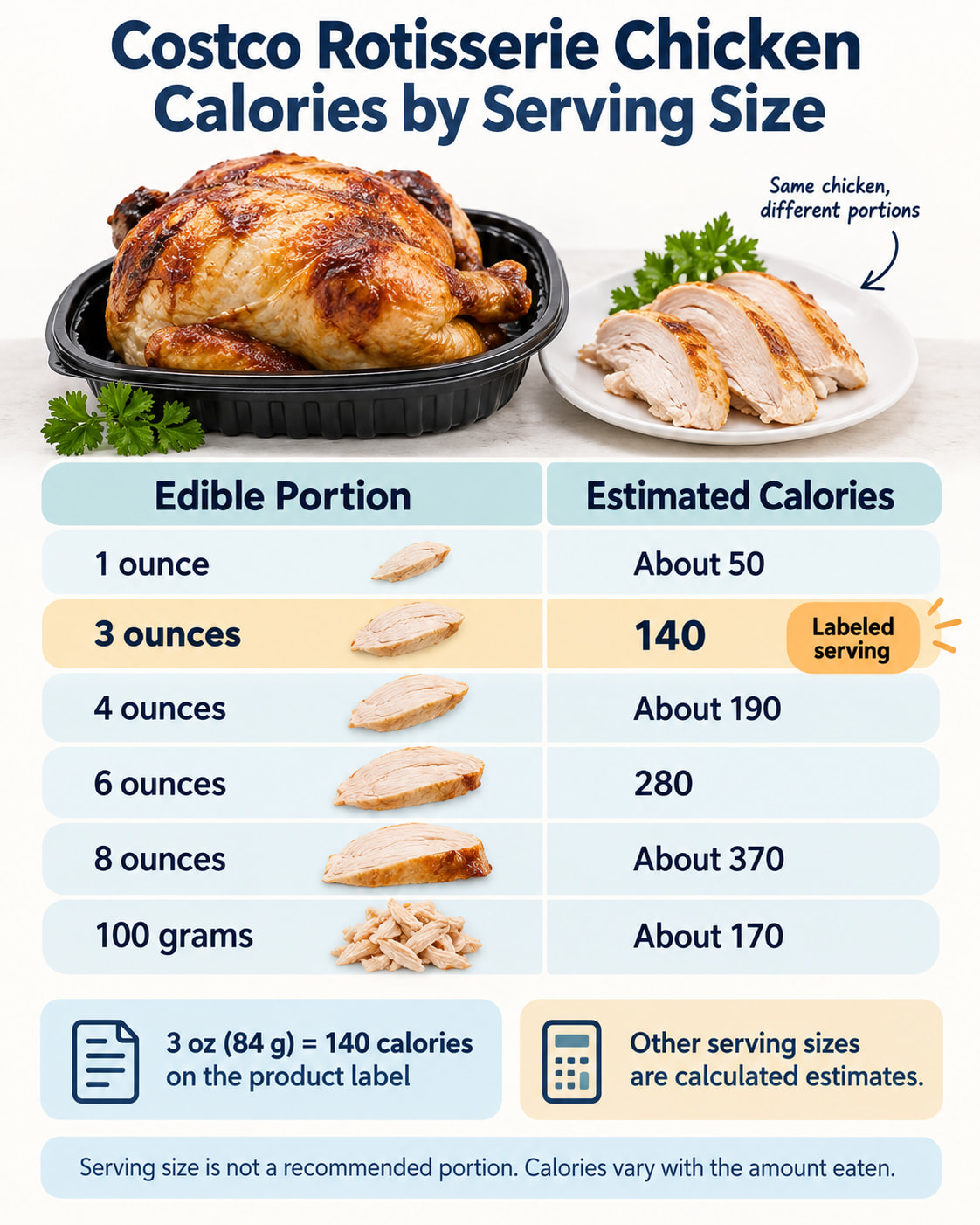
The following table scales Costco’s labeled serving. Only the 3-ounce serving is a directly listed value; the other amounts are calculated estimates.
| Edible portion | Estimated calories |
|---|---|
| 1 ounce | About 50 |
| 3 ounces | 140 |
| 4 ounces | About 190 |
| 6 ounces | 280 |
| 8 ounces | About 370 |
| 100 grams | About 170 |
Ounce-based estimates use 140 calories per 3 ounces. The gram-based estimate uses 140 calories per 84 grams, as printed on the label. Calculated values are rounded to the nearest 10 calories.
These are product-label estimates, not separate measurements for breast meat, thigh meat, or skin.
Also, a serving size on a label is not a rule for how much you should eat. The FDA explains that labeled serving sizes reflect amounts people typically consume rather than recommended portions.
Costco Rotisserie Chicken Nutrition Facts
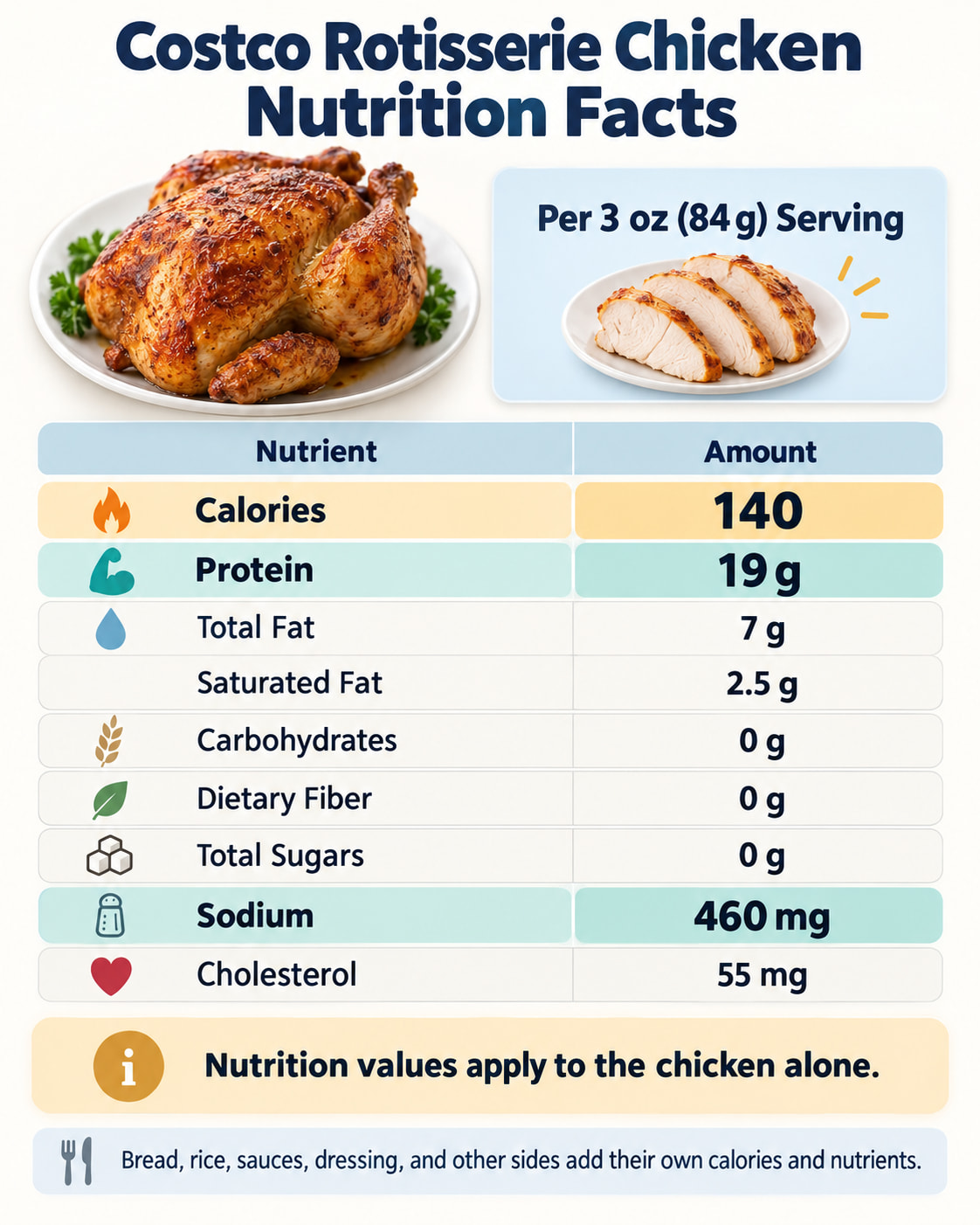
The displayed Nutrition Facts panel provides the following amounts per 3-ounce serving (84 grams).

| Nutrient | Amount per labeled serving |
|---|---|
| Calories | 140 |
| Protein | 19 g |
| Total fat | 7 g |
| Saturated fat | 2.5 g |
| Carbohydrates | 0 g |
| Dietary fiber | 0 g |
| Total sugars | 0 g |
| Sodium | 460 mg |
| Cholesterol | 55 mg |
These figures cover the chicken alone. Bread, rice, dressing, mayonnaise, and other additions need their own entries when calculating a meal.
How Many Calories Are in a Whole Costco Rotisserie Chicken?
There is no single verified calorie total that applies to every whole Costco rotisserie chicken. The displayed label lists a variable number of servings per container rather than a fixed whole-chicken total.
The practical approach is to weigh the edible chicken after removing bones and anything else you will not eat. Then calculate:
Estimated calories = edible weight in grams ÷ 84 × 140
For example, suppose you remove the bones and end up with 900 grams of edible chicken:
900 ÷ 84 × 140 = approximately 1,500 calories
That is a hypothetical calculation—not a verified average yield or official whole-chicken calorie count. It assumes the portion is reasonably represented by the product’s labeled serving.
Do not multiply the entire bone-in weight by the calories per gram. That would count bones as though they were food you consumed.
How Many Calories Are in Half a Costco Rotisserie Chicken?
The same method works for half a chicken: weigh its edible portion and apply the formula.
Using the example above, 450 grams of edible chicken would calculate to approximately 750 calories. However, that does not mean every half chicken contains 750 calories.
A physically divided half may not contain exactly half the edible weight. Weighing your portion is more useful than relying on the word “half.”
Costco Rotisserie Chicken Calories With and Without Skin
Removing skin leaves some of the fat and calories uneaten. The National Heart, Lung, and Blood Institute recommends choosing skinless poultry when limiting saturated fat.
However, Costco’s displayed nutrition panel does not provide separate skin-on, skinless, breast-only, or thigh-only calorie values. You cannot use that panel to establish an exact calorie deduction for removing the skin.
For practical tracking, remove any skin you will not eat before weighing your portion. Then recognize the limits of your chosen nutrition entry:
- The Costco product entry provides a general label-based estimate.
- A cooked, skinless-breast entry is more specific to that cut, but a generic entry is not Costco-specific nutrition information.
Avoid subtracting an arbitrary number of calories for the skin or describing the 140-calorie figure as a verified skinless-breast value.
How to Calculate Calories in Your Portion
You only need a kitchen scale and the serving information on your package.
- Prepare the portion. Remove bones and anything you do not plan to eat. Use the cooked chicken’s weight, not a raw-chicken weight.
- Weigh the chicken. Put an empty plate or bowl on the scale, press “tare” or “zero,” and add the chicken.
- Scale the label. Divide the gram weight by 84, then multiply by 140. Use your package’s values instead when they differ from those shown here.
For quick calculations, the displayed label works out to approximately 1.67 calories per gram. This remains an estimate, not an exact measurement of every piece.
Count Sauces and Other Ingredients Separately
Weighing chicken before mixing it into a meal makes the calculation simpler. Log the chicken first, then account for ingredients such as dressing, cheese, tortillas, or mayonnaise.
For example, the rotisserie chicken label alone cannot tell you the calories in a chicken salad sandwich. You also need the quantities and nutrition information for the other ingredients.
When making a batch recipe, add the calories from all ingredients. Divide that total by the number of equal portions you prepare.
Sodium and Other Nutrition Considerations
Calories are only one part of the label. One labeled serving contains 460 milligrams of sodium, or 20% of the Daily Value. The FDA considers 20% Daily Value or more per serving high in sodium.
Doubling the labeled serving to 6 ounces also doubles the listed sodium to approximately 920 milligrams. That is a calculated amount, just like the larger-serving calorie estimates.
To keep the meal’s sodium lower, consider vegetables without salty sauces, plain rice, or other no-salt-added sides. Check condiments as well because their sodium can add up.
Removing the skin should not be treated as a reliable way to make this product low in sodium. The available panel does not provide a separate skinless sodium value. When following a clinician-recommended sodium limit, use that personal limit to guide your portion and meal choices.
Frequently Asked Questions
How Many Calories Are in 100 Grams of Costco Rotisserie Chicken?
Using the displayed 84-gram serving, 100 grams calculates to approximately 167 calories, or about 170 calories rounded to the nearest 10. This is a label-based estimate, not a separately listed serving value.
How Many Calories Are in a Cup of Shredded Costco Rotisserie Chicken?
There is no dependable fixed number without knowing the weight. A loosely filled cup and a tightly packed cup can hold different amounts.
Weigh the shredded chicken and use the gram-based formula. For example, a portion that weighs 150 grams would calculate to approximately 250 calories. That example does not establish a standard weight for one cup.
How Many Calories Are in One Costco Rotisserie Chicken Breast?
“One breast” is not a fixed serving weight. Weigh the boneless meat you plan to eat.
The serving table can provide a rough product-label estimate, but Costco’s displayed panel does not establish a breast-only calorie count. A skinless breast should not automatically be logged as one 3-ounce serving.
Can I Use These Numbers for Costco’s Other Prepared Chicken Products?
Use the nutrition label on the exact product you are eating. Do not assume that separately packaged chicken meat, chicken salad, or a prepared chicken meal has the same nutrition information as the whole rotisserie chicken.
Check the serving weight as well as the calories before copying an entry into a tracking app.
How Long Does Costco Rotisserie Chicken Last in the Fridge?
Properly handled cooked chicken can generally be refrigerated for 3–4 days at 40°F or below, according to FoodSafety.gov’s storage guidelines. Freeze portions you will not use within that time.
Refrigerate leftovers promptly, within 2 hours, or within 1 hour when exposed to temperatures above 90°F. FoodSafety.gov also recommends using shallow containers for prompt cooling.
When reheating leftovers, use a food thermometer to check that they reach 165°F.
The Bottom Line
Start with 140 calories per labeled 3-ounce serving, then adjust for the edible amount you eat. Whole-chicken, half-chicken, and skinless estimates need more care because the label does not provide separate values for those portions.
For your next meal, check the package, weigh the chicken without bones, and count sauces and sides separately. That gives you a more useful estimate than guessing from the size of the bird.
References
- Costco: Kirkland Signature Rotisserie Chicken product listing and displayed Nutrition Facts panel.
- U.S. Food and Drug Administration: Serving Size on the Nutrition Facts Label.
- National Heart, Lung, and Blood Institute: Choose Heart-Healthy Foods.
- U.S. Food and Drug Administration: Sodium in Your Diet.
- FoodSafety.gov: Cold Food Storage Chart.
- FoodSafety.gov: 4 Steps to Food Safety.
- FoodSafety.gov: Cook to a Safe Minimum Internal Temperature.
This content is for informational purposes only and not medical advice.