
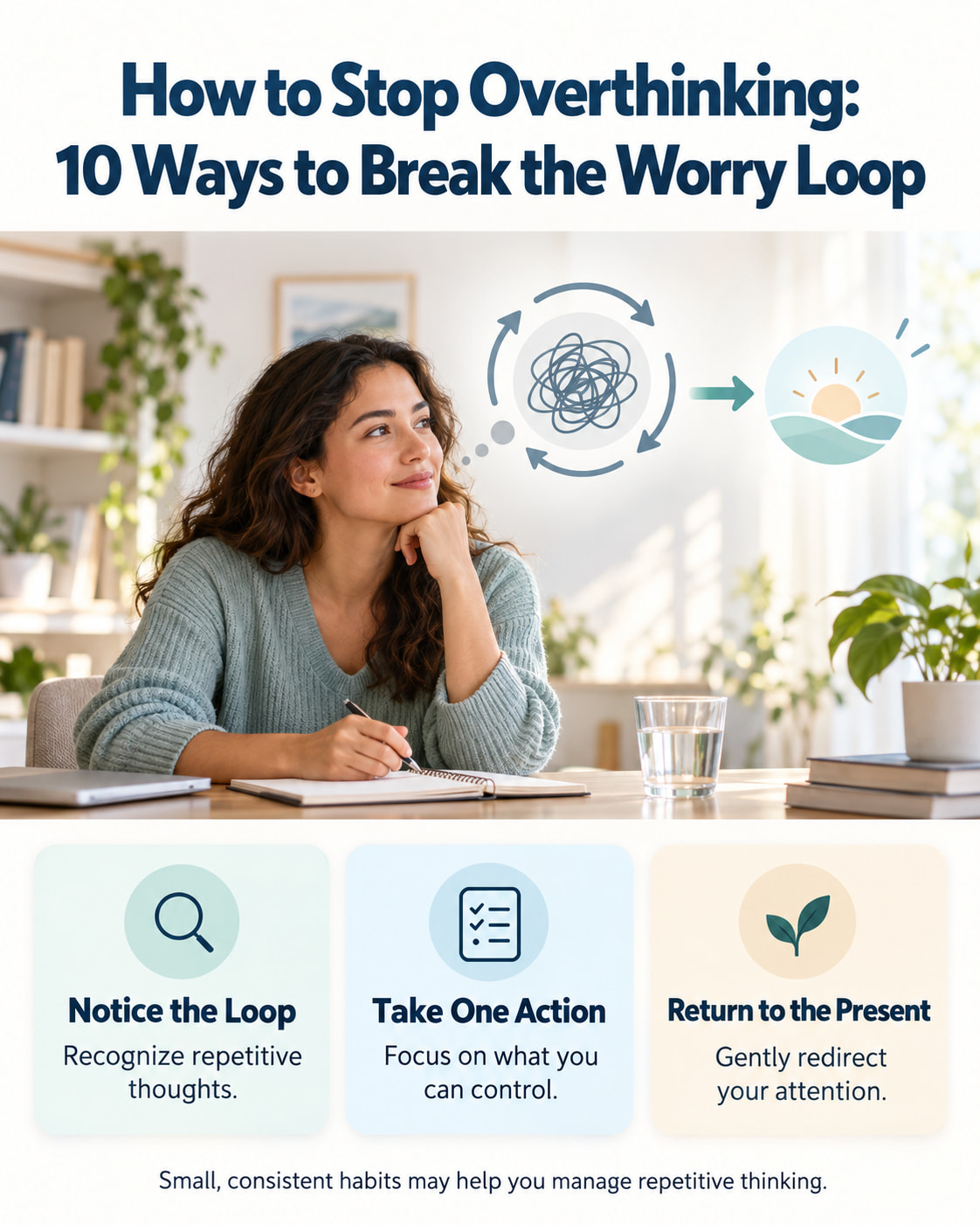
Learning how to stop overthinking starts with noticing repetitive thoughts, identifying any useful action you can take, and gently returning your attention to the present. Writing worries down, setting aside worry time, and practicing more balanced thinking may help you spend less time stuck on the same concerns.
Learning how to stop overthinking takes practice. Start with one or two strategies that fit your situation, and give yourself room to improve gradually. If worry regularly affects your sleep, relationships, or everyday responsibilities, professional support can help you find a more tailored approach.
What Is Overthinking?
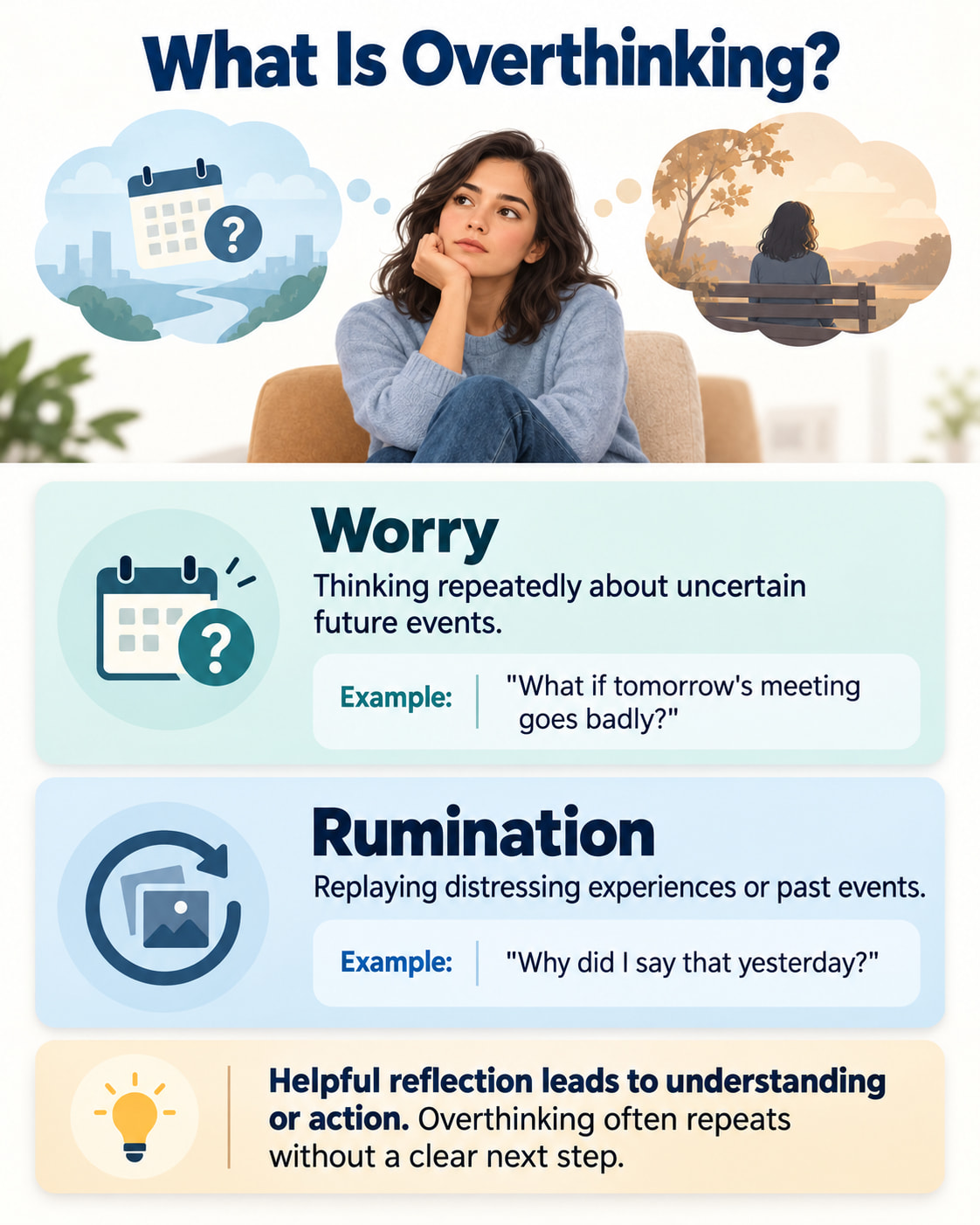
Overthinking is an everyday term for repeatedly analyzing a situation, decision, or concern until it becomes difficult to move forward. It is not a mental health diagnosis, although it can occur alongside stress, anxiety, or depression.
Two patterns commonly appear in repetitive negative thinking:
| Pattern | What it tends to involve | Example |
|---|---|---|
| Worry | Uncertain future events or possible threats | “What if tomorrow’s meeting goes badly?” |
| Rumination | Replaying distressing experiences or dwelling on their meaning | “Why did I say that yesterday?” |
These patterns can overlap. The useful question is whether your thinking is helping you understand something or decide what to do.
For example, reviewing a mistake and choosing how to handle a similar situation next time can be productive. Replaying the same moment without reaching a new understanding may keep you stuck.
Why Do You Overthink?
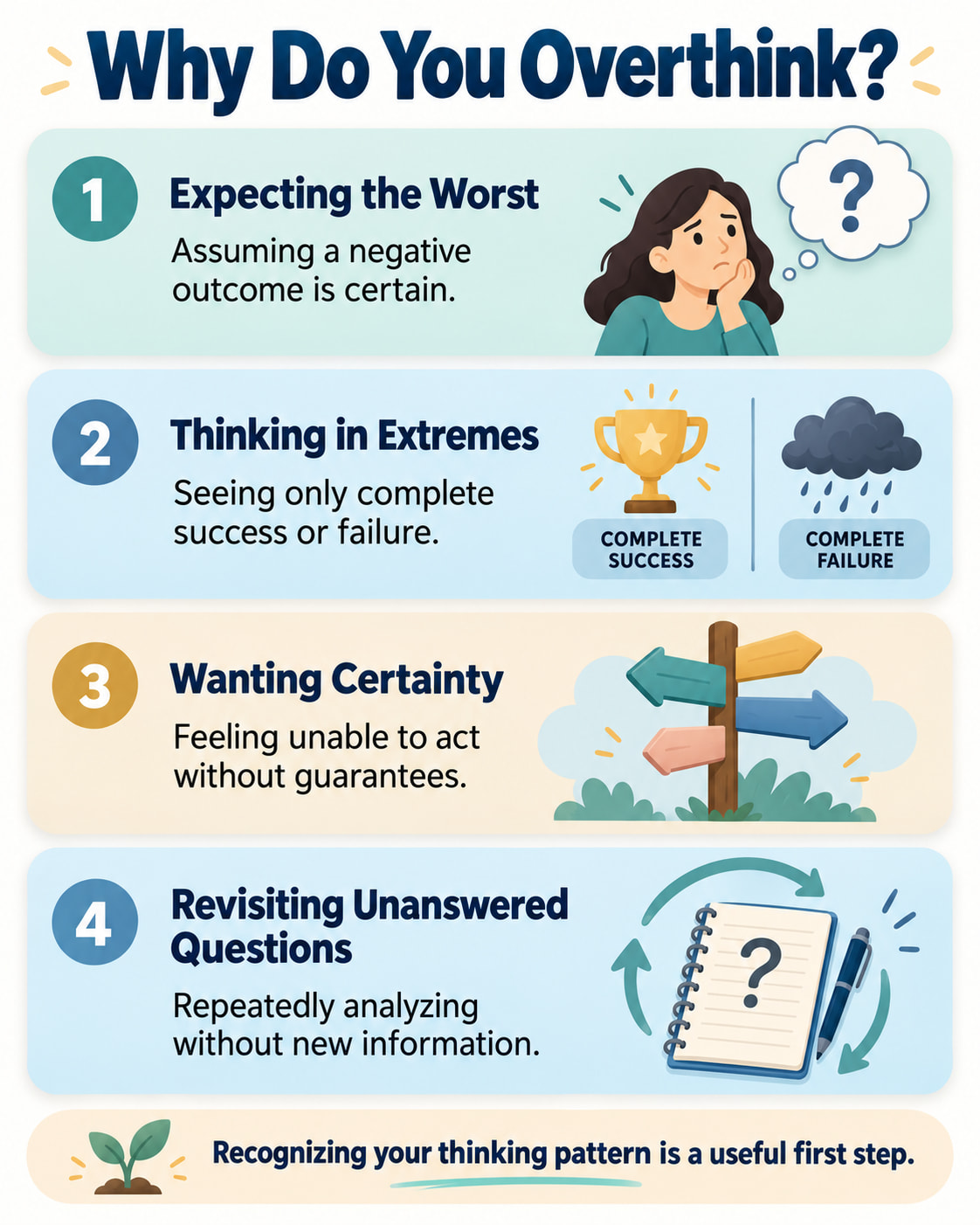
Several thinking habits can contribute to the worry loop:
- Expecting the worst: Treating a possible negative outcome as though it is certain.
- Thinking in extremes: Seeing an outcome as either a complete success or a total failure.
- Wanting certainty: Feeling unable to act until you know exactly what will happen.
- Revisiting unanswered questions: Continuing to analyze something when no new information is available.
You might recognize these patterns around work, relationships, health, or decisions. Sometimes there is a real problem to address. Other times, the difficulty comes from repeatedly trying to predict an outcome you cannot fully control.
The following strategies offer ways to respond to both situations.
How to Stop Overthinking: 10 Practical Ways
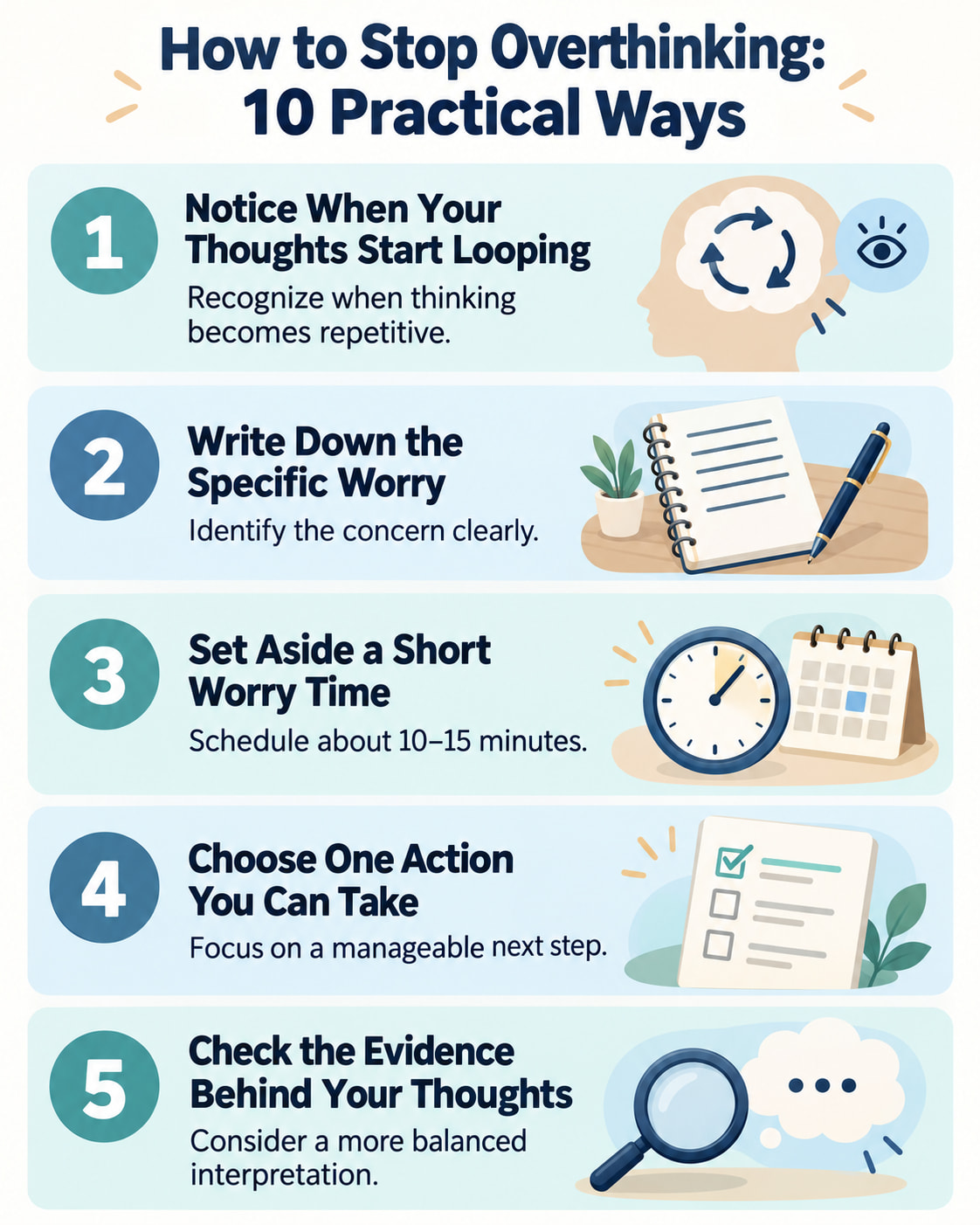
1. Notice When Your Thoughts Start Looping
Start by noticing what your mind is doing. You may be rereading the same message, replaying a conversation, or asking a question you have already considered several times.
Ask yourself:
- Am I learning anything new?
- Have I already identified the next useful step?
- Am I revisiting the same uncertainty?
If the thinking is repeating, label it briefly: “I’m caught in a worry loop.”
Then choose where to put your attention next. That might be a practical action, the task in front of you, or a grounding exercise. When your attention wanders back, practice redirecting it without criticizing yourself.
2. Write Down the Specific Worry
A brief written note can help you identify what is actually bothering you. Use a notebook or a notes app, and keep the entry focused.
For example, “Everything is falling apart” could become:
“I have two deadlines on Friday, and I’m unsure which task to finish first.”
The second statement gives you a clearer starting point.
If helpful, separate the concern into two lines:
- What I know: Both assignments are due Friday.
- What I’m predicting: I will disappoint everyone if I ask for clarification.
Keep the note brief enough to review later. You can then move to problem-solving without repeatedly rewriting the same concern.
3. Set Aside a Short Worry Time
If worries keep interrupting your day, try giving them a specific place in your schedule.
The NHS suggests setting aside about 10–15 minutes to write down concerns and consider possible solutions.
Choose a consistent time, preferably away from bedtime. When a worry appears outside that period:
- Make a short note.
- Remind yourself when you plan to review it.
- Bring your attention back to your current activity.
For example: “If this concern returns during work, I’ll write it down and review it at 6 p.m.”
During worry time, consider which concerns still matter and which need action. You can leave behind concerns that no longer feel relevant. When the period ends, move to another planned activity.
4. Choose One Action You Can Take
Some worries point to a problem that needs attention. Ask:
“Is there something specific I can reasonably do about this?”
If the answer is yes, choose a manageable next step and decide when to do it.
| Concern | Possible next step |
|---|---|
| “I don’t understand the assignment.” | Write down the unclear point and ask for clarification. |
| “I might forget something during the presentation.” | Prepare a short outline of the main points. |
| “My schedule is overloaded.” | Identify one commitment to reschedule or discuss. |
Choose a step that addresses the actual problem. Once you have taken the step, review the situation when new information becomes available.
For hypothetical worries without an action to take now, practice acknowledging the uncertainty and returning to the present.
5. Check the Evidence Behind Your Thoughts
A worrying thought may contain a prediction that you have started treating as a fact.
The NHS approach to reframing unhelpful thoughts involves noticing the thought, examining it, and considering a more balanced interpretation.
Try asking:
- What facts support this thought?
- What information am I missing?
- Is there another reasonable explanation?
- What would I say to a friend in this situation?
For example:
Initial thought: “My friend hasn’t replied. They must be upset with me.”
Balanced thought: “They haven’t replied yet, and I don’t know why. They may be busy. I can give them time.”
Aim for an interpretation you can believe. A brief check is enough for this exercise; repeated analysis can become another loop. If there is evidence of a genuine problem, focus on how to address it.
6. Practice Accepting Some Uncertainty
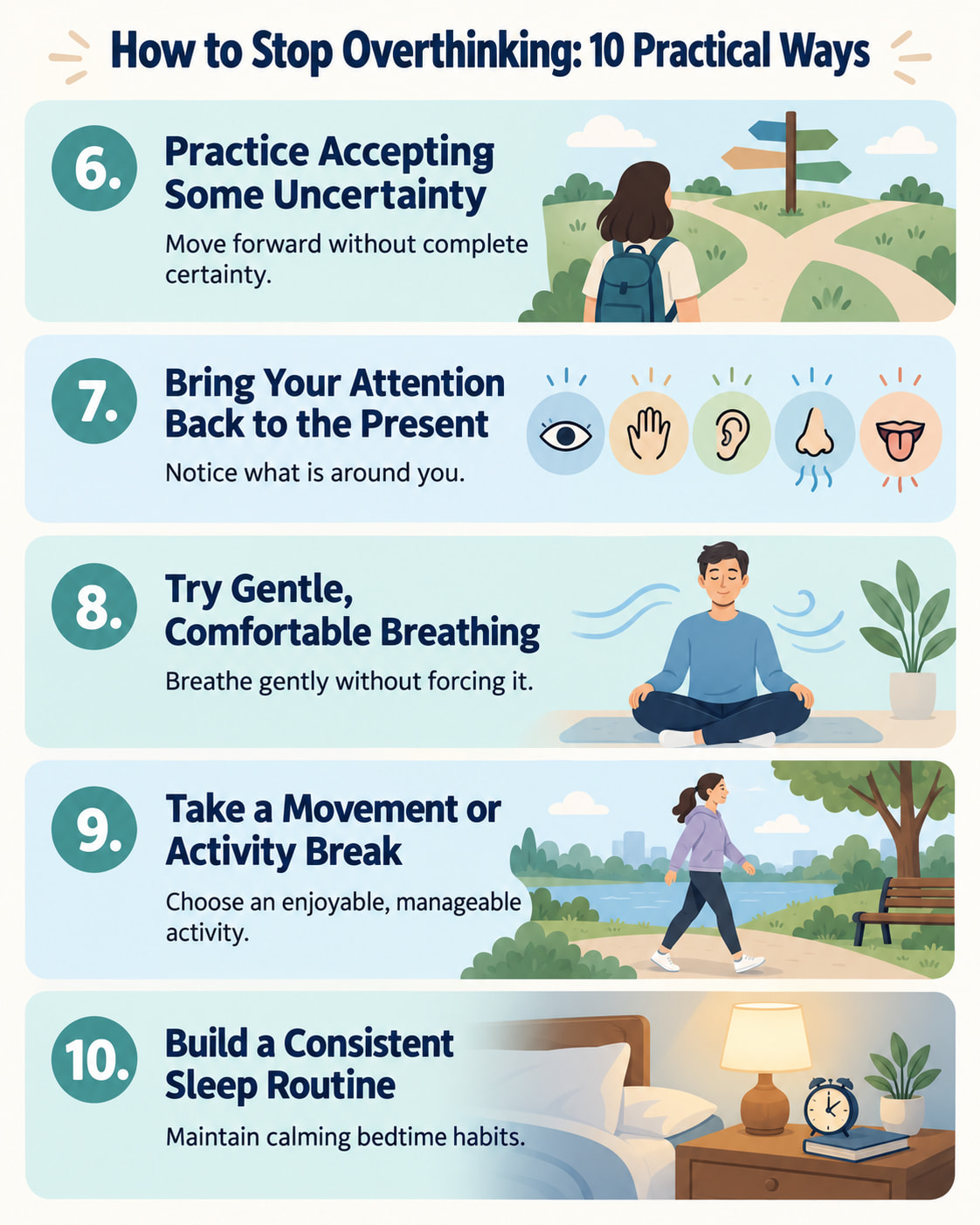
Many decisions have no guaranteed outcome. Waiting for complete certainty can make it difficult to choose and move forward.
Start with a low-stakes situation. For example, choose between two reasonable weekend plans after considering the details that matter to you.
A useful reminder is:
“I have enough information to make a reasonable choice.”
For a more difficult situation, connect uncertainty with preparation:
“I cannot know exactly how the conversation will go. I can prepare what I want to say.”
Notice the urge to seek another guarantee or reconsider the decision. Give yourself a chance to continue with your day while some uncertainty remains. This is a skill that may require repeated practice.
7. Bring Your Attention Back to the Present
Grounding gives your attention something concrete to notice when thoughts feel overwhelming.
Try the 5-4-3-2-1 exercise:
- 5 things you can see
- 4 things you can feel
- 3 things you can hear
- 2 things you can smell
- 1 thing you can taste
Move through the senses comfortably. If a sense is unavailable or difficult to use, focus on the details you can notice.
You can also practice attention during an ordinary activity. While washing a cup, notice the water, the surface of the cup, and the movements of your hands.
When a thought returns, acknowledge it and bring your attention back to the activity. The practice is in returning.
8. Try Gentle, Comfortable Breathing
Breathing exercises may help you settle physical tension while you decide how to respond to a worry.
The NHS breathing exercise for stress uses gentle, regular breathing:
- Sit or stand in a comfortable position.
- Breathe in through your nose and out through your mouth.
- Let the breath move comfortably, without forcing it.
- Count slowly during the inhale and exhale if that helps.
The NHS suggests continuing for at least five minutes. Comfort matters more than reaching a particular count.
If focusing on breathing feels uncomfortable, pause and shift your attention to your surroundings, such as the feeling of your feet on the floor.
9. Take a Movement or Activity Break
A change of activity gives you a practical place to direct your attention. NIMH includes regular movement and enjoyable, low-stress activities in its mental health self-care guidance.
Choose something manageable:
- Take a short walk.
- Do an enjoyable movement activity.
- Read a few pages of a book.
- Spend time on a hands-on hobby.
- Complete a small household task.
Choose an activity that fits your energy and circumstances. If the concern needs action, schedule that step as well.
10. Build a Consistent Sleep Routine
NIMH recommends making sleep a priority and paying attention to how caffeine and alcohol affect your mood and well-being.
Start with a few repeatable habits:
- Keep your sleep and wake times reasonably consistent.
- Allow time to wind down before bed.
- Choose a quiet activity, such as reading or listening to calm music.
- Notice whether late caffeine or alcohol affects your sleep.
- Move planning and concern-reviewing earlier in the evening.
These habits support general well-being. If sleep problems continue, discuss them with a healthcare professional so you can address what is keeping you awake.
How to Stop Overthinking at Night
When a concern shows up in bed, make a brief note if you need to remember it. Add a realistic next step for tomorrow when one is available, then return to your wind-down routine.
For example:
“I need to clarify the deadline. I’ll ask my manager tomorrow morning.”
If you remain awake and unable to sleep, NHLBI’s insomnia guidance includes getting out of bed, doing something quiet, and returning when sleepy.
Worry time does not guarantee better sleep. A 2025 randomized trial published in Psychology & Health followed 186 participants for 14 days and found no significant sleep improvements from its worry-postponement interventions compared with control groups.
For ongoing insomnia, a healthcare professional may discuss cognitive behavioral therapy for insomnia, or CBT-I, which focuses specifically on sleep difficulties.
When to Seek Help for Overthinking
Consider speaking with a primary care provider or qualified mental health professional when repetitive thoughts:
- Interfere with work, school, relationships, or daily responsibilities.
- Regularly disrupt sleep or concentration.
- Feel increasingly distressing or difficult to manage.
- Continue despite your efforts to cope.
NIMH recommends seeking professional help when anxiety starts causing problems in everyday life. You can ask for support whenever you are concerned; you do not need to wait for a specific duration.
CBT offers structured practice in examining unhelpful thoughts and changing behavior patterns that keep worry going.
In a 2025 randomized trial involving 118 adults with elevated worry or rumination and anxiety or depression symptoms, a therapist-supported online program reduced repetitive negative thinking compared with a waitlist after seven weeks. This was a structured program; its results do not establish that any single self-help tip will have the same effect.
If you have suicidal thoughts or urges to hurt yourself, seek immediate help. In the United States, call or text 988. Call 911 for a life-threatening emergency.
Frequently Asked Questions
Why Do I Overthink Everything?
Several patterns can contribute, including expecting the worst, fearing mistakes, and wanting certainty before acting. Overthinking can also occur alongside stress, anxiety, or depression. If it affects many parts of your life, a mental health professional can help you understand the pattern.
Is Overthinking a Mental Illness?
Overthinking is not a diagnosis by itself. It describes a way of thinking that may occur on its own or alongside a mental health condition. Its impact on your daily life is a useful reason to consider seeking support.
What Can I Do When I Start Overthinking?
Name the concern, briefly note it, and ask whether there is an action to take. If there is, choose one manageable step. Otherwise, try grounding or return to your current task. Practice redirecting your attention when the thought returns.
What Is the Difference Between Worry and Rumination?
Worry tends to focus on possible future problems. Rumination often involves replaying past experiences or dwelling on distress and its meaning. They can overlap, and both can become repetitive without producing a useful next step.
Can Writing Down My Thoughts Help?
Brief writing may help you identify a concern and organize your response. Try recording the specific worry and any action it needs. Keep the exercise focused if you notice yourself repeatedly describing the same event without gaining clarity.
How Long Does It Take to Stop Overthinking?
There is no single timeline. Some practices may help you redirect your attention in the moment, while changing a recurring pattern can take continued practice and sometimes professional support. If worry worsens or disrupts daily life, seek help rather than waiting for self-help to work.
Conclusion
Learning how to stop overthinking starts with noticing the loop and choosing a useful response. Begin with one concern: write it down, decide whether it needs action, and practice returning your attention to what you are doing.
Choose one or two strategies to practice consistently. If repetitive thinking keeps interfering with your life, reach out for support.
This content is for informational purposes only and not medical advice.
References
- Cleveland Clinic: How to Stop Overthinking
- American Psychiatric Association: Interventions for Rumination
- NHS: Tackling Your Worries
- Centre for Clinical Interventions: Worry and Rumination Resources
- NHS: Breathing Exercises for Stress
- Hull University Teaching Hospitals NHS Trust: 5-4-3-2-1 Grounding Technique
- NIMH: Caring for Your Mental Health