
No, 10 hours of sleep is not automatically too much. Whether 10 hours is normal depends mostly on your age, your recent sleep debt, your health, and whether you feel alert and refreshed during the day.
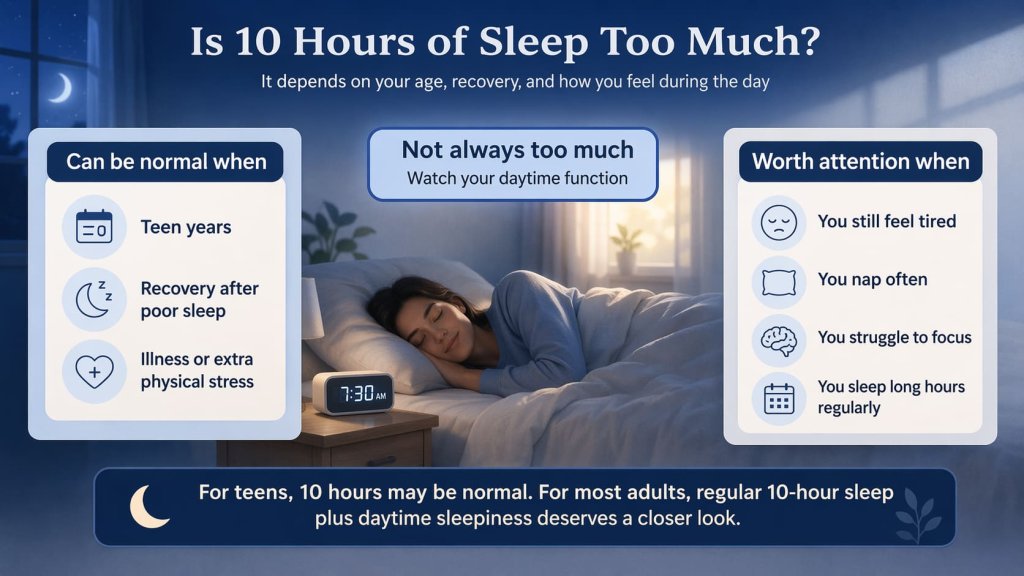
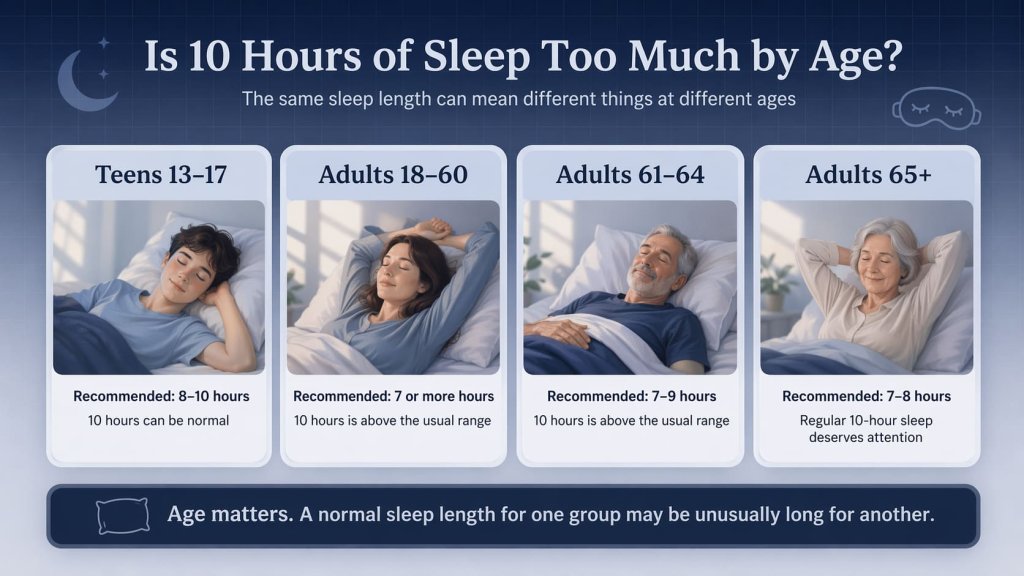
If you are trying to figure out whether 10 hours of sleep is good or a warning sign, the key question is not just how long you sleep. It is whether that amount fits your stage of life and whether you still have daytime sleepiness, brain fog, frequent naps, or signs of poor sleep quality. For most adults, 10 hours is above the usual recommended range. For teens, though, it can still be normal. According to CDC sleep guidance, teens ages 13–17 need 8–10 hours, adults ages 18–60 need 7 or more hours, adults 61–64 need 7–9 hours, and adults 65 and older need 7–8 hours.
Is 10 Hours of Sleep Too Much by Age?
The answer changes with age.
For teenagers, 10 hours may fit squarely within the recommended range. That means a 15-year-old sleeping 10 hours is not automatically oversleeping.
For most adults, 10 hours is above the usual target. That still does not make it harmful by itself. It simply means it is worth paying attention to, especially if it happens regularly and you still do not feel well rested.
A quick way to think about it
- Teenagers 13–17: 10 hours can be normal.
- Adults 18–60: 10 hours is above the usual recommendation.
- Older adults: Needing 10 hours regularly is also above the usual range, and persistent sleepiness deserves attention.
When 10 Hours of Sleep Can Be Normal
There are several situations where 10 hours of sleep may make sense.
The National Heart, Lung, and Blood Institute says adults usually need 7–9 hours, but sleeping more than 9 hours is not necessarily harmful and may help young adults, people recovering from sleep deprivation, and people who are sick. The American Academy of Sleep Medicine also says there is no set upper limit for all adults and that more than 9 hours may be appropriate in those same situations.
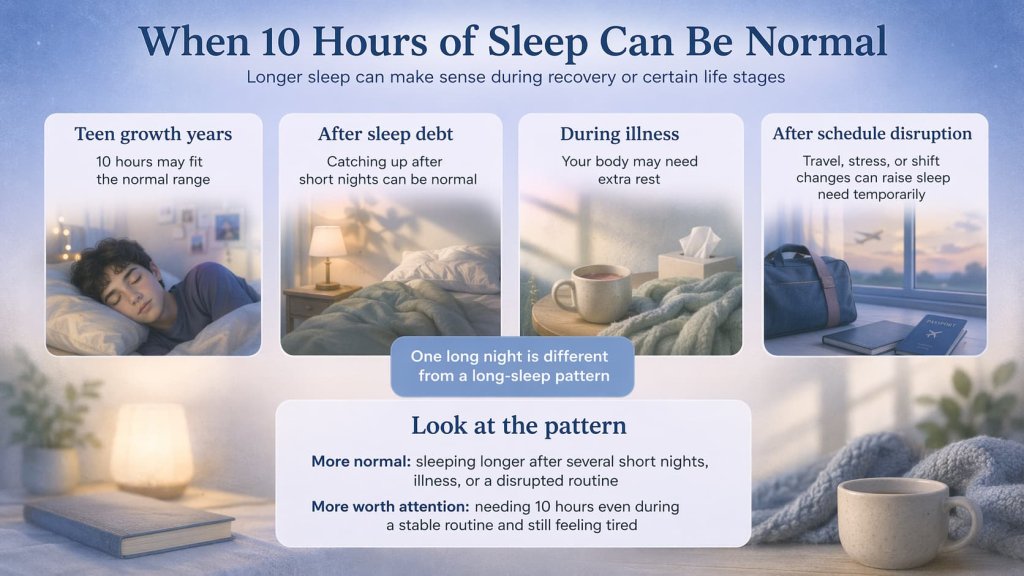
That means 10 hours may be completely understandable if:
- you are a teenager
- you have been sleeping too little for days or weeks
- you are recovering from illness
- you are under unusual physical or mental strain
- you have recently had travel, shift changes, or disrupted sleep
One long night after a stressful week is very different from needing 10 hours every night for months. The first can be normal recovery. The second is more worth looking into.
A useful pattern check is whether the extra sleep shows up mostly after several short nights or whether you need it even during a stable routine. Sleeping longer on weekends or after illness often points to recovery or accumulated sleep debt. Needing 10 hours even when your schedule is consistent and you have had a full week of enough sleep opportunity is the pattern that deserves more attention.
When 10 Hours of Sleep May Be a Sign Something Is Off
Needing 10 hours is more concerning when it comes with poor daytime function or poor sleep quality.
CDC notes that good sleep is not only about hours. Quality matters too. Signs of poor sleep quality include trouble falling asleep, waking up repeatedly during the night, and feeling sleepy or tired even after getting enough sleep. In other words, you can spend 10 hours in bed and still not be getting truly restorative sleep.
It also helps to separate time in bed from time asleep. If you spend 10 hours in bed but lie awake for long stretches, wake up repeatedly, or sleep lightly because of snoring, breathing pauses, pain, or restless legs, your body may be reacting to poor-quality sleep rather than truly needing an unusually long amount of sleep.
Signs to pay attention to
The NHS guidance on excessive daytime sleepiness says warning signs include:
- regularly napping during the day
- falling asleep during the day
- still sleeping long hours at night
- sleepiness that is affecting your life
The NHS also says to see a doctor if you often fall asleep during the day or if the sleepiness is interfering with daily life.
Possible Reasons You Sleep 10 Hours and Still Feel Tired
Sometimes the issue is not “too much sleep.” It is that something is making your sleep less effective or making you unusually sleepy.
Common possibilities include:
- Sleep apnea: The NHLBI sleep apnea overview says sleep apnea can disrupt breathing during sleep and is linked with excessive daytime sleepiness, poor concentration, and other health risks.
- Restless legs syndrome or other movement-related sleep problems
- Narcolepsy or idiopathic hypersomnia
- Depression or bipolar disorder
- Illness, pain, or medication effects
- Alcohol or drug use
- Poor sleep quality despite enough time in bed
Sleep apnea deserves special attention because it is common and often missed. Snoring or gasping at night, waking unrefreshed, and excessive daytime sleepiness are clues that it may be time to bring it up with a healthcare professional. Untreated sleep apnea can raise the risk of heart attack, stroke, and other serious problems.
Is 10 Hours of Sleep Bad if You Feel Fine?
Not necessarily.
If you sleep 10 hours, wake up refreshed, function well during the day, and you are a teenager or going through a recovery period, that amount may be fine. Sleep need is not identical for every person.
But if you are an adult who regularly needs 10 hours just to get through the day, it is reasonable to ask why. Long sleep can sometimes reflect an underlying problem rather than causing one. That is one reason experts focus more on symptoms and function than on the number alone.
What to Do if You Regularly Need 10 Hours
Start by looking for patterns instead of judging one or two nights.
Track your sleep for 2 weeks
CDC says a sleep diary can help your healthcare provider understand what is going on. Useful things to track include:
- when you go to bed
- when you wake during the night
- when you get up in the morning
- naps
- exercise
- caffeine and alcohol
- medications
This can help you spot whether you truly need 10 hours, whether your sleep is fragmented, or whether your schedule is part of the problem.
Tighten up sleep habits
The National Institute on Aging and NHLBI both recommend simple habits that support better sleep:
- keep a regular sleep and wake schedule
- avoid caffeine late in the day
- avoid alcohol close to bedtime
- keep the bedroom quiet, cool, and comfortable
- avoid late-day naps
- limit screens and stimulating light before bed
- get regular exercise, but not right before bedtime
These steps do not solve every sleep problem, but they make it easier to tell whether you are dealing with lifestyle-related sleep disruption or something more medical.
When to See a Doctor About Sleeping 10 Hours
It is a good idea to get checked if any of these are true:
- you regularly sleep 10 hours or more and still feel unrefreshed
- you often fall asleep during the day
- you need frequent naps
- you snore loudly or gasp during sleep
- your sleepiness is affecting school, work, driving, mood, or concentration
- your sleep pattern changed noticeably without a clear reason
Get medical advice sooner rather than later if the sleepiness is creating a safety risk, especially if you feel drowsy while driving, at school, or at work. It is also worth getting checked if your need for 10 hours is new, happens along with loud snoring or gasping, or started after a medication change.
A clinician may review your sleep schedule, medications, mood, and symptoms of conditions such as sleep apnea or other sleep disorders to figure out whether the issue is sleep quantity, sleep quality, or an underlying health problem.
The National Institute on Aging says that if you are always sleepy or have trouble getting enough sleep at night, it may be time to talk with a doctor. CDC also recommends speaking with a healthcare provider if you regularly have sleep problems or notice symptoms of sleep disorders.
Why This Question Matters More Than People Think
A lot of sleep advice online makes long sleep sound automatically unhealthy. That is too simplistic.
The bigger public-health problem is still insufficient sleep. According to CDC FastStats, 69.5% of U.S. adults got sufficient sleep in 2024, which means roughly 3 in 10 adults did not. That context matters because some people worry about 10 hours occasionally when the more important issue may actually be chronic poor-quality sleep or not enough sleep on other days.
FAQ
Is 10 hours of sleep too much for adults?
For most adults, 10 hours is above the usual recommended range, but it is not automatically unhealthy. It may be normal during recovery from sleep debt or illness. It matters more if you regularly need 10 hours and still feel sleepy during the day.
Is 10 hours of sleep normal for a teenager?
Yes. CDC says teens ages 13–17 generally need 8–10 hours of sleep, so 10 hours can be completely normal.
Can depression make you sleep more?
Yes. NHS lists depression among the possible causes associated with excessive daytime sleepiness, and mental health can affect both sleep amount and sleep quality.
Can sleep apnea make you sleep longer?
It can make you feel like you need more sleep because it disrupts sleep quality. NHLBI says sleep apnea is linked with excessive daytime sleepiness and poor sleep quality symptoms.
Final Thoughts
Sleeping 10 hours is not automatically “too much.” For teens, it may be normal. For adults, it is above the usual range, but it can still make sense during recovery, illness, or periods of heavy sleep debt.
The real issue is how you feel and function. If you regularly sleep 10 hours and still feel tired, foggy, or sleepy during the day, do not ignore it. A simple sleep diary and a conversation with a healthcare professional can help you figure out whether you need more rest, better sleep habits, or an evaluation for a sleep disorder.
This content is for informational purposes only and not medical advice.
References
- CDC — About Sleep
- CDC — FastStats: Sleep Health
- National Heart, Lung, and Blood Institute — How Much Sleep Is Enough?
- National Heart, Lung, and Blood Institute — What Is Sleep Apnea?
- American Academy of Sleep Medicine — Seven or More Hours of Sleep per Night: A Health Necessity for Adults
- National Institute on Aging — Sleep and Older Adults
- NHS — Excessive Daytime Sleepiness (Hypersomnia)